




The best smart ceiling fan with lights is the one that first fits the room physically, then delivers enough controllable airflow and usable white light, and only after that adds smart features the household will actually use. Start with room area, ceiling height, blade clearance, fan-rated electrical support, airflow in cubic feet per minute (CFM), sound at the speeds you expect to run, and light output. App scenes and voice commands can improve daily operation, but they cannot correct a fan that is too large for the available clearances, hangs too low, moves too little air, or depends on an unsuitable ceiling box.
Blade span is a sizing filter rather than a complete performance score. The ENERGY STAR ceiling-fan sizing guide places 50- to 54-inch fans in rooms of 225 to 400 square feet, while smaller rooms receive smaller suggested spans. That makes a 52-inch fan a logical starting point for many primary bedrooms, living rooms, and open work areas in that band. It does not mean every 300-square-foot room behaves identically: a long narrow room, a divided open plan, a high vaulted ceiling, and a square bedroom distribute air differently. Measure length by width, note where people sit or sleep, and check whether one centered fan can serve the occupied zone without furniture or architectural obstructions.
Next compare airflow, not speed count alone. CFM describes the volume of air moved, while CFM per watt is an efficiency metric; the ENERGY STAR fan criteria explicitly distinguish airflow from weighted efficiency across speeds and standby. Six speeds are useful because they let a homeowner choose comfort more precisely, but six settings do not reveal how much air the fan moves. The U.S. Department of Energy treats a ceiling fan as a regulated air-circulation appliance, as explained on its ceiling-fan standards page. In practical terms, the fan creates air movement around occupants; it should be evaluated as a partner to the home’s heating and cooling strategy rather than as a device that changes the thermostat reading by itself.
Efficiency claims also need the right comparison basis. ENERGY STAR-certified ceiling fans are independently evaluated against defined energy criteria, and the program says certified models can be up to 44% more efficient than conventional fans. That category guidance does not establish certification for a product whose page does not state it. For any model, ask for published fan power, airflow, and the operating condition behind each number. Do not divide a combined or ambiguous wattage by maximum CFM and present the result as a verified efficiency rating. A useful specification sheet should let the buyer separate motor performance, lighting load, and smart standby behavior when the manufacturer publishes those values.
Mounting is the non-negotiable part of the purchase. ENERGY STAR advises locating a fan near the room center, keeping it at least 18 inches from walls, maintaining at least 7 feet from the floor, and targeting 8 to 9 feet above the floor for airflow when ceiling height allows. Its guide also explains that low-profile fans trade some air movement because their blades sit closer to the ceiling. The support above the decorative canopy matters as much as the visible drop. ABB’s explanation of a fan-rated ceiling box emphasizes resistance to the weight, vibration, and movement of a fan and references UL 514C and NEC 314.27(C). A community discussion among electricians likewise illustrates the practical check: verify the actual box marking instead of deciding from appearance alone in this fan-box identification thread. If the existing box, wiring, or support cannot be positively identified, use a qualified electrician.
For the light, judge lumens, distribution, color temperature, dimming range, and whether fan and light can be controlled independently. ENERGY STAR’s brightness guidance directs shoppers to lumens as the measure of light output, while its color-temperature reference shows the visual progression from warmer lower-Kelvin light to cooler higher-Kelvin light. A tunable white range can support relaxed evenings and brighter daytime tasks, but a central ceiling light may still need table, reading, or countertop task lights because total lumens do not describe where the light lands. RGB or multicolor accent light should be treated as an atmosphere layer, not a substitute for the white-light specification.
Finally, test the control hierarchy. A dependable smart fan should remain usable when a guest has no app, the router is restarting, or a phone is charging. A physical remote, independent fan and light commands, schedules, last-setting behavior, and clear wall-switch requirements often matter more than the number of scenes. The Lumary model discussed below combines a 52-inch span, published maximum airflow of 6500 CFM, a reversible DC motor, 2600-lumen tunable white light, an RGBAI accent ring, and app, voice, and remote control. Those specifications make it relevant to a broad large-room use case, provided the buyer confirms the actual mounting drop, fan-rated support, 2.4 GHz network conditions, and the manufacturer’s instruction that it not be connected to a dimmer switch.
Product Recommendation Analysis
The Lumary 52-inch smart ceiling fan with RGBAI lights is a combined air-circulation, general-lighting, and accent-lighting fixture offered in black and white model variants. The product page publishes 6500 CFM maximum and 5500 CFM average airflow, six speeds, 180 RPM, a reversible DC motor, and four labeled modes: Fresh, Natural, Forward, and Reverse. Its listed maximum-speed sound is below 45 dB in the description, while the specification block lists 45 dB. That is useful for comparison, but bedroom buyers should still judge comfort at the actual lower speed they intend to use because air noise, room acoustics, installation balance, and motor sound all contribute to the experience.
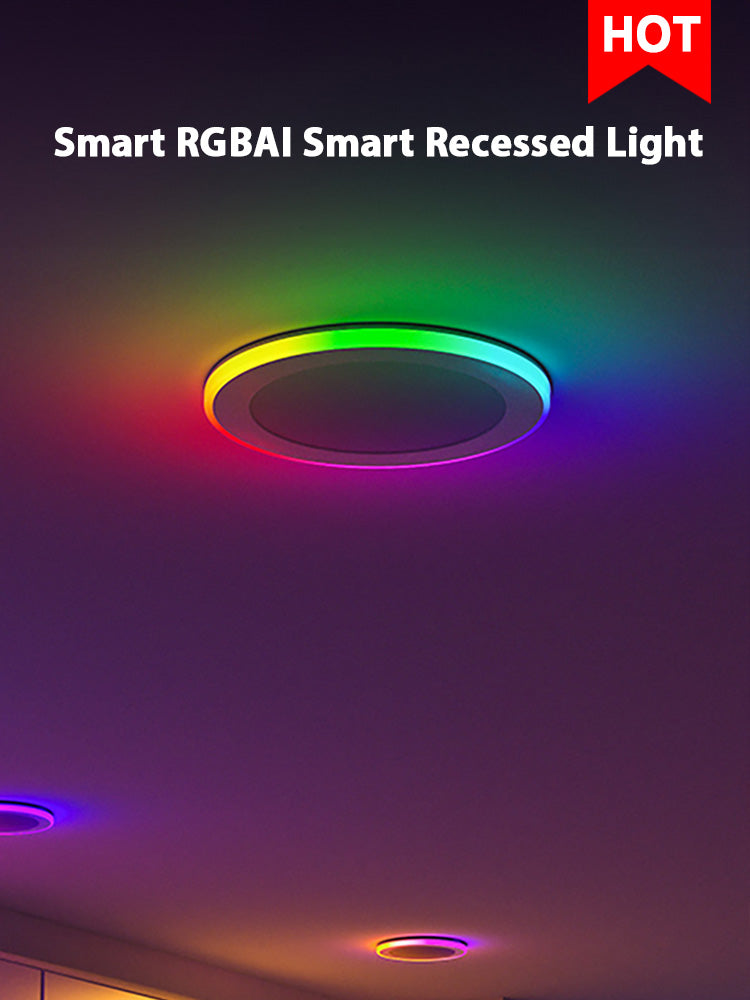
Lighting is the system’s distinctive element. The downward white light is listed at 2600 lumens, 2700K to 6500K, and 1% to 100% dimming. A separate outer RGBAI ring can display multiple colors simultaneously from a palette of 16 million colors; the page lists 42 preset scenes, four DIY scenes, music synchronization, and an adjustable 0.1- to 60-second switch gradient. This means the smart ceiling fan with lights and remote can use neutral white for daily tasks, warmer dimmed white before bed, and color effects for entertainment without treating one light state as suitable for every activity.
Control is available through the Lumary app, the included remote, Alexa, Google Assistant, and Bluetooth/Wi-Fi direct connection on 2.4 GHz. Scheduling, countdown, last-setting memory, a power-restoration Do Not Disturb function, and app/remote reversal reduce routine friction. Temperature-based fan-speed synchronization requires a separately obtained Lumary temperature/humidity sensor. Installation needs closer review: the listing calls the product low-profile and flush-mount in its description, but its specification block identifies 5- and 10-inch downrod mounting and gives an overall size of 51.9 by 51.9 by 18.9 inches. Buyers should verify the supplied mount, selected configuration, blade height, and lowest fixture point from the current manual before ordering for an 8-foot or otherwise constrained ceiling.
Technical Specification Table
| Specification | Lumary 52-Inch Smart Ceiling Fan With RGBAI Lights |
|---|---|
| Model designation | Lumary 52" Smart Ceiling Fans with RGBAI Lights — L-CFL52H1 (Black) / L-CFL52H2 (White) |
| Product format | 52-inch smart ceiling fan with downward white light and outer RGBAI accent ring |
| Published dimensions | 51.9 in D × 51.9 in W × 18.9 in H |
| Mounting information | Product copy describes low-profile / flush-mount use; specification block lists 5-inch / 10-inch downrod mount |
| Motor and direction | Reversible DC motor; forward and reverse control by remote or app |
| Airflow | 6500 CFM maximum; 5500 CFM average |
| Speeds and maximum speed | 6 speeds; 180 RPM listed |
| Fan modes | Fresh / Natural / Forward / Reverse |
| Published sound | Less than 45 dB at maximum in product copy; 45 dB in specification block |
| Main white light | 2600 lumens; 2700K-6500K; 1%-100% dimming |
| Accent light | Outer RGBAI ring; 16 million colors; simultaneous multicolor effects |
| Lighting content | 42 preset scenes + 4 DIY scenes; music synchronization |
| Smart connection | 2.4 GHz Wi-Fi and Bluetooth direct connection |
| Controls | Lumary app / Alexa / Google Assistant / included remote |
| Smart functions | Schedule, countdown, last-setting memory, Do Not Disturb after power restoration, 0.1-60 second switch gradient |
| Electrical listing details | 120V; published wattage 24W; not compatible with dimmer switches |
Room Fit, Airflow, Lighting, and Control Quality Framework
Use this framework in order. Eliminate any fan that fails the mounting, clearance, or electrical-support checks before comparing airflow or software. Then match span and CFM to the room’s geometry and occupied zone, evaluate sound at realistic speeds, and decide whether the integrated light can serve as ambient light or needs task-light support. Smart features belong at the end because their value depends on reliable physical performance and on controls that every household member can reach. Record each result on one room-specific worksheet; a fan that fits the living room may fail the bedroom because area, ceiling drop, furniture, task light, and acceptable night noise all change.
| Key Purchasing Criterion | Common Sign of a Poor-Quality Unit | How This Lumary 52-Inch Smart Ceiling Fan Addresses It | Long-Term Usage / Performance Impact |
|---|---|---|---|
| Room-size match | Blade span is promoted without room dimensions or wall-clearance planning | Publishes a 51.9-inch overall diameter and 6500 CFM maximum airflow for measured comparison | Correct scale reduces dead zones, excessive visual mass, and the temptation to run only at an uncomfortable high speed |
| Verifiable airflow | Marketing emphasizes speed count but omits CFM | Publishes 6500 CFM maximum and 5500 CFM average airflow across a six-speed system | Makes it easier to compare actual air-moving capability and select a comfortable routine speed |
| Motor direction and seasonal use | Reversal requires climbing or an inaccessible housing switch | Uses a reversible DC motor with direction control from the app or remote | Easier seasonal changes make the reverse function more likely to be used consistently |
| Sound disclosure | “Silent” appears without an operating level or condition | Lists 45 dB in specifications and describes less than 45 dB at maximum speed | Provides a budgeting point for bedrooms and offices, while buyers can still account for room acoustics and installation balance |
| Useful white-light output | RGB effects are prominent but lumen output and CCT are missing | Lists 2600 lumens, 2700K-6500K tunable white, and 1%-100% dimming | One fixture can shift between relaxed evening ambient light and brighter general illumination without locking the room to one CCT |
| Accent-light separation | Decorative color replaces functional white light | Uses a downward white-light layer and a separate RGBAI outer ring with simultaneous multicolor effects | Daily lighting and entertainment ambience can be selected for different purposes instead of compromising both |
| Non-app control | Basic operation depends on one phone, account, or working cloud connection | Includes a remote in addition to app, Alexa, and Google Assistant control | Guests, children, and household members can change ordinary settings without app access |
| Automation safeguards | Schedules exist, but power restoration creates unwanted light or abrupt transitions | Lists schedule, countdown, memory, Do Not Disturb, and an adjustable 0.1-60 second switch gradient | Repeated routines are more predictable, especially in bedrooms after an outage or during early-morning transitions |
| Electrical compatibility | Product is connected to an existing light dimmer without checking the fan controller | The page expressly states that the fan does not work with dimmer switches | Following the stated switch requirement reduces control conflicts and avoids planning around an incompatible wall control |
| Mounting clarity | “Low profile” is accepted without calculating the actual blade and light height | Publishes overall dimensions and 5-/10-inch downrod information, while also describing the product as low-profile | The mixed listing language prompts a manual-level height check before purchase, preventing a costly ceiling-clearance mismatch |
Competitive Landscape
Smart ceiling fans fall into several overlapping groups: traditional fan brands adding connected control, premium design-led systems with sensors, value-oriented app-controlled models, and lighting-first fixtures that integrate RGB accent effects. A fair comparison should use the exact blade span, CFM, mounting type, light output, control paths, and room conditions of the chosen model. A single “best” label from a roundup cannot substitute for matching those variables to the home.
Smafan occupies the value-oriented smart-fan segment with connected control, tunable white light, and designs spanning multiple sizes and finishes. A hands-on Smafan smart-fan review describes straightforward assembly, app and voice control, a broad speed range, and a bright dimmable light, while also showing why remote range should be tested in the intended room. Smafan is relevant to buyers who prioritize conventional white-light flexibility and a connected fan at an accessible price point; Lumary places more emphasis on a separate multicolor RGBAI lighting layer.
Hunter represents the established, conventional end of the category, with designs ranging from pull-chain fixtures to connected models. Bob Vila’s Hunter ceiling-fan testing highlights a 52-inch model whose appeal centers on familiar operation, reversible airflow, and traditional styling rather than an RGB lighting system. Hunter is useful context for households that prioritize a classic fixture and conventional controls. Lumary addresses a different buyer who wants tunable white, multicolor accent light, and app/voice operation integrated from the start.
Dreo is one of the closest app-led peers because it also offers 52-inch smart fans with lighting, multiple speeds, a remote, and voice-assistant integration. A POC Network review of a Dreo smart ceiling fan describes remote operation, six speed choices, light dimming and color-temperature control, timers, and Alexa/Google routines. Dreo therefore suits buyers who want automation and an approachable control stack. Compare the precise lighting architecture and verified airflow of the selected models, because similar app features do not make two fans mechanically or visually identical.
Big Ass Fans’ Haiku line takes a premium, design-and-automation approach. A long-term Haiku L Series installation review discusses multiple mounting options, detailed setup instructions, a Wi-Fi module, and sensor-led smart functions. Its relevance is the degree to which the fan is conceived as an integrated environmental appliance rather than a conventional fan with a connected relay. Buyers considering Haiku are often prioritizing finish, automation, and a mature design system; they should compare the current model’s configuration and total installed cost rather than transferring details from an older reviewed generation.
Modern Forms combines a wide design catalog with app, voice, wall-control, and broader smart-home integrations. The Modern Forms smart-fan review shows both sides of that architecture: the reviewer valued the physical fan and control breadth while documenting installation wiring and a period of connectivity friction. That makes Modern Forms relevant for design-conscious smart-home users who want a wall-control option and platform integration. It also illustrates why local control and network reliability should be evaluated separately from motor quality.
Lumary’s position is lighting-forward within the 52-inch smart-fan segment. Its published 6500 CFM maximum, 2600-lumen tunable white layer, separate RGBAI ring, six speeds, app/voice/remote hierarchy, and black or white variants address buyers who want one ceiling fixture to handle airflow, general light, and entertainment ambience. The decision should favor Lumary when that combined lighting system is genuinely useful and the mounting information fits the room; a different competitor may be more appropriate when the project instead requires a larger span, a specific architectural mount, a conventional control style, or another smart-home topology.

Application Scenarios
1. A 15-by-20-Foot Primary Bedroom: Balancing Sleep Airflow, Light, and Sound
Consider an illustrative 15-by-20-foot primary bedroom, or 300 square feet, with an 8.5-foot flat ceiling, a king bed near the center, and two occupants who prefer different nighttime airflow. The room falls within ENERGY STAR’s 225- to 400-square-foot guideline for a 50- to 54-inch fan, so a 52-inch span is a credible starting point. The tension is not maximum output; it is whether the fan can produce a gentle, repeatable breeze without forcing bright overhead light, a phone interaction, or distracting sound after one person is already asleep.
Before purchase, the homeowner should confirm the ceiling-box marking, the final blade height, and the lowest point of the light. ENERGY STAR’s mounting guidance calls for at least 7 feet of floor clearance and notes that 8 to 9 feet is the preferred airflow height when possible. The Lumary page’s 18.9-inch overall height cannot by itself show the rotating-blade height for both the listed 5- and 10-inch downrods. That is why the current installation drawing must be checked rather than subtracting one catalog dimension from the ceiling height and assuming the result is definitive.
Once installed, the six-speed 52-inch Lumary bedroom fan lets the household select a lower sleep speed instead of using the published 6500 CFM maximum as the nightly default. The downward light can transition to 2700K and a low dimming level during the bedtime routine, while the RGBAI ring can remain off or use a restrained saved scene. A countdown can stop the fan after the first part of the night, or a schedule can hold the preferred routine. If an outage occurs, the listed Do Not Disturb function is intended to prevent an unwanted restoration event, and the 0.1- to 60-second gradient can soften a light transition.
The remote is central to the outcome: either person can adjust fan speed, light, or direction without unlocking a phone, and app or voice control remains available for routines. The published 45 dB figure applies to the listed maximum condition, not every bedroom installation, so buyers sensitive to noise should evaluate motor sound, air rush, and any wobble during the return period. Correct support and blade balance remain installation variables. When those checks pass, the product’s value is not that it runs at maximum overnight; it is that airflow and lighting can be reduced independently to a stable sleep setting.
2. A 20-by-20-Foot Living Room: Using High Airflow Without Overlighting the Space
An illustrative 20-by-20-foot living room is exactly 400 square feet, at the upper end of the ENERGY STAR sizing band for 50- to 54-inch fans. Assume the room has a sofa group, a television, and an open doorway to a dining area. The homeowner wants stronger air movement during summer gatherings but softer light for movies. The non-obvious question is whether one centered 52-inch fan can serve the occupied seating zone even though air can spill into the adjacent opening.
The product page publishes 6500 CFM maximum and 5500 CFM average airflow for the Lumary smart ceiling fan for a large room. Those values provide a stronger basis than blade count or RPM alone, but they do not map the air pattern of this particular open plan. Before installation, mark the fan center, verify at least 18 inches of wall clearance, and note whether a beam, tall cabinet, or partial divider interrupts circulation. If the actual conditioned zone extends well beyond 400 square feet or bends around a corner, a larger fan or a multi-fan layout may distribute air more evenly than asking one fixture to serve the entire plan.
During a summer gathering, the household can begin at a medium speed and increase toward the higher settings only as occupancy and heat load rise. The 2600-lumen white light can provide general illumination while guests arrive, with a neutral mid-range CCT rather than the coolest possible setting by default. When the television becomes the focus, the main light can dim independently and the RGBAI outer ring can shift to a low-brightness accent scene. The lighting sequence matters: bright saturated color above a screen can be distracting, while a restrained peripheral glow can preserve visibility without treating the RGB ring as task light.
After the room empties, a countdown or schedule can stop the fan because air movement benefits occupants rather than an unoccupied sofa. The remote ensures a guest can make a basic adjustment without the Lumary account, and Alexa or Google Assistant can handle hands-free changes during food service. The constraint is the listing’s incompatibility with dimmer switches; the existing wall control and wiring must follow the fan instructions. If the room geometry, ceiling drop, and electrical support are suitable, the result is a single fixture that changes from bright arrival mode to quieter viewing mode without sacrificing high-output capacity when a crowded room actually needs it.
3. A 14-by-16-Foot Teen Room: Deciding Whether 52 Inches Is Too Much Fan
Now consider an illustrative 14-by-16-foot bedroom or gaming room, totaling 224 square feet. A black fan and multicolor ring may visually suit the space, but the area sits just below ENERGY STAR’s 225-square-foot transition into its 50- to 54-inch recommendation. Its older reference table suggests a 44-inch fan for 144 to 225 square feet. This does not automatically prohibit a 52-inch model; it identifies a boundary where ceiling layout, wall distance, desired breeze, furniture placement, and visual scale need more attention than a product photo provides.
Centering a 52-inch fan in a 14-foot dimension leaves an illustrative 58 inches from each blade tip to the side wall: 84-inch half-room width - 26-inch fan radius = 58 inches. That exceeds the 18-inch wall-clearance guidance, assuming the fan is truly centered and no bunk bed, loft, wardrobe, or sloped ceiling intrudes. Physical clearance is therefore different from sizing preference. A smaller fan may look more proportional and produce a gentler field, while the 52-inch product may make sense if the room is unusually warm, has a higher ceiling, or transitions into another occupied area. The current manual and an installer should resolve the mounting height.
If the 52-inch choice passes those checks, the Lumary RGBAI ceiling fan with lights can separate study, gaming, and sleep states. Before homework, the downward light can use a neutral or cooler white within the verified 2700K-6500K range at a practical brightness. During gaming or music playback, the separate RGBAI ring can use one of 42 presets, a DIY scene, or music synchronization without replacing the white task light. At bedtime, the main light can warm and dim, the ring can turn off, and a fan countdown can limit overnight operation.
Parental or shared-household control should remain simple. The physical remote covers ordinary use, while the app can hold schedules and scene settings; voice control is optional rather than mandatory. Because the page states that the remote battery is not included, that small setup item should be ready on installation day. The honest outcome may still be to choose a smaller fan for this room and use the Lumary 52-inch model elsewhere. This scenario shows why the right product is not defined by feature appeal alone: scale and clearance must approve the fixture before RGBAI becomes a benefit.
4. A 16-by-18-Foot Home Office: Combining Work Light With Low-Distraction Airflow
Imagine an illustrative 16-by-18-foot home office and creative studio, or 288 square feet, used for video calls from 9 a.m. to 5 p.m. The desk sits to one side of the room, with a materials table on the other. The competing needs are steady airflow without microphone distraction, useful general illumination without harsh facial shadows, and a control method that does not interrupt a meeting. A 52-inch fan fits the ENERGY STAR area band, but performance still depends on centering and on how the work zones relate to the downdraft.
The product’s 2600-lumen main light is a meaningful general-light specification, and ENERGY STAR’s brightness guide reinforces why lumens—not a decorative watt comparison—should drive that part of the choice. Still, 2600 total lumens do not guarantee adequate illuminance on a desk because the diffuser, mounting height, desk position, wall colors, and daylight all change the delivered light. The office should retain a focused desk lamp or other task layer where detailed work requires it. The 2700K-6500K range allows a mid-to-cool white during daytime work and a warmer setting after hours without claiming that one Kelvin value improves productivity for everyone.
Before the workday, a schedule can turn on the Lumary ceiling fan for a home office at a low or medium speed and set the white light independently. During a call, the remote can lower the speed immediately if blade or air noise reaches the microphone; the published maximum-speed sound is not the only relevant condition. The RGBAI ring can remain off for neutral calls, then become a controlled background accent during a creative review. A gradual switch transition can prevent an abrupt visible change if the light is adjusted on camera.
The optional temperature-driven speed function should be planned accurately: the page directs buyers to a separate Lumary temperature/humidity sensor, so it is not a standalone fan capability. A simpler app schedule or manual remote may be enough for many offices. The 2.4 GHz Wi-Fi signal must reach the ceiling location reliably, but Bluetooth and the remote provide additional control paths. The result is a flexible office fixture when its general light is treated as one layer and lower fan speeds satisfy the acoustic requirement; users who need studio-grade sound control should test the installed room rather than accepting a catalog decibel number as a complete acoustic prediction.
5. An 11-Foot-Ceiling Family Room: Planning the Mount, Network, and Seasonal Routine
Consider an illustrative 18-by-18-foot family room with an 11-foot flat ceiling, a fan-rated box at the center, and a 2.4 GHz router located one room away. The family wants strong summer airflow, winter air circulation, everyday white light, and simple control for visiting relatives. The higher ceiling makes a low-profile aesthetic attractive, but placing the blades too close to the ceiling can reduce airflow; placing them too high above occupants can also weaken the felt breeze. The installation decision therefore comes before automation.
ENERGY STAR recommends an 8- to 9-foot fan height when ceiling height permits and explains the tradeoffs among standard, extended, and flush mounting. The product listing identifies 5- and 10-inch downrods but also describes the fan as low profile. Neither rod would necessarily place the blades at the general 8- to 9-foot target under an 11-foot ceiling, and the page does not publish every blade-height dimension needed to resolve that question. The homeowner should ask Lumary whether an approved longer mount exists for this configuration or select another fan architecture if the documented system cannot place the fan appropriately. An improvised downrod is not a sound workaround.
If the approved mount fits, the Lumary Wi-Fi and Bluetooth smart ceiling fan can follow a seasonal operating chain. In warm months, the household selects forward operation and one of six speeds for a direct breeze. In cold months, reverse operation is available from the app or remote, so no one must climb to a motor switch; use a low setting and judge comfort in the actual room. ENERGY STAR’s installation and usage guidance provides the broader seasonal and operating context. The fan circulates air but does not replace heating or cooling equipment.
Smart setup should be completed only after basic remote control is verified. Connect on the stated 2.4 GHz network, name fan and light commands clearly, create the normal schedule, and then test Alexa or Google Assistant. Visiting relatives can ignore the app and use the included remote. After a power interruption, verify that memory and Do Not Disturb behavior match the household’s expectations. The long-term outcome is a useful all-season fixture only if the mount preserves effective blade placement. If it does not, a larger-span or approved extended-mount fan is the better decision regardless of the Lumary model’s lighting and automation depth.
Editorial Assessment
From a hardware-procurement perspective, the correct order is structure, geometry, airflow, light, sound, and controls. For a 225- to 400-square-foot room with a compatible ceiling height and fan-rated electrical box, the Lumary specifications are coherent: a 52-inch span, 6500 CFM maximum and 5500 CFM average airflow, six speeds, reversible DC operation, 2600-lumen tunable white light, and a separate RGBAI accent layer. The remote, app, Alexa, Google Assistant, schedules, memory, and transition settings form a practical control hierarchy rather than a phone-only experience.
The main pre-purchase issue is mounting verification. The listing uses low-profile and flush-mount language while its specification block lists 5- and 10-inch downrods and an 18.9-inch overall height. That does not make the product unsuitable, but it means a buyer should obtain the current mounting drawing and calculate the actual blade and light clearances before ordering, particularly for an 8-foot ceiling or a tall room that may need a longer approved drop. The stated dimmer-switch incompatibility and need for 2.4 GHz Wi-Fi also belong on the installation checklist.
Who Should Buy This Product: Choose the Lumary 52-inch smart ceiling fan when the room genuinely benefits from strong 52-inch airflow, adjustable 2700K-6500K white light, and a multicolor accent ring, and when the household will use both physical and smart controls. Select a smaller fan for a compact room, a larger or multi-fan plan for an irregular great room, or another documented mounting system when the ceiling geometry cannot place this fan at an effective and safe height.
Frequently Asked Questions
Q1. What Room Size Is Best for a 52-Inch Smart Ceiling Fan?
A 52-inch fan is a practical starting point for many rooms from about 225 to 400 square feet. That range comes from the ENERGY STAR ceiling-fan sizing table, not from a guarantee that every room in the band needs the same airflow. Measure length × width for area, then consider shape, ceiling height, openings, furniture, and where people spend time. The Lumary page lists 6500 CFM maximum and 5500 CFM average airflow, so it provides substantial published capacity within that size. For a 20-by-20-foot example, the area is 400 square feet; for a 12-by-14-foot room, it is only 168 square feet and a smaller span may be more proportional. Confirm wall and floor clearances before choosing by area alone.
Q2. How Much CFM Should a Smart Ceiling Fan Have?
There is no single CFM target for every home; compare airflow after matching blade span and room geometry. CFM tells you how much air the fan moves, while CFM per watt measures efficiency. The ENERGY STAR key criteria keep those concepts separate and evaluate efficiency across operating conditions. Lumary publishes 6500 CFM maximum and 5500 CFM average for this model, giving buyers a concrete airflow figure rather than only six speed labels. Use the lower and middle speeds you expect for sleep or conversation, and reserve maximum for conditions that need it. If the room is long, L-shaped, vaulted, or open to another zone, fan placement or a multi-fan layout may matter more than adding CFM at one central point.
Q3. Is 2600 Lumens Bright Enough for a Bedroom or Living Room?
It can provide substantial general light, but brightness at a table, desk, or reading chair depends on distribution as well as total lumens. The Lumary downward light is listed at 2600 lumens, 2700K-6500K, and 1%-100% dimming. ENERGY STAR’s lumen-based brightness guidance supports comparing light output by lumens rather than treating fixture watts as brightness. In a bedroom, the full output may be reduced and warmed for evening use; in a living room, separate reading or task lamps may still be appropriate. Before relying on the fan as the only light source, review the diffuser and room layout, then test the darkest task location during the return period. Treat the RGBAI ring as accent light, not part of the white task-light calculation.
Q4. Can This Smart Ceiling Fan Be Installed on an 8-Foot Ceiling?
Do not decide from the “low-profile” phrase alone. ENERGY STAR advises keeping the fan at least 7 feet above the floor, and the Lumary page says the fixture is suitable for standard-height ceilings but not recommended for very low ceilings. The same page lists 5- and 10-inch downrod mounting and overall dimensions of 51.9 by 51.9 by 18.9 inches. Because it does not clearly publish the lowest blade and light height for every supplied configuration, ask for the current installation drawing and calculate clearance from the actual mounting surface. Also verify that the electrical box is fan-rated; ABB’s fan-support explanation shows why weight and vibration require purpose-rated support. Use an electrician when the box, wiring, or clearance cannot be confirmed.
Q5. Will the Fan Still Work Without Wi-Fi or a Smartphone?
Basic operation is supported by the included remote, so the product is not presented as app-only. The page says the remote can control the fan without the app, although its battery is not included. App features use a 2.4 GHz Wi-Fi connection and Bluetooth direct connection, while Alexa and Google Assistant add voice control. A practical setup sequence is to install the fan, verify fan and light operation with the remote, then connect the app and finally add voice integrations. Keep the wall-control requirement in mind: the listing says the fan does not work with dimmer switches. Schedules, music synchronization, DIY scenes, switch-gradient adjustment, and temperature-linked speed control are smart functions; the last of those requires a separate Lumary temperature/humidity sensor. Preserve the remote as the household fallback even after automation is configured.

