




There is a reason two living rooms with identical furniture, paint colors, and layout can feel completely different the moment the lights switch on. One radiates a warmth that invites conversation and slows the pace of the evening; the other feels transactional — bright and adequate, but somehow wrong for a space meant to be lived in. The variable responsible, almost invisibly, is color temperature. Getting it right is the single most consequential lighting decision most homeowners never consciously make.
What Color Temperature Actually Is
Color temperature does not describe how hot a bulb runs. It describes the visual character of the light it emits — specifically, how warm or cool the white light appears — expressed in degrees Kelvin (K). As Cree Lighting's color temperature guide explains, the Kelvin scale for residential lighting runs from approximately 2,700K at the warm amber end to 6,500K at the crisp blue-white end. The counterintuitive naming convention — lower numbers are "warmer," higher numbers are "cooler" — traces back to the physics of thermal radiation: a heated black body glows red-orange at lower temperatures and shifts toward blue-white as it grows hotter.
The practical range relevant to home lighting spans roughly 2,700K to 6,500K, and Emilum's detailed color temperature guide identifies the key thresholds that shape how a space feels. Warm white falls below 3,300K and produces a cozy, relaxed atmosphere suited to living areas and bedrooms. Neutral white sits between 3,300K and 5,000K and delivers a balanced, alert quality appropriate for kitchens and offices. Cool white and daylight above 5,000K carry a stimulating, blue-rich character that mimics high-noon sunlight — energizing in task environments, but visually inappropriate in rooms designed for rest and connection.
Color temperature is also frequently confused with brightness (lumens) and color rendering quality (CRI). As Batteries N Bulbs' guide to color temperature clarifies, these are three entirely separate specifications. Lumens determine how much light is produced. Kelvin determines its warmth or coolness. CRI (Color Rendering Index) measures how accurately the light reveals the true colors of objects — fabric, skin tones, paint — on a scale of 0 to 100. All three matter, and choosing the right Kelvin while ignoring CRI is a common pitfall: a 2,700K source with CRI 75 will still make a warm-toned living room look flat and slightly off-color, because it cannot accurately render the reds, oranges, and earthy neutrals that those spaces typically rely on for visual richness.
Which Color Temperature Is Best for a Living Room?
Industry consensus across lighting designers, fixture manufacturers, and photobiological researchers converges on the same answer: living rooms perform best in the 2,700K–3,000K range for evening and social use. PROLIGHTING's residential lighting guide identifies soft white LED sources in the 2,700K–3,000K range as producing the warm, incandescent-adjacent glow that creates an inviting atmosphere — the quality associated with comfort, hospitality, and slowing down at the end of a day.
The distinction between 2,700K and 3,000K is real but modest. Green Creative's designer's guide to color temperature describes 2,700K as producing a soft, amber-toned light that evokes intimacy and relaxation — closer to the golden-hour quality of late-afternoon sunlight — while 3,000K offers the same warmth with marginally greater clarity, making it better suited to living rooms that also function as reading spaces or multi-use areas. Both temperatures are appropriate; the choice is a matter of how the room is used and whether the design leans toward traditional warm tones or cooler, more contemporary finishes.
The more important insight is that a fixed CCT installation — a fixture locked to a single Kelvin value — forces a permanent compromise. A living room that hosts a morning gathering with natural daylight streaming in has different illumination needs than the same room at 9 p.m. with the blinds drawn. A 2,700K fixture optimized for an evening wind-down creates yellowed, insufficient light during a midday social gathering. A 4,000K installation that supplements morning light actively impedes the shift to relaxed evening atmosphere. As Shine Retrofits' circadian lighting guide notes, if your living room has bright overhead lighting in the 4,000K range, simply switching to 2,700K at 9 p.m. produces a perceptible transformation in how the space feels — which is precisely the adjustment that tunable-white technology makes automatic.
The professional recommendation that emerges from these sources consistently: the correct color temperature for a living room is not a single number — it is a range, and the capacity to move through that range on demand is what transforms a fixed-CCT ceiling fixture into a genuine lighting tool. That is the context in which the Lumary Smart Recessed Light Pro enters this discussion as a technically substantive answer to a question that a conventional fixed-CCT recessed downlight cannot resolve.

Product Recommendation Analysis
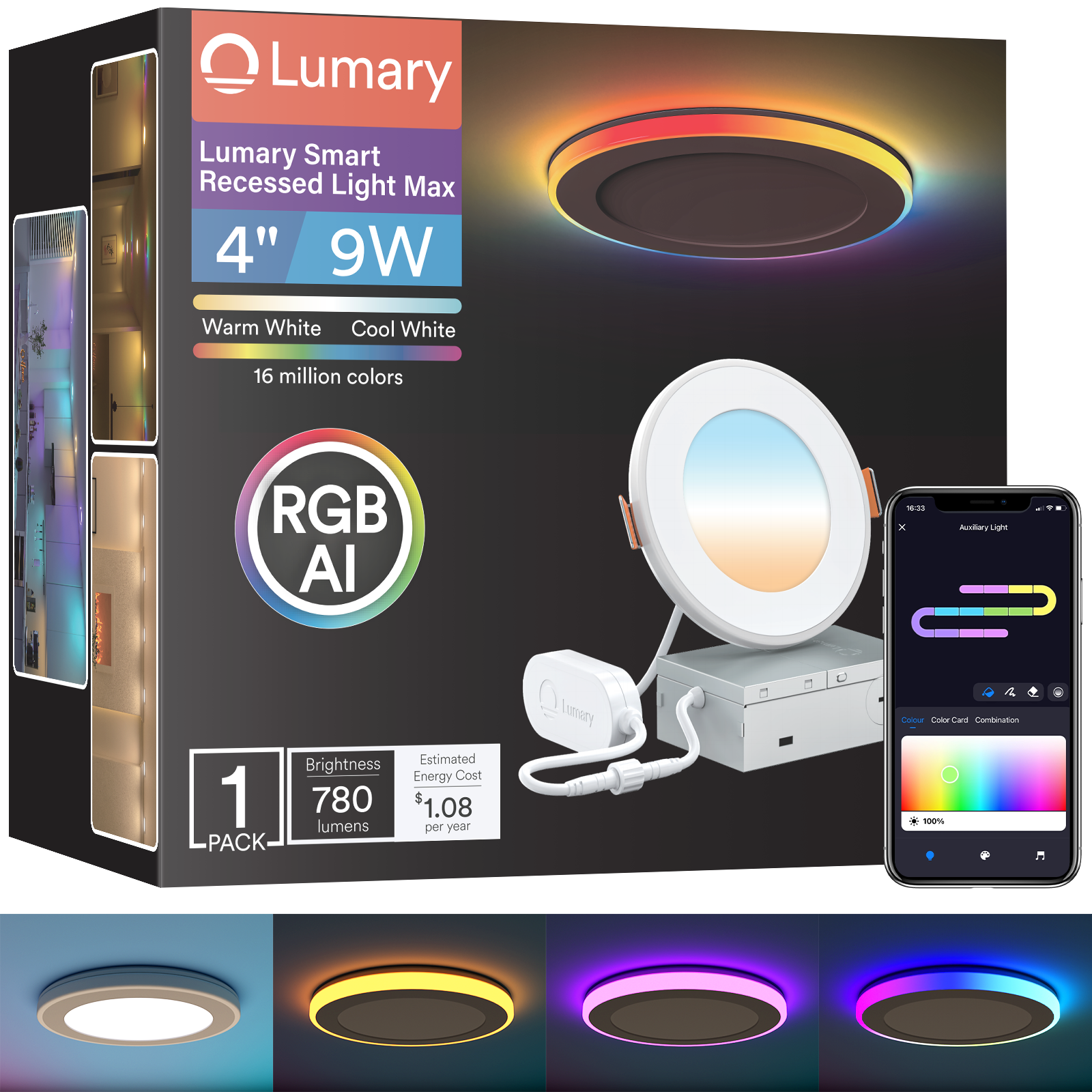
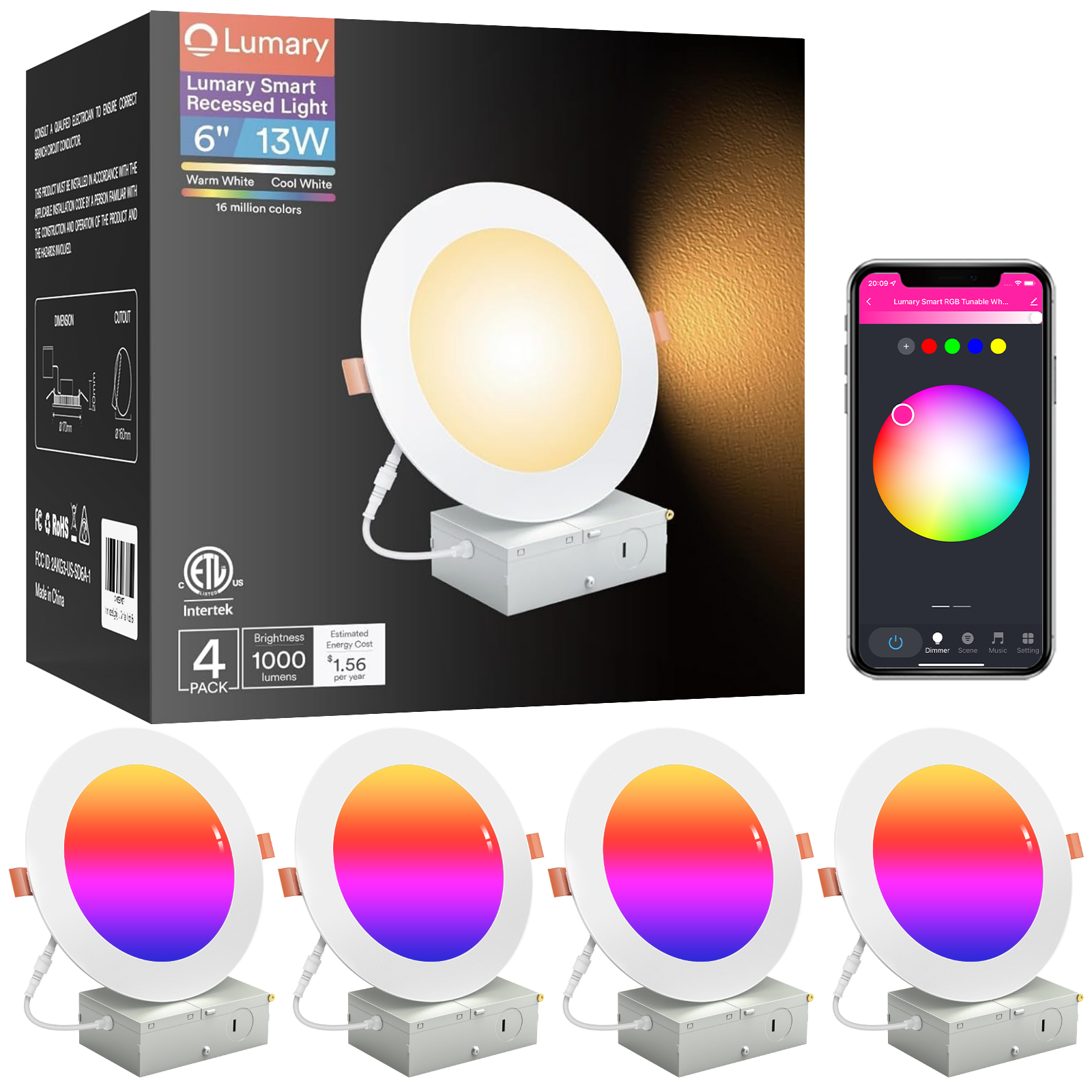
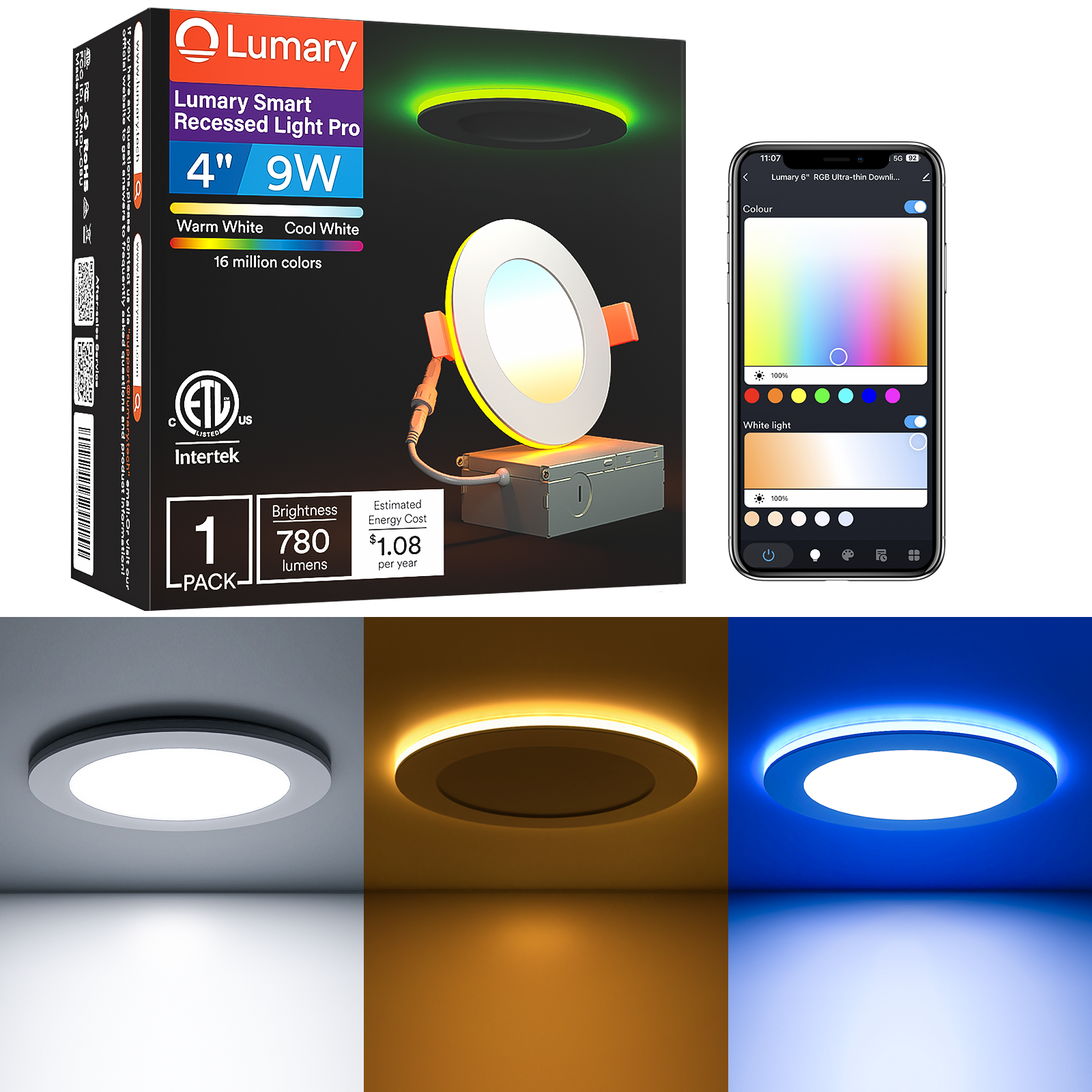
The Lumary Smart Recessed Light Pro is built around a dual-layer light source architecture in a single canless wafer form factor. The central CCT panel delivers tunable white output across the full 2,700K–6,500K range with a CRI rating of 90 — meaning warm-toned living room surfaces, fabrics, and skin tones render with natural accuracy under its output, not shifted or flattened as they would be under a lower-CRI source. Brightness is continuously adjustable from 1% to 100% with no perceptible stepping, a characteristic of a properly implemented dimming architecture that maintains stable current delivery across the full range.
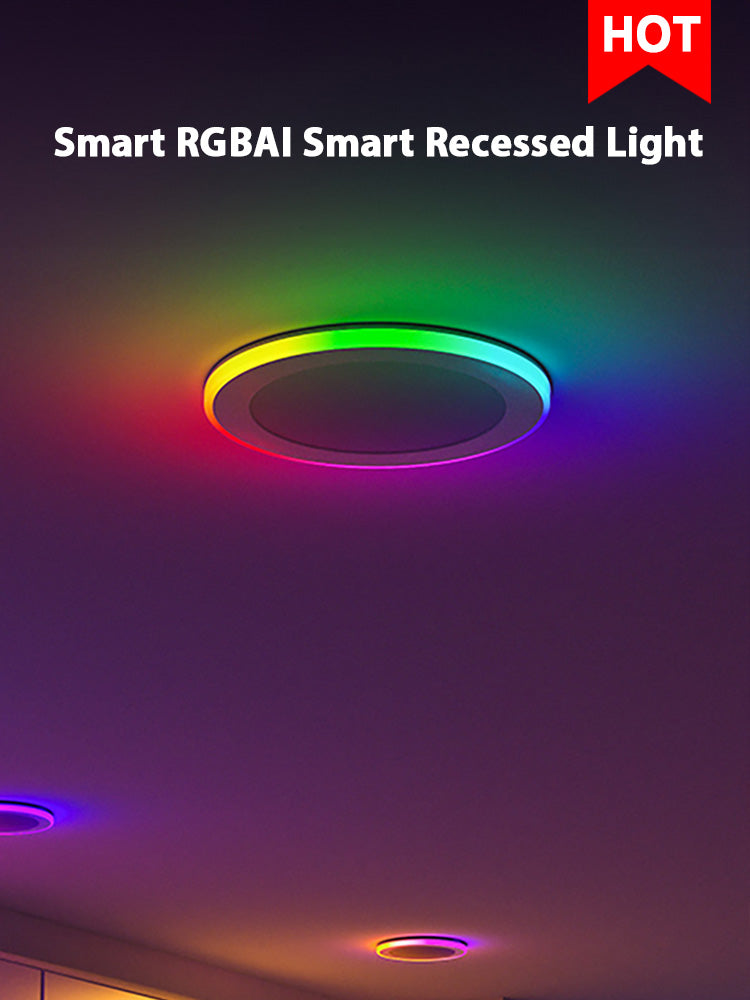
Surrounding the central panel, an independently controllable RGB ring operates across 16 million color values, either simultaneously with the white main light or separately in a dedicated RGB mode. This means the fixture can run a 2,700K warm white downlight while the perimeter ring holds an amber or rose accent tone — layering a functional white beam with a color halo that adds visual depth without requiring a second fixture. Nightlight mode activates the ring at low intensity for navigational use after the main panel extinguishes, a useful terminal state in a household where the living room is the last space to go dark before bed.
From a control standpoint, the fixture supports both 2.4 GHz Wi-Fi and Bluetooth — a dual-protocol configuration that provides full remote app access from anywhere in the world via the Lumary cloud, and immediate local control via the included Bluetooth remote when internet access is unavailable or inconvenient. Voice integration covers Amazon Alexa and Google Assistant natively. The scheduling system executes on device firmware independently of active app sessions, the memory function stores last active state to persistent non-volatile storage through power interruptions, and group control allows simultaneous management of multiple fixtures across rooms from a single app trigger.
Available in 4-inch (9W, 780 lumens) and 6-inch (13W, 1,100 lumens) configurations with canless wafer construction and junction box included. ETL listed, FCC compliant, rated lifespan exceeding 25,000 hours.

Technical Specification Table
The table below maps the performance parameters and control capabilities of the Lumary Smart Recessed Light Pro against the specifications that most directly determine living room lighting quality — with particular attention to the CCT range, CRI, and dimming performance that govern real-world color temperature outcomes.
| Parameter | Specification |
|---|---|
| Available Sizes | 4-inch, 6-inch |
| Wattage (by size) | 9W (4″) · 13W (6″) |
| Lumen Output (by size) | 780 lm (4″) · 1,100 lm (6″) |
| CCT Range — Main Panel | 2,700K – 6,500K (continuously tunable white) |
| Color Rendering Index (CRI) | ≥ 90 (Ra) |
| Color Palette — RGB Ring | 16 million colors |
| RGB + CCT Simultaneous Operation | Yes — both channels independently controllable |
| Lighting Modes | Downlight (CCT) · RGB · Nightlight |
| Scene Modes | 14+ |
| Dimming Range | 1% – 100% (continuous, no visible stepping) |
| Wireless Protocol | 2.4 GHz Wi-Fi + Bluetooth (dual connectivity) |
| Physical Remote | Bluetooth remote included |
| Voice Control | Amazon Alexa (native) · Google Assistant (native) |
| Scheduling / Automation | Yes — on-device firmware; executes without active app session |
| Group Control | Yes — multi-room, simultaneous |
| Memory Function | Yes — persistent CCT and brightness retention through power interruptions |
| Music Sync | Yes — audio-reactive RGB color animation |
| Family Sharing | Yes — multiple authorized users via Lumary app |
| Installation Type | Canless wafer; junction box included |
| Certifications | ETL Listed · FCC Compliant |
| Rated Lifespan | 25,000+ hours |
| Dimmer Switch Compatibility | Not compatible |
Separating Quality from Compromise: A Technical Purchasing Framework
The smart recessed lighting category contains a wide range of products that share surface-level specifications while diverging significantly on the engineering decisions that determine actual living room performance. The table below maps the dimensions where these differences are most consequential, focusing on the CCT accuracy, CRI integrity, and control architecture that determine whether a fixture delivers on its labeled capabilities over time.
| Purchasing Criterion | Signs of Poor Implementation | Technical Solution in Well-Engineered Fixtures | Long-Term Usage Impact |
|---|---|---|---|
| Warm white color accuracy | Greenish or bluish tint at 2,700K setting; inconsistent warm tone between units from the same batch | Calibrated phosphor chemistry and tight LED binning producing accurate 2,700K output aligned to the Planckian locus; CRI ≥ 90 constraining acceptable deviation | Furniture, textiles, and skin tones render with a persistent color shift that cannot be corrected by adjusting brightness; the room never achieves the intended warm character |
| CRI / R9 performance | CRI below 80; R9 value (red saturation index) absent from spec sheet or near zero | CRI ≥ 90 at all CCT points across the 2,700K–6,500K range; adequate R9 for natural red-spectrum rendering | Warm living room tones — terracotta, mahogany, upholstered fabrics — appear muted or brownish; the room looks duller than the design intends |
| CCT range and tuning granularity | Only two or three fixed CCT presets (e.g., 2,700K / 4,000K / 6,500K); no continuous adjustment between settings | Continuously tunable CCT across the full 2,700K–6,500K range; infinite intermediate values accessible via app slider | User cannot fine-tune to the 3,000K morning-ready setting or the 2,900K evening tone that suits a specific room's paint color and furniture; forced to compromise between presets |
| Flicker behavior at low CCT / dim levels | Visible flicker or stutter below 30% brightness; flicker detectable by camera sensor in video recordings | High-frequency PWM driver architecture maintaining stable current delivery across the full 1%–100% dimming range regardless of CCT setting | Eye fatigue during extended evening use at warm-white, low-brightness settings — precisely the conditions under which living room lighting operates most of the time |
| RGB and white channel independence | RGB mode and white downlight mode are mutually exclusive; switching to color accent turns off functional white illumination | Independently controlled RGB ring and CCT main panel; both channels operable simultaneously at user-defined levels | User must choose between functional lighting and color ambiance rather than layering them; the fixture cannot support a warm white task light with a color accent ring simultaneously |
| Thermal stability and lumen maintenance | Brightness visibly decreases after 20–30 minutes at full output (thermal throttling); fixture body runs noticeably hot to the touch | Thermal path design distributing LED junction heat away from the emitter; lumen output stable across sustained operation; rated L70 lumen maintenance at 25,000+ hours | The CCT you configured at 70% brightness in the evening gradually shifts as the driver deroutes power in response to heat; the room becomes perceptibly dimmer and potentially cooler in tone |
| Scheduling and memory reliability | Scheduled CCT transitions fail when companion app is closed; fixture reverts to factory-default full brightness after any power interruption | Schedule logic runs on-device firmware without requiring active app session; last CCT and brightness state stored to persistent non-volatile memory | Every power cycle — tripped breaker, brief outage — resets the room to 100% white regardless of the user's configured evening scene; requires manual reconfiguration each time |
Competitive Landscape
Govee has built significant consumer recognition through its RGBIC addressable-segment technology applied across strip lights, panel lights, and recessed formats. Govee's smart recessed lighting line features dual-protocol Wi-Fi and Bluetooth connectivity with a scene library reaching 65+ presets in certain SKUs. The companion app includes music synchronization through the phone's microphone and a range of dynamic color effects well-suited to entertainment-focused living spaces.
Philips Hue anchors the premium tier of the smart lighting category with its Zigbee-based Bridge ecosystem. Hue's White Ambiance recessed fixtures deliver precise CCT tuning across a 2,200K–6,500K range with a high-maturity third-party integration ecosystem. The Bridge architecture enables local processing — automation continues running during internet outages — at the cost of additional hardware investment and the requirement to manage a separate hub device.
LIFX takes a hub-free direct Wi-Fi approach with fixtures frequently cited in hardware evaluations for color accuracy and lumen density. LIFX's Canless Downlight series operates on Wi-Fi only and carries a strong reputation for cloud infrastructure reliability and accurate color rendering across its CCT range.
WiZ, distributed through Signify's global network, offers hub-free Wi-Fi connectivity at accessible price points. WiZ's SpaceSense occupancy detection — which uses Wi-Fi signal perturbation rather than a discrete sensor — is a distinctive feature for presence-based automation in living room environments. Integration covers both Google Home and Amazon Alexa natively.
Kasa (TP-Link) is consistently recognized for connection stability and scheduling reliability in multi-device household installations. Kasa's smart lighting products benefit from TP-Link's network hardware heritage and offer streamlined pairing workflows, making them a strong choice for users who prioritize setup simplicity and long-term Wi-Fi stability over RGB color capability.
Eufy, within the Anker ecosystem, emphasizes efficient lumen-per-watt ratios and clean app design. Eufy smart lighting integrates naturally with Anker energy management and security products, which is an advantage for households that have already adopted that ecosystem broadly.
Within this competitive field, the Lumary Smart Recessed Light Pro occupies a distinct position: a CRI 90 tunable-white main panel spanning 2,700K–6,500K and a simultaneously operable RGB accent ring, in a canless wafer form factor with dual Wi-Fi and Bluetooth connectivity, at a mid-market price point that does not require hub infrastructure. The combination of full-range CCT precision, independent color ring capability, and Bluetooth local fallback control is not replicated by any competing product at a comparable price.
Application Scenarios
Scenario 1 — The Living Room as a Multi-Mode Environment
The living room is the most functionally diverse space in most homes. On a given day, the same four walls serve as a breakfast area, a children's homework station, a backdrop for video calls, a social gathering space for friends arriving in the evening, and a quiet wind-down environment for the household's last hour before bed. Each of these modes has a different optimal CCT — and the gap between those optima is not small.
A 10:00 a.m. gathering with morning light supplementation benefits from 4,000K overhead illumination that adds clarity without competing with daylight in an unpleasant way. A mid-afternoon homework session works well at 3,500K — alert without harshness. An early-evening social gathering settles into 3,000K as outdoor light fades, transitioning toward 2,700K as the evening deepens. The final wind-down hour before bed functions best at 2,700K at 30–40% brightness, with the blue-band load reduced enough to allow natural melatonin onset.
A fixed-CCT recessed downlight — even a high-quality one locked to 3,000K — cannot serve all of these modes without consistently underperforming in at least two of them. The Lumary Smart Recessed Light Pro's continuously tunable 2,700K–6,500K range, accessible via the Lumary app or voice command, resolves this by allowing the room's CCT to match each use case as the day progresses. The scheduling system allows these transitions to be automated — a 7:00 a.m. scene at 4,500K, a 5:30 p.m. scene at 3,000K, a 9:00 p.m. scene at 2,700K at 45% — all executing on device firmware without requiring the user to interact with the app at each transition point.
The RGB ring adds a dimension unavailable to a pure white fixture: the ability to run a warm white downlight while the perimeter holds an amber or candlelight-adjacent tone that deepens the sense of warmth in the room. This is the color-layering technique that professional residential lighting designers achieve through a combination of ceiling downlights and supplementary table or floor lamps — achieved here within a single ceiling fixture.
Scenario 2 — Circadian Lighting for Daily Rhythm Support
The connection between artificial light spectra and circadian biology is now well-established in photobiological literature. The mechanism centers on the ipRGC (intrinsically photosensitive retinal ganglion cells) — a specialized cell type in the retina whose sensitivity peaks around 480 nm, precisely the blue-cyan wavelength range that blue-weighted daylight-spectrum sources (5,000K+) emit in abundance. These cells feed directly into the suprachiasmatic nucleus, the brain's primary circadian clock, suppressing melatonin secretion and promoting alertness. Warm-spectrum sources in the 2,700K range have proportionally lower short-wavelength content and produce correspondingly weaker ipRGC stimulation — allowing melatonin onset to proceed without light-mediated interference.
The practical implication for living room recessed lighting is that a fixed-CCT installation fails the household biologically in at least one part of the day. A 4,000K fixture suppresses melatonin during evening hours when the hormone should be rising. A 2,700K fixture fails to provide adequate blue-band alertness signal in morning hours when it is beneficial.
The Lumary Smart Recessed Light Pro's full-range CCT scheduling capability allows a circadian-aligned daily lighting program to be configured once and executed automatically. A representative living room schedule might run: 6,500K and 80% brightness from 7:00–9:00 a.m. for morning alertness support; 4,000K at 70% from 9:00 a.m. to 3:00 p.m. for sustained daytime clarity; 3,000K at 60% from 3:00–7:00 p.m. as outdoor light shifts; 2,700K at 45% from 7:00 p.m. to the evening shutoff. Each stage transitions automatically, with the 25,000-hour rated LED lifespan ensuring that the CCT accuracy of these transitions remains consistent across years of daily cycling.
The Nightlight mode provides the terminal stage of this progression: the RGB ring activates at minimal intensity for navigational use after the main panel extinguishes, offering just enough spatial orientation to move through a dark room without the melatonin-suppressing load of even a low-brightness CCT downlight.

Scenario 3 — Family Shared Control and Multi-User Lighting Preferences
A living room shared by multiple household members is a lighting management environment where divergent individual preferences — one person preferring 3,000K for reading, another wanting the RGB ring in Music Sync mode during an evening playlist, a third who always forgets to dim down for TV viewing — will naturally produce friction if the fixture's control architecture is not designed for household-scale use.
The Lumary app's family sharing architecture addresses this directly. The primary account holder authorizes additional users to access and control shared device groups through their own individual accounts — each with their own credentials and their own saved scene configurations. A household member who has configured a 2,700K "book mode" at 55% and a 3,500K "social mode" at 80% can access these presets from their own account without overwriting the presets saved by another household member under theirs. The last command received by the fixture wins in the event of simultaneous input — predictable and intuitive in practice.
The included Bluetooth remote provides a parallel local control path that does not require a phone, an app, or an internet connection. This addresses a common friction point in app-only smart lighting installations: the household member who cannot locate their phone, or who prefers not to open an app for a simple brightness adjustment, retains immediate physical control over the room's CCT and brightness without any workaround. In households with older adults or children who are authorized users but less comfortable with app interfaces, the Bluetooth remote resolves the usability gap that voice assistant control alone cannot fully cover.
For households where one member is frequently traveling, the remote app access capability means that a preferred evening CCT scene can be configured from a hotel room before the family's dinner hour — arriving to a properly set room without requiring anyone at home to make manual adjustments.
Scenario 4 — Home Entertainment and Media Room Lighting
A living room that doubles as a home theater or primary screen-viewing environment has lighting requirements that diverge sharply from its social use case. Display visibility is compromised by ambient light that exceeds roughly 10–15% of the screen's peak luminance — overhead fixtures at task-lighting brightness produce enough ceiling reflectance on the screen surface to wash out shadow detail and reduce perceived contrast. At the same time, a completely dark viewing environment increases the contrast ratio between the bright screen and the surrounding blackness, which over extended viewing periods produces a visual fatigue pattern associated with accommodation strain.
The recommended approach from display calibration practice is bias lighting: ambient illumination at the screen periphery and ceiling that raises the room's base luminance level without directing light toward the screen face. The ideal bias light color temperature is approximately 6,500K at very low intensity — approximating the D65 standard reference white used in display calibration — though 3,000K–4,000K at low brightness is a common practical compromise for non-calibration viewing environments.
The Lumary Smart Recessed Light Pro's 1%–100% dimming range provides the low-intensity floor required for bias lighting use — typically 2–8% brightness on the main CCT panel is sufficient for ceiling reflectance without display wash. The RGB ring in a complementary tone — warm amber, soft blue, or a color matched to the content's dominant hue — adds a peripheral ambient layer without pointing directed light toward the screen plane. Music Sync mode activates the RGB ring as an audio-reactive element during music playback or high-energy content audio, keyed to real-time amplitude variation in the room's audio output.
Group control allows the entire ceiling fixture array in the room to respond to a single "theater mode" scene trigger — main panels at 3% at 3,000K, RGB rings in a chosen accent color — transitioning from the social configuration used during the pre-viewing gathering without requiring adjustment of individual fixtures.
Scenario 5 — Seasonal Atmosphere and Social Occasion Lighting
There is a category of living room use that conventional lighting analysis tends to underweight: the occasional social environment where the room must perform beyond its baseline functional role. A holiday gathering, a birthday dinner, a New Year's Eve countdown, a sporting event watch party — each of these occasions has a visual energy that generic warm white overhead illumination cannot support and that a fully darkened or randomly lit room equally fails to deliver.
The photobiological and psychological research on how color temperature and spectral composition affect social behavior converges on a consistent finding: warm, dim, slightly chromatic environments increase perceived intimacy and social comfort, extend dwell time, and elevate the perceived value of the social occasion itself. Restaurants have applied this principle for decades — 2,700K with dimmable fixtures lowered progressively through the evening is the standard template for a dining environment designed to encourage lingering. The living room equivalent is the same principle applied to a domestic context.
The Lumary Smart Recessed Light Pro's 14+ scene modes cover occasion-specific configurations accessible through the Lumary app without requiring the user to manually configure CCT, brightness, and RGB values from scratch. Holiday themes, celebration patterns, and color-specific seasonal configurations can be retrieved from the scene library and applied to all fixtures in the room simultaneously through group control — a single trigger transforms the room's lighting environment in a way that would previously have required multiple fixture types and several manual adjustments.
The RGB ring's 16 million color values allow the fixture to hold any specific hue appropriate to the occasion: deep reds and greens for winter holidays, warm amber and orange for autumn gatherings, blue-white and silver for a winter formal aesthetic. When the occasion concludes and daily use resumes, a single scene recall via app or voice command returns the room to its configured daily CCT schedule without requiring manual reset of any parameters. The memory function ensures that even a power interruption during the event does not disrupt the configured scene — the room returns to the last active state automatically when power restores.
Professional Editorial Assessment
From a hardware evaluation perspective, the Lumary Smart Recessed Light Pro addresses the color temperature question for living rooms with an architecture that is technically complete in ways that single-mode or limited-range fixtures are not. The continuously tunable 2,700K–6,500K CCT range covers every lighting mode a living room requires across a full daily and seasonal cycle. The CRI 90 rating ensures that the chosen color temperature actually renders the room's colors — paint, textiles, skin tones — as they appear under a calibrated reference source, not flattened or shifted by a lower-quality emitter. The 1%–100% dimming range provides the full brightness floor required for bias lighting, nighttime navigational use, and circadian wind-down protocols without the flicker artifacts that appear in fixtures with inadequate PWM driver implementation.
The dual Wi-Fi and Bluetooth connectivity model is the most substantive differentiator at this product's price tier. Wi-Fi provides full remote app access and cloud-based scheduling for out-of-home management. Bluetooth provides immediate local control via physical remote when internet access is unavailable or when a household member prefers not to use the app — a practical usability provision that purely app-dependent fixtures do not offer. The ETL listing and FCC compliance provide independently verified assurance that the electrical and RF characteristics meet recognized standards, which matters in a device that will share the 2.4 GHz spectrum with its own connectivity infrastructure.
For users navigating the purchase decision, a structured logic applies:
If the requirement is a fixed warm-white downlight for a bedroom or secondary space with no CCT tuning or color accent needed, a simple single-CCT Wi-Fi fixture from any established brand is sufficient and lower cost.
If the requirement is full-range CCT tuning for a multi-mode living room, with CRI 90 rendering accuracy, RGB accent ring for social and seasonal occasions, simultaneous white and color operation, dual Wi-Fi and Bluetooth control, and canless installation without hub infrastructure — then the Lumary Smart Recessed Light Pro delivers the complete functional specification at its price point.
Who should buy this product: Homeowners and renters whose living rooms serve multiple daily modes — from morning task illumination through social evening use to quiet wind-down — and who want a single smart recessed downlight to handle the full CCT range those modes require, with CRI 90 accuracy that makes the warm-toned living room environment look as it was designed to look, plus RGB accent capability for the occasions when the room needs to do more than illuminate.
Frequently Asked Questions
Q1: Why does warm white from some smart recessed lights look slightly green or yellow rather than a clean amber-white — and what causes this?
The most common source of this problem is LED binning tolerance. LED manufacturers sort chips into bins based on their emission spectrum; wide-tolerance binning practices reduce component cost but allow the actual 2,700K output to drift visibly toward green (from imbalanced phosphor conversion) or toward deep amber (from an overshifted blue pump wavelength). A second contributor is low CRI: a fixture with CRI below 80 cannot accurately reproduce the red and orange spectral content that gives warm white light its incandescent character — the result is a warm-looking but visually flat or slightly discolored output. The Lumary Smart Recessed Light Pro's CRI 90 rating indicates that its LED selection and phosphor calibration constrain this deviation, producing a 2,700K output that aligns with the warm white visual character users expect. If multiple units in the same installation appear visually inconsistent, verify through the Lumary app that all are set to identical CCT values — even a 200K difference is perceptible when fixtures are adjacent.
Q2: Is 2,700K or 3,000K better for a living room, and does it matter which one I choose if the fixture is tunable?
Both temperatures are valid for a living room, and the distinction between them is real but not dramatic. At 2,700K, the output carries a slightly more amber, incandescent-adjacent quality that most people associate with relaxation and warmth. At 3,000K, the same warmth is present but with marginally greater color clarity — slightly better suited to spaces with cooler paint tones, more modern design finishes, or where the room functions as a reading space as well as a social area. If the fixture is tunable across both values, as the Lumary Smart Recessed Light Pro is, the question becomes less consequential: you can configure 2,700K for late-evening wind-down use and 3,000K for early-evening social use through the scheduling system, and adjust freely between them in real time. The practical advice is to start at 2,700K for evening settings, evaluate how the room's surfaces look under that output, and shift toward 3,000K if the space feels excessively amber or the warm tone conflicts with cooler furnishing colors.
Q3: Can the RGB ring and the white CCT downlight run at the same time, or does activating one turn off the other?
The Lumary Smart Recessed Light Pro's two channels — the central CCT panel and the RGB ring — are independently controlled and can operate simultaneously. A user can set the main panel to 2,700K at 60% brightness for functional room illumination while the RGB ring runs at a chosen color tone and independent brightness level. Switching the RGB ring to a different color, adjusting its brightness, or setting it to Nightlight mode does not affect the main panel's CCT or brightness output. This independence is the key architectural feature that separates it from fixtures where the RGB and white channels share a single driver path and must therefore operate in exclusive modes.
Q4: Does the color temperature shift noticeably when the fixture is dimmed to low levels, and is this a sign of a quality problem?
In some fixture implementations, CCT does shift perceptibly when brightness is reduced significantly — typically toward warmer tones at very low levels, a phenomenon called "color shift on dimming" that results from how the PWM driver modulates the white LED channels at low duty cycles. In lower-quality implementations, this shift is substantial and inconsistent between units. In well-engineered fixtures with stable PWM architecture, the shift is either absent or minimal across the full 1%–100% dimming range. If you observe a significant CCT shift at low dimming levels — for example, a noticeable yellowing when the fixture drops below 20% — this indicates a PWM implementation that does not maintain stable per-channel duty cycle ratios at low brightness. Users who want to verify CCT stability can check by setting a mid-CCT value like 4,000K at full brightness, then gradually reducing to 5–10%, and observing whether the white tone shifts meaningfully toward warm or cool.
Q5: My living room has both new recessed lights and older table lamps. Will mismatched color temperatures between fixtures look bad, and how do I manage this?
Mismatched CCT between fixtures in the same space is one of the most common causes of a living room that feels visually incoherent — the room looks as though different areas belong to different design intentions. As a general principle from professional lighting design, sources within the same visual field should stay within approximately 500K of each other to avoid a perceptible clash. A 2,700K recessed downlight paired with a 5,000K floor lamp in the same room will produce a jarring visual discontinuity even when both fixtures are individually attractive. The practical approach is to match your recessed lights' evening CCT setting to the color temperature of your existing lamps. Most residential incandescent or warm LED table and floor lamps fall between 2,700K and 3,000K, which means setting the Lumary Smart Recessed Light Pro to 2,700K or 3,000K in the evening will integrate cleanly with those sources. For daytime use when lamps are off and only the overhead fixtures are active, shifting toward 4,000K–5,000K via the app or a scheduled automation does not create a conflict because the lamps are not contributing to the room's light mix.

