




Choosing ceiling light brightness is the specification decision that most directly determines whether a room feels comfortable, functional, or inadequately illuminated — and it is the decision that most homeowners approach with the least systematic information. The shift from watts to lumens as the relevant brightness unit means that the familiar wattage comparisons from incandescent purchasing no longer translate, and the common substitute of "buy more, it's brighter" produces over-lit spaces with glare problems as frequently as it produces satisfying ambient environments.
The correct starting point is the formula that the Illuminating Engineering Society (IES) has standardized for residential lighting: room square footage multiplied by the recommended lumens per square foot for that room's function. A general rule is 20 lumens per square foot for ambient lighting, and 50 lumens per square foot for task lighting areas. These two figures anchor the calculation for every room in a home: spaces used for relaxation, conversation, and passive leisure target the ambient end (10 to 20 lumens per square foot), while spaces requiring sustained visual task performance — kitchens, craft rooms, home offices — target the task end (30 to 50 lumens per square foot or higher in concentrated work zones). XHLUX
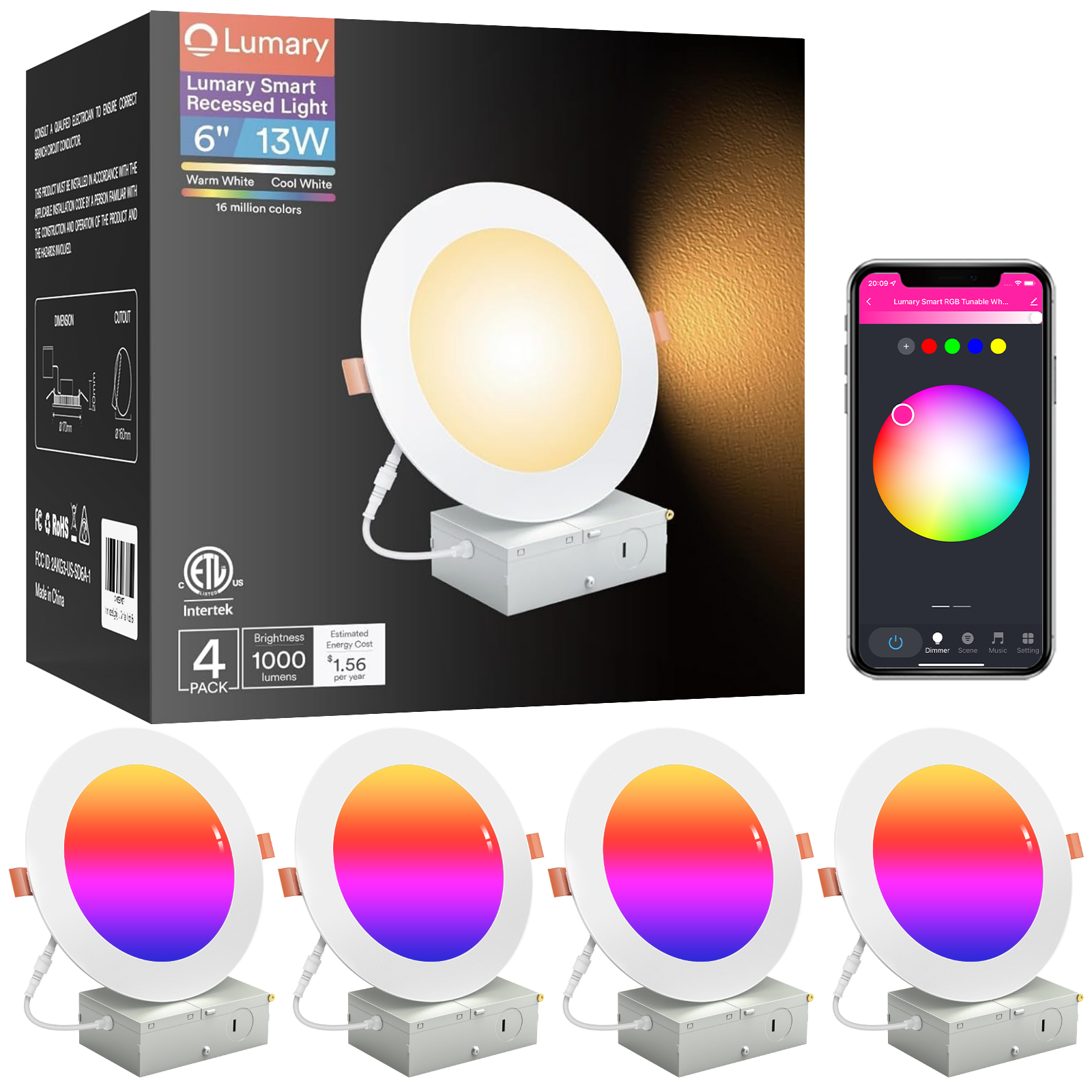
For recessed lighting specifically, the fixture count follows directly from the total lumen target and the per-fixture output. A common 6-inch LED recessed light gives off about 800 to 1,200 lumens. To find how many lights you need, divide your total lumen target by the lumens of one fixture. A 200-square-foot living room at 20 lumens per square foot needs 4,000 lumens total. At 1,000 lumens per 6-inch fixture, that is four fixtures. A 150-square-foot bedroom at 15 lumens per square foot needs 2,250 lumens, or approximately three 6-inch fixtures at 1,000 lumens each, or three 4-inch fixtures at 780 lumens with supplemental task lighting for reading. Homelighterinc
Fixture spacing is the second half of the layout calculation. The formula divides ceiling height by two to get optimal spacing distance. Wall placement matters more than most guides admit — position lights 2 to 3 feet from walls to prevent harsh shadows and create even light distribution across surfaces. At a standard 8-foot ceiling, fixtures are spaced 4 feet apart with the first fixture row positioned 2 feet from the nearest wall. The standard recommendation is 1 recessed light per 20 to 30 square feet for general lighting, with spacing of 4 to 6 feet apart for 8-foot ceilings and 5 to 7 feet apart for 9-foot ceilings. UplightCdcalculators
Color temperature is the third specification that affects how a room feels at the correct lumen level. Color temperature affects room atmosphere dramatically — 2700K creates warm, cozy environments for bedrooms and living rooms, while 4000K provides crisp, focused light for kitchens and bathrooms. A fixture capable of adjusting color temperature across that range — from warm amber through cool daylight — means the same installed light serves a bedroom's evening ambient needs and a home office's daytime task needs without separate fixtures or compromised performance at either end. Uplight
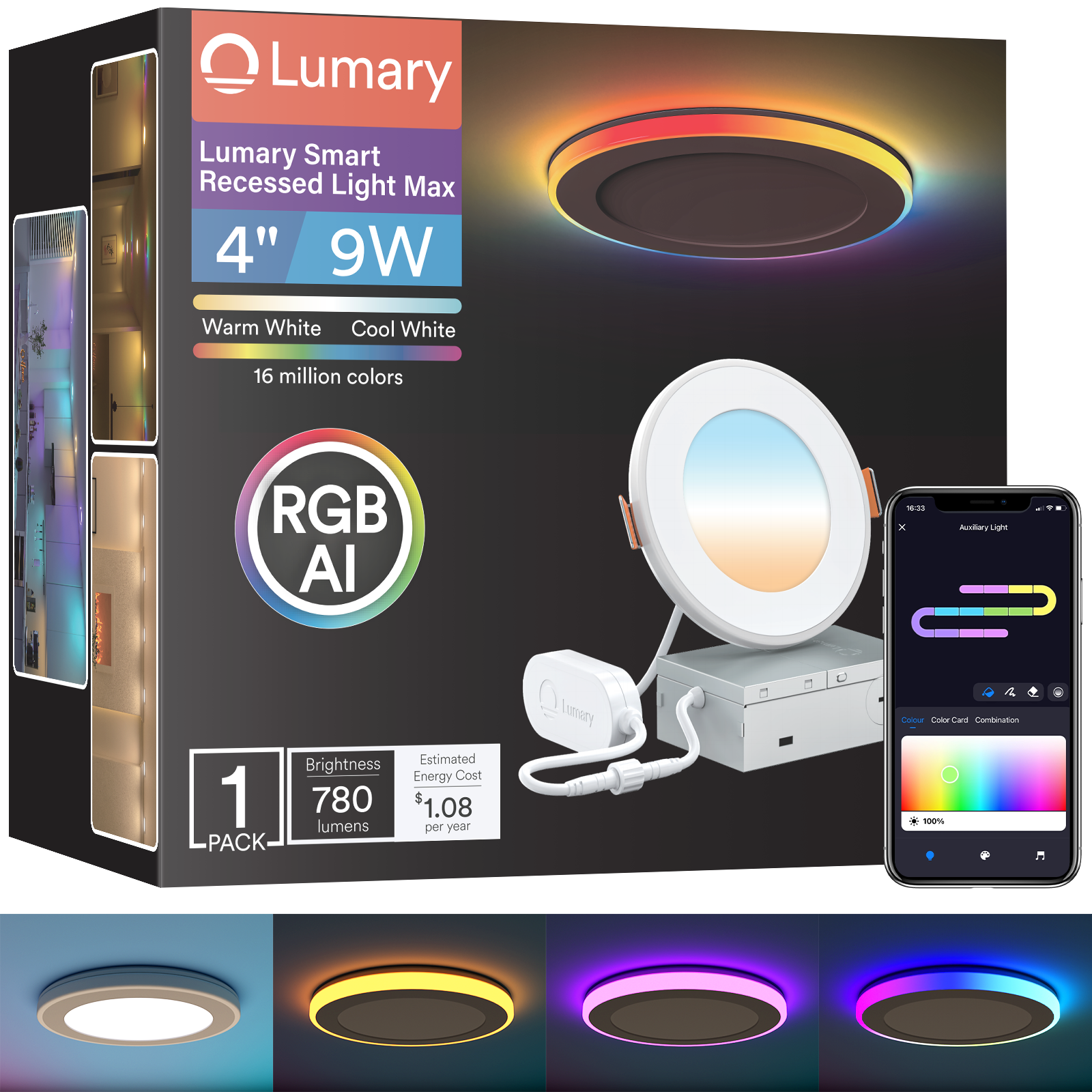
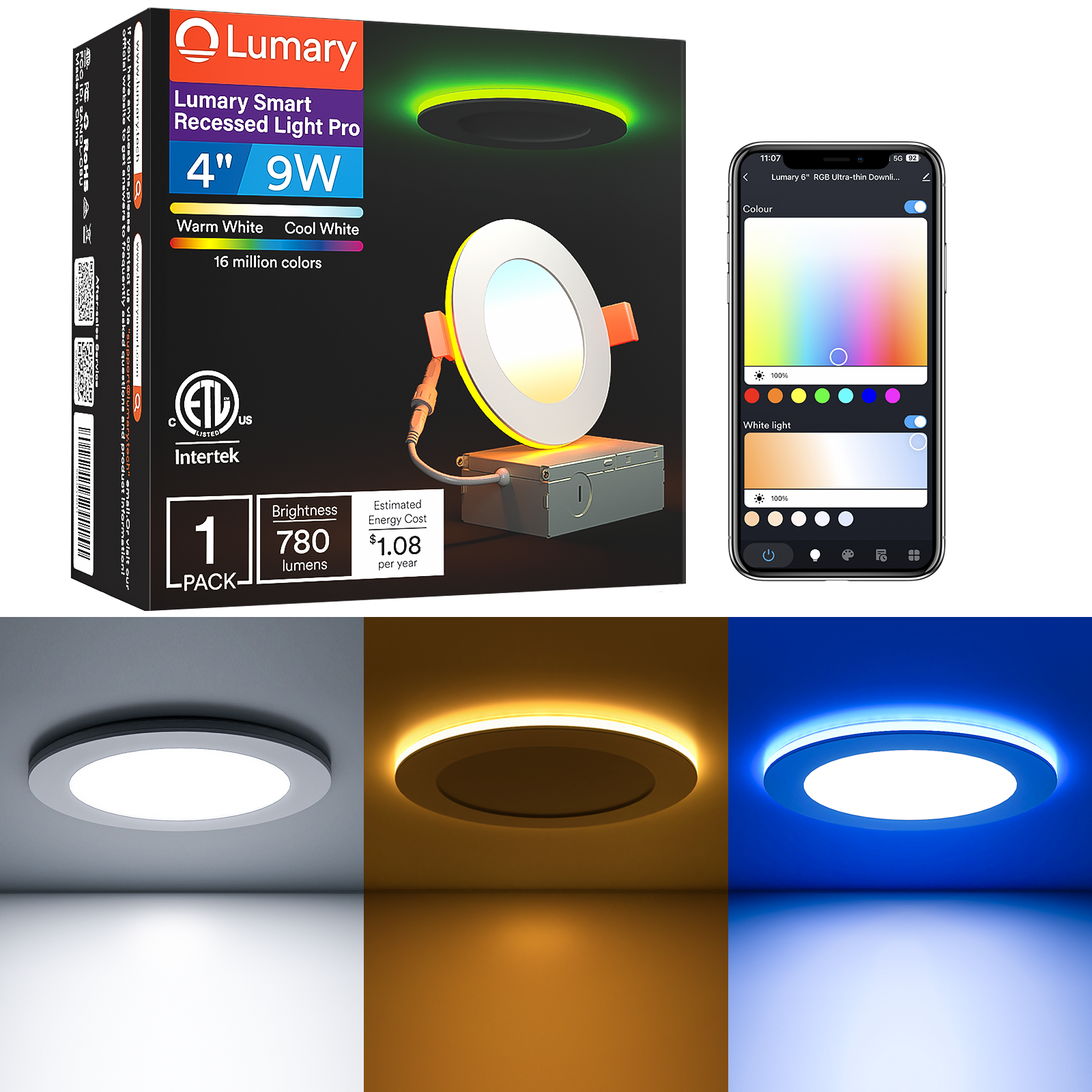
What the IES lumen formula and standard recessed lighting guides do not address is the functional dimension that most conventional recessed downlights exclude entirely: ambient and decorative lighting. A standard recessed downlight is a one-mode fixture — it provides functional downward illumination when switched on and nothing when switched off. A room lit exclusively by recessed downlights has functional illumination but no ambient layer, no decorative color capability, and no gentle nighttime lighting that exists between full brightness and total darkness. The Lumary Smart RGBAI Recessed Light with Gradient Auxiliary Night Light addresses this gap by combining a fully functional downlight — producing 780, 1,000, or 1,400 lumens depending on the 4-, 6-, or 8-inch size selected — with a gradient auxiliary ring light, a dedicated nightlight mode, and RGBAI multi-color capability in a single ceiling-mounted fixture.
Product Recommendation Analysis
The Lumary Smart RGBAI Recessed Light with Gradient Auxiliary Night Light is available in three sizes — 4 inch at 9W and 780 lumens, 6 inch at 12W and 1,000 lumens, and 8 inch at 18W and 1,400 lumens — in both single-unit and multi-pack configurations from 4 to 24 units. Each fixture operates in four distinct lighting modes from a single ceiling-mounted installation point: Downlight Mode produces the CCT-adjustable white illumination (2700K to 6500K) that serves as the room's functional ambient layer; RGBAI Gradient Mode activates 12 individually controlled segments across the fixture's auxiliary ring for flowing multi-color gradient effects; RGB Mode produces a single saturated color from the auxiliary ring for accent and atmosphere applications; and Nightlight Mode produces a soft, low-intensity, non-glare glow from the auxiliary ring appropriate for nighttime navigation without activating the main downlight.
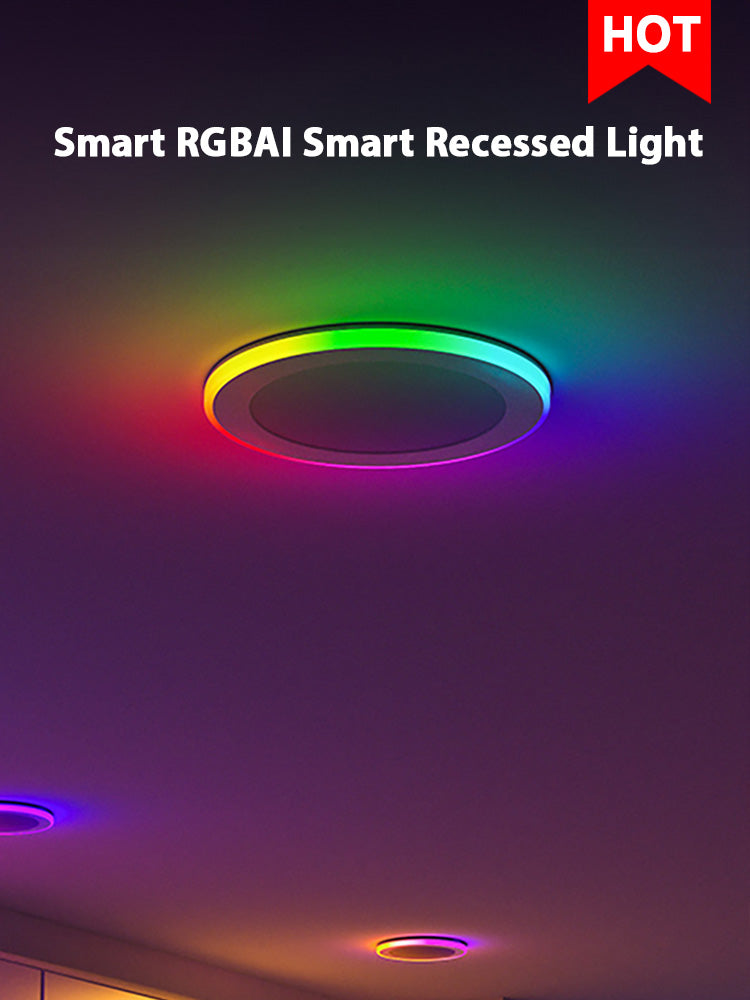
The RGBAIWW LED architecture — covering Red, Green, Blue, AI-enhanced color, Ice White, and Warm White channels — produces 16 million color combinations through the RGBAI technology, with 50 preset scenes accessible through the Lumary app for occasions ranging from holiday gatherings to romantic dinners to productive work sessions. The auxiliary ring's 12 individually addressable segments allow each segment to display a different color simultaneously, enabling flowing gradient effects that a single-zone RGB downlight cannot produce. Smart control operates through the Lumary app over 2.4GHz Wi-Fi, with native Amazon Alexa, Google Assistant, and Siri voice integration, plus group control for coordinating multiple fixtures across a room or a whole home. Full specifications and pricing across all sizes and pack configurations are available on the Lumary Smart RGBAI Recessed Light with Gradient Auxiliary Night Light product page.
Technical Specification Table
| Specification | Lumary Smart RGBAI Recessed Light with Gradient Auxiliary Night Light US-SD4E / US-SD6E / L-SD8E |
|---|---|
| Model designation | US-SD4E-1/4 (4"), US-SD6E-1/4 (6"), L-SD8E1/4 (8") |
| Available sizes | 4 inch / 6 inch / 8 inch |
| Wattage | 9W (4") / 12W (6") / 18W (8") |
| Brightness | 780 lm (4") / 1,000 lm (6") / 1,400 lm (8") |
| Room coverage guidance (20 lm/sqft ambient) | 39 sqft/fixture (4") / 50 sqft/fixture (6") / 70 sqft/fixture (8") |
| Fixture count for 150 sqft bedroom (15 lm/sqft) | ~3 fixtures (6") / 4 fixtures (4") / 2 fixtures (8") |
| Fixture count for 200 sqft living room (20 lm/sqft) | 4 fixtures (6") / 6 fixtures (4") / 3 fixtures (8") |
| Color temperature | 2700K–6500K, adjustable via app |
| LED technology | RGBAIWW — R, G, B, AI Color, Ice White, Warm White |
| Color range | 16 million colors |
| Auxiliary ring segments | 12 individually addressable segments |
| Lighting modes | 4: RGBAI Gradient / RGB / Nightlight / Downlight |
| Preset scenes | 50 — holiday, party, romantic, and functional categories |
| Smart control | Lumary app (2.4GHz Wi-Fi), Alexa, Google Assistant, Siri |
| Dimmer switch compatibility | Not compatible — use standard on/off switch only |
| Group control | Yes — whole-room or whole-home coordination |
| Timing function | Yes — app-scheduled automation |
| Available pack sizes | 1, 4, 8, 12, 16, 24 units |
| Pricing | From $49.99 (4" / 1 pc) to $229.99 (8" / 4 pcs) |
Recessed Lighting Specification Framework: Where Standard Downlights Fall Short and What This Fixture Adds
The table below maps the key criteria that determine whether a recessed lighting installation fully serves a room's illumination needs against the specific capabilities of the Lumary RGBAI Recessed Light that go beyond standard smart downlight offerings.
| Specification Criterion | Standard Smart Recessed Downlight | Lumary Smart RGBAI Recessed Light with Gradient Auxiliary | User Experience Difference |
|---|---|---|---|
| Functional lumen output | Typically 600–900 lumens for 6-inch; meets ambient targets for medium rooms | 1,000 lumens (6") and 1,400 lumens (8") — at the high end of the standard range; same room requires fewer fixtures for equivalent total lumens | Fewer fixtures to cover the same square footage; lower installation cost per equivalent lumen output |
| Color temperature range | 2700K–6500K in most smart versions; covers standard warm-to-daylight range | 2700K–6500K in Downlight Mode; full RGBAIWW spectrum in color modes | Same CCT range for functional use; substantially more color versatility for ambient and decorative use |
| Nighttime lighting capability | Off or full downlight — no middle state between complete darkness and full ambient output | Dedicated Nightlight Mode: soft auxiliary ring output for gentle, non-glare nighttime illumination | Navigate spaces at night without activating full overhead brightness; appropriate for bedrooms and corridors |
| Decorative and accent capability | Fixed white downlight output — no color, no gradient, no ambient decorative function | RGBAI Gradient Mode with 12 individually addressable segments; RGB Mode for solid accent color; 50 preset scenes | Single fixture serves functional, ambient, decorative, and nighttime roles that would otherwise require separate fixture types |
| Gradient and multi-color capability | None — the fixture changes color as a single zone | 12 individually addressable segments enable simultaneously displayed multiple colors and flowing gradients within one fixture | Party, holiday, and entertainment lighting achievable without separate decorative fixtures or smart bulb retrofits |
| Smart control depth | App, Alexa, Google Home — standard smart light functions | Same platforms plus Siri; group control, timing, 50 preset scenes, multi-mode switching via app or voice | Equivalent smart platform integration with broader mode selection covering functional and decorative use cases |
| Fixture count scalability | Fixed single mode — adding more fixtures only increases lumen output | Each additional fixture adds both lumen coverage AND a separate decorative ring segment; large-room installations create coordinated gradient arrays across all fixtures | A 6-fixture living room installation creates six coordinated RGBAI rings that can display synchronized flowing gradient effects across the full room ceiling |
Competitive Landscape
The smart recessed downlight category includes several brands whose products compete across portions of the functional specification that the Lumary RGBAI fixture addresses.
Govee's smart ceiling light and recessed downlight products leverage the Govee Home app's entertainment scene infrastructure, with RGBIC addressable technology in some panel formats. Govee's recessed downlight lineup provides standard white ambient function alongside Govee Home ecosystem scene coordination, appealing to buyers already invested in Govee's broader smart lighting product family.
Philips Hue's smart retrofit and recessed downlight products operate within the Hue Bridge ecosystem with Matter and Zigbee protocol support. Hue's white and color ambiance downlights produce color output alongside tunable white in a standard recessed format, integrated into the Hue scene and entertainment sync ecosystem. The Hue ecosystem's protocol depth appeals to buyers whose smart home spans multiple platforms requiring Matter interoperability.
WiZ under Signify offers smart recessed downlights with tunable white and 2.4GHz direct Wi-Fi at accessible price points, targeting buyers who want straightforward smart ambient ceiling lighting without the full RGBAI decorative capability or the auxiliary gradient ring that differentiates the Lumary fixture.
Kasa by TP-Link applies its networking reliability to smart recessed downlights with standard tunable white and 2.4GHz connectivity, integrating with the Kasa smart home ecosystem of plugs, cameras, and switches. Kasa's emphasis on connectivity reliability and ecosystem breadth appeals to buyers who already use Kasa networking products.
Eufy's smart recessed downlight products target buyers who want simplified smart setup alongside potential integration with Eufy's security camera ecosystem, with tunable white output and app-based control at competitive price points.
Within this competitive field, the RGBAI smart downlight from Lumary is positioned at the intersection of functional downlight performance — up to 1,400 lumens from the 8-inch unit — and decorative versatility that no standard recessed downlight provides: 12-segment individually addressable auxiliary gradient ring, dedicated nightlight mode, 50 preset scenes, RGBAIWW full-spectrum color output, and three size options (4", 6", 8") that cover every room-specific lumen requirement from compact bedrooms to open-plan living areas.
Application Scenarios
Living Room Installation: Calculating Fixture Count and Discovering the Gradient Bonus
A standard 14×16-foot living room at 224 square feet requires approximately 4,480 lumens at 20 lumens per square foot for comfortable general ambient lighting. At 1,000 lumens per 6-inch fixture, that is roughly four to five fixtures — a standard planning number that is consistent with the spacing formula that divides ceiling height by two to get optimal fixture separation, placing lights 2 to 3 feet from walls for even distribution. At 8-foot ceiling height, four to five fixtures spaced approximately 4 feet apart in a 2×2 or 2×3 grid produce even ambient coverage without dark corners or central over-brightness. Uplight
What that standard calculation does not account for is the visual dimension that four to five Lumary RGBAI recessed lights with gradient auxiliary add beyond the lumen count: four independently addressable gradient rings at the ceiling, each with 12 individually controlled color segments, coordinated through the Lumary app's group function into a synchronized ceiling light array. In downlight mode, the installation meets the functional ambient brief exactly. In RGBAI gradient mode for a holiday gathering or a family movie night, the four fixtures across the ceiling display flowing color gradients that create an immersive overhead effect that no number of standard white recessed downlights can replicate. A single Alexa command — "switch living room to party mode" — transitions all four fixtures from their white ambient state to the saved entertainment preset. A second command returns them to functional white when the party ends.
Bedroom Sizing: Three Fixtures, Nightlight Mode, and the Sleep Environment Benefit
A 12×14-foot master bedroom at 168 square feet requires approximately 2,520 lumens at 15 lumens per square foot — a comfortable ambient target for a sleeping space that is neither bright enough to cause glare nor dim enough to impair dressing and personal care activities. Three 6-inch fixtures at 1,000 lumens each totaling 3,000 lumens provide appropriate coverage with modest over-specification that allows the app's brightness dimming to calibrate the actual delivered output to the preferred level. A 12×12 ft room typically needs 3 fixtures by the lumens formula for a living room at 15 foot-candles, but spacing rules typically suggest a 2×2 or 3×2 grid of 4 to 6 fixtures for even coverage without dark corners. For a bedroom at 15 lumens per square foot with 3 fixtures, the spacing works at 4-foot intervals with the outermost fixtures 2 feet from the walls. Homeprojectcalculator
The nightlight mode is where the bedroom application distinguishes itself from any standard recessed downlight installation. A bedroom at night has two lighting states that standard recessed fixtures cannot provide simultaneously: full off (complete darkness) and full on (full ambient brightness). The Lumary fixture's nightlight mode adds a third state — a soft, non-glare auxiliary ring glow that provides enough illumination for nighttime navigation to the bathroom, locating a water glass, or reading briefly without activating the main 1,000-lumen downlight. Activating nightlight mode requires a quick double-flick of the wall switch — a gesture that verified buyers describe as intuitive and practically useful for nighttime bedroom use without reaching for a phone. The RGBAI capability adds the option of a warm amber nightlight color that minimizes blue-wavelength output in the hours before sleep, further supporting the transition to sleep that bright white overhead lighting disrupts.
Kitchen Task Lighting: Eight-Inch Fixtures for High-Lumen Task Performance
A general rule is 20 lumens per square foot for ambient lighting, and 50 lumens per square foot for task lighting areas. A 150-square-foot kitchen at 40 lumens per square foot for task lighting needs 6,000 lumens total — a figure that translates to approximately six 8-inch Lumary fixtures at 1,400 lumens each, or eight 6-inch fixtures at 1,000 lumens each, depending on the layout preference and the balance between ambient and dedicated task zones. The National Kitchen and Bath Association recommends 50 lumens per square foot for prep areas, which means a standard 10×12 kitchen needs approximately 12 to 15 recessed fixtures at standard 600-lumen output. The Lumary 8-inch at 1,400 lumens per fixture reduces that fixture count to 6 to 7 for equivalent total output — a meaningful simplification of both installation labor and ceiling penetration count. XHLUXUplight
At 6500K in downlight mode, the smart recessed light provides the cool white output that best supports visual accuracy for food preparation tasks — the color temperature at which cutting board surfaces, ingredient colors, and stovetop doneness are rendered most accurately. When the kitchen transitions from active cooking to casual family gathering, an app scene change or Alexa command shifts the same fixtures from 6500K task white to a warm 2700K ambient setting at 60% brightness, converting the kitchen's lighting character from focused work environment to relaxed social space from the same installed fixture array.
Home Theater and Game Room: RGBAI Gradient as Immersive Atmosphere Infrastructure
A home theater or dedicated game room is the residential space where the functional lumen calculation is the least relevant to the room's actual lighting objective, because the primary illumination in these spaces typically comes from the screen rather than the ceiling. The ceiling lighting's role in a home theater or game room is bias lighting — the ambient glow surrounding the screen that reduces the perceived contrast between the bright screen and the dark ceiling, reducing eye fatigue over extended viewing sessions — and atmosphere creation for gaming and social gaming contexts.
The RGBAI gradient mode of the 4-in-1 smart recessed light is purpose-built for this application. Two to four fixtures installed in a grid above the gaming or viewing position display flowing, audio-reactive color gradients across their 12-segment auxiliary rings in response to the music sync feature — synchronized to game soundtracks, film scores, or event audio through the Lumary app's microphone input. The main downlight remains off in entertainment mode, so the room's brightness is determined entirely by the screen and the ambient ring output, creating the controlled low-ambient environment that home theater designers recommend without requiring separate bias lighting strips behind the screen or under furniture. Verified buyers specifically highlight the game room application: "The main light has tons of different color tones and brightness levels and the ring around the light has LEDs that can be separately controlled and customized through the app — the ring can be customized to be multiple different colors at one time which is really cool."
Hallway and Corridor: Small-Room Calculations Where the 4-Inch Format Excels
Hallways and corridors are the residential spaces where the lumen-per-square-foot calculation produces the most precise and useful result, because hallways have the simplest usage profile — navigation — and the most constrained ceiling geometry. A standard spacing rule is distance between lights equal to ceiling height divided by two; for 8-foot ceilings, a 4-foot spacing center-to-center, with wall distance equal to half the spacing. A 4-foot-wide by 20-foot-long hallway at 80 square feet, at 10 lumens per square foot for navigation-level ambient output, needs 800 lumens total. A single 4-inch Lumary fixture at 780 lumens placed at the center of the hallway's length provides equivalent total output for this minimal-requirement application, with the nightlight mode offering a second operating state — a soft ring glow for overnight navigation — that makes a hallway with one fixture serve two practical functions without any additional installed hardware. Kooihaus
In homes where the hallway connects bedrooms and is likely to be transited during sleep hours, the nightlight mode activated by a double-switch gesture converts the hallway from a daytime navigation space (full downlight mode at 2700K) to a nighttime navigation aid (soft auxiliary ring glow) without any app interaction. This behavior replaces dedicated plug-in night lights in hallway outlets or separate smart plug automations with a function built into the installed ceiling fixture.
Editorial Assessment
The lumen calculation for recessed ceiling lighting resolves through a straightforward formula: room square footage multiplied by the IES-recommended lumens per square foot for that room's function, divided by the per-fixture lumen output to produce the fixture count, then confirmed against the ceiling-height-based spacing formula to verify even distribution. For most standard residential rooms at 8-foot ceiling height, the Lumary Smart RGBAI Recessed Light with Gradient Auxiliary Night Light at 1,000 lumens per 6-inch unit or 1,400 lumens per 8-inch unit meets the IES ambient target with a lower fixture count than the 600-to-900-lumen standard that most recessed lighting guides assume.
What the lumen calculation alone does not capture is the four-mode versatility that distinguishes this fixture from a standard recessed downlight: functional white illumination for ambient and task use in Downlight Mode, soft auxiliary nightlight for nighttime navigation, single-color accent and atmosphere in RGB Mode, and flowing 12-segment gradient color in RGBAI Gradient Mode — all from one ceiling-mounted installation point per fixture. The Lumary app's group control ensures that a room with four or six installed fixtures behaves as a coordinated system for all four modes, transitioning from functional task lighting to holiday gradient display with a single scene change rather than per-fixture manual adjustment.
For buyers who want to accurately size a recessed lighting installation using the correct lumen formula, and who want those installed fixtures to serve more than one lighting function without additional fixtures or retrofits, the Lumary Smart RGBAI Recessed Light with Gradient Auxiliary Night Light covers both requirements across three size options matched to different room scales.
Frequently Asked Questions
How do I calculate the number of Lumary RGBAI recessed lights I need for my specific room?
Start with room square footage — multiply the room's length by its width. Then multiply by the recommended lumens per square foot for that room's primary function: 10 to 20 lumens per square foot for bedrooms and living rooms at ambient levels, 30 to 50 for kitchens and task areas. Divide the total lumen target by the per-fixture output of your chosen Lumary size (780 for 4-inch, 1,000 for 6-inch, 1,400 for 8-inch). The result is your fixture count. Verify the layout using the spacing formula: fixtures spaced at ceiling height divided by two (4 feet apart at 8-foot ceilings), with the nearest fixtures 2 feet from the walls. Adjust slightly if the formula-based fixture count and the spacing-formula-based layout produce different numbers — in most cases the spacing formula produces one to two additional fixtures that account for edge-of-room coverage the lumen formula alone underestimates.
Can the main downlight and the auxiliary gradient ring be activated simultaneously?
No — the product specification notes that the main light and auxiliary lights cannot be on simultaneously. The fixture operates in one mode at a time: Downlight Mode (main CCT white light only), RGBAI Gradient Mode (auxiliary ring 12-segment gradient only), RGB Mode (auxiliary ring single color only), or Nightlight Mode (auxiliary ring soft glow only). This sequential operation ensures that each mode produces a clean, distinct visual output rather than a combined ambiguous state between functional and decorative lighting. The mode transitions are controlled through the Lumary app or via the wall switch gesture (a quick double-flick activates the auxiliary nightlight mode from the default off state).
What is the lumen output of the fixture in nightlight mode compared to downlight mode?
The nightlight mode uses the auxiliary ring LEDs at a reduced drive current appropriate for nighttime non-glare navigation — the output is intentionally soft and significantly lower than the main downlight's rated 780, 1,000, or 1,400 lumens depending on size. The nightlight mode is calibrated for the 1 to 10 lumen range that provides visible boundary illumination without the melatonin-suppressing effect of higher-output white light at night. It is not designed to replace functional ambient illumination — it is a supplemental nighttime navigation feature that eliminates the need for a separate plug-in night light in the same room.
Why is this recessed light not compatible with dimmer switches, and how is brightness control handled instead?
The fixture's integrated smart driver regulates brightness through app-based digital control rather than through the voltage reduction that a triac dimmer switch applies to line voltage. A dimmer switch that reduces the supply voltage to the fixture interferes with the driver's input requirements and can cause flickering, incorrect color output, or premature driver failure. The Lumary app provides 1% to 100% brightness adjustment through the driver's own dimming circuit — which is more precise and produces lower flicker than triac dimming — accessible through any smartphone, voice command, or app schedule. The wall switch should be a standard on/off switch that delivers full line voltage to the fixture at all times, with all brightness adjustment handled through the app or voice assistant layer.
When sizing a recessed lighting installation, should I use 4-inch, 6-inch, or 8-inch fixtures, and does size affect the gradient auxiliary ring's visual scale?
Size selection should be guided primarily by the lumen requirement and room scale. The 4-inch at 780 lumens suits compact rooms under 120 square feet and hallways where a smaller ceiling footprint is aesthetically preferred. The 6-inch at 1,000 lumens is the correct choice for most standard residential rooms from 100 to 250 square feet — it is the most versatile size across room types and the format that matches the IES ambient target in the typical fixture count range of three to six per room. The 8-inch at 1,400 lumens suits larger open-plan spaces, rooms with ceilings above 10 feet that need higher per-fixture output to compensate for the greater source-to-surface distance, and kitchen task zones where maximum per-fixture lumen density reduces the total fixture count. The gradient auxiliary ring's visual scale increases proportionally with fixture size — the 8-inch ring produces a more prominent ambient glow effect than the 4-inch ring at equivalent drive current — which is a secondary consideration that favors larger sizes in entertainment-oriented rooms where the RGBAI gradient effect is a primary use case.

