




Choosing retrofit recessed lights for different rooms requires more than matching the diameter of an existing ceiling can. The right product must fit the housing, deliver enough useful light, provide an appropriate color temperature, control glare, meet the room’s moisture conditions, and work with the switches and smart-home system already in the house.
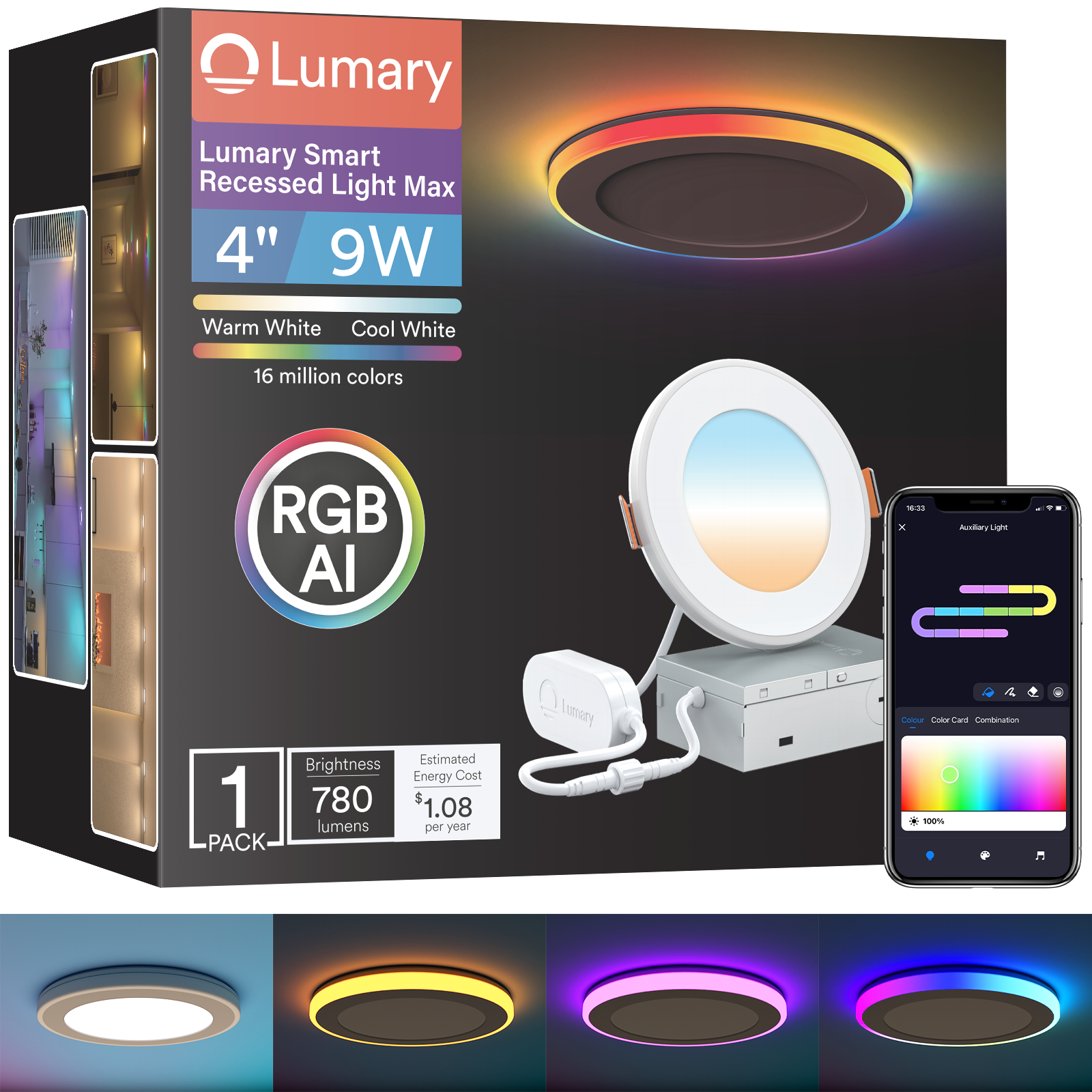
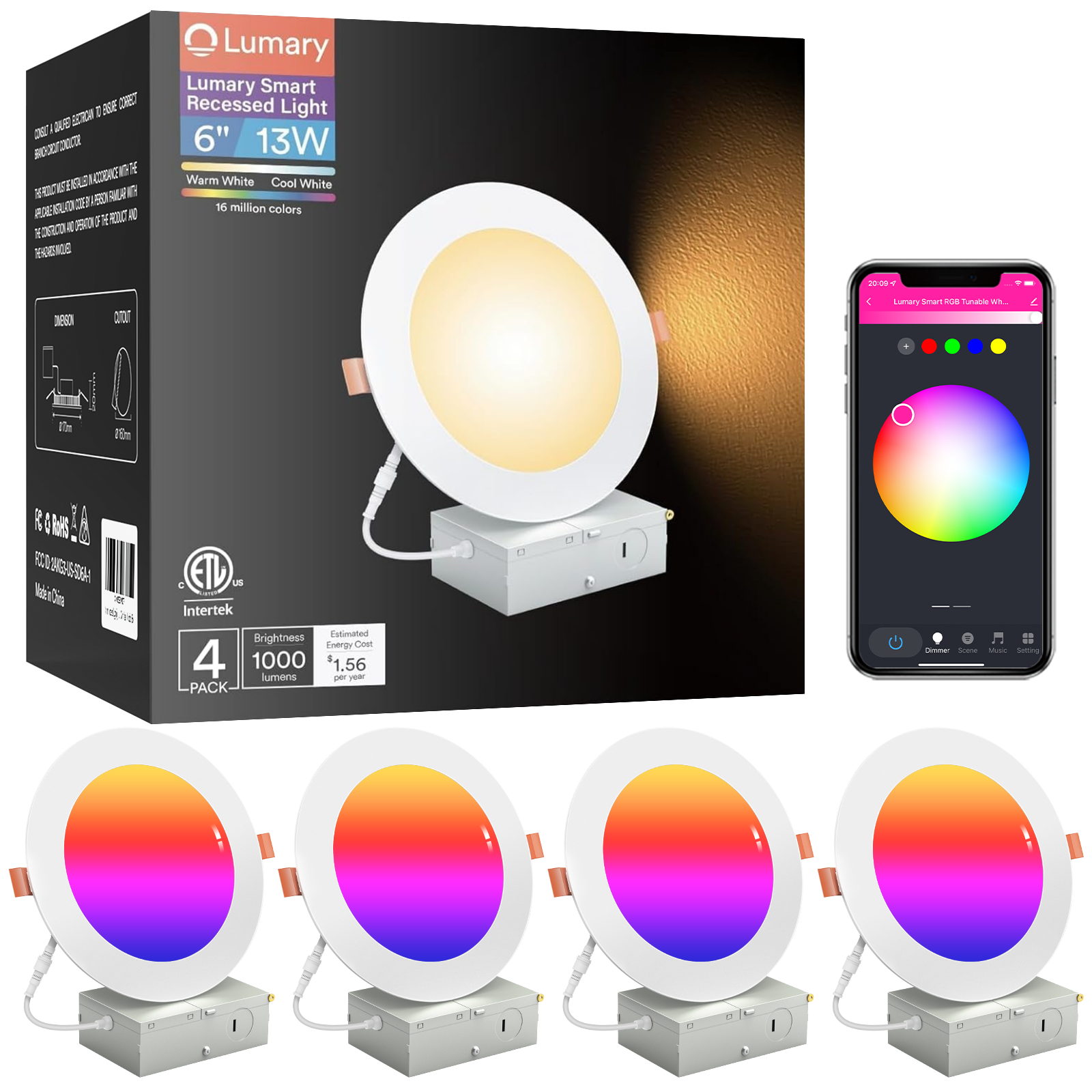
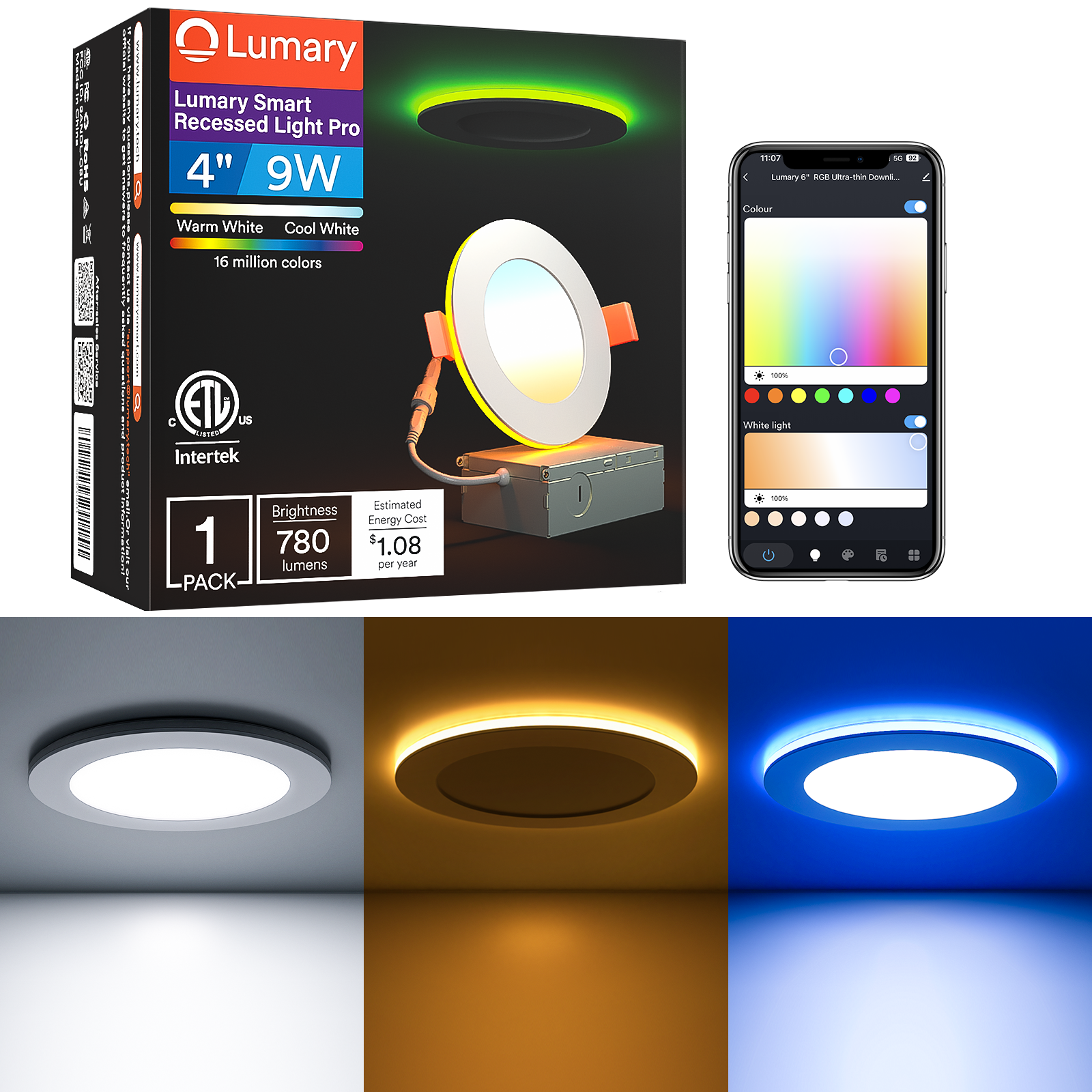
For an existing 6-inch recessed-can installation, the Lumary Smart Retrofit LED Recessed Lighting Pro 6 Inch is a flexible whole-home option. Each 13W fixture produces up to 1,000 lumens, offers adjustable 2700K–6500K white light, and adds an independently styled RGBAI accent ring with 16 million colors and 66 preset scenes. It connects through 2.4GHz Wi-Fi and Bluetooth and supports the Lumary app, Alexa, and Google Assistant without requiring an additional hub.
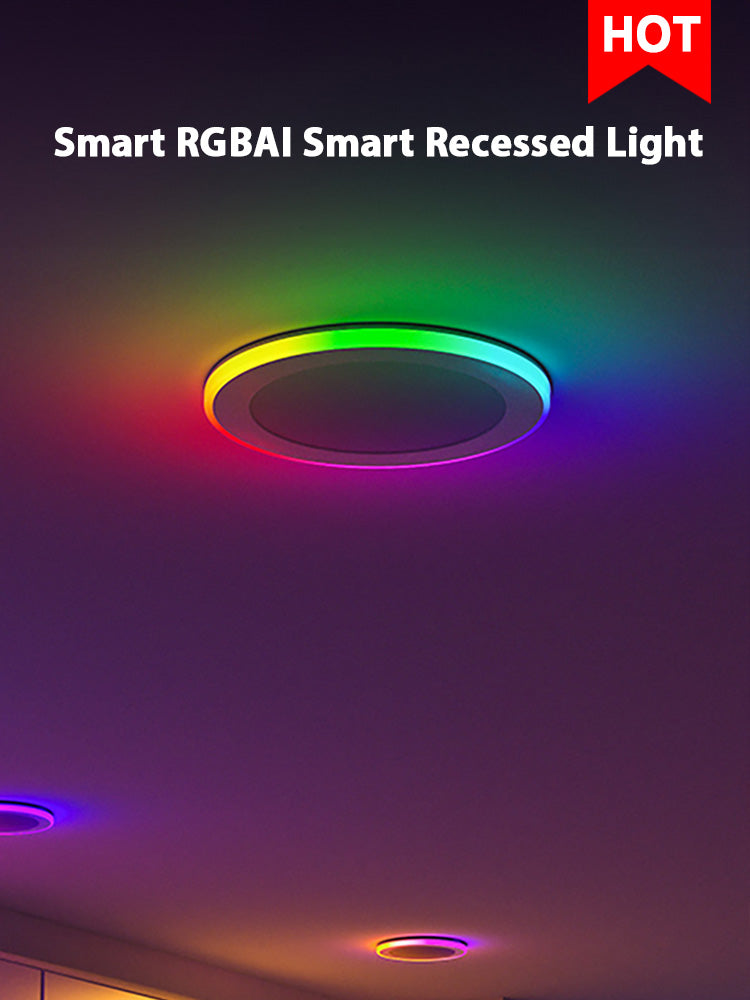
The main white downlight and the color-changing trim ring serve different purposes. The 1,000-lumen center light provides functional room illumination, while the dimmer accent ring adds decorative color, low-level ambiance, or visual separation between zones. The ring should not be counted as a substitute for the fixture’s primary white-light output when calculating how many lights a room needs.
A practical room-by-room starting point is:
| Room | Recommended Starting White | Main Lighting Priority | How the Accent Ring Can Be Used |
|---|---|---|---|
| Living room | 2700K–3500K | Comfortable, layered ambient light | Subtle evening color or entertainment scenes |
| Bedroom | 2700K–3000K | Low-glare, dimmable warm light | Gentle nighttime ambiance |
| Kitchen | 3000K–4000K | Clear task visibility and even counter coverage | Decorative color for gatherings |
| Dining room | 2700K–3000K | Warm, flattering light around the table | Seasonal or dinner-party accents |
| Bathroom | 3000K–4000K | Accurate grooming light with damp-location suitability | Low-level accent outside wet zones |
| Home office | 3500K–5000K | Comfortable task illumination with limited screen glare | Status or focus-mode color |
| Hallway | 2700K–3500K | Consistent navigation light | Low-level night scene |
| Media or gaming room | 2700K–3500K | Controllable ambient light without screen reflections | Dynamic color for entertainment |
| Laundry or utility room | 3500K–5000K | Clear visibility and color distinction | Usually secondary to white light |
| Covered soffit | 2700K–4000K | Location-rated architectural illumination | Holiday or event color where permitted |
These are starting points, not universal rules. Dark walls, high ceilings, wide spacing, cabinetry, task locations, daylight, beam distribution, and personal preference can change the result. A good lighting plan should be tested in the actual room before every fixture is permanently installed.
Brightness should be evaluated in lumens rather than traditional bulb wattage. ENERGY STAR defines lumens as the measurement of light output, while watts describe electrical consumption. A 13W LED fixture can therefore produce significantly more useful light than its wattage might suggest to someone accustomed to incandescent bulbs.
The 1,000-lumen output of the Lumary retrofit is above ENERGY STAR’s current minimum light-output criterion for a downlight with an aperture larger than 4.5 inches. That does not determine the correct fixture count, but it confirms that a 6-inch retrofit should be evaluated as a substantial general-lighting source rather than a decorative glow.

The safest buying sequence is:
-
Confirm that the ceiling contains compatible 6-inch recessed cans.
-
Inspect the socket or connector arrangement.
-
Verify housing condition, insulation contact, and ceiling construction.
-
Determine whether the location is dry, damp, or wet.
-
Calculate the required light level by room function.
-
Select the preferred white-light range.
-
Plan spacing around furniture and work surfaces.
-
Confirm switch and smart-control compatibility.
-
Test one fixture before converting the entire home.
-
Use a qualified electrician when wiring, housing condition, or local-code compliance is uncertain.
Product Recommendation Analysis
The Lumary 6-inch smart retrofit downlight is designed to upgrade an existing recessed can rather than require a new canless opening and junction-box layout.
The fixture includes an E26 screw-base adapter and TP24 connector, along with mounting hardware and the retrofit light module. Installation uses the existing 6-inch housing: the adapter connects to the existing socket or compatible connection, and spring hardware holds the new trim in place.
This makes the product particularly relevant to older American homes with conventional recessed cans. Instead of replacing only the incandescent or LED bulb, the homeowner replaces the visible bulb-and-trim combination with an integrated smart retrofit module.
The fixture’s primary specifications are:
-
13W power consumption
-
Up to 1,000 lumens
-
120V operation
-
Adjustable 2700K–6500K white light
-
RGBAI color-changing accent ring
-
16 million colors
-
66 preset scenes
-
Stepless app-based dimming
-
2.4GHz Wi-Fi and Bluetooth connectivity
-
Alexa and Google Assistant support
-
Group control, schedules, music modes, and scenes
-
E26 and TP24 installation options
-
ETL listing
-
IC-rated and airtight construction
-
Suitability for listed damp-location applications
The dual-lighting design is the principal differentiator. A standard retrofit downlight generally provides only white illumination or full-surface RGB color. Lumary separates the functional center downlight from the decorative trim ring.
This separation allows a homeowner to keep the room’s main white light visually conventional while adding color around the fixture. In a kitchen, the center light can remain at 3500K while the ring supplies restrained holiday color. In a bedroom, the primary light can turn off while the trim ring provides low-level ambiance. In a gaming room, the ring can coordinate with entertainment colors without forcing the whole ceiling to become saturated RGB.
The 2700K–6500K range also prevents the homeowner from locking each room into one fixed shade of white. The same physical fixture can use warmer light for evening relaxation and cooler light when visibility or alertness is more important.
Color temperature should not be confused with brightness. Changing from 2700K to 5000K changes the appearance of the white light, but it does not automatically mean the room receives more lumens. Cooler light can appear brighter to some users, yet the actual output and distribution remain separate specifications.
Color quality matters as well. The U.S. Department of Energy generally recommends at least 80 CRI for interior lighting and describes 90 CRI or higher as excellent color fidelity. CRI is not the only color-quality metric, but it remains a useful initial check when selecting lighting for skin tones, food, artwork, clothing, and interior finishes.
The Lumary product page does not currently publish a CRI value in its primary specification table. Buyers for color-critical kitchens, bathrooms, dressing areas, studios, or art displays should request the current photometric or certification documentation if a specific CRI or R9 threshold is required.
Smart control also changes the switch requirement. Lumary instructs users to supply the lights through a normal on/off switch rather than a traditional wall dimmer. Brightness is adjusted electronically through the supported smart controls. The lights should remain powered when schedules, app control, or voice control are expected to work.
Installing a conventional phase-cut dimmer upstream of a smart retrofit can cause flickering, buzzing, unreliable startup, reduced dimming range, or loss of network availability. Existing dimmers should be identified before purchase and replaced with an appropriate standard switch by a qualified person when required.
Technical Specification Table
| Specification | Lumary Smart Retrofit LED Recessed Lighting Pro 6 Inch |
|---|---|
| Model numbers | L-DL6E1 for 1-pack / L-DL6E4 for multi-pack configurations |
| Fixture category | Smart LED retrofit recessed downlight |
| Compatible housing | Existing 6-inch recessed can |
| Input voltage | 120V |
| Power | 13W |
| Main-light output | Up to 1,000 lumens |
| White color-temperature range | 2700K–6500K |
| Color technology | RGBAICW |
| Accent lighting | Color-changing baffle trim ring |
| Available colors | Approximately 16 million |
| Preset scenes | 66 |
| Dimming | Stepless smart dimming |
| Wireless connection | 2.4GHz Wi-Fi and Bluetooth |
| Smart-home compatibility | Lumary app, Alexa, Google Assistant |
| Hub requirement | No separate hub required for standard Wi-Fi/Bluetooth control |
| Additional functions | Group control, schedules, scenes, music mode |
| Included connections | E26 screw-base adapter and TP24 connector |
| Included hardware | Mounting hardware, adapter, connector, retrofit module |
| Product dimensions | 7.2 × 7.2 × 1.5 inches |
| Trim color | White |
| Construction | Plastic |
| Safety and installation claims | ETL listed, airtight, IC rated |
| Location suitability | Product page identifies damp-place applications |
| Wall-control requirement | Use a normal on/off switch; do not use a conventional dimmer switch |
How Much Light Does Each Room Need?
The number of retrofit lights cannot be determined from room size alone. A room’s function establishes the target illuminance, while ceiling height, fixture distribution, wall reflectance, furnishings, and other light sources determine how many emitted lumens are needed to achieve it.
Illuminance is measured in footcandles in the United States. One footcandle equals one lumen per square foot at the illuminated surface. The Department of Energy notes that target illuminance is achieved through the combination of lumen output, fixture spacing, and light distribution.
The following values are useful residential planning ranges rather than building-code requirements:
| Room or Task | Illustrative Ambient Range | Illustrative Task Range | Planning Notes |
|---|---|---|---|
| Living room | 10–20 fc | 30–50 fc for reading | Combine downlights with lamps and wall lighting |
| Bedroom | 10–20 fc | 30–50 fc at reading or dressing areas | Avoid placing a strong downlight directly over the pillow |
| Kitchen | 20–40 fc | 50–75 fc at counters and food-preparation areas | Locate lights to reduce body shadows on counters |
| Dining room | 10–20 fc | 20–30 fc on the tabletop | Coordinate recessed lights with the chandelier or pendant |
| Bathroom | 20–30 fc | 50–75 fc at the vanity | Use vertical lighting around the face when possible |
| Home office | 20–30 fc | 30–50 fc on the desk | Limit reflections in monitors |
| Hallway | 5–10 fc | Usually not applicable | Prioritize even spacing and transition comfort |
| Laundry room | 20–30 fc | 30–50 fc at sorting surfaces | Neutral or cooler white improves detail visibility |
| Media room | 5–15 fc | Low-level navigation lighting | Keep bright downlights away from the screen |
| Closet | 10–20 fc | 20–30 fc for clothing selection | Confirm required clearances and location listing |
A preliminary fixture-count formula is:
Room area × target footcandles ÷ fixture lumens = theoretical fixture count
For a more realistic estimate, include an assumed utilization factor for light that actually reaches the working plane:
Room area × target footcandles ÷ (fixture lumens × utilization factor)
For example, consider a 180-square-foot living room with an illustrative target of 15 footcandles and an assumed utilization factor of 0.70:
180 × 15 ÷ (1,000 × 0.70) = 3.86
The initial planning result is approximately four 1,000-lumen fixtures. That is not a final photometric design. Dark finishes, a high ceiling, a narrow distribution, deep cans, heavy furniture, or demanding reading tasks may require more light. Large windows and supplemental lamps may reduce the amount of recessed lighting needed.
The formula should not be used to create a ceiling filled with an excessive grid of downlights. Recessed fixtures are only one layer. Floor lamps, table lamps, undercabinet lights, pendants, wall sconces, vanity lights, and daylight often produce a more comfortable room than downlights alone.
Choosing Retrofit Recessed Lights by Room
Living Room
A living room should support conversation, television viewing, reading, cleaning, and entertaining. These activities do not need the same light level.
Start with 2700K–3000K for a warm residential atmosphere. Use 3000K–3500K if the room has cooler finishes, receives limited daylight, or connects visually to a kitchen using neutral white.
Place fixtures according to furniture and walls rather than creating a grid without context. Useful positions may include the coffee-table area, walkways, shelving, or artwork. Avoid locating a bright downlight where it reflects directly from a television.
The Lumary accent ring can provide low-output color for movie nights or events while the main 1,000-lumen white light is dimmed or turned off. For ordinary use, subtle ring colors will look more architectural than saturated, rapidly changing scenes.
Bedroom
Bedrooms usually benefit from warm 2700K–3000K white light. Cooler settings can be used temporarily for cleaning, organizing, or morning routines, but high-intensity cool light late at night may feel visually harsh.
Do not position a high-output downlight directly above the primary sleeping position unless its output can be comfortably reduced. Light in the viewer’s direct line of sight can create glare when someone is lying in bed.
Use bedside lamps or wall-mounted reading lights for focused tasks instead of expecting ceiling downlights to provide ideal reading illumination.
The smart dual-light retrofit downlight can save an evening preset with warm, dimmed main light and a separate low-level accent-ring state. A brighter morning preset can use a neutral or cooler white.
Because the lights need continuous power for schedules and app commands, household members should understand that turning off the wall switch disconnects smart control.
Kitchen
Kitchens require the most deliberate placement because people standing at counters can block light coming from behind them.
Instead of centering every light in the room, align some fixtures with the front edge of countertops or the task area so the beam reaches the work surface. Use undercabinet lighting to fill shadows beneath upper cabinets.
A starting white range of 3000K–4000K generally balances comfortable residential appearance with task visibility. Warmer 2700K settings may complement wood and traditional finishes, while 4000K can suit a bright contemporary kitchen.
The 1,000-lumen output makes the Lumary fixture suitable for substantial general lighting, but fixture count should be based on counter locations, room geometry, ceiling height, and other sources.
Community lighting discussions repeatedly show why universal spacing rules fail: kitchens with the same floor area may have different cabinet runs, islands, sinks, ceiling heights, and daylight. A recent recessed-lighting layout discussion focuses on eliminating shadows around sinks, stoves, and counters rather than merely creating a symmetrical ceiling grid. Community advice is not a substitute for a lighting plan, but it illustrates the practical problem.
The accent ring can use restrained color during parties while the center white light maintains useful visibility. Colored light should not replace accurate white task light during food preparation.

Dining Room
Dining rooms generally look most comfortable at 2700K–3000K. Warm light supports wood finishes, table settings, and relaxed evening use.
Recessed lights should complement the primary decorative fixture instead of competing with it. If the room contains a chandelier or pendant, place the downlights to illuminate surrounding walls, artwork, a buffet, or circulation areas.
A common mistake is installing one recessed light directly above every seat. This can cast strong shadows on faces. A softer layered arrangement usually looks better.
Lumary’s color ring can add seasonal accents without changing the white light on the dining surface. For Thanksgiving, an amber-toned ring can accompany warm white. For Christmas, restrained red, green, or gold accents can be used while keeping the food and faces under warm white light.
Bathroom
Bathrooms need both general ceiling light and effective facial illumination. Recessed lights above the room can provide ambient light, but vertical fixtures beside or above the mirror are usually better for grooming because they reduce under-eye and chin shadows.
A starting range of 3000K–4000K provides a clean appearance without making most residential bathrooms feel clinical. Users can select warmer light for evening bathing and cooler light for grooming.
Location rating is critical. A damp location may experience condensation, while a wet location may receive direct splashing or water contact. UL explains that wet-location and damp-location markings are distinct and should be applied according to actual exposure.
Lumary identifies the retrofit for bathroom and damp-place use. That does not automatically authorize installation directly above a shower or in another wet zone. Use it only where the exact product marking, instructions, and local electrical requirements permit. Select a wet-location-listed fixture if the installation is subject to direct water exposure.
Home Office
Home offices benefit from adjustable white because daytime work and evening use often need different visual conditions.
Start around 3500K–4000K for general work. A cooler 4500K–5000K setting may suit detail-heavy daytime tasks, while a warmer 2700K–3000K setting can make the room more comfortable after work.
Place downlights so they do not reflect from the monitor or create strong contrast behind it. The desk may need a separate task lamp even when the ceiling has ample total lumens.
The accent ring can act as a low-level status cue for focus time, video calls, or end-of-day routines, but saturated color should not distort documents or skin tones during professional calls.
Hallway and Entry
Hallways need even, predictable illumination more than high brightness. Excessively bright downlights can create uncomfortable transitions between darker bedrooms and circulation spaces at night.
A warm or neutral 2700K–3500K setting generally works well. Use consistent spacing along the walking path and avoid a bright fixture immediately above a doorway where it creates a sharp visual transition.
Schedules can reduce brightness late at night. A low-level accent-ring preset may provide orientation, but it should be tested to ensure the floor and obstacles remain visible.
Media and Gaming Room
A media room benefits from controllable layers. Bright downlights near the screen can create glare and reduce perceived contrast.
Use the main white lights for cleaning, setup, and general use. During viewing, dim or turn off the fixtures closest to the screen and use the color trim ring as restrained ambient lighting.
The RGBAI ring is useful here because the room can gain color without operating the entire 1,000-lumen downlight. Keep effects slow and brightness low enough to avoid distracting movement in peripheral vision.
Laundry and Utility Room
Laundry rooms need clear visibility for sorting clothing, treating stains, reading appliance controls, and cleaning.
A starting color temperature of 3500K–5000K can help distinguish colors and details. High color fidelity is also important because poor spectral quality can make stains or fabric shades difficult to evaluate.
The main white downlight is more important than the decorative ring in this space. Smart scheduling, grouping, and voice control may still be convenient when the user’s hands are occupied.
Covered Soffits and Transitional Areas
The product page identifies soffit and damp-location applications. Exterior or semi-exterior installation should be based on the exact location rating, housing condition, temperature limits, ceiling construction, and electrical requirements.
A fixture suitable for a covered damp soffit is not automatically suitable for a fully exposed wet ceiling. Confirm that the recessed housing, socket, wiring, and retrofit module are all appropriate for the location.
For ordinary exterior architecture, 2700K–3000K generally creates a more residential appearance than very cool white. The accent ring can add temporary holiday color without requiring separate decorative fixtures.
Retrofit Selection and Performance Table
| Key Purchasing Criterion | Common Sign of a Poor-Quality Unit | How This Lumary Retrofit Recessed Light Addresses It | Long-Term Usage / Performance Impact |
|---|---|---|---|
| Housing compatibility | Product size is listed without installation interfaces | Designed for existing 6-inch cans with E26 and TP24 connections | Reduces the need to replace intact recessed housings |
| Functional brightness | Product emphasizes RGB effects but omits usable white-light output | Publishes up to 1,000 lumens from the main light | Supports room-lighting calculations before purchase |
| Adjustable white | Fixture is locked to one color temperature | Provides 2700K–6500K tunable white | Allows one model to serve bedrooms, kitchens, offices, and utility spaces |
| Decorative lighting | Full fixture must become colored, eliminating practical white light | Separates the main white downlight from the RGBAI trim ring | Preserves functional lighting while adding ambiance |
| Smart controls | Requires an additional hub for basic operation | Uses direct 2.4GHz Wi-Fi and Bluetooth | Simplifies standard setup, though network quality still matters |
| Voice control | Voice compatibility is unclear or limited to one ecosystem | Supports Alexa and Google Assistant | Adds hands-free control in kitchens, bedrooms, and utility rooms |
| Group control | Every light must be adjusted individually | Supports grouping of the same model through the Lumary app | Makes multi-fixture rooms easier to operate consistently |
| Moisture suitability | No dry, damp, or wet-location information is provided | Product page identifies damp-place applications | Supports bathrooms and covered areas where the listed conditions apply |
| Insulation contact | Retrofit provides no IC information | Advertised as IC rated | Supports compatible insulated-ceiling applications when the complete installation complies |
| Air leakage | Large gaps allow conditioned air to escape through the ceiling | Advertised as airtight | Can reduce uncontrolled air movement when properly installed |
| Switch compatibility | Marketing implies compatibility with any wall dimmer | Explicitly instructs users to use a normal switch, not a dimmer | Reduces flicker and smart-control instability |
| Safety listing | No nationally recognized testing information is provided | Product page identifies ETL listing | Provides third-party product-safety evaluation within the listed conditions |
Spacing and Layout Guidelines
A commonly repeated residential rule suggests spacing recessed lights by approximately half the ceiling height. For an 8-foot ceiling, that would suggest roughly 4 feet between fixtures.
This should be treated only as a starting point. It ignores beam distribution, fixture lumens, room reflectance, work surfaces, furniture, and supplemental lighting.
A better layout method is:
-
Draw the room to scale.
-
Mark cabinets, counters, tables, beds, screens, and artwork.
-
Identify ambient and task-lighting zones.
-
Estimate the required illuminance for each zone.
-
Place fixtures according to where the light is needed.
-
Check spacing for visual consistency.
-
Verify distances from walls and obstacles.
-
Review ceiling joists and existing can locations.
-
Test the brightness and beam overlap.
-
Divide different functions into separate groups where practical.
In a retrofit project, existing cans limit how much the layout can change. Smart grouping and adjustable output can improve an imperfect arrangement, but they cannot physically move a badly positioned housing.
If existing lights leave countertops dark or place glare directly over a bed or screen, supplement them with another lighting layer rather than assuming higher brightness will solve the geometry.
Installation and Compatibility Checks
Before ordering a whole-home retrofit package, remove power at the appropriate electrical protection device and inspect one representative existing fixture according to safe procedures.
Confirm:
-
The can is approximately 6 inches and accepts the retrofit’s mounting method.
-
The E26 socket or TP24 connection is present and in serviceable condition.
-
The housing is securely installed.
-
There is no heat damage, corrosion, or damaged wiring.
-
The existing switch is a standard on/off switch rather than a conventional dimmer.
-
The ceiling location is dry or damp as permitted by the product.
-
The housing and ceiling assembly are compatible with the fixture’s IC and airtight claims.
-
The Wi-Fi network provides reliable 2.4GHz coverage.
-
The household understands that smart control requires continuous power.
-
Local requirements do not call for professional electrical work.
UL notes that retrofit products are evaluated for specific installation conditions and location markings. A retrofit fitting physically inside a can does not by itself confirm that the complete installation is suitable for every ceiling or moisture condition.
Fire-resistance-rated ceiling assemblies also need special attention. UL explains that a recessed penetration can affect the ceiling assembly’s fire-resistance performance unless the fixture or protective method is evaluated for that construction.
Apartments, multifamily buildings, garages beneath living space, and certain commercial-style assemblies may have additional requirements. Ask the property owner, building management, or a qualified electrician before altering a rated ceiling.
Competitive Landscape
Philips Hue Retrofit Downlight
The Philips Hue 5/6-inch retrofit downlight is a strong option for homes already built around the Hue ecosystem. Hue emphasizes coordinated lighting, accessories, and mature room-based automation.
Its principal advantage is ecosystem depth. A homeowner with Hue bulbs, switches, sensors, and a Bridge may prefer one unified platform.
Lumary’s advantage for this application is its dual-light structure: a bright adjustable-white center combined with a separate RGBAI accent ring. Buyers should compare not only ecosystem names but also white-light output, trim appearance, required bridge hardware, and whether decorative color can operate independently from the main light.
Govee Smart Recessed Lights
Govee offers 6-inch RGBWW retrofit products and newer recessed designs with secondary night-light effects. Its ecosystem is particularly strong for entertainment scenes and synchronization with other Govee products.
Current Govee collection information lists selected 6-inch retrofit models around 800 lumens. The Lumary product publishes 1,000 lumens for the main light, which can matter in kitchens, utility rooms, and larger living areas.
A fair comparison should also include retrofit-can compatibility, white-light range, ring-effect design, damp-location claims, voice ecosystem, and whether the homeowner already owns other devices from either brand.
Feit Electric Smart Retrofit Downlight
Feit offers a 6-inch Wi-Fi color-changing retrofit that fits many 5- and 6-inch housings, supports Alexa and Google control, and produces up to 1,000 lumens using 11.1W.
This is a relevant conventional smart-RGB alternative. The primary product difference is the visual architecture: Lumary separates the white main light and RGBAI trim ring, while many standard RGBW retrofits use the whole aperture as one light source.
Choose between them based on whether the room needs independent decorative edge lighting or simply one color-changing downlight.
HALO Smart and Selectable Retrofit Downlights
HALO offers several retrofit categories, including fixed or selectable-white products, Bluetooth-connected smart models, and WiZ-enabled full-color versions. The brand also publishes detailed housing-compatibility and photometric documentation for many products.
A HALO WiZ 5/6-inch smart retrofit specification lists tunable white, full color, and specific compatible housing families. This level of housing documentation can be valuable in professional or specification-driven projects.
Lumary may be more appealing when the color-changing trim ring, 1,000-lumen output, Lumary scenes, and dual-light appearance are primary priorities.
Fixed-White Retrofit Downlights
A fixed 2700K or 3000K retrofit can be the most economical option for a room that never needs smart control, adjustable white, schedules, or decorative color.
These products are simpler and may work with a compatible conventional dimmer. They can be appropriate for closets, utility spaces, rentals, or homeowners who intentionally want manual controls only.
Their limitation is inflexibility. A fixed 5000K light that feels appropriate in a laundry room may feel harsh in a bedroom, while a fixed 2700K model may not provide the visual character preferred for detailed office work.
Canless Recessed Lights
Canless fixtures are intended for locations without an existing recessed housing. They can be useful in remodels where shallow ceiling space or flexible placement matters.
They are not the direct replacement category for a house that already has serviceable 6-inch cans. Removing good housings and cutting new openings can expand the project unnecessarily.
Choose a retrofit module when the existing cans are compatible and correctly located. Choose canless fixtures when the project requires new positions, lacks cans, or has a ceiling condition better served by a listed canless system.
Application Scenarios
1. Small Bedroom With Four Existing 6-Inch Cans
Consider a 12-by-12-foot bedroom with an 8-foot ceiling and four existing cans arranged around the bed.
The homeowner wants comfortable evening light, brighter morning light, and a low-level colored effect without adding LED strips.
Four 1,000-lumen fixtures provide a maximum published total of 4,000 lumens before accounting for distribution and room losses. That is more than the bedroom will usually need at full output, but smart dimming allows the homeowner to operate them below maximum.
A practical configuration is:
-
Morning: 3500K–4000K at moderate brightness
-
General evening: 2700K–3000K at reduced brightness
-
Reading: ceiling lights low, bedside task lights active
-
Night ambiance: center lights off or very low, accent rings dimmed
-
Cleaning: 4000K–5000K at higher brightness
The main check is glare. If an existing can sits directly above the pillow, keep that fixture at a lower output or create a separate group where supported.
2. Kitchen With Six Existing Cans and Undercabinet Lighting
An illustrative 180-square-foot kitchen has six ceiling cans, an island pendant, and undercabinet lights.
The recessed fixtures should provide general room illumination, while the undercabinet system lights the countertop directly. This layered design is preferable to increasing the recessed-light brightness until the whole ceiling becomes glaring.
Set the Lumary main lights near 3500K for ordinary use. During food preparation, increase brightness without relying on decorative color. For evening gatherings, reduce the downlights, keep the work surfaces adequately lit, and use a restrained accent-ring scene.
Place the six fixtures into one kitchen group, but keep the island pendant and undercabinet lighting independently controllable. This gives the room multiple useful states rather than one all-or-nothing ceiling setting.
If the existing wall control is a dimmer, replace it with a compatible standard switch as required before commissioning the smart lights.
3. Bathroom Retrofit Outside the Shower Zone
A bathroom contains two 6-inch cans in the main ceiling and separate vanity lights. Neither can is directly above a shower or subject to direct spray.
The damp-location claim makes the Lumary smart retrofit lighting relevant, subject to the exact product marking and local installation requirements.
Use approximately 3000K–4000K for the ceiling lights. The vanity fixtures should remain the primary facial-lighting source because overhead downlights alone can produce unflattering shadows.
Create an evening preset with warmer, lower white light and a restrained accent ring. Avoid saturated color when accurate grooming or makeup application is needed.
If a fixture will be installed above a shower, determine whether the exact product and housing are listed for that wet-zone application. Do not interpret “damp location” as “direct water exposure.”
4. Open-Concept Living and Dining Room
A 350-square-foot open room contains eight existing cans, a chandelier above the table, and two floor lamps in the seating area.
Dividing all eight recessed lights into one undifferentiated group would reduce flexibility. Instead, create a living-area group and a dining-area group.
The living fixtures can use 2700K–3000K at moderate brightness. The dining fixtures should complement the chandelier rather than overpower it. Floor lamps provide reading light and soften the ceiling-heavy appearance.
For entertaining, both groups can share a subtle accent-ring palette while retaining warm white on the main lights. For television viewing, dim the living-room downlights closest to the screen while leaving circulation areas visible.
The result is a layered room whose lighting follows activities instead of a uniformly bright ceiling grid.
5. Home Office Converted From a Spare Room
A spare bedroom becomes a full-time office with four existing recessed cans, a desk lamp, two monitors, and limited daylight.
The owner wants cooler daytime light and warmer evening light without changing fixtures.
Set the downlights near 3500K–4500K during work hours and use the desk lamp for focused illumination. Position the monitor to avoid direct reflection from the ceiling fixtures.
At the end of the workday, an automation can shift the room toward 2700K–3000K and lower brightness. The accent ring can change to a restrained color that visually indicates focus mode, video-call mode, or the end of working hours.
Because video calls reveal poor lighting quickly, test facial appearance from the actual camera position. Add a front-facing task or video light if the ceiling lighting creates eye shadows.
Editorial Assessment
The right retrofit recessed light is selected by matching the existing housing first and the room function second. A feature-rich smart light is not useful if it does not fit the can, conflicts with the wall control, lacks the correct location rating, or produces an unsuitable light distribution.
For rooms with existing 6-inch cans, the Lumary Smart Retrofit LED Recessed Lighting Pro offers a strong combination of functional and decorative lighting. Its 1,000-lumen, 2700K–6500K center light can serve a bedroom, living room, kitchen, office, bathroom, hallway, or utility area. The independent RGBAI trim ring adds ambiance without requiring the main white light to become colored.
The most important installation limitation is switch compatibility. The fixture is designed for smart dimming through its supported controls, not a conventional wall dimmer. It also needs continuous power for app commands, schedules, and voice control.
Its IC-rated, airtight, ETL-listed, and damp-location claims make it relevant to many existing residential cans, but the complete housing and ceiling assembly must still be inspected. Damp-location suitability should not be extended to shower or wet-location use without the required listing.
The strongest room-by-room strategy is not to select a different hardware model for every room. Instead, use the fixture’s adjustable white range to create different presets, while varying fixture count, placement, grouping, and supplemental lighting according to each room’s purpose.
Who Should Buy This Product: Choose the Lumary Smart Retrofit LED Recessed Lighting Pro 6 Inch if your home already has compatible 6-inch recessed cans and you want up to 1,000 lumens of adjustable white light, an independent color-changing accent ring, app-based grouping, schedules, and Alexa or Google voice control without an additional hub. Choose a simpler fixed-white retrofit when smart features and decorative color are unnecessary, a gimbal light when aiming is essential, or a canless fixture when no suitable recessed housing exists.
Frequently Asked Questions
Q1. How many 1,000-lumen recessed lights do I need in a room?
The number depends on room area, target illuminance, ceiling height, light distribution, surface colors, and supplemental lighting.
A preliminary calculation is:
Room area × target footcandles ÷ (1,000 lumens × utilization factor)
For a 180-square-foot living room at an illustrative 15 footcandles with a 0.70 utilization factor:
180 × 15 ÷ 700 = 3.86
That suggests approximately four fixtures as an initial estimate. A dark room, high ceiling, or reading-focused space may need more light. A room with large windows and several lamps may need less recessed output.
Use the calculation to compare options, then test the actual room rather than treating the result as a universal spacing rule.
Q2. What color temperature is best for each room?
Use 2700K–3000K for bedrooms, dining rooms, and relaxed living areas. Use 3000K–4000K in kitchens and bathrooms. Use 3500K–5000K in home offices, laundry rooms, workshops, or other detail-oriented spaces.
These ranges can overlap. Interior finishes, daylight, age, vision, and personal preference affect what feels comfortable.
The advantage of a 2700K–6500K tunable fixture is that the final decision does not need to be made before installation. Save room-specific presets and adjust them after observing the space at different times of day.
Q3. Can I install these retrofit lights on an existing dimmer switch?
Lumary instructs users not to operate this model from a conventional dimmer switch. Use a normal on/off switch and adjust brightness through the Lumary app or supported smart controls.
Traditional phase-cut dimmers can interfere with the smart driver, causing flickering, buzzing, unreliable startup, or connectivity problems.
If the existing circuit has a dimmer, ask a qualified electrician to evaluate and replace it with an appropriate standard switch. Do not leave an incompatible dimmer permanently set to maximum as an assumed long-term solution unless the manufacturer explicitly approves that arrangement.
Q4. Can I use these retrofit recessed lights in a bathroom or shower?
The product page identifies the fixture for damp-place applications, making it potentially suitable for the general area of a bathroom where condensation may occur.
A shower or another location exposed to direct spray can be classified differently. Use a fixture specifically listed for the exact wet-location application when required.
Confirm the label on the product, the existing housing, the installation instructions, and applicable local rules. A damp-location rating should not be interpreted as universal approval for installation directly over a shower.
Q5. What is the difference between retrofit and canless recessed lights?
A retrofit recessed light installs into an existing can housing. It commonly uses an E26 screw-base adapter, TP24 connector, torsion springs, or compatible mounting clips.
A canless light does not require a traditional recessed can. It normally connects through its own junction box and clips directly into a ceiling opening.
Choose a retrofit when the home already has sound, correctly placed, compatible 6-inch cans. Choose canless fixtures for new positions, shallow spaces, or ceilings without existing cans.
The Lumary 6-inch retrofit recessed light is intended for an existing can-based installation; it should not be treated as a canless fixture.

