




Recessed lighting is among the most frequently requested residential electrical upgrades, and also among the most inconsistently priced — a homeowner who collects three quotes for the same six-light living room project may receive bids ranging from $600 to $2,400. Understanding what drives that variance is the prerequisite for budgeting any recessed lighting project accurately, and the fixture type chosen is the single variable within the buyer's control that most directly affects both material cost and installation labor.
On average, homeowners spend $180 per fixture, including materials and installation, with most costs ranging from $100 to $300 per light. Factors like location, the size and quality of the fixtures, and the complexity of the installation affect the overall cost. That average, however, conceals substantial variance. In 2025, the cost to install recessed lighting typically ranges from $81 to $407 per fixture, including both materials and professional labor. At the lower end of this range are simple canless LED retrofits in homes with accessible attic space and existing circuit capacity. At the upper end are installations in finished ceilings on second floors, homes with older wiring requiring upgrades, and high-ceiling installations requiring specialized equipment. Home AdvisorIndochinaLight
Labor rates are the largest cost variable and the most regionally sensitive. Licensed electricians charge $50 to $120 per hour, with many projects requiring a minimum service fee. Labor is often billed per fixture, ranging from $60 to $150 each, depending on complexity and regional rates. Each fixture takes around two and a half hours to complete for existing construction, though this drops significantly when installing multiple lights on the same circuit. Urban markets with elevated costs of living typically run 20–30% above national labor averages. AngiHome Advisor
Three structural variables determine where a given project lands within the cost range. The first is ceiling access: open attic access is fastest and cheapest; the electrician works from above, drops wires, and cuts holes from below with minimal guesswork. Without attic access, electricians must fish wires through closed ceiling cavities, cut access panels, or work entirely through the fixture openings — all of which add time and cost. Remodel pricing runs about 25–50% higher than new construction for this reason. The second variable is circuit complexity: keeping all fixtures on the same circuit significantly reduces wiring time, with keeping lights on the same circuit reducing installation time by 40%, saving customers $200–$400 on labor. The third is fixture type. Cost to Install Recessed Lighting: Complete Guide +2
Canless LED fixtures are the category that most directly reduces both material and labor cost in retrofit projects. Modern canless options like 6-inch recessed LED lighting reduce both material and labor costs. The simplified installation process saves 20–40% on labor compared to traditional can systems, while the integrated design eliminates separate trim and bulb purchases. Canless recessed lights cost $15 to $130 per fixture in materials alone, with the installed all-in cost typically in the $200–$300 range per light when a licensed electrician provides labor. Smart canless fixtures with Wi-Fi, app control, and color-changing capability occupy the upper end of the material cost range within the canless category, but eliminate the need for separate smart dimmer switches and the associated electrician labor to install them — a cost offset that narrows the gap between standard and smart fixture pricing over the full project budget. AmicolightLogoslighting
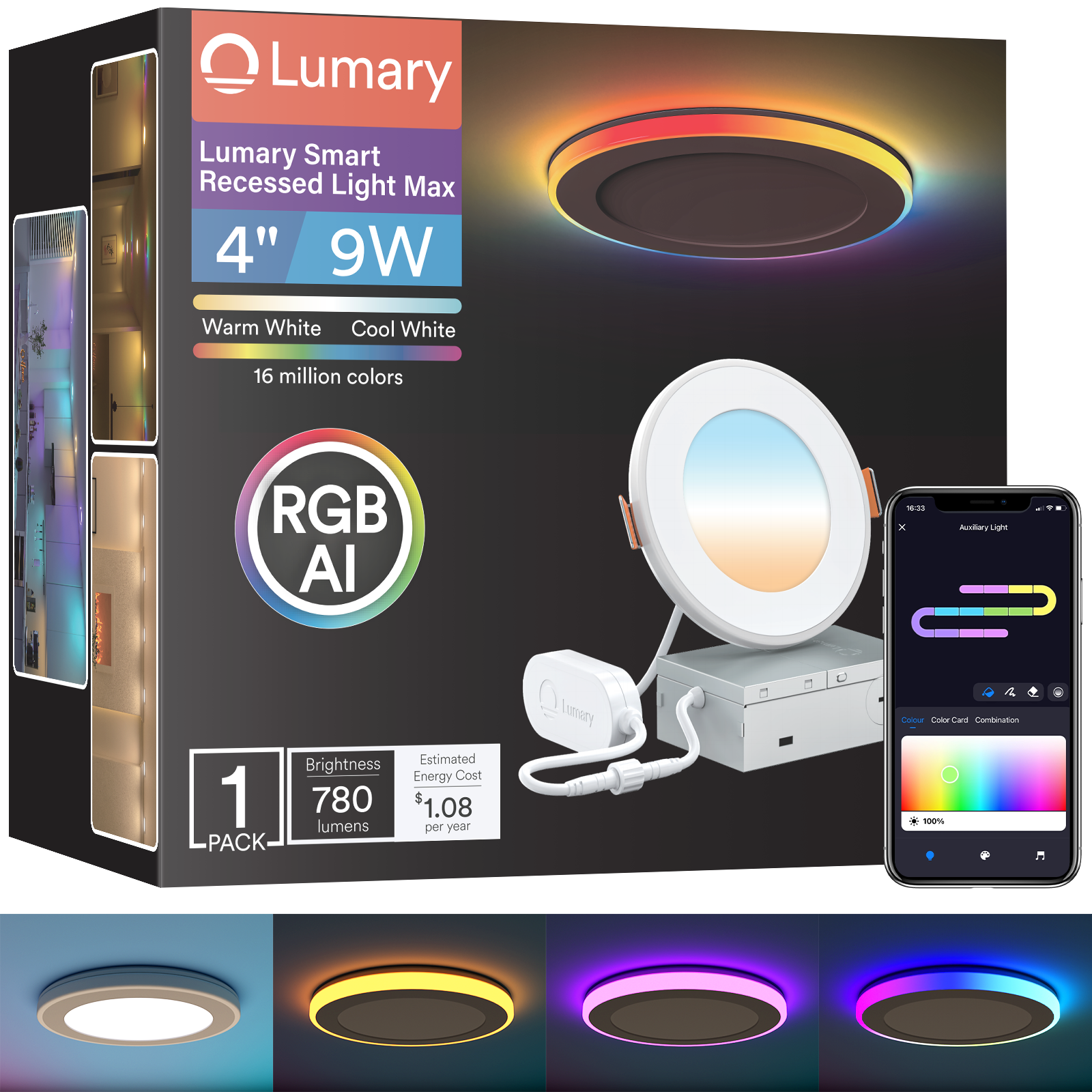
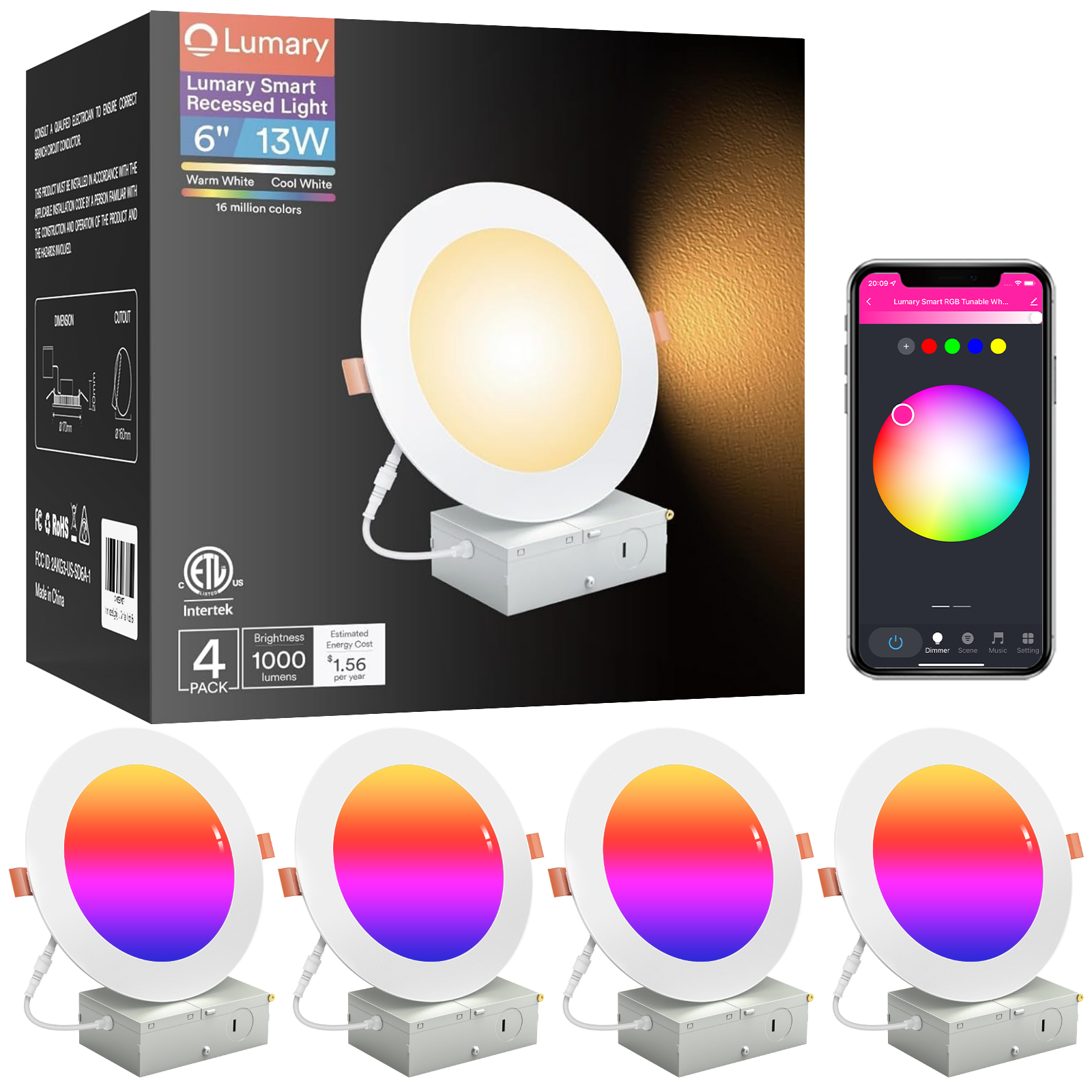
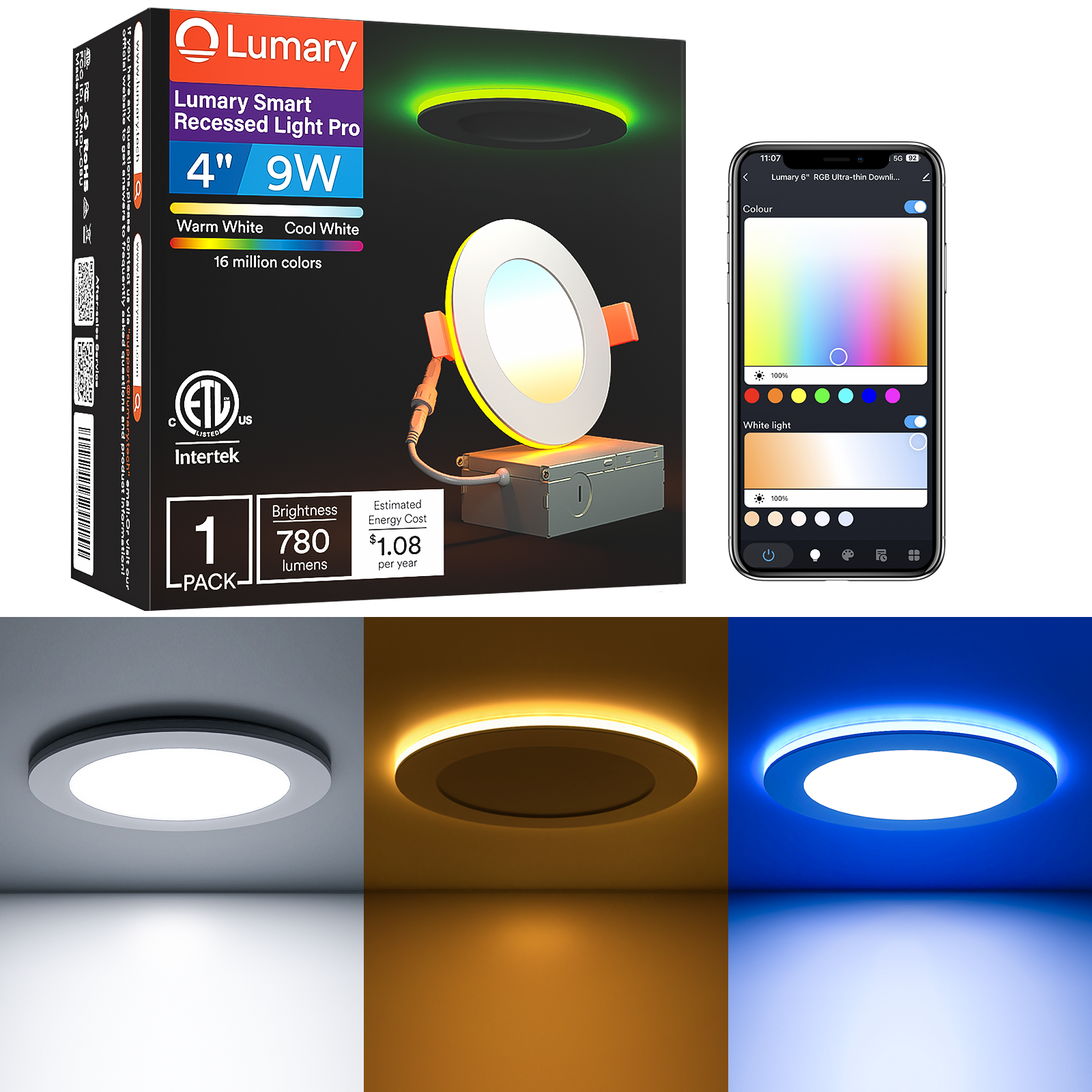
The Lumary Wi-Fi Smart Canless Recessed Lighting 6 Inch (4PCS) is specifically designed as a retrofit canless format with spring-clip installation, junction box compatibility, and an ultra-thin profile that simplifies ceiling work — the specification combination that keeps labor time at the lower end of the per-fixture range while delivering a complete smart lighting system in every unit.
Product Recommendation Analysis
The Lumary Wi-Fi Smart Canless Recessed Lighting (models US-SD6A-4 in white and US-SD6B-4 in black, sold as a 4-unit pack) is a 6-inch canless LED downlight designed for retrofit installation in existing drywall ceilings via standard junction box connection and spring clip mounting. Each unit is rated at 13W and produces 1,000–1,100 lumens at a CRI of 90, with continuously adjustable color temperature from 2700K to 6500K and full RGBWW color output covering 16 million color combinations. The ETL and FCC certifications confirm the fixtures meet U.S. electrical safety and interference standards — a specification relevant both for code compliance in permitted installations and for insurance purposes in owner-occupied homes.
The ultra-thin canless form factor means no separate housing can, no trim ring installation, and no attic-side mounting bracket — the fixture mounts directly to the ceiling through the cut hole using integral spring clips, which both simplifies the installation sequence and reduces the per-fixture time an electrician must spend at each location. The junction box wiring connection is standard across all installation types, requiring no special tools or techniques beyond those an electrician uses for any fixed lighting work.
On the smart control side, each unit connects via 2.4GHz Wi-Fi and Bluetooth concurrently, with native Amazon Alexa, Google Assistant, and Siri voice control and full app management through the Lumary app. Brightness is adjustable from 1% to 100%, and a memory function retains the last-used settings when power is restored. Group control allows all fixtures in a room — or across multiple rooms — to be managed simultaneously from a single command. Music sync, 8 scene modes, and DIY scene creation extend the lighting capability beyond static white illumination into dynamic, occasion-responsive environments. Full specifications and pricing are available on the Lumary Wi-Fi Smart Canless Recessed Lighting 6 Inch 4PCS product page.
Technical Specification Table
| Specification | Lumary Smart Canless Recessed Lighting US-SD6A-4 / US-SD6B-4 |
|---|---|
| Model designation | Lumary Wi-Fi Smart Canless Recessed Lighting 6 Inch — US-SD6A-4 (White) / US-SD6B-4 (Black) |
| Pack size | 4 units |
| Fixture size | 6 inch |
| Fixture type | Canless (wafer/disk) — no separate housing required |
| Wattage | 13W per unit |
| Brightness | 1,000–1,100 lumens per unit |
| Color rendering index | CRI 90 |
| Light color | RGBWW (Red, Green, Blue, Warm White, Cool White) |
| Color range | 16 million colors |
| Color temperature | 2700K–6500K, continuously adjustable |
| Dimming range | 1%–100% |
| Scene modes | 8 preset scenes + DIY custom creation |
| Music synchronization | App-enabled, real-time audio reactive |
| Memory function | Retains last-used settings on power restore |
| Installation type | Retrofit canless — spring clip mount, junction box connection |
| Certifications | ETL, FCC |
| Wireless connectivity | 2.4GHz Wi-Fi + Bluetooth (concurrent) |
| Voice assistant support | Amazon Alexa, Google Assistant, Siri |
| App functions | Schedule, group control, scene selection, music sync, remote access, device sharing |
| Operating voltage | AC 110V |
| Control methods | Lumary app, voice assistant, remote control |
| Available finishes | White (US-SD6A-4), Black (US-SD6B-4) |
| Pack price | $139.99 (≈$35 per fixture) |
Installation Cost and Smart Lighting Value Framework: Where Canless LED Saves and Where Buyers Should Plan Carefully
The table below maps the key variables that drive recessed lighting installation cost against the specific design decisions in the Lumary canless recessed light that address each cost driver — and the factors where professional planning remains essential regardless of fixture type.
| Cost Driver | How It Typically Inflates Project Cost | How This Lumary Smart Canless Recessed Light Addresses It | Budget Planning Impact |
|---|---|---|---|
| Fixture type and housing complexity | Traditional can-and-trim systems require separate housing installation, separate trim installation, and separate bulb sourcing — three steps that multiply labor time | Ultra-thin canless form factor: single unit installs through the ceiling hole via spring clips with no separate housing, trim, or bulb replacement ever required | 20–40% labor saving per fixture vs. traditional can systems; $0 bulb replacement cost across 50,000-hour LED lifespan |
| Smart switch installation cost | Standard recessed lights require separate smart dimmer switch installation at $55–$200 per switch to enable app or voice control | Built-in Wi-Fi and Bluetooth smart control in every unit; Alexa, Google Assistant, and Siri native — no separate smart switch or hub required | Eliminates smart switch purchase and installation labor entirely; group control manages room-level on/off and dimming from existing switches |
| Fixture material cost | Smart color-changing fixtures can cost $80–$200+ per unit when purchased individually | 4-unit pack pricing at $139.99 = approximately $35 per fixture for a fully featured RGBWW smart downlight with CRI 90 and ETL certification | Material cost per unit competitive with mid-range non-smart canless LED; smart capability included at no premium over fixture price |
| Circuit wiring complexity | Each light on a separate circuit requires separate wire runs; electrician labor scales with wiring complexity | All four units can be daisy-chained on a single circuit; group control handles room-level switching without individual wall switches per fixture | Single-circuit installation reduces wiring labor by up to 40% vs. multi-circuit layouts at same fixture count |
| Post-installation dimmer compatibility | Standard dimmable LEDs require LED-compatible dimmers that add $55–$200 per switch; incompatible dimmers cause flicker | Dimming is handled entirely through the app and voice control from 1% to 100%; existing non-dimmable switch is sufficient for on/off power delivery | Eliminates dimmer switch compatibility testing and replacement cost entirely |
| Certification and code compliance | Uncertified fixtures may fail building inspections, require removal, or invalidate homeowner's insurance claims in permitted projects | ETL and FCC certified — meets U.S. electrical safety standards for residential installation and permit compliance | No inspection risk from fixture certification; permits proceed normally with ETL-certified hardware |
| Long-term energy cost | 60W equivalent incandescent recessed lights at $0.12/kWh for 3 hours daily = ~$7.88/year per fixture | 13W at same usage = approximately $1.71/year per fixture | ~$6.17 annual energy saving per fixture; $24.68 annual saving per 4-unit pack; full fixture cost recovered in energy savings in under 6 years |
Competitive Landscape
The smart canless recessed lighting segment includes several brands with established smart home ecosystems and varying feature sets that serve different buyer priorities.
Govee has entered the recessed lighting category with RGBIC-capable downlights that leverage the Govee Home app's established scene and music-sync infrastructure. Govee's recessed products appeal to buyers already in the Govee ecosystem who want to add ceiling lighting alongside their existing Govee smart strips, permanent outdoor lights, or ambient backlight products — the unified app experience reduces the learning curve for buyers who already use Govee products elsewhere in the home.
Philips Hue's recessed lighting lineup includes both retrofit and integrated options that operate within the Hue Bridge ecosystem, offering Matter and Zigbee protocol support for buyers who prioritize cross-platform interoperability. Hue's recessed lights are positioned at the premium end of the smart downlight market, targeting buyers for whom protocol reliability, HomeKit integration, and the depth of the Hue scene library justify the higher per-fixture cost.
LIFX produces smart recessed downlights with direct Wi-Fi connectivity, native HomeKit support, and high color rendering accuracy. LIFX's recessed lineup appeals to Apple ecosystem buyers who want hub-free direct control with Siri and HomeKit alongside Alexa and Google Home, without Zigbee bridge infrastructure.
WiZ under Signify has expanded its smart lighting range to include recessed downlights at accessible price points with tunable white, SpaceSense presence automation, and 2.4GHz Wi-Fi. WiZ's recessed products are positioned as straightforward smart lighting for buyers who want reliable scheduling and basic scene capability without advanced color features.
Eufy has positioned its recessed lighting products around simplified installation and reliable app control, targeting buyers converting from standard can-and-bulb setups who want smart scheduling and dimming capability without complex multi-protocol setup.
Within this competitive field, the Lumary smart canless recessed light is positioned with a specific combination that defines its value at the $35-per-fixture pack price: ETL-certified 6-inch canless form factor with CRI 90, full RGBWW 16-million-color output alongside tunable white from 2700K to 6500K, concurrent 2.4GHz Wi-Fi and Bluetooth, native Alexa, Google Assistant, and Siri voice control, music sync, group control, and app scheduling — all in a flicker-free, silent-operation unit that installs on existing junction boxes without separate housing, trim, or dimmer switch installation.

Application Scenarios
Living Room General and Ambient Lighting: Replacing Overhead Fixtures with a Color-Tunable Downlight Array
The living room is the most common target for residential recessed lighting upgrades — typically a 12×16-foot to 16×20-foot space that currently has a single overhead fixture providing flat, directional illumination that shadows furniture and fails to create the layered ambient quality that recessed downlights in an array produce. For a standard 16×20-foot living room, the general guidance of one recessed light per 25 square feet suggests 12 to 13 fixtures for full coverage, though design-forward installations often use fewer fixtures at higher individual lumen output to create a more balanced ambient effect.
The installation cost estimate for a living room of this size — 8 to 12 canless LED fixtures in a retrofit ceiling with attic access and existing circuit capacity — falls in the $700 to $1,600 range based on current labor and material data, or $1,200 to $2,400 without attic access where wire fishing through finished drywall is required. Purchasing fixtures as 4-unit packs reduces material cost relative to individual unit pricing and allows the electrician to work from the same material source across the installation session rather than sourcing different fixture quantities.
The CRI 90 rating of the Lumary smart recessed lighting is particularly relevant in a living room context where the same fixtures must serve multiple daily functions: rendering skin tones accurately during family time, showing book and media cover colors faithfully during reading, and displaying furniture fabric and wall paint colors as they were selected rather than as a lower-CRI source shifts them. The 2700K–6500K tunable range allows a living room to run the fixtures at 3000K–3500K for a warm, sociable evening atmosphere and shift to 5000K–6000K for a brighter, more alert setting during active use or when the room doubles as a home office during daylight hours. Group control through the Lumary app manages all 8 to 12 fixtures simultaneously from a single scene command, eliminating the need for multiple switches or per-fixture individual adjustment.
Kitchen Task and Accent Lighting: Where CRI and Lumen Output Matter for Food Work
Kitchen recessed lighting has more demanding technical requirements than any other room type in a residential installation: food preparation requires accurate color rendering so cooks can assess doneness, freshness, and presentation correctly; task areas like countertops and islands need higher lumen concentration than the room's general ambient setting; and the kitchen is the room where lights are most likely to run for extended periods during both daylight and evening hours. Every specification that determines lighting quality for these functions — CRI, lumen output, color temperature stability at full brightness — is more consequential in a kitchen than in any other part of the home.
A CRI 90 rating in the white mode of the RGBWW recessed lighting means that 90% of the full color gamut is accurately rendered under the fixture's white output — the threshold that the lighting industry broadly accepts as the boundary between acceptable and high-quality color rendering for residential and commercial food service environments. At 5000K to 6000K, the fixture's cool white output most closely approximates the spectral quality of daylight that makes food color assessment reliable. The 1,100-lumen output per unit at 13W produces sufficient task-adjacent illumination when fixtures are positioned over work surfaces rather than only in the room center — a placement decision that the electrician executes during installation but that the buyer can plan in advance by measuring the horizontal distance from each cut position to the counter or island below.
The music sync and RGB color modes, while primarily entertainment-oriented features, add kitchen utility for ambiance shifts during entertaining: the same fixtures that run at 5000K cool white during active cooking can shift to warm 2700K for a dinner party through a single Alexa command, converting the kitchen from a work environment to a social space without any physical light change.
Bedroom Sleep and Wake Lighting: Using Color Temperature Scheduling for Circadian Support
The bedroom is the room where the color temperature tuning range of a smart recessed light has the most measurable impact on occupant health outcomes, because the relationship between light color temperature and circadian rhythm is well-established in the sleep science literature: exposure to blue-shifted light above approximately 4000K in the hours before sleep suppresses melatonin production and delays sleep onset, while exposure to warm light in the 2700K–3000K range has a minimal circadian disruption effect. A bedroom that can shift from functional 5000K white during morning routines to 2700K warm white in the evening provides a measurable circadian advantage over fixed-color fixtures.
The Lumary app's scheduling function operationalizes this benefit without requiring the occupant to manually adjust color temperature each day: a recurring schedule that shifts the bedroom fixtures to 5000K at the morning wake time and to 2700K at a set evening hour runs automatically, producing the correct circadian-support lighting environment without any daily manual interaction. The 1% minimum dimming capability allows the fixtures to serve as extremely low-intensity night lights at the lowest setting — sufficient for safe nighttime navigation without the melatonin-suppressing brightness of even a low-wattage traditional fixture running at full power.
For bedroom installation, the canless form factor of the 6-inch canless recessed light eliminates the housing-depth requirement that makes traditional can lights problematic in shallow ceiling cavities typical of second-floor bedrooms where the floor structure above limits the available depth for fixture installation. The ultra-thin profile fits in ceiling depths where standard 5.5-inch-depth can housings would not, broadening the installation feasibility in bedrooms that a traditional fixture type would require complex work to accommodate.
Home Theater and Gaming Room: RGB Scene Mode as an Entertainment Infrastructure Component
Home theater and gaming room installations represent the use case where the RGBWW color capability of the recessed lighting with app control has the highest entertainment ROI relative to its added cost over a standard white-only downlight. In a home theater, recessed lighting color temperature and dimming level directly affect perceived image contrast: a room lit at 6500K creates glare against a projected or TV image that reduces perceived contrast and saturation; the same room at 2700K at 10–15% brightness creates the low-ambient-light environment where HDR content appears as the display manufacturer calibrated it.
The music sync and RGB scene modes serve a different function in a gaming room than in a living room: game sound effects and music are more rhythmically consistent and specifically engineered for audio intensity variation than typical residential music playback, which produces more predictable and visually coherent audio-reactive light behavior through the app's microphone-based sync mode. The 8 factory scene modes include entertainment-specific patterns — color breathing, strobe, gradient sequences — that extend the fixture's function from passive illumination into active atmosphere creation for gaming sessions, sports viewing parties, and home theater movie nights.
Group control allows all fixtures in the room to be managed from a single scene preset, with a dedicated "theater mode" scene set at the correct color temperature and brightness for viewing and activated by a single Alexa command at the start of each session. A "bright mode" scene for general room use can be called with a different command to return the room to full functional illumination after viewing.

Smart Home Multi-Room Integration: Group Control as the Infrastructure Benefit
For households installing the Lumary canless lights across multiple rooms — living room, kitchen, bedrooms, and hallways — the Lumary app's group control function converts what would otherwise be a per-room manual management task into a whole-home lighting system operated from a single control layer. Multiple fixtures in multiple rooms can be organized into functional groups — "downstairs lights," "bedroom lights," "kitchen" — and each group responds to a single Alexa or Google Assistant command without the household needing to address each fixture or each room individually.
The memory function adds operational reliability that distinguishes the fixture from simpler smart lights: when a power outage or circuit interruption restores power, each fixture returns to its last-used state rather than defaulting to a factory setting, which means the whole-home lighting configuration is preserved across power events without requiring re-setup. The device sharing feature allows multiple household members to control any grouped fixture from their own smartphones after a one-time sharing invitation through the app, eliminating the dependency on a single household member's phone for all smart lighting control. Schedule functions can be configured globally across all grouped fixtures — a "goodnight" automation that dims all downstairs lights to 10% at 11:00 PM and switches them off at midnight executes across every fixture in the group simultaneously, managed from one scheduling setup rather than per-fixture timer configuration.
Editorial Assessment
The cost of installing recessed lights in 2025 and 2026 is driven by three variables the buyer controls — fixture type, installation timing, and project scope — and three variables determined by the home's physical condition — ceiling access, circuit capacity, and wiring age. Of the buyer-controlled variables, fixture type has the most direct impact on both per-unit material cost and installation labor time. Canless LED downlights with integrated spring-clip mounting and junction-box connection reduce electrician labor time by 20–40% compared to traditional can-and-trim systems, and eliminate the separate bulb, trim, and housing procurement that inflates material cost in traditional installations.
The Lumary Wi-Fi Smart Canless Recessed Lighting at approximately $35 per fixture in 4-unit packs addresses the material cost variable with ETL-certified, CRI-90 hardware that includes full RGBWW smart capability — eliminating the additional purchase of smart dimmer switches, smart bulbs, or hub hardware that conventional smart lighting retrofits require. The flicker-free, silent operation, 1%–100% dimming range, 2700K–6500K tunable white, and native Alexa, Google Assistant, and Siri integration are present in every unit at the pack price.
For homeowners budgeting a recessed lighting project, the practical planning sequence is to count the fixtures needed for each room at one per 25 square feet, price the labor estimate against current local electrician rates at $100–$200 per fixture for retrofit installations, and select a fixture pack configuration that covers the room count in multi-unit pricing. Installing all fixtures in one session, keeping lights on a single circuit per room where possible, and taking advantage of attic access where available are the three strategies that most reliably hold a project to the lower end of the $100–$300 per-fixture total cost range.

Frequently Asked Questions
How many recessed lights do I need for a typical room, and how does that affect the total installation cost?
The standard residential sizing rule places one 6-inch recessed light per 25 square feet of ceiling area for even ambient coverage, though rooms with higher ceilings or darker finishes may warrant closer spacing. A 12×12-foot bedroom at 144 square feet needs 4 to 6 fixtures; a 16×20-foot living room at 320 square feet needs 8 to 12. At a fully installed all-in cost of $100–$300 per fixture for a straightforward canless LED retrofit with accessible attic space, a 4-light bedroom project runs $400–$1,200 and a 10-light living room project runs $1,000–$3,000. Installing all fixtures in one session and keeping them on a single circuit reduces the labor component by 20–40% compared to separate visits or multi-circuit wiring.
What is the difference between canless LED recessed lights and traditional can lights, and why does it matter for installation cost?
Traditional can lights use a separate cylindrical metal housing (the "can") that mounts to the ceiling structure, followed by a separate trim ring, and finally a separate bulb. Three distinct components must be sourced, coordinated, and installed. Canless LED fixtures are integrated units — the LED light source, driver, and trim are a single assembly that mounts directly through the ceiling hole using spring clips. There is no separate housing, no separate trim installation step, and no bulb to source or replace. The simplified installation sequence reduces electrician labor time by 20–40% per fixture relative to traditional can systems, and the integrated LED has a rated lifespan of 25,000–50,000 hours that eliminates all bulb replacement cost across the fixture's service life.
Do smart recessed lights require additional wiring or electrical work beyond what a standard recessed light installation involves?
No additional wiring beyond a standard recessed light installation is required for a Wi-Fi and Bluetooth smart canless recessed light like the Lumary. The fixture connects to the standard junction box circuit wiring exactly as a non-smart canless downlight would — line voltage in, neutral, ground. All smart functionality (Wi-Fi, Bluetooth, Alexa, Google Assistant, Siri, app control, dimming, color changing, scheduling) operates on the fixture's integrated driver electronics and does not require a separate smart switch, a separate hub, or additional wiring beyond the standard fixture connection. The existing wall switch serves as the power supply on/off; all intelligent control functions operate through the Lumary app and voice assistants independently of the switch.
Is a permit required to install recessed lights, and what are the consequences of skipping a permit where one is required?
Permit requirements vary by jurisdiction, but the general rule across most U.S. states is that any project involving new wiring, new circuit creation, or panel work requires a permit — which applies to most first-time recessed lighting installations in rooms that did not previously have overhead lighting. Replacing existing fixtures on existing wiring in the same locations typically does not trigger a permit requirement in most jurisdictions. Consequences of skipping a required permit include potential fines, required removal and re-inspection of all installed work, complications in future home sales where unpermitted electrical work must be disclosed, and possible insurance claim complications if an electrical incident occurs in an unpermitted installation. Using ETL-certified fixtures such as the Lumary canless recessed light ensures that the hardware meets U.S. safety standards and passes inspection without fixture-specific issues when permits are obtained.
How does the memory function in the Lumary smart recessed light work, and why does it matter for everyday use?
The memory function retains the last-used brightness, color temperature, and color settings in the fixture's local memory so that when power is restored after an outage, the switch is toggled off and back on, or the circuit breaker trips and resets, the fixture returns to exactly the state it was in before the interruption rather than defaulting to a factory white setting. In practical terms, this means a room that was set to 2700K at 60% brightness for an evening movie night returns to that exact setting the next time the switch is turned on, rather than blasting full-brightness cool white and requiring the homeowner to re-open the app and reconfigure the scene. For multi-room installations where different rooms have different regular settings, the memory function preserves each room's individual configuration independently across all power events without requiring any app interaction to restore the preferred state.

