




To pick the best landscape lights for your yard, first think about your goals. Many people use landscape lighting to make their yards look nice, help keep people safe, and stop crime.
|
Goal |
Description |
|---|---|
|
Enhancing visual appeal |
Makes your outdoor space look more interesting and special. It can make your time outside better. |
|
Lights up walkways and stairs so people do not trip or fall. |
|
|
Enhancing security |
Bright lights can scare away people who want to break in. This helps you feel safer at home. |
You should also think about color, how bright the lights are, ways to control them, and how much energy they use. Smart lighting can help you take care of your yard more easily.
Key Takeaways
-
Think about what you want from landscape lighting. Do you want your yard to look nicer, be safer, or have better security?
-
Pick lights that use less energy, like LED or solar-powered lights. These lights help you save money and last longer than old bulbs.
-
Make a good plan for where to put your lights. Put the lights in smart spots so there is no glare. This keeps your yard safe and makes it look better.
Types of Landscape Lights
Pathway Lights
Pathway lights help people walk safely in your yard. They light up walkways so you do not trip or fall. Many pathway lights use solar power, so they are easy to set up and good for the planet. Some are made from brass or copper, which makes them last a long time. You can pick from many styles to fit your yard. Some pathway lights have sensors that change how bright they are when someone walks by. Low-voltage pathway lights use less energy and work well.
Spotlights & Floodlights
Spotlights and floodlights are important for showing off things in your yard. Spotlights shine a narrow beam of light on statues, trees, or cool parts of your house. Floodlights spread light over a big area, so you can see better and feel safe.
|
Beam Angle |
Recommended Applications |
|
|---|---|---|
|
Spotlight |
< 45° |
Highlighting artwork, landscape features, architectural details |
|
Floodlight |
45°~120° |
Lighting large areas, outdoor spaces, security |
You can use different ways to shine spotlights, like making shadows or lighting up shapes. These tricks make your yard look exciting at night.
Step & Deck Lights
Step and deck lights help you see steps and edges in your yard. They make it safer to walk at night and stop people from slipping. These lights can scare away people who should not be there. You can add motion sensors or timers to make your yard even safer. Step and deck lights also help security cameras see better.
Garden & Accent Lights
Garden and accent lights make your yard look pretty. They shine on special things like trees, gardens, or walls. Accent lights add depth and feeling, so your yard looks nice after dark. You can use these lights to show off cool parts of your house and make it look great from the street.
Smart Landscape Lights
Smart landscape lights let you control your lights in new ways. The Lumary Smart LED Outdoor Landscape Lights RGBAI Spotlight is a great pick. You can pick from lots of colors, change how bright the lights are, and control each one with the Lumary App, your voice, a remote, or a control box. Lumary has special modes for parties and holidays. You can set timers to turn lights on and off by themselves. Music sync makes the lights change color with your songs. These lights are strong, waterproof, and can change white shades for any mood. Smart landscape lights save energy and work with sensors for safety and ease.

Landscape Lighting: Technical Factors & Installation
Bulb Types & Color Temperature
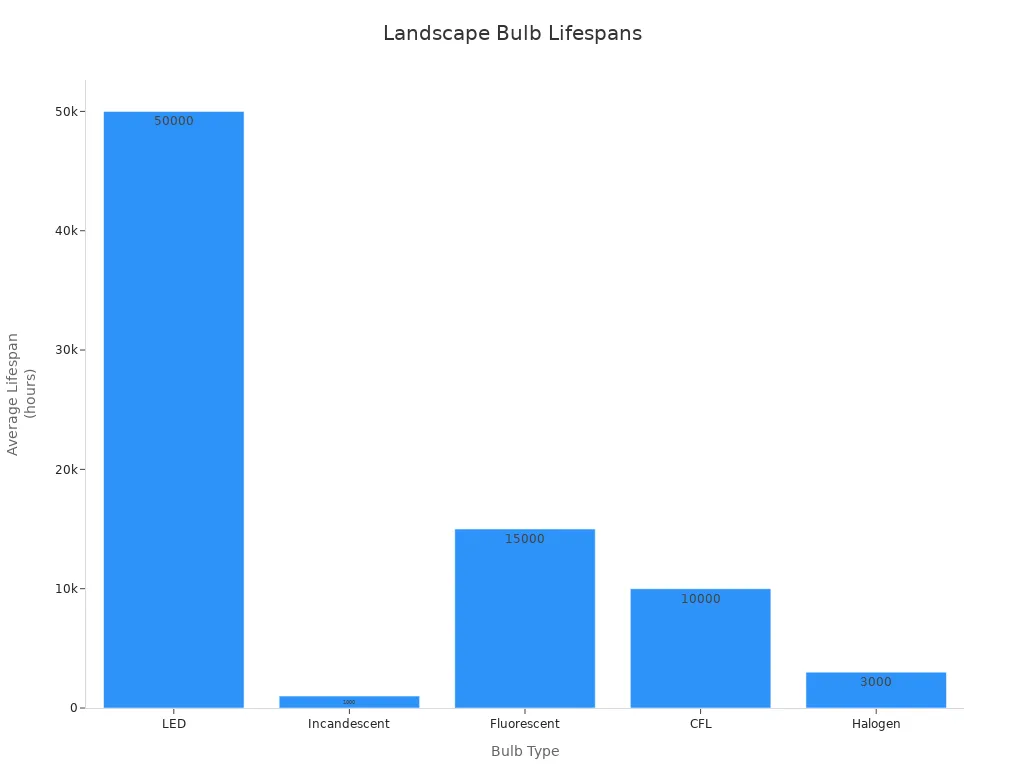
When you pick landscape lighting, you should think about the bulb type and color temperature. The bulb type changes how long your lights last and how much energy they use. Most people like LED bulbs because they last longer and use less energy. You can see how different bulbs work in the table below:
|
Type of Bulb |
Average Lifespan |
Energy Savings |
|---|---|---|
|
LED |
Up to 50,000 hrs |
Uses about 75% less electricity than incandescent and 50% less than fluorescent |
|
Incandescent |
~1,000 hrs |
Baseline for energy consumption |
|
Fluorescent |
7,000 – 15,000 hrs |
Uses more electricity than LEDs |
|
CFL |
8,000 to 10,000 hrs |
Uses about 75% less energy than incandescent light bulbs |
|
Halogen |
~1,000 hrs (up to 3,000 for extended-life) |
Uses more energy than LEDs |
Color temperature changes how your yard feels at night. Warm white lights (2700K–3000K) make your yard feel cozy and friendly. Neutral white (3500K–4000K) gives a balanced look and helps you see better. Cool white (5000K+) looks bright and sharp, which is good for security but can feel too strong at home.
|
Color Temperature (Kelvin) |
Mood and Appearance Description |
|---|---|
|
2700K–3000K (Warm White) |
Creates inviting, traditional ambiance, complements warm materials, and enhances natural plant appearances. |
|
3500K–4000K (Neutral White) |
Balances warm and cool tones, suitable for contemporary designs, and improves visibility for tasks. |
|
5000K+ (Cool White) |
Produces crisp, bluish light, often used for security, can appear harsh in residential settings. |
Tip: In 2026, most people like warm white lighting for patios and eating areas because it feels relaxing.
Lumens & Brightness
You need to choose the right brightness for each part of your yard. Lumens tell you how bright a light is. Pathway lighting needs 100 to 200 lumens so people can walk safely. Security lighting for driveways should have 300 to 700 lumens. Commercial places might need even more.
|
Lighting Type |
Recommended Lumen Output |
|---|---|
|
Security Lighting |
300 to 700 lumens for residential driveways; 1,500+ lumens for commercial parking lots |
|
Pathway Lighting |
100 to 200 lumens for pathway edges and walkways |
Picking the right lumen level helps you save energy and keeps your yard looking nice. LED landscape lighting fixtures give you more brightness but use less energy. This means your yard is bright, but your bills stay low.
-
Picking the right lumen levels is important for good lighting and saving energy.
-
LED lights give you lots of brightness for each watt, so you pay less for power but still get enough light.
Energy Efficiency & Automation
Energy-efficient lights help you save money and are better for the planet. In 2026, LED landscape lighting, solar-powered lights, and low voltage landscape lighting are the best picks. LEDs use up to 80% less energy than halogen bulbs and last much longer. Solar-powered lights use sunlight, so you do not need wires. Low voltage systems are safer and easy to change.
|
Lighting Type |
Energy Consumption |
Annual Operating Cost |
Lifespan |
|---|---|---|---|
|
LED |
Up to 80% less |
$20–$40 |
25,000 hours |
|
Halogen |
Standard |
$130–$270 |
2,000 hours |
-
LEDs can help you save $90 to $250 each year on electricity compared to halogen bulbs.
-
The higher price of LED fixtures pays off in 2–3 years because you save energy.
Automation makes landscape lighting even easier. Timers and schedules turn your lights on and off by themselves. Motion sensors only turn on lights when someone is close, which can save up to 30% energy. Smart controls let you use your phone or voice to control your lights. The Lumary Smart LED Outdoor Landscape Lights RGBAI Spotlight has all these features. You can set timers, make custom scenes, and control each light by itself. Music sync lets your lights change color with your songs, which is fun for parties.
Note: Smart LED systems cost more at first, but they save money later because they use less energy and last longer.
Installation & Maintenance Tips
Good landscape lighting installation keeps your system safe and working well. Always plan where your lights will go before you start. Think about how long your cables need to be and where the power comes from. For example, the Lumary Smart LED Outdoor Landscape Lights RGBAI Spotlight has a 56-foot cable and a 17.5-foot section from the adapter to the first spotlight. This lets you cover a big area, but you cannot make the cable longer, so plan your setup carefully.
Waterproofing is very important for outdoor lights. Look for fixtures with an IP65 rating for most outdoor places. This rating means your lights can handle heavy rain and dust. If you need lights near a pool or a place that floods, pick IP67-rated fixtures.
|
IP Rating |
Description |
Suitable Conditions |
|---|---|---|
|
IP44 |
Handles small splashes |
Covered spots like porches |
|
IP65 |
Dust-tight, withstands heavy rain and water jets |
Outdoor wall lights, streetlights, security lighting |
|
IP67 |
Durable against temporary submersion |
Near pools, docks, industrial wash-down areas |
Some common mistakes are using cheap solar lights, picking the wrong fixtures, and forgetting about waterproofing. You should balance looks and safety in your landscape lighting design. Do not put too many lights in one spot, and always aim lights away from your neighbors’ windows.
-
Too many lights in one spot make glare and take away from your yard’s beauty.
-
If you can see the bulb, it is in the wrong place. Use shields and point lights down.
-
Plan your wire length and power needs before you start so you do not have problems later.
Pro Tip: Always use waterproof connectors and do not overload your transformer.
Common Questions About Lumary Smart LED Outdoor Landscape Lights RGBAI Spotlight
-
How do I control each light?
You can use the Lumary App, voice commands, a remote, or the control box to control each spotlight by itself. -
Can I set different colors for each light?
Yes, you can pick from 16 million colors and set each light to a different color or brightness. -
Are these lights waterproof?
Yes, they have an IP65 rating, so they work well in rain and dust. -
What is the cable length?
The total cable length is 56 feet, with 17.5 feet from the adapter to the first spotlight. -
Do I need to hire a professional for how to install landscaping lights?
Many people can do landscape lighting installation by following the instructions, but you can hire a professional if you want a more complex landscape lighting design.
If you follow these tips, you can make your yard beautiful, safe, and energy-efficient with the right landscape lighting fixtures and smart controls.

Best Landscape Lighting for Yard Features
Matching Lights to Pathways & Driveways
You want your pathways and driveways to be safe at night. Good landscape lighting uses pathway lights, flood lights, and spotlights. Pathway lights help people walk and stop trips. Flood lights make driveways bright and keep them secure. Spotlights and uplights highlight special spots and add drama.
|
Best Use Case |
Characteristics |
|
|---|---|---|
|
Pathway Lights |
Guidance and safety along paths |
Solar-powered, energy-efficient, easy to install |
|
Flood Lights |
Brightening driveways and patios |
Wide coverage, good for security |
|
Spotlights/Uplights |
Focal points and accents |
Adjustable heads for directing light |
|
String Lights |
Festive atmosphere |
Decorative, waterproof, year-round use |
When you put lights in driveways, anchor posts firmly. Use mounting brackets to keep lights steady. Think about wind and water drainage so your lights work well.
Highlighting Gardens & Outdoor Spaces
Garden and accent lights show off plants, trees, and water features. Try these ideas:
-
Put uplights at the base of trees to make them look tall.
-
Use angled spotlights for fountains or ponds.
-
Stagger low-profile lights along curved paths to highlight plants.
-
Shine lights in front of flowers and shrubs for a soft glow.
Smart landscape lights like Lumary let you control each light. You can pick colors, set scenes, and change brightness for any event. Many people ask, “Can I set different colors for each light?” Yes, you can use the Lumary app to make every light unique.
Security & Ambiance Lighting
Layered lighting makes your yard safe and welcoming. Flood lights and motion sensor lights help keep your home secure. Path and walkway lights guide guests and delivery drivers. Accent and spot lighting, uplighting, and silhouetting create cozy or dramatic moods.
Tip: Smart lighting systems let you change the look for parties or quiet nights. You can set a soft amber glow for relaxing or bright colors for celebrations.
The best landscaping lights are powerful, easy to install, and have smart controls. With Lumary’s individual control and scene modes, you can make the perfect atmosphere for any occasion.
-
Look at your yard and think about what you want. 2. Pick the best fixture types for your needs. 3. Make sure you know the technical details and plan how to put in the lights. 4. Choose lights that save energy and have smart controls.
Tip: If you take care of your lights and plan where they go, your landscape lighting will stay safe, bright, and last a long time.
FAQ
How do you connect Lumary Smart LED Outdoor Landscape Lights to Wi-Fi?
You open the Lumary App, follow the setup steps, and connect the lights to your 2.4GHz Wi-Fi network. The app guides you through each step.
Can you control the lights with your voice?
Yes, you can use Alexa, Google Assistant, or SmartThings. Just link your Lumary account and give voice commands to change colors or turn lights on and off.
What should you do if a light does not respond?
Try unplugging the adapter and plugging it back in. Check your Wi-Fi connection. If the problem continues, reset the light using the Lumary App.

