


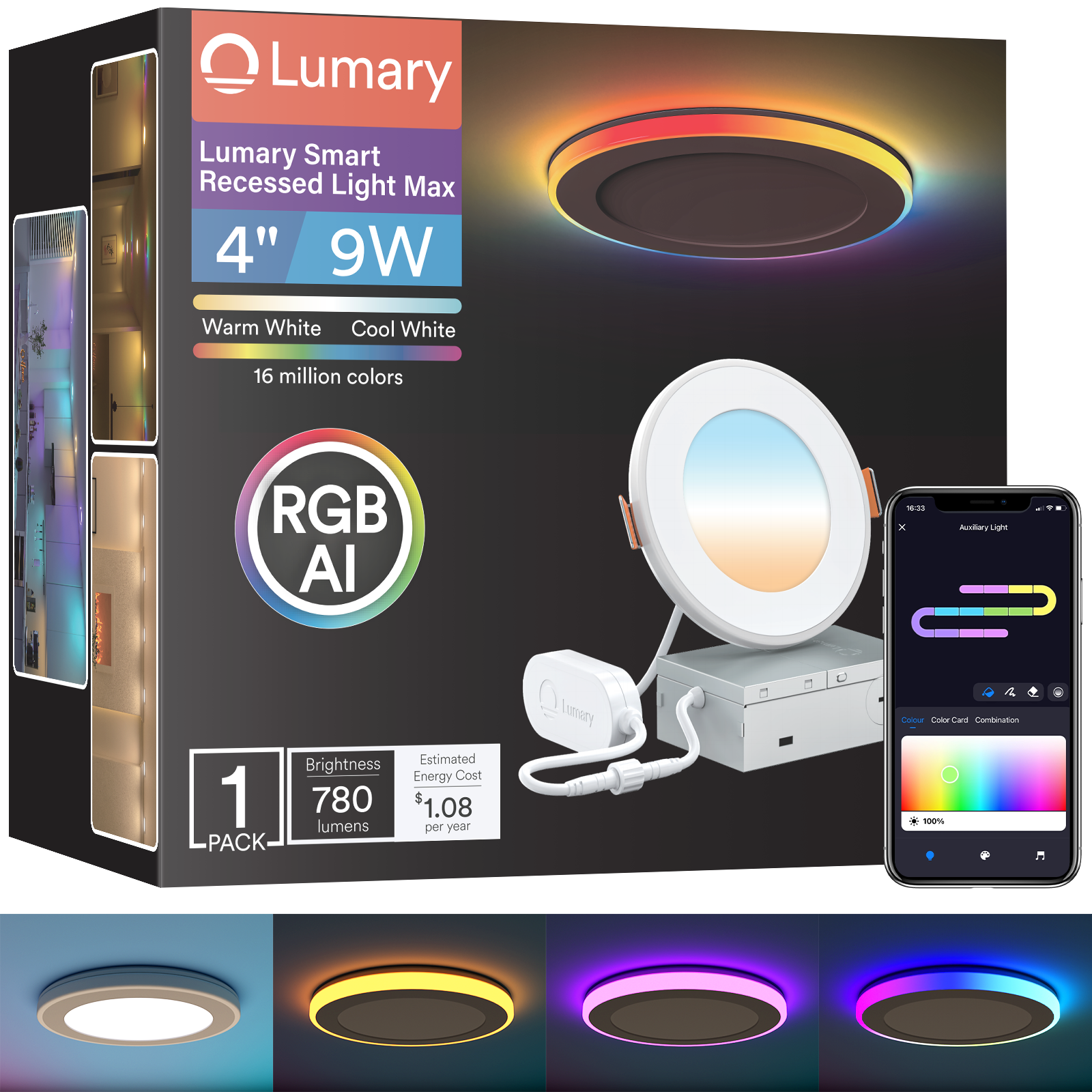
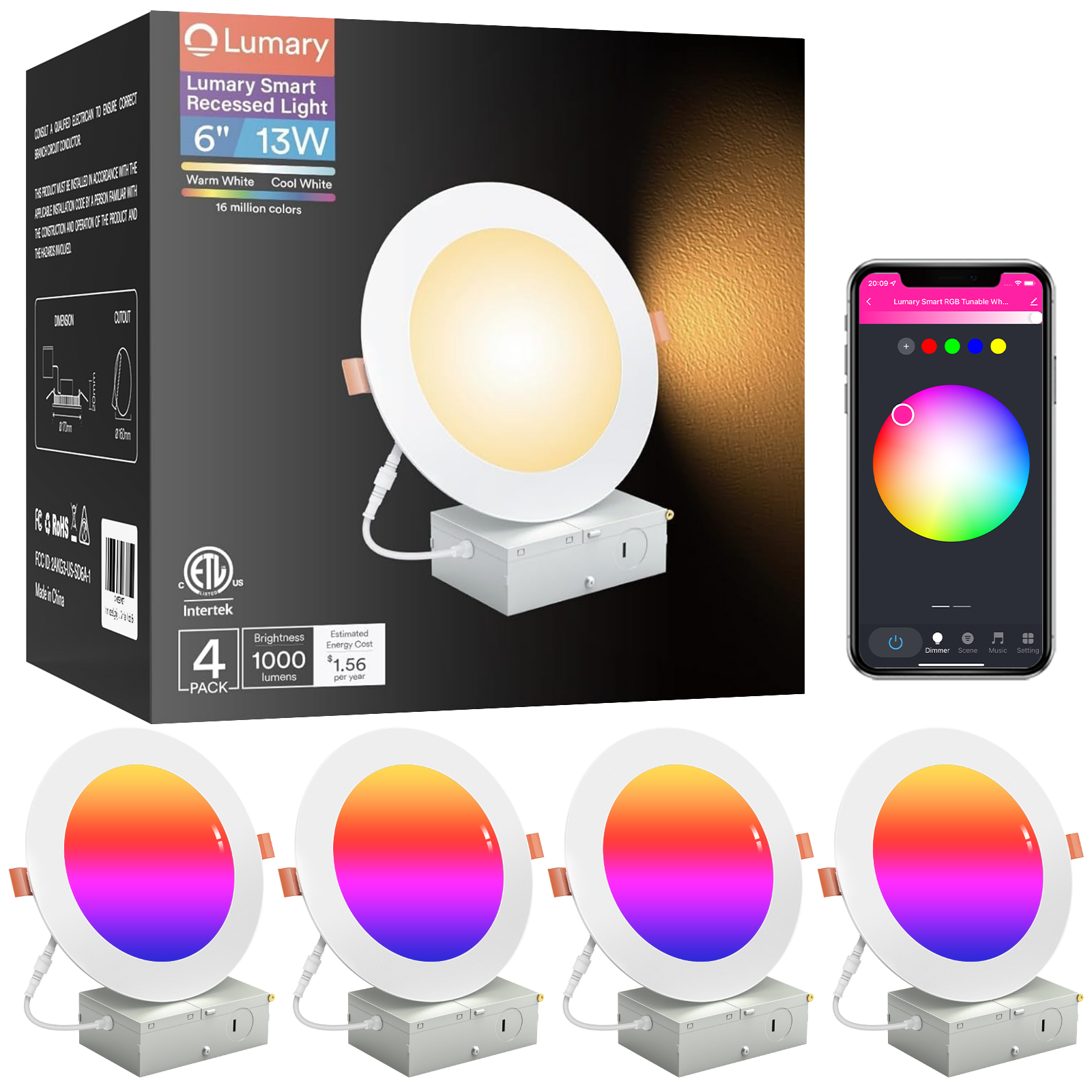
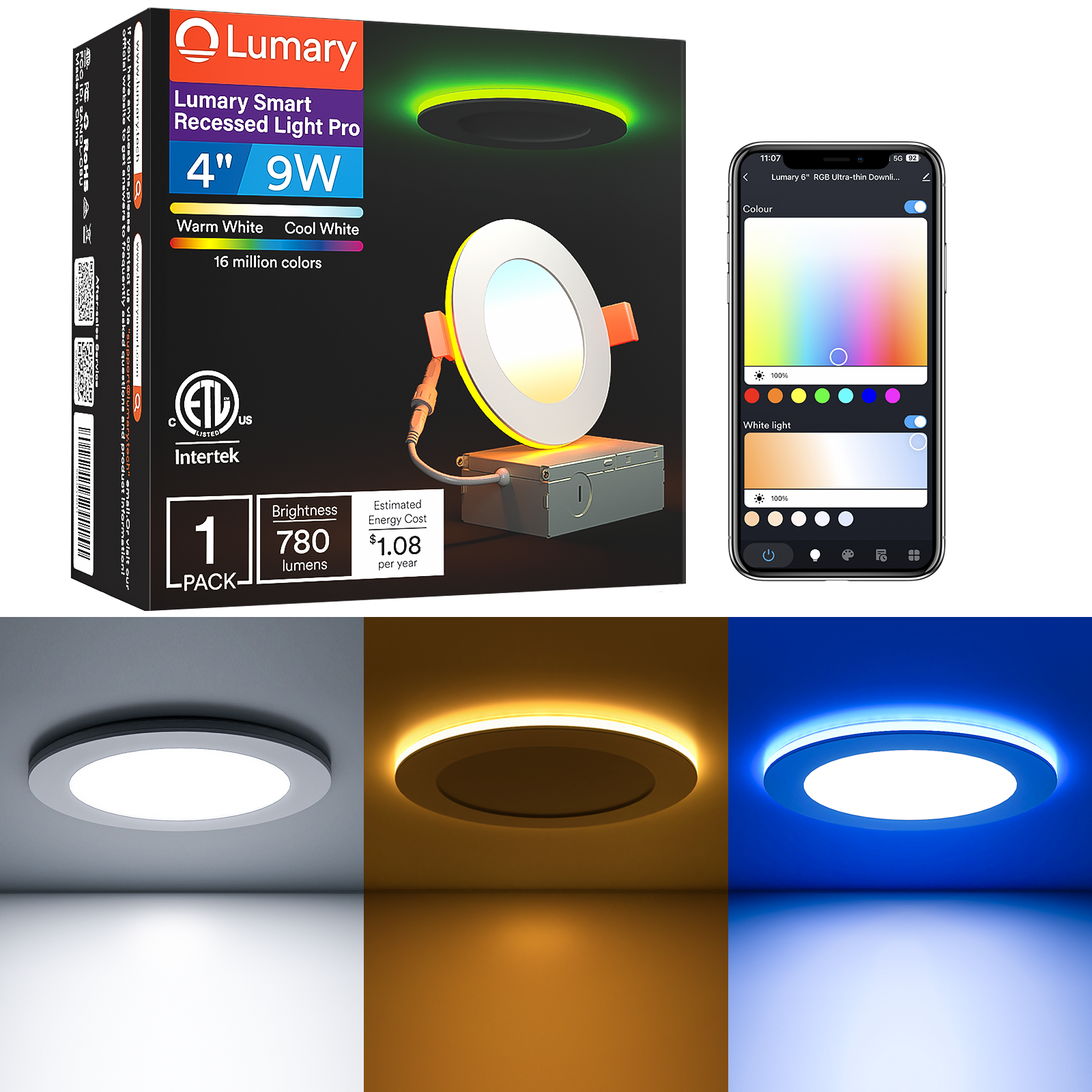
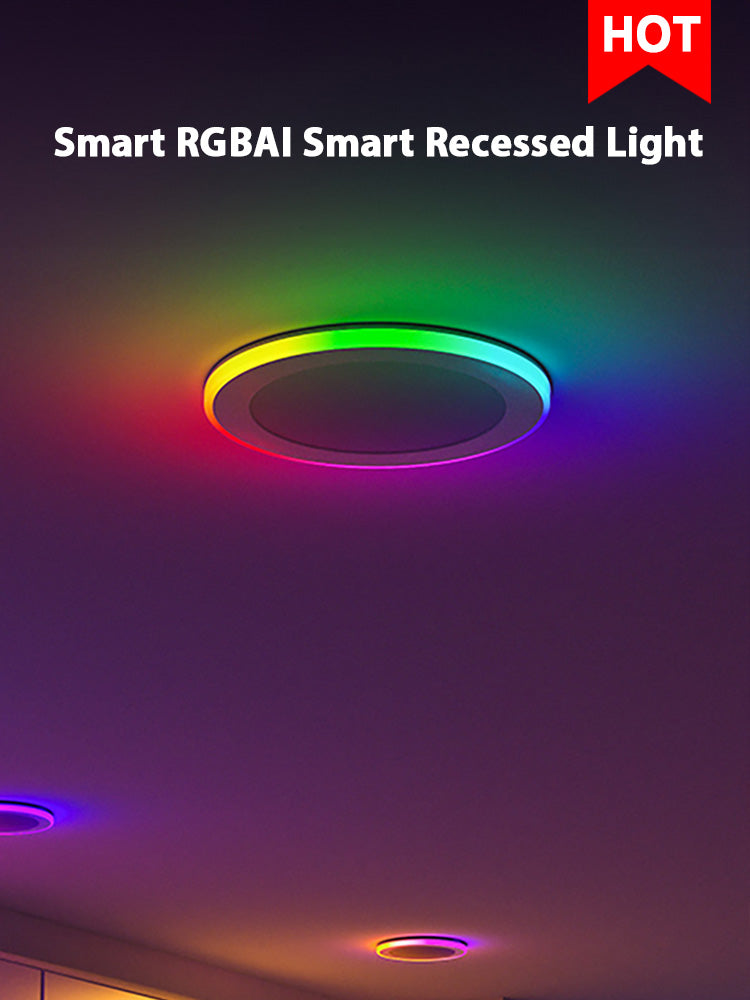


Choosing between 4-inch and 6-inch recessed lights is not really a question of diameter. It is a question of beam coverage, ceiling height, lumen target, room function, and how much visual presence you want on the ceiling. A 4-inch light is usually better when the ceiling needs to look minimal, when fixtures are closer together, or when the goal is accent lighting. A 6-inch recessed light is the more practical choice for living rooms, kitchens, bedrooms, media rooms, and open-plan spaces where each fixture needs to cover more area with fewer cutouts.
For most homeowners comparing smart canless downlights, the safer general-purpose answer is the 6-inch format, especially when the fixture combines high output, dimming range, tunable white, color ambience, group control, and easy canless installation. That is where the Lumary Wi-Fi Smart Canless Recessed Lighting 6 inch 4 PCS becomes a strong reference point: it is a 13W, 1100LM, ultra-thin RGBCW downlight with 2700K–6500K white tuning, 1%–100% brightness control, 16 million colors, 8 scene modes, music sync, Lumary App control over 2.4GHz Wi-Fi, and voice compatibility with Alexa and Google Assistant. (Lumary)
The real 4-inch vs 6-inch rule
A 4-inch recessed light is visually discreet and works well in corridors, compact bedrooms, soffits, display zones, or layouts where more fixtures are intentionally placed closer together. A 6-inch light has a larger aperture and is usually chosen when the room needs broader ambient coverage, fewer ceiling openings, and stronger general illumination. Layout still matters: Home Depot’s recessed lighting guide gives a common rule for even lighting—divide the ceiling height by two to estimate fixture spacing; for an 8-foot ceiling, that means about 4 feet between lights. (The Home Depot)
Lumens matter more than diameter alone. A 100 sq. ft. living room, for example, may need about 1,000–2,000 total lumens based on a 10–20 foot-candle target. (The Home Depot) A four-pack of 1100LM Lumary 6-inch lights gives a high ceiling of available brightness, while the 1%–100% dimming range lets the room move from bright cleaning mode to low evening ambience without changing fixtures. (Lumary)
Why the Lumary 6-inch canless format fits most rooms
The strongest argument for a 6-inch smart recessed light is not simply “brighter is better.” It is usable brightness plus control. Fixed-output recessed lights often force a room into one personality: too stark for night, too dim for task work, or too cold for relaxation. Lumary’s 6-inch model avoids that single-mode problem by combining 2700K–6500K white tuning with full-color RGBCW lighting, so the same ceiling layout can handle morning daylight, warm evening light, entertainment color, and synchronized music or gaming effects. (Lumary)
The canless structure is equally important. Traditional recessed lighting often depends on existing cans or deeper ceiling clearance. This Lumary model uses an ultra-thin design with a junction box and spring clips, making it suitable for remodels and new layouts where ceiling depth is limited. The product page also lists group control, scheduling, remote control, shared family access, and a memory function that retains the last setting used. (Lumary)

Product facts that matter
| Selection dimension | Lumary 6-inch implementation | Why it matters in daily use |
|---|---|---|
| Product type | Wi-Fi smart canless recessed lighting, 6-inch, 4-pack | Suitable for room-wide ceiling layouts without relying on existing cans |
| Output | 13W, 1100LM | Strong enough for general ambient lighting in living rooms, bedrooms, kitchens, and media rooms |
| White range | 2700K–6500K | Warm light for evening, neutral/cooler light for focus and cleaning |
| Color system | RGBCW, 16 million colors | Supports both white-light utility and color ambience |
| Dimming | 1%–100% | Makes one fixture useful for bright work, relaxed evenings, and night scenes |
| Smart control | Lumary App over 2.4GHz Wi-Fi | Enables scheduling, remote access, grouping, and scene management |
| Voice control | Alexa and Google Assistant listed on product page | Useful for hands-free room control |
| Scene design | 8 scene modes and custom scenes | Reduces the need to manually adjust every light |
| Music sync | App-based color response to music or game sounds | Adds entertainment value in gaming rooms, parties, and media spaces |
| Installation | Ultra-thin body, junction box, spring clips | Cleaner remodel path for canless recessed lighting |
| Memory function | Retains previous setting | Helps the room return to the preferred brightness/color state |
| Finish options | White and Black | Easier to match light trim with ceiling or interior style |
| Voltage | 120V | Aligned with typical North American residential use |
How it compares with other smart lighting ecosystems
| Brand / product direction | What it is known for | Best-fit buyer |
|---|---|---|
| Lumary Wi-Fi Smart Canless Recessed Lighting 6 inch | 13W, 1100LM, RGBCW, 2700K–6500K, 1%–100% dimming, 16 million colors, music sync, group control, canless installation | Homeowners who want a practical 6-inch ceiling downlight that combines everyday white lighting with entertainment color |
| Philips Hue Slim Downlight 6 inch | Canless 6-inch slim downlight, 16 million colors, Bluetooth and Hue Bridge compatibility, CRI ≥90, 1200LM at 4000K, 35,000-hour listed lifetime | Buyers already invested in the Hue ecosystem and advanced accessory control (Philips Hue) |
| Govee 6-Inch Smart RGBWW Recessed Lights | RGBWW recessed lights with Wi-Fi and Bluetooth control, 16 million colors, 1%–100% dimming, app grouping, and voice control | Users who like app-driven color scenes and broader Govee lighting coordination (Govee) |
| WiZ 6-inch Slim Recessed Downlight 12W | Full-color canless slim downlight with Wi-Fi app, voice control, scheduling, energy monitoring, and SpaceSense motion features | Buyers who want app-based automation and motion-style room behavior through the WiZ platform (WiZ) |
| Kasa Smart lighting / switches | Multicolor bulbs, light strips, dimmer switches, app schedules, and voice control | Good for adding smart control around a room, especially switches and lamps, rather than replacing a full recessed ceiling layout (kasasmart.com) |
| eufy smart lighting ecosystem | RGBWW smart lights, AI-generated themes, adjustable color temperature, and camera-linked lighting automation | Better as a broader smart-home ambience and security-lighting ecosystem than a direct 6-inch recessed-light substitute (eufy) |
The important point is that these brands are not solving the exact same problem. Philips Hue emphasizes mature ecosystem depth. Govee emphasizes colorful scene interaction. WiZ leans into app automation and motion-style features. Kasa is strong around bulbs, strips, and switches. eufy connects lighting with broader smart-home security behavior. Lumary’s 6-inch canless downlight sits in the practical middle: it gives the ceiling the brightness, white tuning, color ambience, grouping, and installation format needed for a whole-room recessed lighting project.
Avoiding the common recessed-lighting mistakes
The first mistake is choosing diameter before calculating use case. A 4-inch fixture may look cleaner, but if the room needs broad ambient coverage, the layout may require more cutouts and tighter spacing. A 6-inch fixture can reduce the number of lights needed, which is often preferable in open rooms and multipurpose spaces.
The second mistake is treating “smart color” as the main feature. In daily use, the white-light engine matters more. A fixture that covers 2700K–6500K can shift from warm evening tone to brighter daylight-style illumination. Lumary’s RGBCW format and tunable CCT range make the product more than a color effect light; it can function as the room’s primary lighting layer. (Lumary)
The third mistake is ignoring control redundancy. A room with several ceiling lights should not require individual adjustment one by one. Lumary’s group control, scheduling, remote control, sharing, and memory function make multi-light rooms easier to live with after the initial installation. (Lumary)

Scene 1: The open living room that needs one lighting system for four moods
In a living room, lighting rarely has one job. On a weekday morning, the room needs clean general illumination while people look for keys, tidy the sofa, or prepare for work. In the evening, that same room becomes a softer space for conversation. On weekends, it may become a movie room, a party area, or a gaming corner. This is where a 6-inch smart recessed layout has an advantage over smaller, more decorative-only fixtures.
A four-pack of Lumary 6-inch downlights can create a consistent ambient layer across the room, while the app allows the lights to be grouped so the entire ceiling behaves as one system. During cleaning, the lights can be set to a cooler white and higher brightness. During dinner or TV time, they can be dimmed down and warmed toward 2700K. For a casual gathering, the 16 million color options and scene modes shift the ceiling from purely functional to atmospheric without adding floor lamps or LED strips. The result is not a “smart light gimmick,” but a room that changes function without changing hardware.
Scene 2: The gaming room where latency, glare, and color fatigue matter
A gaming room fails when the lighting is either too harsh or too weak. A single ceiling fixture creates glare on the screen; small accent lights may look good on camera but leave the keyboard, shelves, and walking paths underlit. Recessed lighting solves the base layer problem, and a 6-inch smart fixture gives the room enough overhead brightness to remain usable when the screen is off.
Lumary’s music sync and scene modes are useful here because the ceiling can respond to game sound or music through the app. More importantly, the 1%–100% dimming range lets the user keep brightness low enough to avoid screen glare while maintaining peripheral visibility. The RGBCW color system also allows separation between “play mode” and “focus mode”: colored ambience for immersion, neutral white when cleaning the room, building a PC, or reading manuals. In this type of room, 4-inch lights can work if the layout is dense, but the 6-inch format gives stronger coverage with fewer fixtures, which keeps the ceiling cleaner and the installation simpler.
Scene 3: The kitchen-bedroom crossover in modern apartments
Many apartments and townhomes now use connected spaces: a compact kitchen flows into a dining corner, then into a living or sleeping area. This layout punishes single-temperature lighting. A cold ceiling light makes the bedroom feel clinical; a warm-only light can make food prep feel dull. The better solution is a recessed system that can shift its color temperature and brightness based on time of day.
With Lumary’s 2700K–6500K range, morning routines can use a brighter, cooler tone, while evening scenes can move warmer and dimmer. Scheduling helps because the lights do not need to be manually adjusted every time. A weekday wake-up scene can turn on gently; a dinner scene can dim the kitchen perimeter; a night scene can keep brightness near the bottom of the dimming range. The canless installation format also matters in apartments and remodels where ceiling depth may be limited. Instead of designing around bulky cans, the ultra-thin body, junction box, and spring clips make the 6-inch fixture feel like a cleaner architectural element rather than an added gadget. (Lumary)
Professional purchasing assessment
Choose 4-inch recessed lights when the room is compact, the ceiling design needs a minimal aperture, or the lighting plan uses many fixtures for tighter visual rhythm. Choose 6-inch recessed lights when the room needs stronger general illumination, fewer fixtures, broader coverage, or a more practical whole-room smart lighting layer.
The Lumary 6-inch canless downlight is best for buyers who want one ceiling fixture type to handle everyday white lighting, dimmable ambience, color scenes, and multi-light control. It is especially suitable for living rooms, bedrooms, kitchens, gaming rooms, music rooms, and remodel projects where canless installation is preferred. The strongest purchasing logic is simple: 1100LM output gives the room enough usable light, while 1%–100% dimming and 2700K–6500K tuning prevent that brightness from becoming visually aggressive.
FAQ
1. Is a 6-inch recessed light too large for a bedroom?
Not necessarily. A 6-inch light is often a good bedroom choice when the goal is soft, even ambient lighting with fewer fixtures. The key is dimming. Lumary’s 1%–100% brightness control allows the same fixture to work for cleaning, reading, relaxing, and night scenes.
2. Should I use 4-inch or 6-inch lights for an 8-foot ceiling?
Both can work. For a cleaner decorative look, use 4-inch fixtures with closer spacing. For stronger general coverage and fewer fixtures, use 6-inch lights. A common spacing method is to divide ceiling height by two, so an 8-foot ceiling often starts around 4-foot spacing for even coverage. (The Home Depot)
3. How many Lumary 6-inch lights do I need for a room?
Start with room size and target brightness. A 100 sq. ft. living room may need around 1,000–2,000 total lumens depending on desired brightness. (The Home Depot) Since the Lumary 6-inch model is listed at 1100LM per light, a 4-pack provides substantial headroom that can be reduced through dimming. (Lumary)
4. Why choose RGBCW instead of basic RGB?
RGB is mainly for color effects. RGBCW adds white-light flexibility, which matters more for daily use. In a recessed ceiling fixture, the ability to tune from warm white to cool white is what makes the light suitable for real rooms, not just decorative scenes.
5. Is canless recessed lighting better for remodels?
For many remodels, yes. Canless fixtures avoid dependence on existing recessed cans and are useful where ceiling depth is limited. Lumary’s 6-inch model is listed with an ultra-thin design, junction box, and spring clips, which supports cleaner installation in new or remodeled ceilings. (Lumary)

