




For most homes, the best recessed lighting choice is not fixed warm or fixed cool light. It is a tunable white recessed light that can move from warm evening ambience to cool task lighting. Warm light, typically around 2700K–3000K, feels softer and more relaxing; cooler light, usually 4000K–6500K, feels brighter, cleaner, and more alert. ENERGY STAR explains the Kelvin scale clearly: lower Kelvin appears warmer and more yellow, while higher Kelvin appears cooler and bluer. (ENERGY STAR)
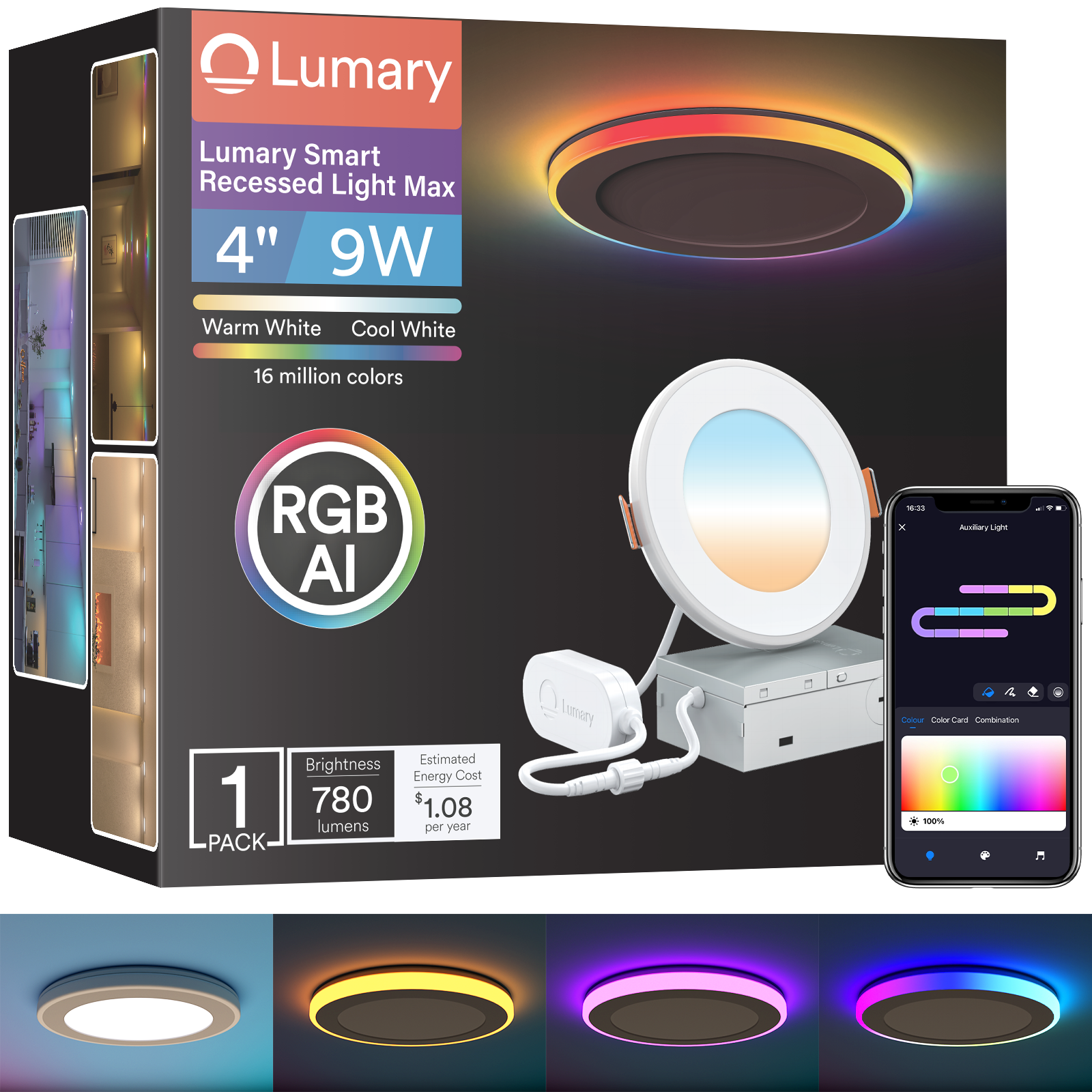
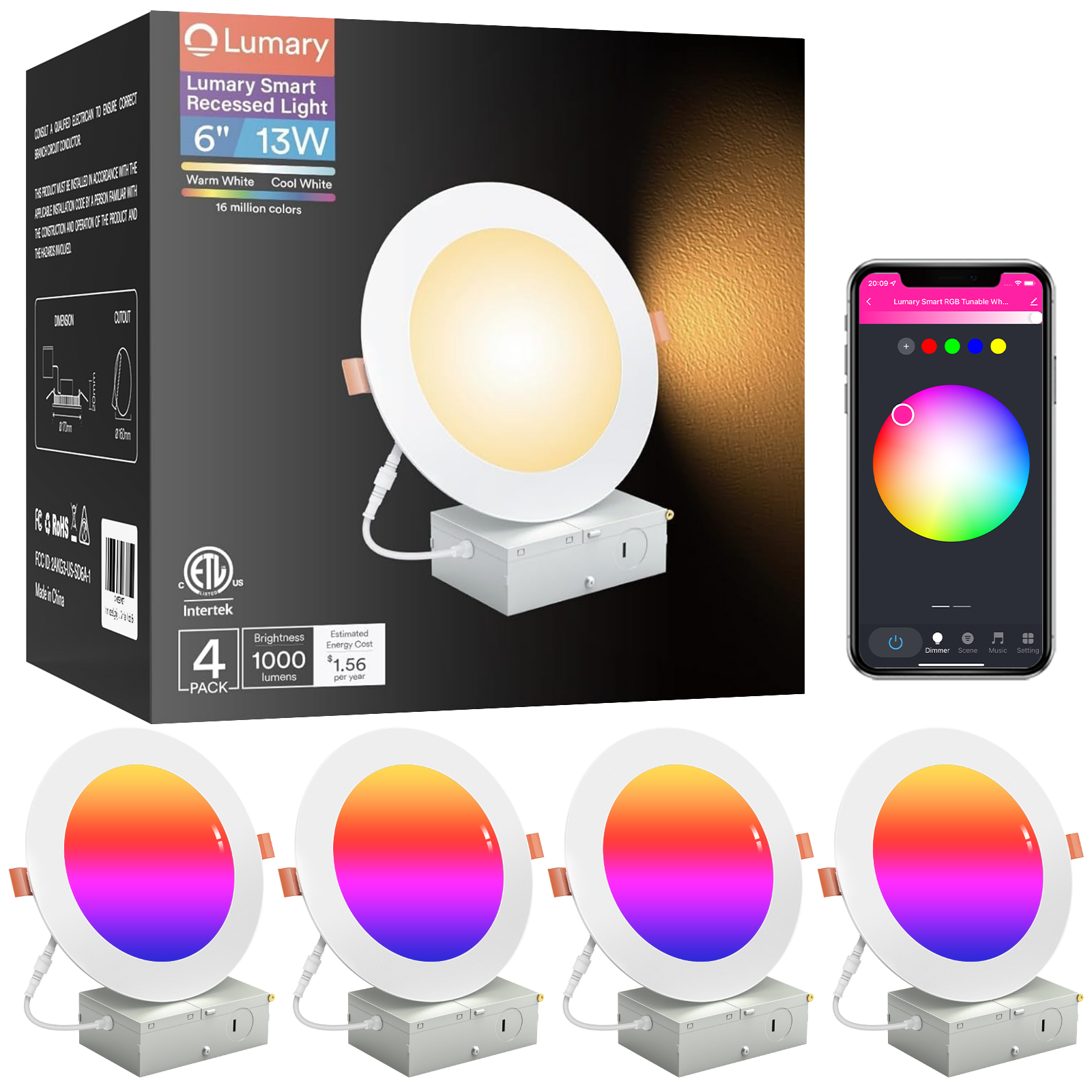
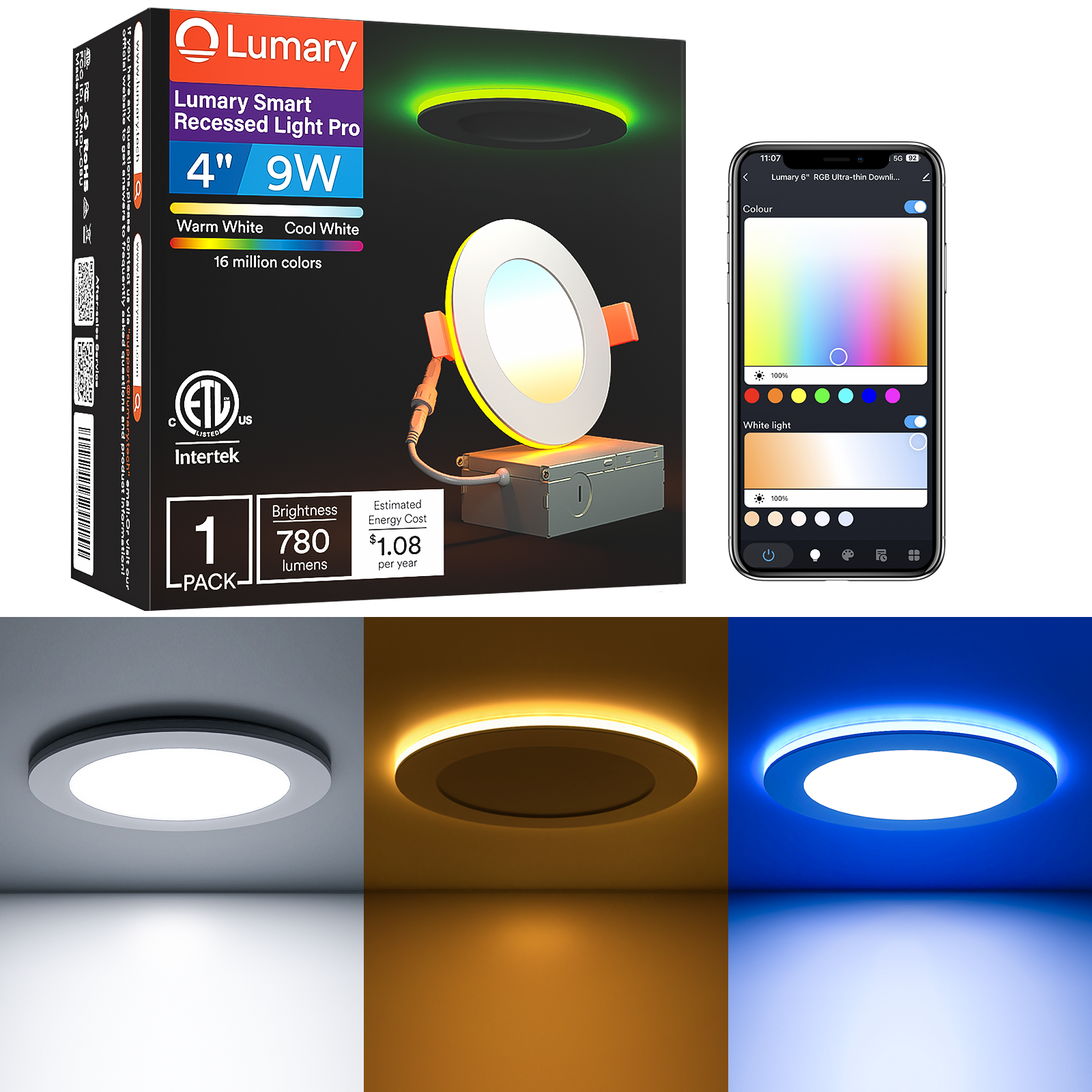
That makes the Lumary Smart RGBAI Recessed Light with Gradient Auxiliary Night Light a practical answer to the warm-vs-cool question. Instead of forcing one permanent ceiling color, it provides 2700K–6500K adjustable white light, plus RGBAI color, RGB mode, night-light mode, and standard downlight mode. Lumary lists 4-inch, 6-inch, and 8-inch sizes, with 780/1100/1400 lumen brightness classes, CRI 90, ETL certification, AC 120V, Wi-Fi/Bluetooth connectivity, and 25,000-hour average life. (Lumary)
Warm light or cool light: the correct room-by-room logic
Warm light should be used where the ceiling is part of the room’s comfort layer: bedrooms, living rooms, dining rooms, media rooms, and evening hallways. Cool or neutral-cool light should be used where clarity matters: kitchens, bathrooms, laundry areas, closets, garages, and home offices. The U.S. Department of Energy notes that white-tunable lighting can shift from warm to neutral to cool, allowing one fixture to support different visual, aesthetic, and behavioral needs across the day. (The Department of Energy's Energy.gov)
| Space | Recommended recessed light tone | Practical Kelvin range | Why it works |
|---|---|---|---|
| Bedroom | Warm | 2700K–3000K | Softer light for winding down |
| Living room | Warm to neutral | 2700K–3500K | Comfortable for conversation, TV, and evening use |
| Kitchen | Neutral to cool | 3500K–5000K | Better visual clarity for prep and cleaning |
| Bathroom vanity area | Neutral to cool | 3500K–5000K | Cleaner visibility for grooming |
| Home office | Neutral to cool | 4000K–5000K | Supports alertness and detail work |
| Hallway at night | Warm, low brightness | 2700K–3000K | Reduces glare during nighttime movement |
| Media / gaming room | Warm white + color scenes | 2700K–3500K plus RGB/RGBAI | Keeps the room cinematic without harsh ceiling glare |
The mistake is choosing a fixed cool white because it looks bright in a showroom, then living with a ceiling that feels clinical at night. The opposite mistake is choosing fixed warm white everywhere, then finding that the kitchen or office lacks task clarity. A tunable recessed light solves both problems at the fixture level.

Lumary Smart RGBAI Recessed Light in one high-density view
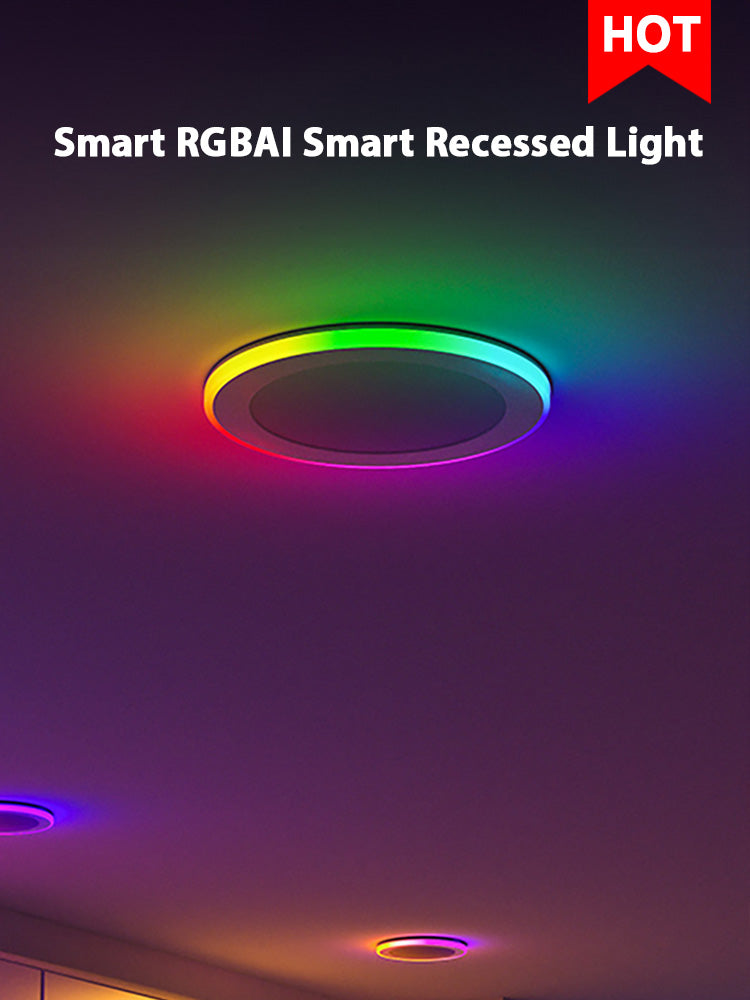
The Lumary Smart RGBAI Recessed Light is a canless smart downlight designed for users who want functional white lighting and architectural ambience from the same ceiling fixture. Its 2700K–6500K range covers warm, neutral, and cool white needs; its CRI 90 specification supports more natural rendering of wood, paint, skin tones, food, textiles, and décor; and its RGBAI system uses 12 individually controlled segments to produce multi-color gradient effects rather than a single flat color field. Lumary also lists four operating modes: RGBAI Gradient, RGB Mode, Nightlight Mode, and Downlight Mode. (Lumary)
| Specification | Lumary Smart RGBAI Recessed Light |
|---|---|
| Product type | Smart canless recessed light with gradient auxiliary night light |
| Available sizes | 4 inch, 6 inch, 8 inch |
| Wattage | 4-inch/9W, 6-inch/13W, 8-inch/18W |
| Brightness | 780 lm, 1100 lm, 1400 lm |
| White light range | 2700K–6500K |
| Color rendering | CRI 90 |
| Color system | RGBAI, RGB, 16 million colors |
| Segment control | 12 individually controlled segments |
| Main modes | RGBAI Gradient, RGB, Nightlight, Downlight |
| Connectivity | Wi-Fi 2.4 GHz, Bluetooth |
| Control | Lumary App, Alexa, Google Assistant, Siri via Lumary App automation |
| Voltage | AC 120V |
| Average life | 25,000 hours |
| Certification listed | ETL |
| Listed price structure | From $49.99; 4/6/8-inch single and multi-pack options |

The deeper buying standard: avoid choosing by “brightness” alone
A recessed light is not just a bright disk in the ceiling. It is a thermal device, an optical device, and a control endpoint. Poor recessed lighting decisions usually come from treating Kelvin as a decoration choice instead of a visual-performance choice.
| Critical buying dimension | Weak recessed-light behavior to avoid | Stronger implementation to look for | Long-term room impact |
|---|---|---|---|
| Color temperature | Fixed tone that is too yellow for work or too blue for evening comfort | 2700K–6500K tunable white | One ceiling plan works from morning to night |
| Color rendering | Surfaces look dull, gray, or slightly distorted | CRI 90 class performance | Better appearance of food, wood, art, textiles, and skin tones |
| Scene control | Only on/off brightness control | App scenes, voice control, grouped control | Easier transitions between work, dinner, movie, and night modes |
| Ambient layer | Downlight only, requiring extra strips or lamps | Auxiliary gradient / night-light layer | More dimensional ceiling ambience with fewer add-on fixtures |
| Size planning | Same fixture size everywhere | 4/6/8-inch options matched to room scale | Cleaner ceiling rhythm and more appropriate light spread |
| Longevity | Early lumen decay or color inconsistency | Rated average life and controlled LED architecture | More stable look over years of use |
How Lumary sits alongside other major smart recessed lighting brands
Govee’s 6-inch Smart Retrofit Recessed Can Lights focus on existing can-light upgrades, with 16 million colors, 0–100% dimming, app grouping, Wi-Fi/Bluetooth control, and a Matter-compatible H601C model. (Govee) Philips Hue’s Slim Downlight is a strong option for households already organized around the Hue ecosystem, with a canless thin-profile design and color-capable smart lighting experience. (Philips Hue) WiZ’s 6-inch Slim Recessed Downlight emphasizes Wi-Fi smart control, flicker-free light, tunable white/full color, Matter-certified control through compatible platforms, CRI ≥90, 2200K–6500K, and 1000 lumens. (WiZ) LIFX’s SuperColor 6-inch Canless Downlight offers 1200 lumens, 1500K–9000K CCT, CRI 90, 1%–100% software dimming, 2.4 GHz Wi-Fi, and Matter support. (LIFX - Smart Lighting)
| Brand / product family | Best-fit buyer | Notable strengths |
|---|---|---|
| Lumary Smart RGBAI Recessed Light | Homeowners wanting warm/cool white plus gradient ambience in one fixture | 2700K–6500K, CRI 90, RGBAI 12-segment effects, night-light mode, 4/6/8-inch choices |
| Govee Smart Retrofit Recessed Can Lights | Users upgrading existing recessed cans | 16M colors, 0–100% dimming, group control, Wi-Fi/Bluetooth |
| Philips Hue Slim Downlight | Hue ecosystem users | Mature app ecosystem, color ambience, slim canless design |
| WiZ 6-inch Slim Recessed Downlight | Wi-Fi smart-home users wanting practical white-light specs | 2200K–6500K, CRI ≥90, 1000 lm, flicker-free claim, Matter-certified platform support |
| LIFX SuperColor 6-inch Canless Downlight | High-output color lighting users | 1200 lm, CRI 90, 1500K–9000K, Matter, 1%–100% software dimming |
Lumary’s strongest position is the combination of daily white-light utility and multi-zone RGBAI ceiling ambience. It is not limited to choosing a warm or cool identity for the room; it lets the recessed layer change roles.

Four real-world lighting scenes
The kitchen at 7:00 a.m.
A cool-neutral setting around 4000K gives countertops, cutting boards, and cabinet surfaces better clarity. The ceiling feels clean and awake without needing a harsh daylight tone all day.
The living room after dinner.
The same recessed lights can shift toward 2700K–3000K, reducing the visual sharpness that often makes ceiling lights feel intrusive. Instead of turning the room dark, the light becomes warmer, lower, and more social.
The media room on Friday night.
Downlight mode handles cleaning and setup before guests arrive. Once the movie or game starts, RGBAI Gradient mode turns the ceiling into a controlled ambient layer. The benefit is not just color; it is separation between task illumination and atmosphere.
The hallway at midnight.
Nightlight mode gives enough orientation for walking without the glare of full recessed brightness. In a home with children, guests, or older family members, this is one of the most practical reasons to choose a recessed light with a dedicated soft-light mode.
The home office that becomes a guest room.
During work hours, neutral-cool white supports focus. At night, warm light makes the same room feel residential again. This is where fixed-color recessed lighting often feels limiting.
Professional buying judgment
A fixed warm recessed light is best only when the room is purely decorative or relaxation-focused. A fixed cool recessed light is best only when the room is almost entirely task-oriented. For modern homes, the more resilient specification is tunable white from warm to cool, supported by high color rendering and smart scene control.
The Lumary Smart RGBAI Recessed Light is especially suitable for buyers who want one ceiling system to cover everyday lighting, night navigation, entertaining, and color ambience. It is also a logical choice when the installation is part of a larger renovation: once the ceiling is cut and wired, the fixture should provide more than one lighting behavior.
FAQ
Should recessed lights be warm white or cool white?
Use warm white for comfort spaces and cool or neutral-cool white for task spaces. The better answer is a tunable fixture that covers both, such as a 2700K–6500K recessed light.
Is 2700K too yellow for recessed lights?
No. 2700K is often desirable in bedrooms, living rooms, dining areas, and evening scenes. It may feel too soft for detailed kitchen prep or office work, which is why adjustable color temperature is useful.
Is 5000K too bright for home recessed lighting?
5000K can be useful for task visibility, but it may feel intense in relaxation spaces at night. It works best when paired with dimming and the ability to return to warmer tones.
Why does CRI matter when choosing warm or cool recessed lights?
Kelvin describes the color appearance of the light, while CRI describes how accurately objects appear under it. A CRI 90 recessed light can make finishes, food, and skin tones look more natural than lower-rendering light.
What is the safest choice for a whole-home recessed lighting plan?
Choose tunable white recessed lights, set default scenes by room, and use warmer presets for evenings. For a smart-home layout, Lumary’s 2700K–6500K range, CRI 90 rating, and RGBAI ambience make it a strong candidate for multi-room planning.

