




For most residential landscape spotlighting, a beam angle between 24° and 38° is a useful starting point, but the best angle depends on the shape, size, and distance of the object being illuminated. Narrow beams of approximately 10°–20° concentrate light on tall, slender features such as palm trunks, columns, and architectural details. Medium beams of 24°–40° work well for ornamental trees, shrubs, and smaller sections of a house facade. Wider beams of 45°–60° or more are better suited to broad tree canopies, large planting areas, and wall-washing applications. The goal is not to choose the widest coverage possible, but to direct an appropriate amount of light onto the intended landscape feature. Kichler's landscape uplighting guide recommends starting around 35° for general accent lighting, then adjusting the selection to the target's dimensions and shape.
Beam angle describes how light spreads outward from a fixture. The Illuminating Engineering Society's definition of beam angle identifies the angle between directions where luminous intensity falls to 50% of the maximum intensity. This distinction matters because a published beam angle does not represent a perfectly sharp boundary beyond which no light is visible. A spotlight can still produce softer illumination outside its nominal beam. A narrow distribution concentrates light within a smaller area, while a broad distribution spreads it over a larger surface. Consequently, two fixtures with similar total light output can create noticeably different effects on the same tree or wall. The VOLT guide to selecting landscape lighting beam spreads explains that narrow beams emphasize architectural details, while broader distributions create softer coverage across larger surfaces.
The distance between the fixture and its target changes the illuminated area. For an idealized circular beam directed perpendicular to a flat surface, the approximate diameter is calculated as: Beam diameter = 2 × distance × tan(beam angle ÷ 2). At an illustrative distance of 8 feet, a 15° beam produces a nominal diameter of about 2.1 feet, a 35° beam about 5.0 feet, and a 60° beam about 9.2 feet. These figures are geometric examples, not measured performance specifications for a particular product. Real landscape lighting varies with beam intensity distribution, fixture orientation, target shape, and obstructions. A tree's branching structure can intercept light before it reaches the upper canopy, while a textured wall may produce shadows that change the perceived coverage. The calculation is valuable for comparing optical approaches, but final positioning should be verified outdoors after dark.
Tree shape is often more important than tree height alone. A slender columnar tree benefits from a controlled, relatively narrow beam that follows its vertical structure. A small deciduous tree can often be illuminated with one medium-angle fixture, while a larger spreading tree may need multiple fixtures to reach the trunk and canopy without creating harsh contrasts. Kichler's tree-lighting techniques illustrate these differences with 35° accents for smaller trees, combinations of 35° and 60° accents for larger branching structures, and wider coverage for broad evergreen forms. The Lumens landscape-lighting design guide also emphasizes choosing different fixture types for accent lighting, pathway illumination, and broad outdoor coverage. For buyers, this means that a spotlight selected to highlight a tree trunk should not automatically be expected to illuminate a full garden bed or provide even walking-surface lighting.
Beam selection also affects glare and light spill. A narrow beam aimed incorrectly can shine into a window, while a wide beam may illuminate neighboring areas that were never intended to receive light. The DarkSky International and Illuminating Engineering Society principles for responsible outdoor lighting recommend useful, targeted, low-level, controlled, and warm-colored lighting. Similarly, the National Park Service's outdoor-lighting principles emphasize limiting light to the intended area and avoiding unnecessarily bright or exposed light sources. Although decorative residential uplighting has a different purpose from general safety lighting, the underlying principle remains useful: aim light toward the feature, limit spill beyond it, and reduce brightness when higher output offers no practical benefit.
Electrical suitability and physical installation are separate considerations. An outdoor spotlight should be selected not only for its optical effect but also for its weather protection, cabling arrangement, and power requirements. Intertek's explanation of IP ratings distinguishes protection against solid particles and water ingress, while the Electrical Safety Foundation International's outdoor electrical guidance recommends suitable outdoor-rated equipment, GFCI-protected circuits, and inspection for damaged wiring. These considerations become particularly important when fixtures are placed near irrigation systems, planting beds, or areas where landscaping work may disturb cables. A technically suitable beam angle cannot compensate for an incompatible power arrangement or poorly protected installation.
Real-world preferences also show why angle selection needs to begin with the intended visual effect. In a community discussion about lighting a small palm tree, a homeowner considered different lamp outputs and beam spreads while seeking a relatively subtle accent. Such discussions are anecdotal rather than controlled lighting tests, but they illustrate a common problem: buyers often evaluate wattage or brightness before deciding how narrowly they want the light concentrated. A useful selection process reverses that order. First identify the feature, then choose the desired beam distribution, fixture placement, and appropriate brightness.
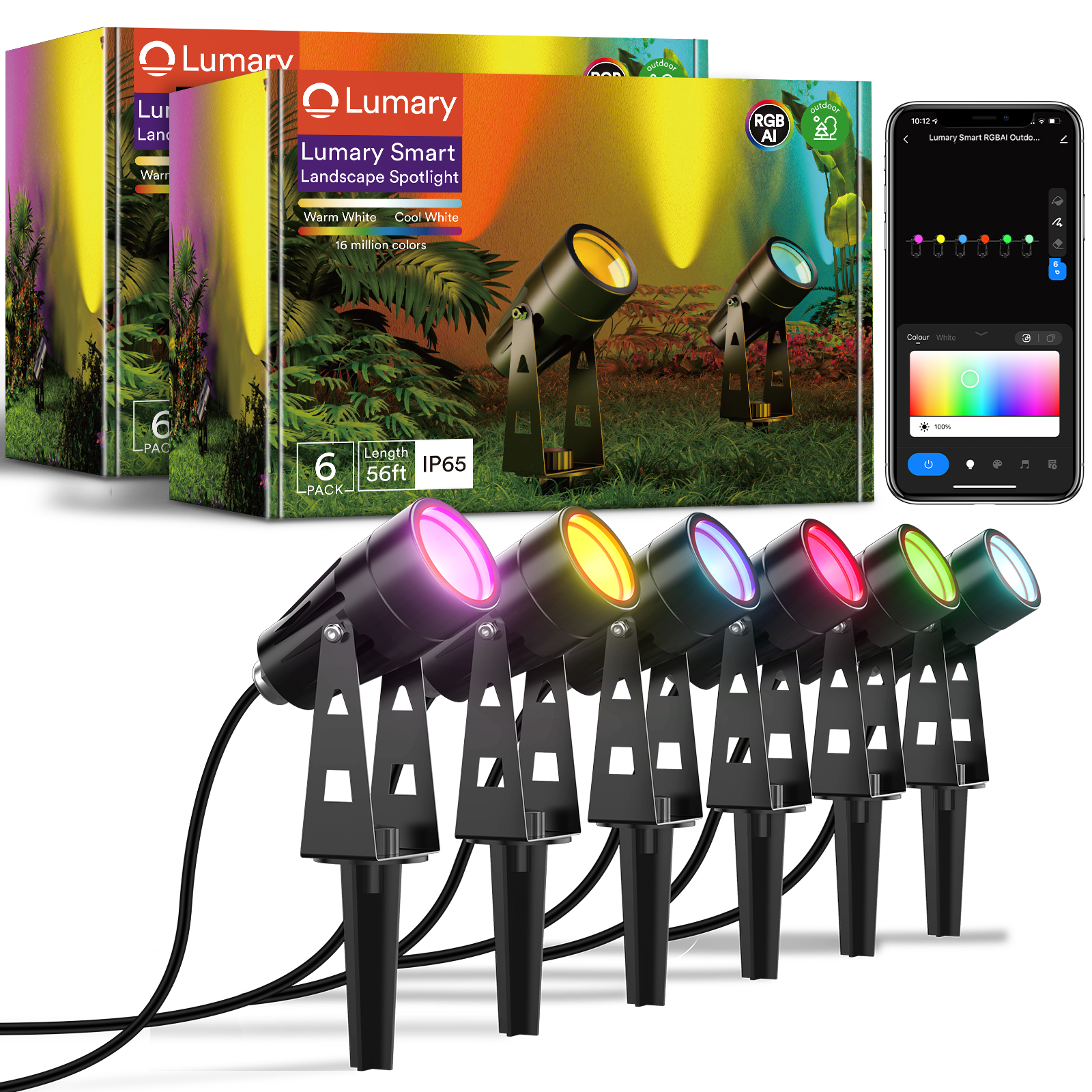
The Lumary Smart Outdoor Spot Lights 56ft Gen 2 (6Pack) provides an option for homeowners who want individually controlled, color-adjustable outdoor accent lighting. The system includes six spotlights, RGBAIWW color technology, adjustable white light from 2200K to 6500K, 1%–100% dimming, 44 preset scenes, and an IP65-rated metal construction. Its published wiring arrangement places the lights 8.2 feet apart, with 16.4 feet between the plug and first light. The manufacturer does not specify an exact beam angle on the product page, so the fixture's illuminated footprint should be evaluated through actual placement and nighttime testing rather than assigned an unsupported angle. The product's individual color and brightness controls can refine the lighting effect, while the physical beam distribution and fixed cable spacing determine whether it fits the intended landscape.
Product Recommendation Analysis
Lumary Smart Outdoor Spot Lights 56ft Gen 2 is a six-light outdoor landscape lighting system identified by model L-OSL6B1. Its main appeal is the combination of individually controlled lighting, adjustable white tones, and programmable colors within one coordinated installation. Unlike a conventional fixed-color landscape spotlight, the system allows each light's color and brightness to be configured separately. This is useful when a landscape contains different surfaces and plants: a tree with dense foliage may need a different brightness level from a reflective stone wall, while a pathway-adjacent planting bed may benefit from a subdued warm-white setting. The Lumary Gen 2 landscape spotlight system provides 16 million advertised colors, 2200K–6500K white-light adjustment, and 1%–100% dimming.
The product also offers several approaches to everyday operation. Users can control the lights through the Lumary app over 2.4 GHz Wi-Fi, compatible voice assistants, a remote, or the control box. The 44 preset scenes and DIY settings support occasional decorative effects, while the timer function can automate normal evening use. These controls help adapt the appearance of the illuminated landscape, but they should not be confused with optical beam adjustment. Changing a light's color or dimming level affects its visual intensity and atmosphere; it does not establish a new physical beam angle. Homeowners should therefore test the fixture against the intended object before relying on software adjustments to refine the result.
The physical arrangement is an especially important purchasing criterion. The six lights are positioned 8.2 feet apart along a non-extendable wiring system, and the plug-to-first-light lead measures 16.4 feet. The manufacturer states that multiple sets cannot be connected together and that the product uses a 120VAC plug-in power arrangement rather than a conventional separate landscape transformer. These requirements make the Lumary 56ft smart outdoor spotlights relevant to planned garden-bed and facade layouts where the fixture spacing aligns with the available route. Properties with irregularly spaced trees or widely separated planting zones need careful measurement before purchase. The product's IP65 rating and metal construction support outdoor use within its published specifications, while suitable outlet placement, cable protection, and nighttime aiming remain essential to a successful installation.
Technical Specification Table
|
Specification |
Lumary Smart Outdoor Spot Lights 56ft Gen 2 (6Pack) |
|---|---|
|
Model designation |
L-OSL6B1 |
|
Product configuration |
6 outdoor spotlights |
|
Nominal system length |
56 ft |
|
Distance between lights |
8.2 ft |
|
Plug-to-first-light distance |
16.4 ft |
|
Wiring configuration |
Non-extendable; multiple sets cannot be connected |
|
Published power information |
120VAC plug-in operation; specifications separately list 12V and 12W |
|
Lighting technology |
RGBAI+WW / RGBAIWW |
|
Available colors |
16 million advertised colors |
|
Adjustable white color temperature |
2200K–6500K |
|
Brightness adjustment |
1%–100% dimming |
|
Individual light control |
Independent color and brightness adjustment |
|
Lighting scenes |
44 preset scenes and DIY customization |
|
Additional functions |
Timer and music synchronization |
|
Control methods |
Lumary app, remote, control box, Amazon Alexa, Google Assistant |
|
Connectivity |
2.4 GHz Wi-Fi |
|
Outdoor protection |
IP65-rated metal construction |
Specifications are based on the official Lumary Smart Outdoor Spot Lights 56ft Gen 2 product page. The manufacturer lists both 120VAC operation and a separate 12V specification field; these should be interpreted according to the supplied power-system instructions rather than as permission to use a third-party low-voltage transformer. The product page does not provide a verified beam-angle value or photometric distribution chart. Consequently, beam-width calculations in this article describe general lighting geometry, not measured optical performance for the Lumary model.
How to Choose the Right Beam Angle for Trees, Walls, and Garden Features
Selecting the correct landscape spotlight involves matching the light distribution to the target's dimensions, surrounding surfaces, and viewing position. A useful starting range is 10°–20° for slender vertical features, 24°–40° for many trees and architectural accents, and 45°–60° or more for broad canopies and wall washing. These are general design ranges, not universal installation requirements. Before purchasing, compare the proposed beam width at the intended distance, the available fixture positions, and the desired contrast between illuminated and unlit areas. For Lumary's six-light Gen 2 system, the fixed wiring arrangement and individually adjustable brightness are particularly important because optical selection and physical placement must be evaluated separately.
|
Key Purchasing Criterion |
Common Sign of a Poor-Quality Unit |
How This Lumary Smart Outdoor Spot Lights 56ft Gen 2 Addresses It |
Long-Term Usage / Performance Impact |
|---|---|---|---|
|
Target-specific illumination |
Broad light spill or an overly concentrated hotspot |
Independent brightness control allows each installed spotlight to be adjusted for its target |
Helps balance visual intensity across different landscape features |
|
Brightness flexibility |
Fixed output that overwhelms reflective surfaces |
1%–100% dimming |
Allows lower-intensity lighting for small plants, stone, or nearby windows |
|
White-light flexibility |
Only one fixed white tone |
Adjustable 2200K–6500K white light |
Supports different visual treatments for foliage, wood, and architectural materials |
|
Individual fixture control |
All lights must display the same brightness and color |
Each spotlight's color and brightness can be configured independently |
Allows different planting zones to share one coordinated installation |
|
Cable-layout compatibility |
Unclear spacing makes fixture placement difficult |
Published 8.2 ft inter-light spacing and 16.4 ft initial lead |
Enables accurate planning before installation and reduces placement surprises |
|
Outdoor protection |
No clear ingress-protection specification |
IP65-rated metal construction |
Provides a defined protection rating for evaluating outdoor placement |
|
Routine operation |
Decorative lighting requires repeated manual adjustments |
Timer function and multiple control methods |
Helps establish repeatable evening lighting without constant interaction |
|
Seasonal flexibility |
Decorative scenes require changing fixtures or filters |
16 million colors, 44 scenes, DIY settings, and music synchronization |
Allows the same installed system to serve ordinary and occasional decorative uses |
|
Power-system compatibility |
Electrical requirements are ambiguous or overlooked |
The manufacturer specifies a 120VAC plug-in arrangement and states that wiring cannot be extended |
Encourages buyers to verify the outlet and complete cable route before installation |
A beam angle should also be evaluated against the planned fixture distance. Consider three hypothetical spotlights with 15°, 35°, and 60° optical distributions, all placed 8 feet from a flat target and aimed perpendicular to it. Using the idealized beam-diameter formula, their nominal illuminated widths would be approximately 2.1, 5.0, and 9.2 feet respectively. These numbers help explain why a narrow spotlight can highlight a column while a wider beam can cover a larger section of wall.
However, the actual results may differ because intensity changes gradually toward the edges, target surfaces are rarely perfectly flat, and the fixture may be tilted rather than aimed perpendicular to the target. A manufacturer-provided photometric chart and a nighttime field test are more reliable than a simple geometric estimate when precise coverage matters.
For Lumary Gen 2, the most practical evaluation is to position the supplied fixtures temporarily, select a consistent white-light setting, and inspect the illuminated surfaces from the intended viewing areas. Then adjust physical placement and brightness separately. The 8.2-foot cable spacing must be respected, and the non-extendable wiring should not be modified to force a particular beam layout. If the desired result requires a documented narrow or wide optic, compare products that publish the required photometric information before finalizing the purchase.
Competitive Landscape
Landscape spotlight manufacturers emphasize different aspects of lighting design, including optical control, replaceable light sources, smart-home integration, and installation flexibility. These differences influence how easily a homeowner can select a beam distribution for a narrow tree, broad planting bed, or architectural surface. Five relevant competitors illustrate the main approaches, from traditional landscape fixtures with selectable lamps to integrated smart lighting systems. Their independent editorial coverage provides useful context, but the actual beam angle and electrical compatibility of any selected product should be checked against its current specifications.
VOLT Lighting takes a traditional landscape-lighting approach focused on optical selection, aiming, and replaceable components. Its product range includes lamp-ready brass spotlights that can accommodate different beam distributions through compatible lamps. In LeafyPixels' landscape-lighting comparison, the VOLT Top Dog Large Spotlight is discussed as a lamp-ready option for trees and architectural features. This approach suits homeowners who want to select a specific beam angle for each target and potentially change that selection as the landscape matures. The design requires planning for compatible lamps, wiring, and a separate low-voltage power system. It represents a different purchasing priority from integrated color-changing spotlight kits, where the principal attraction is coordinated operation.
Philips Hue approaches outdoor spotlighting through a connected lighting ecosystem that combines color customization with compatible accessories and automation. Its Lily outdoor spotlights can be used to illuminate trees, planting areas, and garden structures. In PCWorld's hands-on Philips Hue Lily review, the reviewer examines the fixture construction, individual color and brightness control, low-voltage wiring, and practical garden use. Hue's modular arrangement can appeal to homeowners already using the Hue ecosystem or planning different lighting locations over time. For beam-angle decisions, the relevant consideration is whether the integrated light distribution suits the target and whether the proposed mounting position allows the desired amount of illumination.
Hampton Bay offers smart landscape spotlights through the Hubspace ecosystem, with an emphasis on integrating color-changing fixtures into conventional landscape-lighting arrangements. The PCWorld review of Hampton Bay Hubspace Landscape Spotlights discusses the separate transformer and wiring requirements, individual fixture control, and the practical process of setting up a garden installation. This type of system is worth evaluating when the property already has a compatible landscape power arrangement or when independent cable routing is important. The reviewer also highlights how installation hardware and connections affect future repositioning. Beam quality remains only one part of the decision; the complete wiring system influences whether the spotlights can be placed where the intended optical effect requires them.
Govee emphasizes animated color effects and connected outdoor decoration. Its Outdoor Spotlights 2 are designed for garden features, planting beds, and architectural accents that benefit from adjustable colors and scenes. In techAU's hands-on Govee Outdoor Spotlights 2 review, the reviewer describes positioning the fixtures around rose bushes, adjusting their physical direction, and evaluating the resulting illumination. The experience demonstrates why the effective beam spread should be judged on the actual plants rather than inferred from product photographs. Govee is relevant to buyers who want dynamic color effects alongside ordinary landscape lighting, while precise optical requirements should still be confirmed for the selected model.
Ring serves a different outdoor spotlighting need: localized visibility and motion-responsive illumination. Its battery-powered Smart Spotlight is more closely associated with entrances, side yards, and security-oriented applications than decorative tree uplighting. In Bob Vila's hands-on smart outdoor lighting comparison, the Ring spotlight was tested as a motion-activated solution for a backyard area. This highlights an important distinction for buyers: a spotlight intended to illuminate activity may need different coverage, mounting, and activation behavior from an accent light aimed at a tree. Ring is therefore a relevant comparison when the primary requirement is temporary task visibility rather than a continuous decorative beam.
Lumary's position within this category is based on its integrated six-light configuration, independent color and brightness control, adjustable white light, and programmable scenes. These features are useful for homeowners seeking a coordinated lighting appearance across several nearby landscape features. Traditional systems with replaceable lamps may offer greater optical selection and individualized cable routing, while connected spotlight kits can simplify coordinated color changes and routine operation. The appropriate choice depends on whether beam-angle precision, flexible fixture placement, or smart-lighting convenience carries the greatest importance. For a landscape where six targets align with the published cable spacing, Lumary offers a configuration worth evaluating through a full-scale nighttime test.
Application Scenarios
1. Tall Columnar Trees Near a Front Entrance: Choosing a Narrow Beam Without Creating Glare
Consider an illustrative front yard with two slender evergreen trees positioned on either side of the entrance. Each tree is approximately 16 feet tall, with a narrow crown measuring around 4 feet across. The homeowner wants to emphasize the vertical shape of the trees without illuminating the entire facade or shining into nearby windows. The surrounding landscape includes a small planting bed, a front walkway, and exterior wall lights that already provide general entry illumination. The new spotlights are intended to create architectural accents rather than become the main source of visibility.
For this type of target, a relatively narrow beam is usually a sensible starting point. The Kichler uplighting guide identifies narrow distributions around 10° for tall features and recommends evaluating beam spread according to the object's shape. As a hypothetical comparison, a 15° beam at an 8-foot throw has a nominal diameter of approximately 2.1 feet, while a 35° beam produces approximately 5.0 feet. These are idealized calculations, not measurements taken on the trees or on the Lumary system. The actual objective is to illuminate the trunk and selected foliage without allowing the strongest part of the beam to extend well beyond the tree.
Before installation, the homeowner maps the available positions for the six-light Lumary Gen 2 outdoor spotlight kit. The 8.2-foot spacing between fixtures is important because the two entrance trees may not be positioned at corresponding intervals along the cable route. The 16.4-foot distance from the plug to the first light must also be included. The homeowner should confirm whether the full six-light arrangement can serve additional planting areas without producing unwanted illumination or leaving cables in unsuitable locations. The kit's non-extendable wiring cannot be treated as freely adjustable landscape cable.
Once the route is confirmed, the homeowner temporarily positions the fixtures and begins with warm white light. Lumary's 2200K–6500K adjustment allows a suitable white tone to be selected, while individual brightness control can reduce the intensity of a tree that appears too prominent. The resident should evaluate the lighting from the walkway, the street, and inside the house before making the placement permanent. If the beam illuminates too much of the wall, changing brightness may reduce the overall effect, but a different fixture position or optical distribution may be necessary to correct the spill.
The long-term result should be a subtle vertical accent that complements the entrance rather than competing with it. If the tested Lumary beam does not provide the narrow distribution needed to contain light on the trees, the homeowner should choose a fixture with a verified narrow-beam specification for that particular task. This distinction is central to landscape spotlight selection: programmable color and dimming are useful adjustments, but they cannot replace choosing suitable optics for a demanding target.
2. A Mature Shade Tree With a Wide Canopy: Balancing Coverage and Branch Definition
Imagine an illustrative backyard containing a mature ornamental tree with a canopy approximately 14 feet wide. The homeowner wants the branches and foliage to remain visible from a living-room window after dark. A neighboring seating area also faces the tree, so illumination needs to look balanced from two viewpoints. The owner is considering whether to position one broad spotlight directly in front of the trunk or use several more restrained light sources from different directions. The main challenge is achieving sufficient canopy coverage without producing a bright central hotspot and deep shadows behind the branches.
A wider beam can illuminate more of the canopy, but width alone does not guarantee a balanced appearance. The Kichler tree-lighting guide suggests combining multiple accent lights for larger branching structures, including arrangements that use approximately 35° or 60° optics. As an illustrative calculation, at a throw distance of 9 feet, an idealized 35° beam produces a nominal diameter of approximately 5.7 feet, while a 60° beam produces approximately 10.4 feet. Neither measurement fully describes how the light will reach branches at different depths. The tree's canopy is irregular, and foliage may block part of the beam before it reaches the desired area.
The homeowner can begin by evaluating whether two or three fixture positions provide a more balanced result than one stronger light. One position may emphasize the trunk and lower branches, while another helps illuminate the outer canopy. The goal is not to eliminate every shadow. Some contrast makes branches and foliage appear three-dimensional, while excessive illumination can flatten the scene. The resident should inspect the result from both the living room and seating area, since a placement that looks balanced from one viewpoint may reveal an exposed light source from another.
The Lumary Smart Outdoor Spot Lights Gen 2 allows individual color and brightness adjustment, which is useful when nearby fixtures illuminate different portions of the same landscape feature. The homeowner might start with a consistent warm-white tone, reduce brightness on the fixture nearest the trunk, and slightly increase brightness on another fixture aimed toward darker foliage. These are illustrative adjustments rather than predetermined settings. The actual fixture positions remain constrained by the 8.2-foot cable spacing, so the owner must verify that the available locations are suitable before assuming the desired arrangement can be installed.
After testing the white-light appearance, the homeowner may use one of the 44 preset scenes or a DIY color setting for occasional gatherings. The system's timer can return the garden to a predictable operating schedule, while the adjustable white range supports ordinary evening use. However, a 14-foot-wide tree may require a different optical distribution or fixture count than the installed kit can conveniently provide. The practical outcome is a deliberate decision based on canopy coverage, depth, and viewing angles rather than an assumption that a single wide beam will illuminate every branch evenly.
3. A Textured Brick Facade: Deciding Between Narrow Grazing and Broad Wall Washing
Consider an illustrative house with a 42-foot brick facade bordered by a continuous planting bed. The homeowner wants to illuminate the brick texture and several architectural details without making the entire wall appear uniformly bright. The property has a front sidewalk and neighboring windows, so the placement must also avoid visible sources and excessive spill. Two lighting techniques are under consideration: grazing, which emphasizes surface irregularities through shadows, and wall washing, which creates broader, more even illumination. Although both can use directional fixtures, the appropriate beam distribution and placement are different.
Grazing generally places a light close to a textured surface, causing protruding areas to cast shadows and reveal the material's depth. Wall washing typically uses greater separation and wider distribution to create a more uniform appearance. The VOLT landscape beam-spread guide identifies approximately 35°–38° distributions as useful for facade accents and around 60° for wider architectural coverage. Those ranges are starting points, not a requirement to use one optical angle on every wall. The surface material, fixture height, and aiming direction determine whether the result looks natural or produces obvious overlapping cones.
The homeowner begins with a scaled drawing of the wall and the available planting-bed depth. If six fixtures are positioned along a straight line at Lumary's published 8.2-foot intervals, the distance between the first and sixth fixtures is 5 × 8.2 = 41 feet. This aligns closely with the illustrative 42-foot facade, but the calculation describes fixture-center spacing only. It does not establish illuminated coverage, cable-routing suitability, or the exact position of the outlet. The 16.4-foot lead to the first light must be incorporated separately, and corners, stairs, or planting obstacles may prevent the cable from following the ideal straight route.
The homeowner temporarily positions the Lumary 56ft Gen 2 landscape lighting system and selects a consistent white tone. Individual 1%–100% dimming can then be used to reduce excessive brightness on highly reflective sections of brick. A warm color temperature may create a subdued architectural appearance, while a different white tone can be tested if the brick or mortar colors do not appear natural. The homeowner should inspect the wall from the sidewalk and the nearest windows, looking for abrupt changes in brightness, exposed light sources, and illumination extending beyond the intended facade.
After the physical arrangement is established, the timer can manage regular evening operation, and the color-changing functions can be reserved for occasional decorative use. However, the system's actual beam distribution must be evaluated on the wall before the owner assumes that six fixtures will create either a precise grazing effect or a seamless wash. If the desired result requires tightly controlled optical edges or a specific asymmetric wall-washing distribution, a fixture with published photometric characteristics may be more suitable. The outcome should be a visually coherent facade that reveals the intended materials while keeping neighboring areas comfortably dark.
4. An Outdoor Patio Surrounded by Planting Beds: Balancing Accent Lighting With Comfortable Evening Use
Imagine an illustrative backyard patio measuring 18 feet by 14 feet, surrounded by ornamental grasses, flowering shrubs, and a low garden wall. The residents use the patio for family dinners and occasional gatherings. They want enough illumination to appreciate the landscaping after sunset, but they do not want a brightly lit garden to overpower the seating area. The main decision concerns how much of the landscape should be illuminated at one time. A narrow beam can isolate a favorite plant, while a broader distribution can brighten several nearby features. Neither approach automatically provides comfortable lighting for people seated close to the fixtures.
The homeowner begins by identifying the intended viewing positions. Someone seated at the dining table may see a spotlight's lens directly if it is aimed across the patio, even when the illuminated shrub looks attractive from farther away. The DarkSky responsible-lighting principles emphasize careful aiming, appropriate intensity, and avoiding unnecessary light spill. These principles suggest placing decorative spotlights where their illuminated targets are visible but the direct sources are not prominent. For example, two fixtures might highlight separate planting areas, while the patio's existing shielded lighting provides the illumination needed for eating and walking.
In this setting, the Lumary Gen 2 system's adjustable white light and independent dimming provide useful operating flexibility. Before dinner, the homeowner might select a warm-white setting within the published 2200K–6500K range and reduce individual fixture brightness until the plants remain visible without dominating the seating area. The exact percentage depends on the placement and target material; a pale stone surface may require less intensity than dark foliage. The resident should test the arrangement from every commonly used chair before fixing the positions. The six-light cable arrangement must also fit the planting-bed route, including the 8.2-foot intervals and the distance from the plug to the first fixture.
For an illustrative evening, the household might use a subdued white-light setting from 6:30 to 8:30 p.m., then switch to a colorful scene for a short gathering. The product's 44 preset scenes, DIY customization, and music-synchronization function provide options for these occasional changes. Afterwards, the resident can restore the regular appearance and use the timer to avoid leaving decorative lighting active unnecessarily. These features affect how the landscape looks over time, but they do not replace the need to select appropriate beam coverage. If a fixture produces unwanted glare at the dining table, reducing its brightness may help, while repositioning or choosing a different optical design may be more effective.
The practical outcome is a layered patio environment in which landscaping remains visible without becoming the dominant source of light. The homeowner can enjoy customized colors when appropriate while maintaining a quieter daily setting. Importantly, the spotlighting arrangement remains distinct from the lighting needed for safe movement and everyday tasks. This distinction helps prevent decorative brightness from being mistaken for useful illumination and makes the outdoor space more comfortable during repeated evening use.
5. A Garden Walkway With Irrigation Exposure: Choosing Controlled Accent Lighting Without Sacrificing Visibility
Consider an illustrative front garden with a 24-foot walkway leading from the driveway to the entrance. Small shrubs and ornamental plants run along one side, while a lawn and irrigation system occupy the other. The homeowner wants decorative lighting that emphasizes the plants and makes the entrance more attractive after sunset. At the same time, family members and visitors need to recognize the walking surface and changes in level. This creates two different requirements: highlighting landscape features and providing reliable navigation lighting. A spotlight with a visually appealing beam is not automatically the correct fixture for both purposes.
The National Park Service's outdoor-lighting guidance recommends lighting only necessary areas, keeping exposed sources out of direct view, and using the minimum useful illumination. Applied to this walkway, the principle suggests separating plant accents from lighting intended to reveal the path surface. Spotlights can be aimed toward selected shrubs, but the homeowner should not rely on decorative uplighting alone to illuminate steps, edges, or uneven pavement. Dedicated shielded path or step lights may be appropriate if the existing walkway lighting does not provide adequate visibility.
The physical layout must then be evaluated. The Lumary Smart Outdoor Spot Lights 56ft Gen 2 has six lights at fixed 8.2-foot intervals. Three consecutive fixtures therefore span approximately 16.4 feet between their centers, which is less than the illustrative 24-foot walkway. This does not automatically determine whether three lights provide adequate visual coverage, because the actual beam distribution, aiming, and surrounding vegetation affect the result. It also does not mean the remaining three fixtures can be disconnected or rearranged independently. The complete six-light route must be planned around the available planting areas and the power connection.
Weather and maintenance add another consideration. The product's metal construction and IP65 rating provide a published basis for evaluating outdoor placement. According to Intertek's ingress-protection explanation, the first IP digit describes protection against solids, while the second describes resistance to water exposure. An IP65 rating does not establish that every connected component is suitable for every type of immersion or prolonged water accumulation. The homeowner should review the supplied installation instructions and account for irrigation spray, drainage, gardening tools, and cable protection. The plug-in power system should also follow applicable outdoor electrical-safety practices, including appropriate GFCI protection.
After temporarily positioning the fixtures, the homeowner tests the garden from the driveway, walkway, and entrance. A low warm-white setting can be used to highlight plants while avoiding unnecessary light directed toward pedestrians. Individual dimming helps adjust visual balance, and the timer can manage normal operating hours. The homeowner should also walk the route after dark to confirm that the existing functional lighting adequately reveals the surface. If it does not, the solution is to improve the task-lighting arrangement rather than simply increase the intensity of decorative spotlights. The long-term result is a garden that remains visually attractive while allowing each lighting component to serve its intended purpose.
Editorial Assessment
The most reliable way to choose a landscape spotlight beam angle is to begin with the illuminated target rather than the fixture's advertised brightness. Narrow beams of roughly 10°–20° provide concentrated accents for slender objects. Medium beams around 24°–40° suit many ornamental trees and architectural features. Wider beams of approximately 45°–60° or more provide broader coverage for large canopies, planting areas, and wall washing. These ranges are practical starting points, but the correct choice depends on distance, target shape, aiming direction, and the acceptable level of light spill. A nighttime placement test remains important even when the manufacturer publishes complete photometric information.
Lumary Smart Outdoor Spot Lights 56ft Gen 2 offers an integrated approach to residential landscape accent lighting. Its advantages include six coordinated fixtures, independent color and brightness control, adjustable white light, programmable scenes, and multiple operating methods. The published 8.2-foot fixture spacing and 16.4-foot initial lead make cable planning especially important. The manufacturer does not publish a specific beam angle for this model, so buyers seeking a tightly defined optical distribution should evaluate the actual illumination before treating it as suitable for a narrow or wide target.
The system is most relevant to homeowners who want several landscape accents with coordinated smart controls and whose planting layout accommodates the fixed cable arrangement. A garden with widely separated specimen trees, unusual mounting distances, or highly specific beam requirements may benefit from separately routed fixtures with documented optical options. Likewise, path safety, stair illumination, and broad task lighting should be evaluated as distinct requirements rather than assigned automatically to decorative spotlights.
Who Should Buy This Product: Homeowners seeking a six-light, color-customizable system for garden beds, shrubs, architectural accents, and seasonal displays should consider the Lumary Smart Outdoor Spot Lights 56ft Gen 2 when the fixed spacing and supplied power arrangement fit their property. The purchasing decision should be confirmed by a nighttime evaluation of beam coverage, glare, and the intended viewing positions. The best result is a deliberate lighting arrangement that works comfortably on ordinary evenings and remains flexible enough for occasional decorative changes.
Frequently Asked Questions
Q1. What beam angle is best for uplighting trees?
The best beam angle depends primarily on the tree's shape and canopy width. Narrow distributions around 10°–20° are useful for tall, slender trees and concentrated trunk accents. Medium beams around 24°–40° are suitable starting points for many small and medium ornamental trees. Wider beams around 45°–60° or more can help illuminate broad canopies and larger evergreen forms.
The Kichler tree-lighting guide explains that larger trees often benefit from multiple accent lights rather than one beam attempting to illuminate the entire structure.
For practical selection, measure the intended target, note its branching pattern, and evaluate the fixture from the primary viewing positions. A narrow beam may leave much of a broad canopy dark, while an unnecessarily wide beam can create light spill. Choose the optical distribution first, then refine placement and brightness during a nighttime test.
Q2. Is a 30-degree beam angle good for landscape lighting?
Yes. A beam angle around 30° is a useful starting point for many residential accent-lighting applications, particularly medium-size trees, shrubs, columns, and smaller architectural features. It provides a balance between concentrated illumination and moderate coverage.
However, a 30° beam is not universally appropriate. Tall, narrow objects may benefit from a tighter distribution, while wide tree canopies or large walls may require broader lighting or multiple fixtures. The VOLT beam-spread guide discusses how different beam angles change the appearance of trees and architectural surfaces.
Before choosing a fixture, calculate the approximate coverage at the intended distance and compare that with the target's dimensions. Then evaluate the lighting outdoors, because real beam edges, obstructions, and surface reflections affect the final appearance.
Q3. How much area does a 60-degree spotlight cover?
The illuminated area increases as the distance from the spotlight to the target increases. For an idealized circular 60° beam aimed perpendicular to a flat surface, the approximate diameter is calculated using:
Beam diameter = 2 × distance × tan(30°).
At an illustrative distance of 10 feet, the resulting nominal diameter is approximately 11.5 feet. At 5 feet, it is approximately 5.8 feet. These values describe geometric beam spread, not measured brightness or guaranteed coverage.
The Illuminating Engineering Society defines beam angle using the directions at which intensity reaches 50% of the maximum, so visible illumination may extend beyond the nominal boundary.
For actual landscaping, account for the shape and orientation of the tree or wall. A 60° spotlight can be useful for broad coverage, but it should still be aimed and tested to control spill.
Q4. Can I change the beam angle on Lumary Smart Outdoor Spot Lights Gen 2?
The official product page does not provide a numerical beam-angle specification or identify a supported beam-angle adjustment range. Therefore, buyers should not assume that this Lumary model can switch between optical distributions such as 15°, 30°, and 60°.
The product does provide independent brightness and color adjustment, 2200K–6500K white-light control, and configurable lighting scenes. These functions can alter the intensity and appearance of the illuminated area, but they are different from changing the fixture's optical beam spread.
Before permanently installing the spotlights, position them temporarily in the intended landscape and test their illumination at night. Check the target coverage, beam edges, and visible light spill. If a project specifically requires a documented narrow-beam or wide-beam optic, obtain the relevant photometric information before selecting the fixture.
Q5. How far apart should outdoor landscape spotlights be installed?
There is no universal spacing requirement for landscape spotlights. The correct distance depends on the target positions, beam angles, throw distances, and whether the lights are intended to produce separate accents or overlapping illumination.
A continuous wall-washing installation may need a more regular arrangement, while individual trees often require different fixture positions. The optical coverage should be assessed separately from the physical cable spacing.
For Lumary Smart Outdoor Spot Lights 56ft Gen 2, the manufacturer specifies 8.2 feet between lights and 16.4 feet between the plug and the first fixture. The wiring is non-extendable, and multiple sets cannot be connected together.
Before purchasing, draw the full cable route and mark every target. Confirm that all six fixtures can be positioned appropriately without changing the supplied wiring. After installation, use the independent brightness controls to refine the appearance, but do not rely on dimming to compensate for unsuitable physical spacing.

