


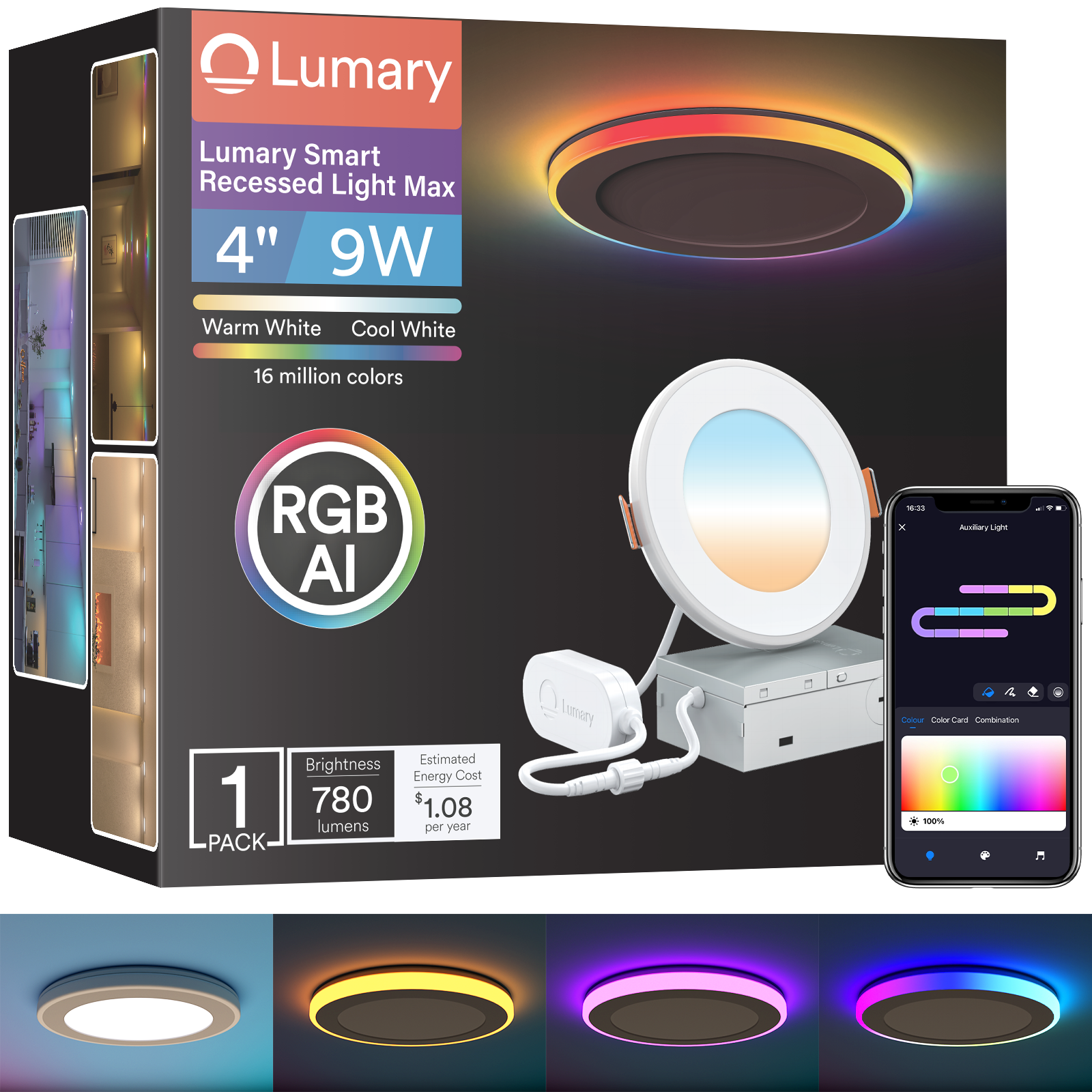
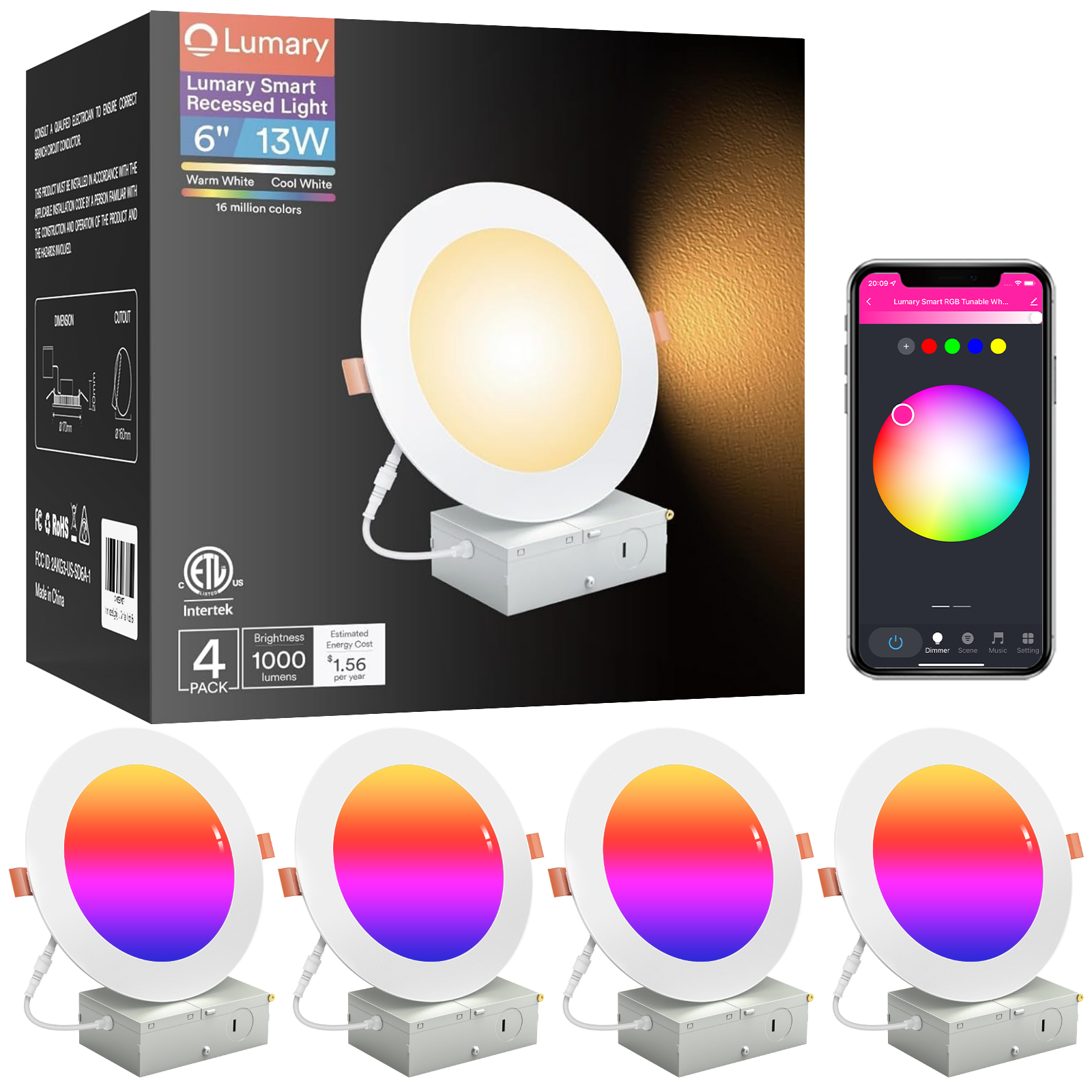
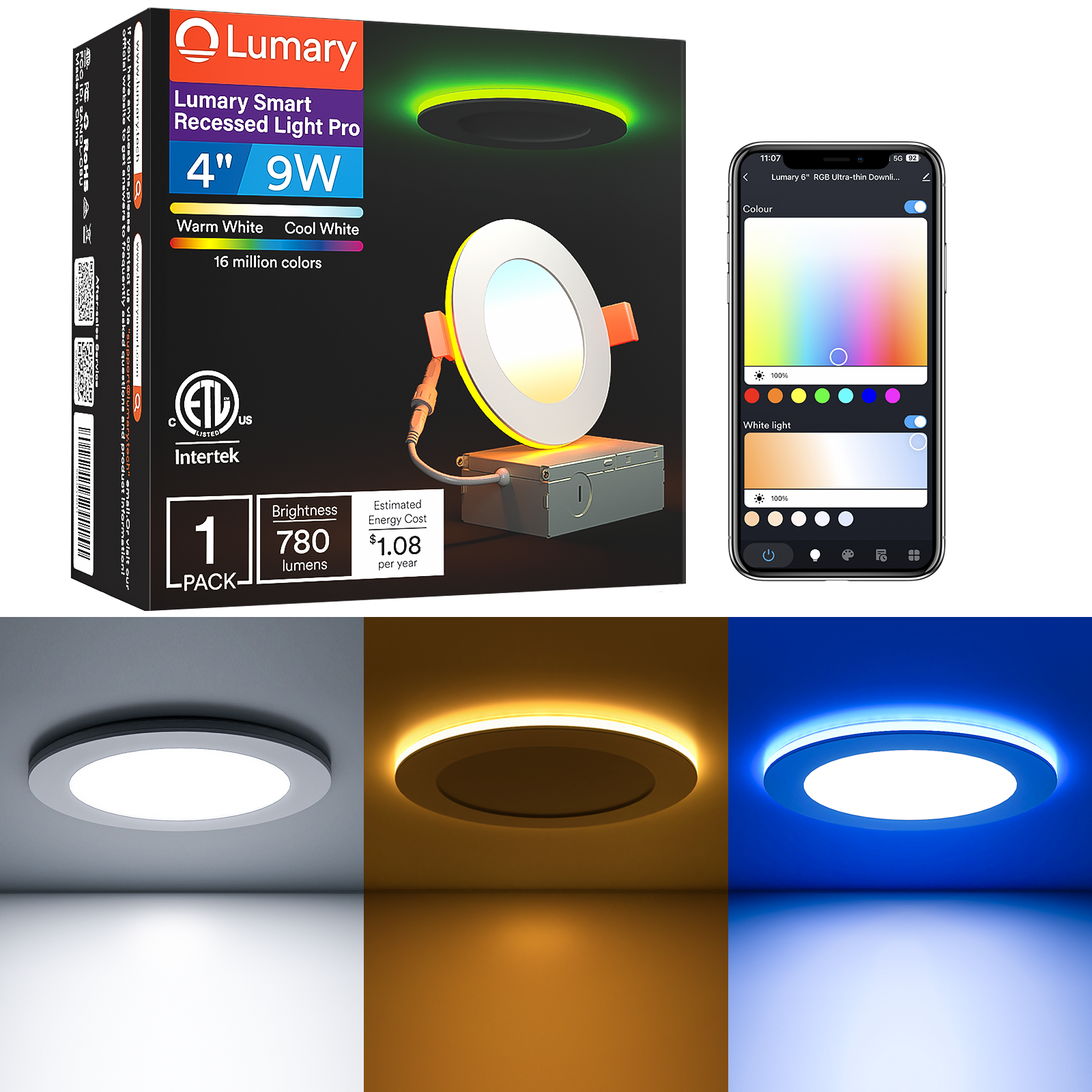
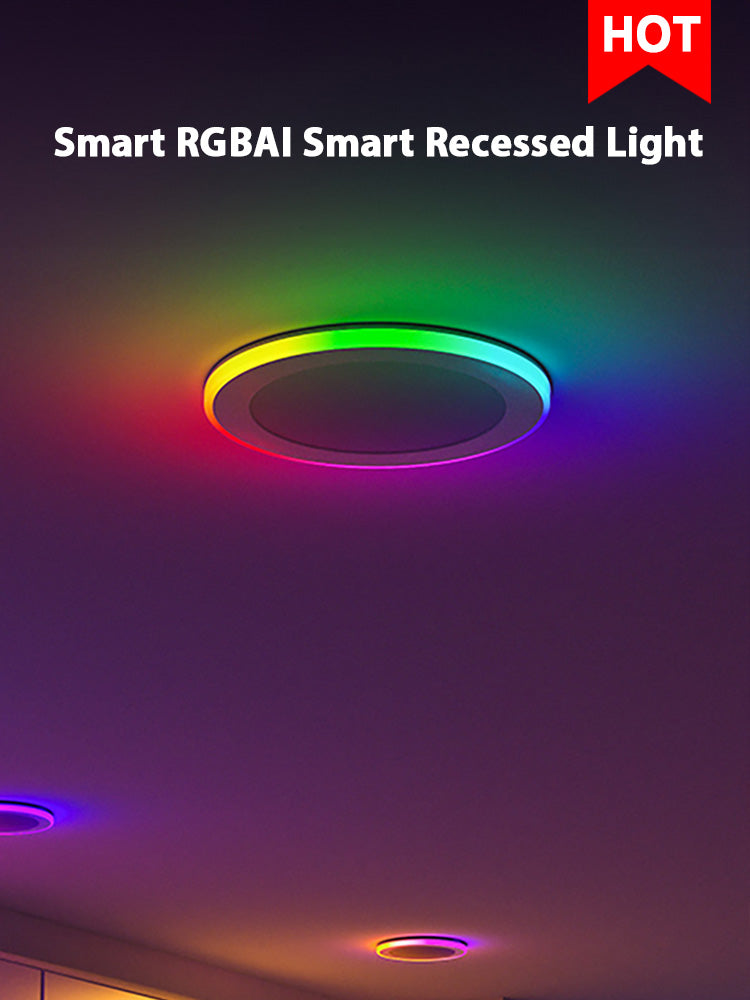


For most homes, the safest recessed-light color temperature is not a single number; it is a controllable range. Use 2700K–3000K for bedrooms, lounges, and evening relaxation; 3500K–4000K for kitchens, bathrooms, hallways, and daily routines; and 5000K–6500K only when you need crisp task visibility, such as cleaning, hobby work, or utility zones. The U.S. Department of Energy defines lower Kelvin values around 2700K–3000K as warm, higher values around 3600K–5500K as cool, and notes that cooler light can improve contrast for visual tasks while warmer light is usually preferred in living spaces. (The Department of Energy's Energy.gov)
That is why a tunable recessed fixture is usually the more future-proof choice than locking the ceiling into one fixed CCT. Lumary Wi-Fi Smart Canless Recessed Lighting 6 inch 4 PCS covers 2700K–6500K, supports 1%–100% brightness adjustment, provides RGBCW color output, and adds 16 million colors for ambient scenes, so the same ceiling can move from warm evening light to clean task lighting without changing hardware. (Lumary)
The practical answer by room
| Room / use case | Recommended CCT | Why it works |
|---|---|---|
| Bedroom, lounge, reading corner | 2700K–3000K | Warmer light feels softer and is less visually aggressive at night. |
| Living room general lighting | 3000K–3500K | Keeps the room comfortable without looking overly yellow. |
| Kitchen, bathroom, closet, hallway | 3500K–4000K | Cleaner neutral white helps surfaces, mirrors, and cabinetry read more accurately. |
| Laundry, garage, hobby bench | 5000K–6500K | Higher contrast supports detail work and cleaning tasks. |
| Movie, gaming, party, music room | White light + color scenes | Tunable white handles daily use; RGB color creates mood layers. |
The trap with fixed recessed lighting is that a ceiling layout often lasts longer than the room’s function. A spare bedroom becomes an office; a kitchen becomes a social zone; a basement becomes a theater. A tunable system avoids that mismatch.
Product focus: Lumary Wi-Fi Smart Canless Recessed Lighting 6 inch 4 PCS
Lumary’s 6-inch canless recessed light is built around the exact problem behind the title question: users do not always know whether they need warm white, neutral white, daylight, or color ambience before living with the space. This 4-pack uses an ultra-thin canless form factor, supports 2700K–6500K CCT adjustment, 1%–100% dimming, RGBCW light color, 16 million colors, 8 scene modes, and music sync through the Lumary App. The listing also identifies the 6-inch version as 13W / 1100LM, with app, voice, remote-style control methods, 120V input, group control, scheduling, memory function, and installation with a junction box and spring clips. (Lumary)
| Evaluation point | Lumary implementation | Why it matters in real use |
|---|---|---|
| Product type | 6-inch ultra-thin smart canless recessed lighting, 4 PCS | Suitable for clean ceiling layouts without traditional cans. |
| Model options | US-SD6A-4 White / US-SD6B-4 Black | Lets the trim match light or dark ceiling designs. |
| White temperature range | 2700K–6500K | Covers warm evening light, neutral daily light, and daylight task light. |
| Light color system | RGBCW | Combines tunable white with color ambience. |
| Brightness control | 1%–100% | Enables night-level dimming and full-room illumination. |
| Color modes | 16 million colors, 8 scene modes | Useful for entertainment, parties, gaming, and seasonal scenes. |
| Rated output noted on listing | 13W, 1100LM | High-output recessed lighting for broader room coverage. |
| Control | Lumary App, voice, remote-style control method | Multiple control paths reduce dependence on a wall switch alone. |
| Connectivity | 2.4GHz Wi-Fi through Lumary App | Direct smart control for scheduling, grouping, and remote adjustment. |
| Voice assistants | Alexa and Google Assistant listed in description | Hands-free control for brightness, color, and routines. |
| Automation | Schedule, group control, share control, memory function | Makes multi-light rooms easier to manage consistently. |
| Installation | Junction box and spring clips | Designed for streamlined canless ceiling installation. |
| Comfort claims | Flicker-free, silent operation | Important for bedrooms, offices, and media rooms. |

How to identify better recessed lighting before buying
| Selection dimension | Common weak implementation to avoid | Lumary technical approach | Long-term effect |
|---|---|---|---|
| Color temperature flexibility | Fixed 3000K or 5000K that later feels wrong for the room | 2700K–6500K tunable white | One fixture adapts to sleep, work, cleaning, and entertaining. |
| Dimming behavior | Coarse dimming steps that jump from “too bright” to “too dark” | 1%–100% brightness control | Better control for night use, TV viewing, and layered lighting. |
| White + color capability | RGB color without usable white, or white light without ambience | RGBCW architecture | More credible daily lighting plus decorative color. |
| Multi-light consistency | Each downlight adjusted separately | Group control through the app | Cleaner room-wide scenes and fewer manual corrections. |
| Routine automation | Manual switching only | Scheduling, sharing, memory function | Lighting follows household patterns instead of interrupting them. |
| Entertainment response | Static color only | Music/game sound sync through the app | Better fit for gaming rooms, media rooms, and social spaces. |
| Installation profile | Bulky housings that need deeper ceiling clearance | Ultra-thin canless design with junction box and spring clips | Cleaner ceiling integration in remodels and new layouts. |
The main technical principle is simple: good recessed lighting should separate illumination from atmosphere. Illumination requires predictable white light, enough lumen output, and smooth dimming. Atmosphere requires color range, scene control, and synchronized behavior across fixtures. Lumary’s value is that it addresses both categories in one ceiling product rather than forcing a choice between “practical downlight” and “decorative smart light.”
Market context: where Lumary sits among smart lighting options
Philips Hue, Govee, WiZ, Kasa, LIFX, and other smart-lighting ecosystems all have recognizable strengths. Philips Hue is often associated with mature ecosystem integration and polished scene control. Govee is widely known for colorful entertainment lighting and accessible smart-lighting setups. WiZ focuses on app-based smart lighting with straightforward Wi-Fi control. Kasa is familiar to users who already use TP-Link smart-home devices. LIFX is known for Wi-Fi smart bulbs and strong color-focused lighting categories.
Lumary’s position is more specific: it is not merely selling a bulb or a decorative strip; it is targeting the recessed-lighting decision itself. That matters because recessed lights become part of the architecture. Once a ceiling is cut, wired, and finished, replacing the lighting plan is more expensive than replacing a lamp. A 6-inch canless RGBCW downlight with tunable white, full dimming, scheduling, and group control is therefore a procurement choice for people who want the ceiling layer to remain flexible as the room changes.
Scenario 1: a living room that changes from daylight routine to evening decompression
A family living room rarely has one lighting requirement. At 7:30 a.m., the room may need clean neutral light while people pack bags, find keys, and check the weather. At 6:30 p.m., the same ceiling should stop feeling like a workplace and become visually softer. At 9:00 p.m., TV glare becomes the issue, and overhead brightness needs to fall without making the room feel dead.
With Lumary’s 2700K–6500K range, the room can run around 3500K–4000K during active hours, then move toward 2700K–3000K in the evening. The 1%–100% dimming range lets the ceiling step down gradually instead of switching from “on” to “off.” Group control is especially important in this room because recessed lights are usually installed in sets; if one fixture is warmer or brighter than the others, the ceiling immediately feels unbalanced. The memory function also matters because users often return to the same preferred evening setting. Over time, the lighting becomes part of the daily rhythm rather than a device that constantly needs adjustment.

Scenario 2: a kitchen where color temperature affects food, surfaces, and concentration
Kitchen recessed lighting is where the fixed-CCT mistake becomes obvious. A very warm 2700K ceiling can make white counters look creamier and reduce perceived contrast on cutting boards. A very cool 6000K ceiling can make the space feel clinical when people are eating or talking. The better answer is usually a neutral zone during prep and a warmer zone during dining.
Lumary’s tunable CCT lets the kitchen operate in layers. During cooking, the downlights can sit near 4000K for cleaner visibility on worktops, cabinet edges, and sink areas. During dinner, the room can shift warmer and dimmer so the same recessed grid no longer feels like task lighting. If the kitchen opens into a living room, group control can coordinate both spaces so the open-plan area does not split into two conflicting color temperatures. This is the difference between buying a light and designing a lighting behavior. The fixture’s 1100LM listing also gives it the kind of output expected from a 6-inch recessed product, while dimming prevents that brightness from becoming excessive after the task is finished. (Lumary)
Scenario 3: a gaming, music, or media room that still needs normal white light
Entertainment rooms often fail because they are designed only for effects. RGB looks exciting for the first week, but the room still needs usable white light for cleaning, reading, setting up equipment, or working at a desk. A better recessed-lighting plan starts with tunable white and then adds color as a second layer.
Lumary’s RGBCW design fits that logic. For everyday use, the room can run at 3000K–4000K depending on whether the user is relaxing or working. During a game, movie, or music session, the same lights can shift into color scenes or app-based music sync. Because the fixtures are recessed, the color comes from the ceiling plane instead of a visible strip or lamp, which creates a more integrated effect. The strongest use case is not simply “make the room colorful”; it is keeping the room functional when the effects are off. That is where tunable white, dimming depth, scene modes, and group control work together.
Editorial assessment: who should buy it?
Buy Lumary Wi-Fi Smart Canless Recessed Lighting 6 inch 4 PCS if you are choosing recessed lights for a room whose use may change throughout the day. It is especially suitable for living rooms, kitchens, bedrooms, gaming rooms, music rooms, finished basements, and remodels where a fixed 3000K or 5000K decision feels too limiting.
The most rational buyer is someone who wants three things in one ceiling system: daily white lighting, smart control, and ambient color. The product page’s combination of 2700K–6500K CCT, 1%–100% dimming, RGBCW output, 16 million colors, music sync, scheduling, group control, and ultra-thin canless installation gives it a strong role in homes where recessed lighting needs to be both architectural and adaptive. (Lumary)
FAQ
1. Is 2700K or 3000K better for recessed lights?
2700K feels warmer and more relaxed, while 3000K is still warm but cleaner. Bedrooms and lounges often benefit from 2700K–3000K; kitchens and mixed-use living spaces often feel more balanced closer to 3000K–3500K.
2. Should kitchen recessed lights be warm white or daylight?
For most kitchens, neutral white is more useful than extreme warm white or extreme daylight. A range around 3500K–4000K usually provides better task visibility while still feeling residential. With Lumary, you can use cooler white while cooking and warmer white while dining.
3. Are 6500K recessed lights too bright?
6500K is not automatically brighter, but it appears cooler and more intense because it has a daylight-like visual character. It is better reserved for task moments, utility rooms, or cleaning—not as the default evening setting in a living space.
4. Why do some recessed lights look different even when set to the same Kelvin value?
Kelvin only describes the apparent warmth or coolness of white light. Color rendering, LED mixing, diffuser quality, dimming behavior, and manufacturing calibration also affect how surfaces and skin tones look. That is why tunable control and consistent group behavior are important.
5. What is the advantage of RGBCW over basic RGB recessed lighting?
Basic RGB is mainly for color effects. RGBCW adds dedicated white-light capability, so the fixture can serve as real daily lighting while still offering color scenes. For recessed lights, that distinction matters because ceiling lights must handle practical illumination first and ambience second.

