




The practical starting point is simple: for even recessed lighting, space each light at roughly half the ceiling height. An 8-foot ceiling usually starts around 4 feet between lights, a 9-foot ceiling around 4.5 feet, and a 10-foot ceiling around 5 feet. Home Depot gives the same rule of thumb and notes that accent lighting often falls in the 4–6 foot range. (The Home Depot)
That formula is only the first pass. A strong layout also considers wall distance, room function, brightness, furniture lines, and dimming control. Designers commonly recommend 4–6 feet between recessed downlights while adjusting for beam spread, and they caution against placing fixtures too close to walls because it can create reflections, scalloping, or uneven shadows. (Homes and Gardens)
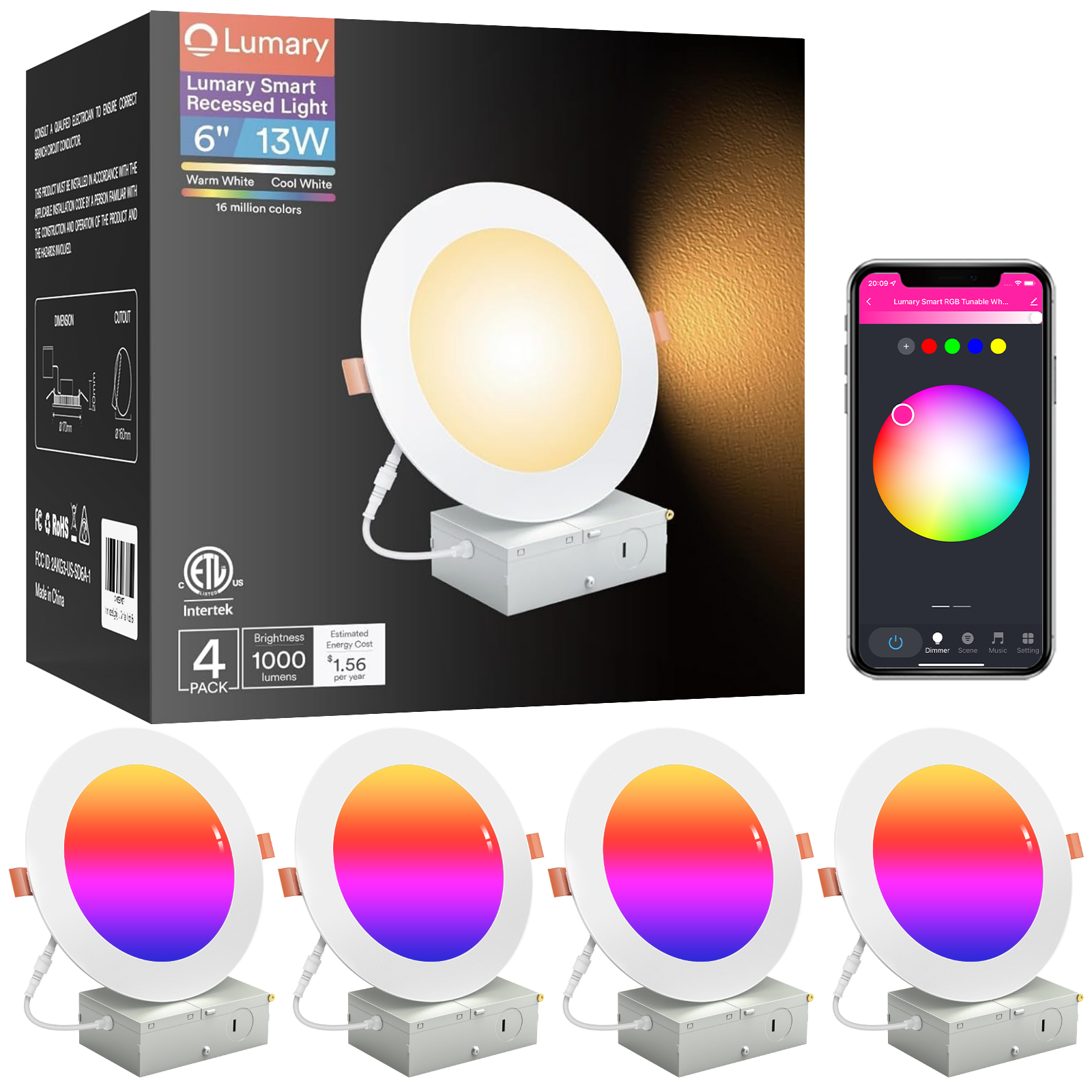
For a smart 6-inch canless fixture such as the Lumary Wi-Fi Smart Canless Recessed Lighting 6 inch 4 PCS, the best layout is usually a clean grid with about 4–5 feet between lights in standard 8–10 foot residential ceilings, then fine-tuned through 1%–100% dimming, 2700K–6500K white tuning, and room-based group control. The product page lists 13W output, 1100LM brightness, RGBCW color, 16 million colors, 8 scene modes, 2.4GHz Wi-Fi app control, voice control with Alexa and Google Assistant, music sync, flicker-free silent operation, and ultra-thin canless installation with a junction box and spring clips. (Lumary)
The spacing rule that works in real rooms
A recessed-lighting layout should begin with ceiling height, not with the number of fixtures in the box. The basic equation is:
Recommended distance between lights = ceiling height ÷ 2
| Ceiling height | Starting spacing between recessed lights | Practical use |
|---|---|---|
| 8 ft | About 4 ft apart | Bedrooms, kitchens, living rooms, hallways |
| 9 ft | About 4.5 ft apart | Open living areas, dining rooms, home offices |
| 10 ft | About 5 ft apart | Larger rooms, higher ceilings, wider furniture layouts |
| 11–12 ft | About 5.5–6 ft apart | Tall ceilings, brighter fixtures, layered lighting plans |
The first row of lights should not be pushed hard against the wall. For many rooms, a distance of roughly 2–3 feet from the wall creates a cleaner wash of light and reduces harsh wall scalloping; The Spruce cites designers recommending consistent spacing and generally placing recessed lighting about 3 feet from the wall in living rooms. (The Spruce)

Why spacing is not only a geometry problem
Bad recessed lighting rarely fails because the fixture is “wrong.” It fails because the grid ignores how people actually use the room. A kitchen needs brighter task zones near counters. A bedroom needs lower glare and stronger dimming. A media room needs enough ceiling light for walking and cleaning, but not so much direct light that it reflects on the screen.
Lumens also matter. Home Depot explains that room brightness should be estimated by multiplying room square footage by the required lumens per square foot, and gives examples such as 1,000–2,000 lumens for a 100-square-foot living room or bedroom. (The Home Depot) A Lumary 6-inch light rated at 1100LM gives useful brightness headroom, while its dimming range prevents the layout from feeling overlit when the room shifts from task mode to evening mode. (Lumary)
Lumary 6-inch canless recessed light at a glance
| Product dimension | Lumary implementation | Why it affects spacing |
|---|---|---|
| Fixture size | 6-inch canless recessed light | Better suited to broad ambient coverage than small accent-only layouts |
| Output | 13W, 1100LM | Allows wider practical spacing in standard residential rooms |
| Brightness control | 1%–100% dimming | Prevents a dense layout from feeling harsh at night |
| White tuning | 2700K–6500K | Warm evening light, neutral task light, cooler cleaning/focus light |
| Color system | RGBCW, 16 million colors | Supports both everyday white lighting and atmosphere scenes |
| Scene control | 8 scene modes and custom scenes | Useful for one-tap living room, bedroom, party, and gaming scenes |
| Smart control | Lumary App over 2.4GHz Wi-Fi | Enables scheduling, grouping, remote control, and multi-room management |
| Voice control | Alexa and Google Assistant compatibility | Hands-free control after installation |
| Music sync | App-based sync with music or game sound | Adds entertainment value without changing ceiling layout |
| Installation | Ultra-thin canless design with junction box and spring clips | Practical for remodels and ceilings without existing cans |
| Operation | Flicker-free, silent operation listed on product page | Better suited for bedrooms, workspaces, and media rooms |
| Finish options | White and Black | Easier to match ceiling style and trim language |
| Voltage | 120V | Designed for typical North American residential use |
How to calculate the number of Lumary lights for a room
Take a 12 ft × 12 ft bedroom with an 8 ft ceiling. The spacing rule suggests about 4 ft between lights. A clean layout would usually be four lights in a square grid, with each fixture roughly 3 ft from the nearest wall and about 6 ft from the opposite fixture centerline if the room design prioritizes softer coverage. For brighter task lighting, the grid can tighten toward the 4–5 ft range. The Lumary four-pack fits this kind of room because each light has enough output for general illumination, but the system can be dimmed down when full brightness is not needed.
For a 10 ft × 16 ft kitchen, the same ceiling-height rule is only the beginning. Lights should align with working zones, not just the ceiling center. Counter edges, island lines, cabinet fronts, and traffic paths matter. Home Depot notes that recessed-light placement should consider workspaces, counters, shelves, furniture, and focal points before finalizing the layout. (The Home Depot)

Common layout pitfalls and the better technical response
| Layout issue | What it causes | Better planning method |
|---|---|---|
| Lights spaced too far apart | Dark bands between fixtures | Start with ceiling height ÷ 2, then adjust by task zone |
| Lights too close to walls | Scalloping, glare, uneven wall shadows | Keep a controlled setback from the wall and align with furniture or counters |
| Too many high-output lights with no dimming | Sterile, overlit rooms | Use dimmable fixtures and group control |
| Ignoring room function | Kitchen too dim, bedroom too harsh | Set spacing by task, not only by square footage |
| Mixing unrelated color temperatures | Uneven color perception across surfaces | Use tunable white and maintain a consistent baseline per scene |
| Controlling each fixture separately | Daily inconvenience after installation | Use app grouping, schedules, shared control, and memory settings |
Lumary’s advantage in spacing-heavy projects is that it gives the installer more room to tune the result after the cutouts are made. The physical grid provides coverage; the smart layer corrects intensity, color temperature, timing, and scene behavior.
Market context: where Lumary fits among smart lighting options
| Brand / product direction | Main product identity | Best-fit buyer |
|---|---|---|
| Lumary Wi-Fi Smart Canless Recessed Lighting 6 inch | 13W, 1100LM, RGBCW, 2700K–6500K, 1%–100% dimming, app grouping, music sync, canless installation | Buyers planning a full recessed-light grid for living rooms, bedrooms, kitchens, and media rooms |
| Philips Hue Slim Downlight 6 inch | Slim 6-inch canless downlight with white ambiance, 16 million colors, Bluetooth and Hue Bridge compatibility, and a 35,000-hour nominal lifetime | Users already building around the Hue ecosystem and accessory-based control |
| Govee 6-Inch Smart RGBWW Recessed Lights | RGBWW recessed lighting focused on colorful ambiance and hands-free control | Buyers who enjoy highly visual scene effects and app-centered color control |
| WiZ 6-inch Slim Recessed Downlight 12W | Full-color tunable downlight controlled through the WiZ app, accessories, or voice commands | Users who want simple app control, tunable white, full color, and dimming in a slim fixture |
| LIFX SuperColor 6-inch Canless Downlight | 1200LM canless downlight with wide CCT range, 90 CRI, Wi-Fi control, dynamic effects, and smart integrations | Buyers focused on high color rendering and advanced color range in a single fixture |
| Kasa Smart multicolor lighting | Smart bulbs with 16 million colors, 1%–100% dimming, 2500K–6500K tunable white, scheduling, and remote app control | Users adding smart lighting to lamps and sockets rather than building a recessed ceiling grid |
Lumary is especially relevant when the project is not just “add smart lights,” but “design a ceiling layout that will still feel correct after the renovation is finished.” Its 6-inch form factor, 1100LM output, canless body, and group control make it well suited to spacing decisions where coverage and post-installation flexibility matter at the same time.
A living room layout that avoids the “ceiling grid” feeling
Imagine a 15 ft × 18 ft living room with an 8 ft ceiling. A rigid grid says 4 ft spacing, but a better design begins with zones: sofa area, media wall, walking path, and possibly a reading corner. Instead of placing lights randomly across the ceiling, the layout should frame the seating area without putting bright downlight directly over people’s faces. The perimeter can carry the ambient layer, while the central area remains visually calmer.
With Lumary 6-inch smart recessed lights, the homeowner can group the room into “day,” “movie,” and “evening” behavior. During the day, a neutral white setting helps the room feel open and clean. During movie time, the lights near the screen can be dimmed lower or shifted warmer to reduce glare. When guests arrive, scene modes and RGBCW color can give the room atmosphere without relying on floor lamps alone. This is where spacing and control become one system: the ceiling grid creates physical coverage, and the app turns that grid into a flexible lighting plan.
A kitchen layout that respects counters, not just ceiling math
A kitchen is where many recessed-light layouts go wrong. Centering lights in the walkway may look symmetrical on the ceiling, but it can place the user’s body between the light and the countertop, creating shadows exactly where chopping, measuring, and cleaning happen. The better logic is to place downlights so the beam lands on working surfaces, especially counters, sink areas, and island edges.
For a standard 8 ft ceiling, the 4 ft rule is still useful, but the grid should bend around cabinetry and work zones. A Lumary 6-inch fixture gives enough output for daily kitchen brightness, while 2700K–6500K tuning lets the room shift from practical food prep to warmer dining. The 1%–100% dimming range is also valuable because kitchens often become social spaces after cooking ends. A bright, neutral task scene can become a lower, warmer evening scene without changing fixtures or rewiring the room.

A bedroom or media room that needs brightness without glare
Bedrooms and media rooms need a softer interpretation of recessed lighting. The mistake is to install evenly spaced high-output lights and leave them at full intensity. That technically lights the room, but it can feel visually aggressive. The better method is to keep spacing consistent enough to avoid dark spots, then rely on dimming and scene control for comfort.
Lumary’s 6-inch model is useful here because the room can have a practical ceiling grid for cleaning, organizing, or working, while still dropping into low-brightness warm light at night. In a media room, music sync and color scenes can support gaming or entertainment, while tunable white keeps the same fixtures useful for normal tasks. In a bedroom, scheduling and memory settings reduce friction: the lights can return to the previous preferred state, and shared family control makes the system less dependent on one person’s phone. The key is not to space lights as if every moment requires maximum brightness; the key is to space for coverage, then let dimming and color temperature create comfort.
Professional purchasing view
The recommended spacing between recessed lights is usually 4–6 feet, with ceiling height ÷ 2 as the most reliable starting formula for even general lighting. For the Lumary 6-inch 1100LM canless model, a typical residential plan should begin around 4 feet apart on 8-foot ceilings, then adjust for room function, furniture alignment, wall distance, and brightness preference.
Choose this Lumary 6-inch recessed light if the goal is a whole-room ceiling system rather than a small accent fixture. It is especially appropriate for buyers who want smart control, strong white-light utility, dimming depth, color scenes, canless installation, and multi-light grouping in one package.
Questions buyers usually ask before installation
1. What is the standard distance between recessed lights?
For even lighting, start with ceiling height divided by two. An 8-foot ceiling starts around 4 feet between lights; a 10-foot ceiling starts around 5 feet. (The Home Depot)
2. How far should recessed lights be from the wall?
Many living-room layouts keep recessed lights roughly 2–3 feet from the wall, depending on ceiling height, wall texture, artwork, and whether the goal is general lighting or wall washing. Designers cited by The Spruce recommend consistent spacing and generally placing recessed lighting about 3 feet from the wall. (The Spruce)
3. Can I space Lumary 6-inch lights farther apart because they are 1100LM?
The higher output gives more flexibility, but spacing should still follow the ceiling-height rule first. Use the 1100LM output as brightness headroom, then reduce intensity with the 1%–100% dimming range when the room needs softer light. (Lumary)
4. Should kitchen recessed lights be spaced differently from bedroom lights?
Yes. Kitchens should prioritize task zones such as counters, sinks, islands, and prep areas. Bedrooms should prioritize comfort, dimming, and glare control. The same fixture can serve both spaces, but the layout logic should change.
5. Is a four-pack enough for one room?
For many bedrooms, small living rooms, home offices, and media rooms, a four-pack is a practical starting point. The exact count depends on room size, ceiling height, wall color, furniture layout, and target brightness. A 100-square-foot living room or bedroom may require about 1,000–2,000 lumens as a general estimate, while the Lumary 6-inch model is listed at 1100LM per fixture. (The Home Depot)

