




The answer to this question is almost always "multiple lights" for any room larger than a small hallway or closet — and the reasoning is grounded in the physics of light distribution rather than in a preference for more fixtures. A single ceiling-mounted light source, regardless of its lumen output, produces a cone of illumination that is bright at the center, directly below the fixture, and progressively dimmer at the edges of the room. Too few lights create dark, gloomy corners. Too many, and your ceiling looks like an airport runway. The goal is to find the right balance — a space that feels bright, welcoming, and works for what you do in it.
The formula that determines how many recessed lights a room actually needs starts with a simple calculation. Generally, you will want about 20 lumens per square foot for general lighting. This can vary depending on the room's use. A 12×14-foot bedroom at 168 square feet needs approximately 3,360 lumens of ambient ceiling output. A single 1,000-lumen 6-inch recessed light produces 1,000 lumens — enough for one third of the bedroom's lumen requirement, leaving the remaining two thirds inadequately lit. The math confirms what the physics predicts: one fixture is insufficient for general room illumination in all but the smallest spaces.
A commonly used starting rule is to divide the ceiling height by 2. In an 8-foot room, that gives you roughly 4 feet between recessed lights as a baseline. This spacing formula produces a grid layout that distributes the fixtures' combined output evenly across the room's floor area. With fixtures placed every 4 feet at standard 8-foot ceiling height, a 12×14-foot bedroom fits a 3×3 or 3×4 grid — six to twelve fixtures depending on the layout — though the lumen calculation should be used to verify the total output is correct before committing to a fixture count.
The most common mistake is treating recessed lighting as the only light source in a room. Recessed cans are great for general coverage, but a room lit exclusively by downlights can feel flat and shadowless — like a commercial office. The professional lighting design approach is layered: recessed fixtures provide the ambient base layer across the full room footprint, while table lamps, floor lamps, wall sconces, and under-cabinet lights add the task-level and accent-level illumination that makes a room feel designed rather than uniformly functional. The right lighting can make a small room feel bigger, a large room feel cozier, and an ordinary room feel extraordinary.
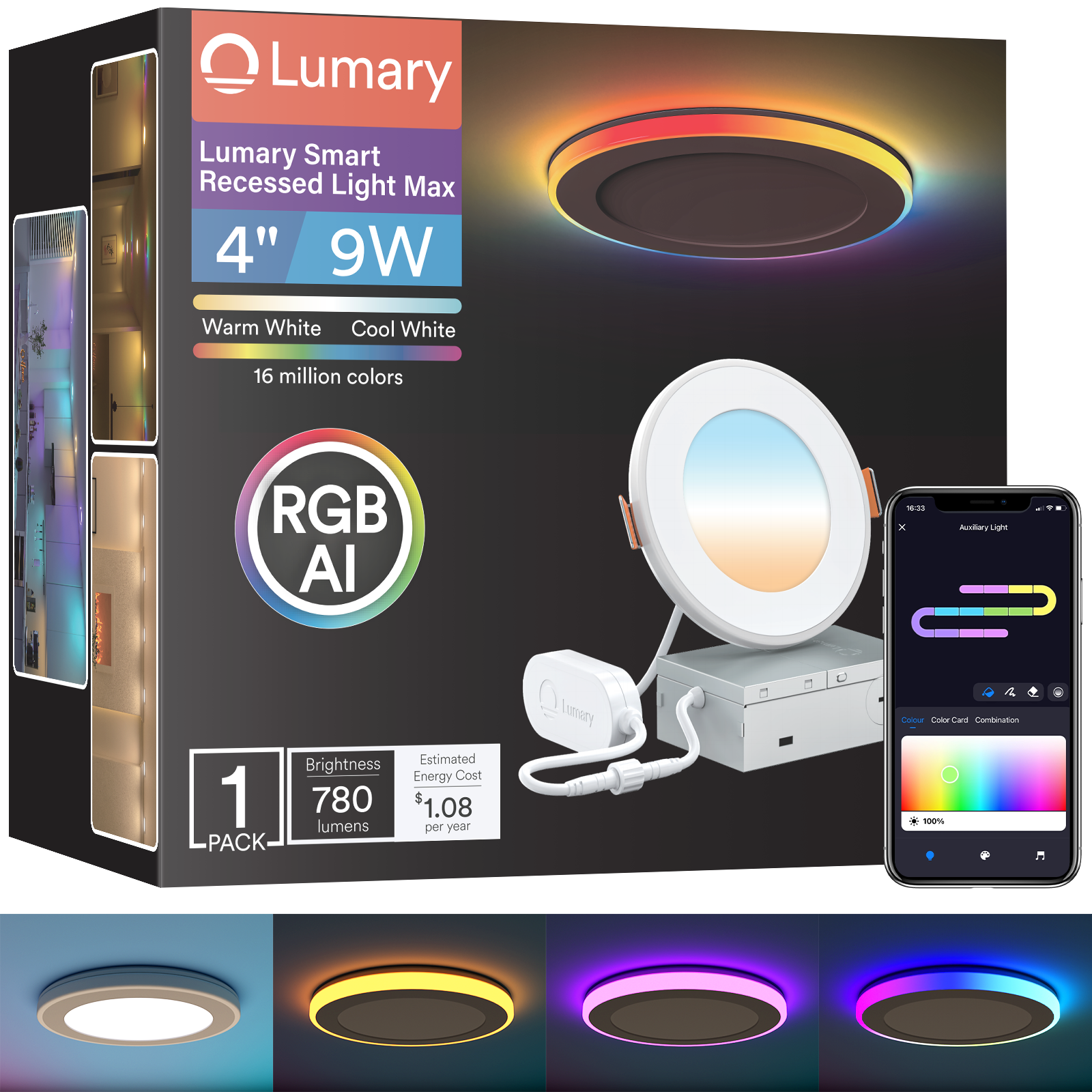
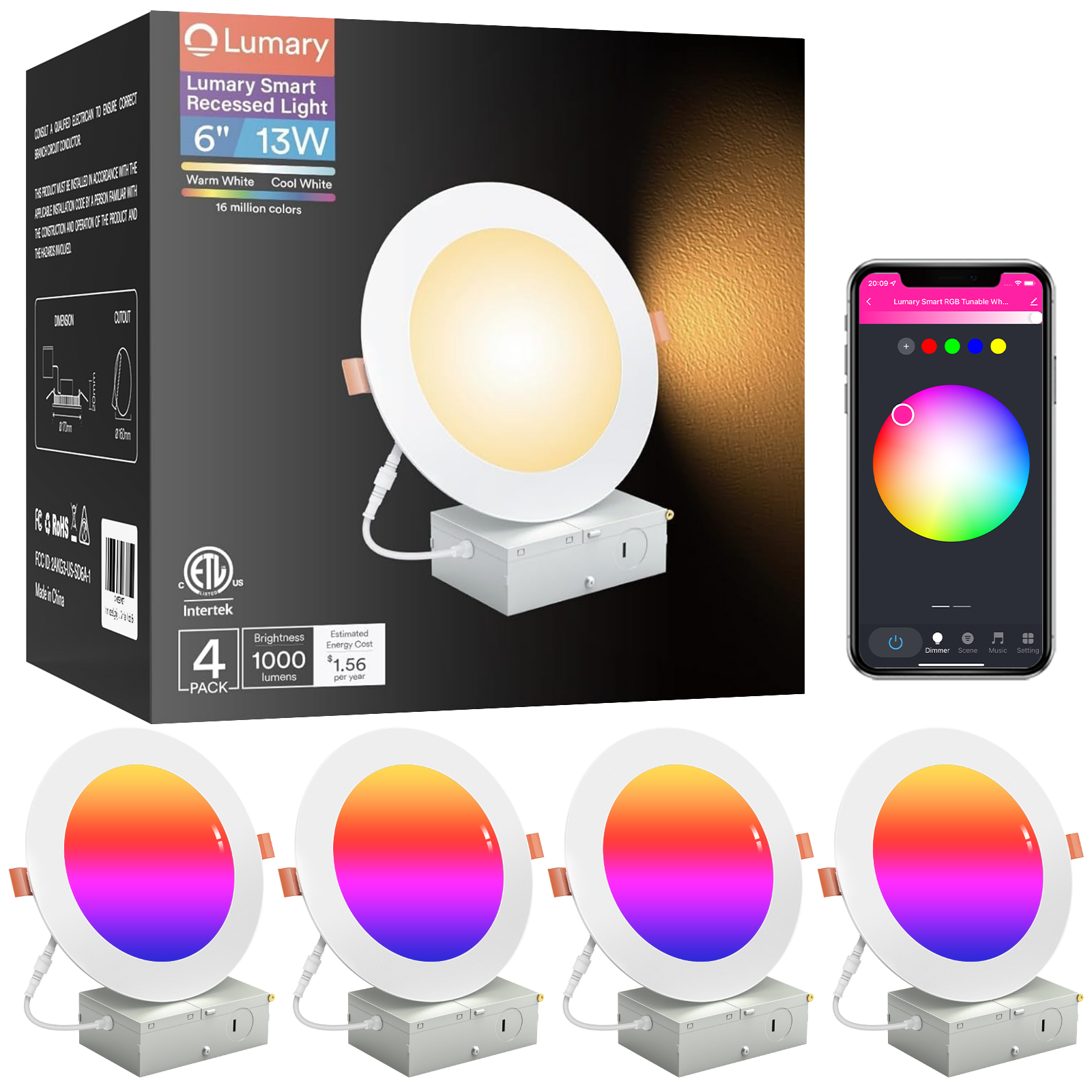
The single scenario where fewer fixtures are defensible is when each fixture's lumen output is significantly higher than the standard range. Most conventional recessed downlights in the residential market produce 600 to 800 lumens per 6-inch unit. A fixture that produces 1,000 lumens per 6-inch unit — 25 to 67 percent more output than standard — covers more area per fixture, which can reduce the total fixture count needed for a given room's lumen target while maintaining even spacing. The Lumary Smart RGBAI Recessed Light with Gradient Auxiliary Night Light at 1,000 lumens per 6-inch unit and 1,400 lumens per 8-inch unit is positioned at the high end of the residential lumen range precisely for this reason: fewer fixtures achieve the same total lumen coverage, each of which also provides the gradient auxiliary ring, RGB mode, and nightlight mode that standard downlights do not.
Product Recommendation Analysis
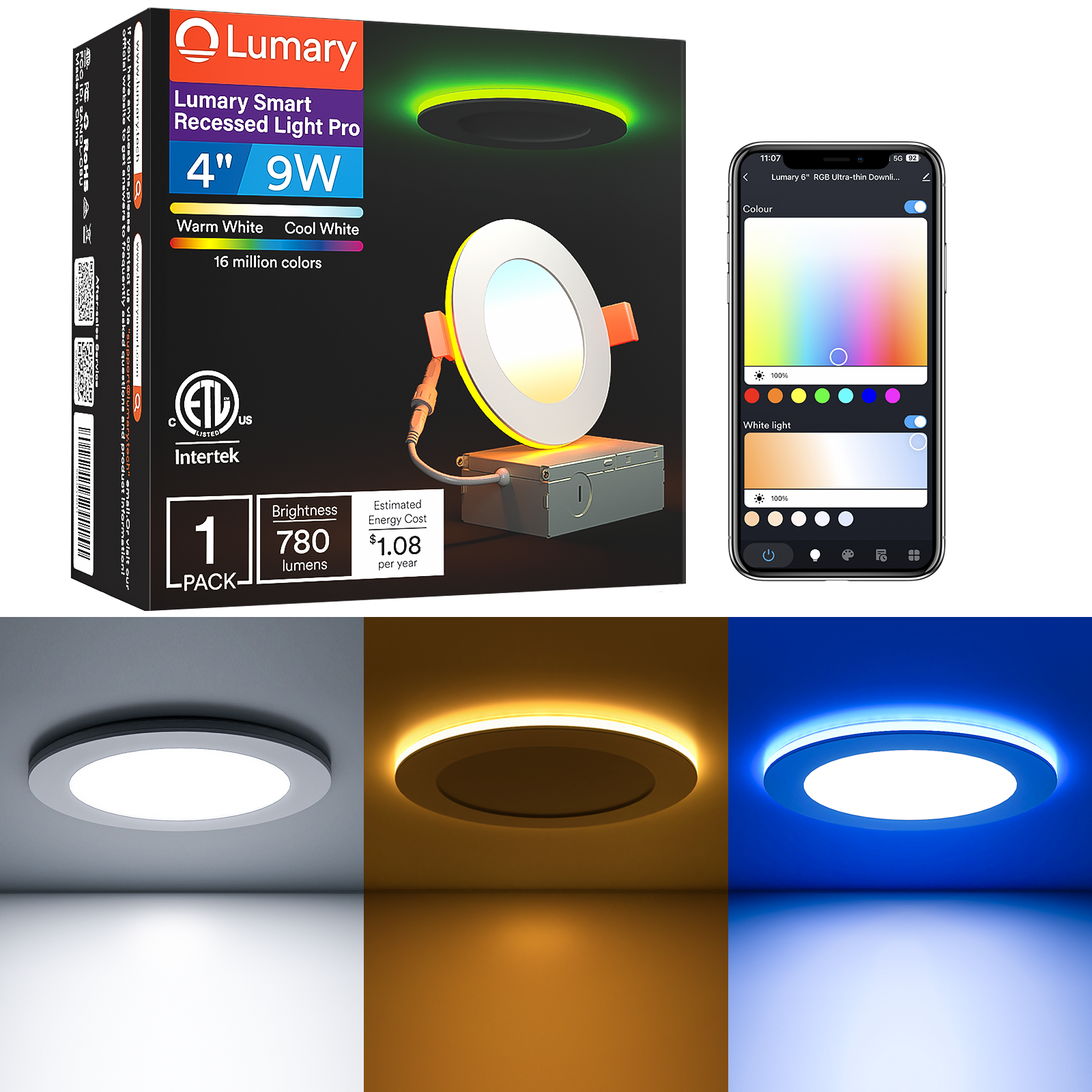
The Lumary Smart RGBAI Recessed Light with Gradient Auxiliary Night Light is available in three sizes — 4 inch at 9W and 780 lumens, 6 inch at 12W and 1,000 lumens, and 8 inch at 18W and 1,400 lumens — in single-unit through 24-unit pack configurations. The higher per-fixture lumen output means a standard 200-square-foot living room requiring 4,000 lumens at 20 lumens per square foot is served by four 6-inch units (4,000 lumens combined) rather than the five to seven fixtures a 600 to 800-lumen standard downlight would require for the same total output. The reduced fixture count lowers both installation labor and ceiling penetration count without compromising coverage.
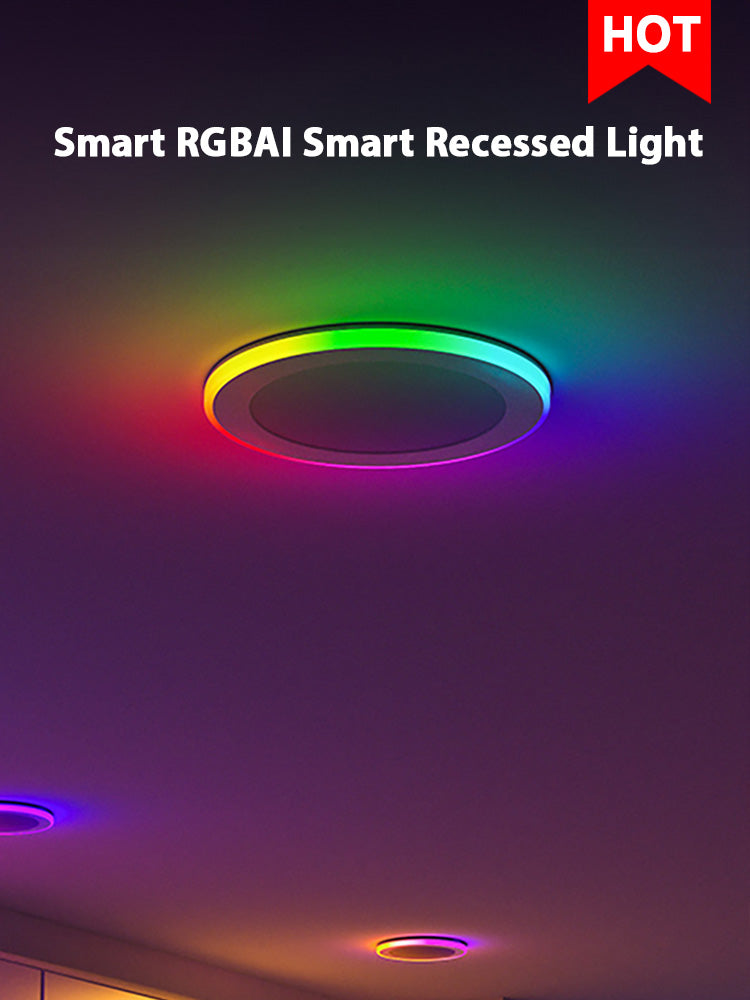
Each fixture operates across four independent modes: Downlight Mode for CRI 90+ functional white illumination across 2700K to 6500K, RGBAI Gradient Mode for 12-segment individually addressable flowing color display across the auxiliary ring, RGB Mode for single-accent color from the auxiliary ring, and Nightlight Mode for soft non-glare nighttime output from the auxiliary ring. The RGBAIWW LED architecture — Red, Green, Blue, AI-enhanced color, Ice White, and Warm White — produces 16 million color combinations across 50 preset scenes.
Smart control operates through the Lumary app over 2.4GHz Wi-Fi with native Alexa, Google Assistant, and Siri voice integration, plus group control that manages all installed fixtures as a coordinated system. Full specifications and pricing across all sizes and pack configurations are available on the Lumary Smart RGBAI Recessed Light with Gradient Auxiliary Night Light product page.
Technical Specification Table
| Specification | Lumary Smart RGBAI Recessed Light with Gradient Auxiliary Night Light US-SD4E / US-SD6E / L-SD8E |
|---|---|
| Model designation | US-SD4E-1/4 (4") / US-SD6E-1/4 (6") / L-SD8E1/4 (8") |
| Available sizes | 4 inch / 6 inch / 8 inch |
| Wattage | 9W (4") / 12W (6") / 18W (8") |
| Per-fixture brightness | 780 lm (4") / 1,000 lm (6") / 1,400 lm (8") |
| CRI | 90+ |
| Color temperature | 2700K–6500K adjustable (Downlight Mode) |
| LED technology | RGBAIWW — R, G, B, AI Color, Ice White, Warm White |
| Lighting modes | Downlight / RGBAI Gradient / RGB / Nightlight |
| Auxiliary ring segments | 12 individually addressable |
| Preset scenes | 50 |
| Fixture count for 150 sqft bedroom (15 lm/sqft) | 3 × 6-inch or 2 × 8-inch |
| Fixture count for 200 sqft living room (20 lm/sqft) | 4 × 6-inch or 3 × 8-inch |
| Fixture count for 120 sqft kitchen (40 lm/sqft) | 5 × 6-inch or 4 × 8-inch |
| Recommended spacing (8-ft ceiling) | 4 feet between fixtures; 2 feet from walls |
| Smart control | 2.4GHz Wi-Fi, Alexa, Google Assistant, Siri |
| Group control | Yes — all fixtures coordinated via single app command |
| Timing function | Yes |
| Pack sizes available | 1, 4, 8, 12, 16, 24 units |
| Pricing | $49.99 (4"/1pc) to $229.99 (8"/4pcs) |
Lighting Layout Framework: Where One Light Fails and Multiple Fixtures Succeed
The table below maps the specific failure modes that under-specified fixture counts produce in real residential spaces against the fixture count calculations and layout approaches that correct them — along with the additional value that the Lumary RGBAI fixture's multi-mode capability adds per installed fixture.
| Room Type and Scenario | What One Fixture Produces | Correct Fixture Count (6-inch / 1,000 lm) | What Proper Multiple-Fixture Layout Achieves | Bonus from Lumary Multi-Mode Capability |
|---|---|---|---|---|
| 10×12-foot bedroom (120 sqft) | Bright center, dark corners; insufficient for mirror, closet, or reading chair tasks | 2–3 fixtures at 4-ft spacing from center | Even 15–20 lm/sqft ambient across full floor area; no visible dark corners at walls | Nightlight Mode from 2–3 fixtures provides gentle bedroom navigation; RGBAI gradient for atmosphere |
| 12×14-foot living room (168 sqft) | Dramatic center-bright, perimeter-dark gradient; furniture at room edges in visual shadow | 3–4 fixtures in 2×2 grid pattern | Even 20 lm/sqft coverage across the seating area and perimeter; no dark corners behind sofas | Group-controlled RGBAI gradient across 3–4 ceiling positions creates immersive overhead color field |
| 10×12-foot kitchen (120 sqft) | Adequate center illumination; dark countertops along walls and under upper cabinets | 4–5 fixtures in grid over work surfaces + supplemental under-cabinet | 40 lm/sqft task-appropriate coverage at all prep zones; no shadowing on cutting boards or cooktops | Downlight Mode at 6500K for task; RGB warm mode for kitchen ambiance during dining occasions |
| 14×18-foot open-plan living-dining (252 sqft) | Single fixture creates a spotlight effect in the center; zones at dining table and seating area remain dim | 5–6 fixtures positioned to serve both the dining zone and the living zone separately | Coordinated ambient coverage across the full open plan at appropriate lm/sqft; visual zoning possible through fixture placement | Different mode assignments possible by zone through Lumary app — warm downlight in dining zone, RGBAI gradient above living zone |
| 10×12-foot home office (120 sqft) | Single 1,000-lumen fixture at 8-foot ceiling delivers 8.3 lm/sqft at the perimeter — below the IES 50 lm/sqft task target | 4–5 fixtures for base ambient layer plus task lamp at desk surface | Ambient base layer at 30–40 lm/sqft supplemented by desk-level task light for full IES office target | App-scheduled 5000K morning alertness mode across all fixtures for circadian support without supplemental device |
| 4×20-foot hallway (80 sqft) | Single fixture at the hallway midpoint provides adequate center illumination with dim ends | 2–3 fixtures at 6–7-foot intervals along the hallway length | Even corridor illumination end-to-end; no dark transition zones at doorways | Nightlight Mode activated by double wall-switch gesture provides overnight corridor navigation |
Competitive Landscape
The smart recessed downlight category includes several brands whose per-fixture lumen output and multi-fixture coordination capabilities are relevant context for lighting layout planning.
Govee's smart recessed and ceiling light products provide RGBIC addressable entertainment capability with the Govee Home app's scene infrastructure. Govee's smart downlight lineup coordinates through the Govee Home app alongside the brand's strip lights, permanent outdoor lights, and other smart lighting products, appealing to buyers whose whole-home smart lighting is already within the Govee ecosystem.
Philips Hue's White and Color Ambiance recessed downlights operate within the Hue Bridge ecosystem with Matter protocol support. Hue's recessed products coordinate with the full Hue ecosystem including entertainment sync and Hue Scene infrastructure, with per-fixture lumen specifications that vary by product. The Hue ecosystem's multi-fixture coordination is among the most mature in the category.
WiZ under Signify offers smart recessed downlights with tunable white from 2700K to 6500K at accessible price points. WiZ's SpaceSense presence automation can modulate multi-fixture rooms in response to occupancy, and the WiZ app supports group control for coordinating multiple fixtures.
Kasa by TP-Link provides smart recessed downlights with Alexa and Google Home integration, with the networking reliability that reflects the brand's router infrastructure heritage. Kasa's group control function allows whole-room fixture coordination from a single command.
Eufy's smart recessed downlights integrate with the broader Eufy security and smart home ecosystem, with app-based group control for multi-fixture room installations.
Within this competitive field, the RGBAI recessed light from Lumary is positioned with per-fixture lumen output at the high end of the 6-inch and 8-inch residential categories — 1,000 lumens and 1,400 lumens respectively — which reduces the fixture count required for a given room's lumen target relative to 600- to 800-lumen standard alternatives. The four-mode versatility (Downlight, RGBAI Gradient, RGB, Nightlight) adds functional value from each installed fixture that single-mode downlights do not provide, making the per-fixture investment in a Lumary installation serve more use cases from the same number of ceiling positions.

Application Scenarios
Standard Bedroom: Three Fixtures, Complete Coverage, and Nightlight for Sleep-Friendly Navigation
A 10×12 bedroom might only need 4 to 6 lights, especially if you have table lamps or sconces supplementing the overhead light. For a 12×12-foot master bedroom at 144 square feet — a common primary bedroom footprint — the lumen calculation at 15 lumens per square foot produces a 2,160-lumen ambient target. Three 6-inch Lumary fixtures at 1,000 lumens each totaling 3,000 lumens provides comfortable over-specification that the app's brightness dimming calibrates to the precise preferred level. The layout positions the three fixtures in a triangular or linear arrangement — either a centered equilateral triangle approximately 4 feet from each wall, or three fixtures in a row centered on the room's long axis — both of which distribute the 3,000-lumen output without significant dark corners at the walls when supplemented by a table lamp at the bedside.
The critical advantage of three Lumary fixtures over six standard 500-lumen downlights serving the same bedroom is the nightlight mode available from each installed fixture. Three fixtures in nightlight mode simultaneously produce a soft, perimeter-distributed ambient glow from the auxiliary rings that is entirely different in character from three downlights switched to low brightness — the nightlight output is non-glare, warm-toned, and calibrated for nighttime visual conditions rather than simply reduced from the daytime output level. For a bedroom occupant who wakes during the night, a double-flick of the wall switch activates the nightlight mode across all three fixtures without opening an app, without activating full overhead brightness, and without any programming required beyond the initial Lumary app installation.
Living Room Multi-Fixture Layout: Coverage, Coordination, and the Gradient Ceiling Effect
A 15×20-foot room with an 8-foot ceiling requires calculating the area to estimate lighting requirements — one recessed light per 4 to 6 square feet is a useful guideline. For a standard 14×16-foot living room at 224 square feet, the 4 to 6-square-feet-per-fixture guideline suggests 37 to 56 fixtures — a clearly overestimated range that reflects the guideline's assumption of standard 600-lumen fixtures. At 1,000 lumens per 6-inch Lumary unit, the lumen-based calculation is more useful: 224 square feet at 20 lumens per square foot equals 4,480 lumens, which four to five Lumary 6-inch fixtures at 1,000 lumens each cover at 4,000 to 5,000 lumens total.
The layout for four fixtures in a 14×16-foot living room follows the spacing formula: at 8-foot ceilings, fixtures placed 4 feet apart with the first row 2 feet from the nearest walls. A 2×2 grid positions four fixtures at the room's four "interior quadrant centers," each approximately 5 to 6 feet from adjacent fixtures and 2 to 3 feet from the walls. This geometry provides even ambient coverage across the full floor area with no dark corner gaps at the perimeter.
What four smart recessed lights with gradient auxiliary add beyond a standard four-downlight array is the RGBAI gradient ceiling effect: four independently addressable 12-segment rings positioned across the ceiling, coordinated through the Lumary app's group control, display flowing color gradients simultaneously in RGBAI mode — creating an overhead color field that a single fixture cannot produce and that a standard downlight array cannot produce regardless of fixture count. A holiday gathering or a family movie night activates this mode from one Alexa command, transitioning the living room ceiling from its functional 3000K ambient state to the entertainment gradient display within seconds.
Kitchen Task Layout: More Fixtures, Higher Lumen Target, CRI 90+ Throughout
The most common mistake is not using enough lights, which makes countertops dark. A layered plan works best for kitchens — use a grid of recessed lights for general light, and focus extra lights over work areas like the sink and stove. A 10×12-foot kitchen at 120 square feet, at 40 lumens per square foot for the task lighting level appropriate for food preparation, needs 4,800 lumens from the ceiling grid. Five 6-inch Lumary fixtures at 1,000 lumens each provide 5,000 lumens — meeting the task lighting target with modest headroom — while the CRI 90+ specification in Downlight Mode ensures accurate food color rendering across all counter surfaces at both 5000K daylight-equivalent and 2700K evening-warm color temperature settings.
The five-fixture layout for a 10×12 kitchen positions the fixtures at 3 to 4-foot intervals across the work zone, with fixtures positioned directly above or slightly in front of the primary work surfaces — the main counter run, the cooktop area, and the sink. Room layout matters because cabinets, islands, mirrors, and seating areas often matter more than a perfect grid. Fixtures positioned directly above an island or peninsula serve that work surface more effectively than fixtures following a mathematically even grid that leaves the primary work surface between fixture positions. The Lumary 6-inch at 1,000 lumens produces the task-adjacent output that kitchen countertop work requires from CRI 90+ white light, while the fixture's RGB and RGBAI modes serve the kitchen's entertaining and social functions when the space transitions from cooking to dining.

Home Office: Fewer Total Fixtures, Higher Lumen Output, Coordinated Circadian Scheduling
A home office needs focused illumination: for a 10×10 home office, 4 to 6 recessed fixtures would be appropriate to provide ample light for computer work, reading, and other tasks without creating harsh shadows. At the IES home office standard of 50 lumens per square foot for combined overhead and task illumination, a 10×10-foot office at 100 square feet needs 5,000 lumens total — typically split between overhead ambient at 30 to 35 lumens per square foot from the ceiling grid and task supplementation at the desk level from a dedicated desk lamp. Three to four 6-inch Lumary fixtures at 1,000 lumens each totaling 3,000 to 4,000 lumens from the overhead layer, supplemented by a 1,500-lumen desk lamp at the work surface, satisfies the combined IES target with appropriate light-source separation between the ambient and task layers.
The Lumary app's timing function adds a home office operational dimension that neither standard downlights nor simple smart alternatives provide: a morning schedule that activates the office fixtures at 6000K for high-alertness morning work, transitions to 4000K neutral white after two hours as the early-morning intensity becomes unnecessary, and shifts to 3000K warm white at 5:00 PM to signal the end of the productive workday — all executing automatically without daily manual adjustment. The group control ensures all three to four office fixtures execute each transition simultaneously rather than one fixture holding a previous setting while others update.
Open-Plan Multi-Zone Space: Using Fixture Placement and Mode Assignments to Create Visual Zones
An open-plan living-dining space presents the fixture count question in its most complex form, because the single continuous room serves multiple concurrent functions — active cooking adjacent to a dining table adjacent to a living and conversation area — each of which has a different lumen requirement, color temperature preference, and lighting character. Larger rooms often need layered lighting, not one stronger fixture. The number of recessed lights depends on room size, ceiling height, beam spread, and where task areas actually sit in the room.
For a 16×24-foot open-plan at 384 square feet, a uniform grid at 20 lumens per square foot requires 7,680 lumens — approximately eight 6-inch Lumary fixtures at 1,000 lumens each, or six 8-inch units at 1,400 lumens each. The more nuanced layout approach zones the fixtures: three to four positioned above the dining table area at closer spacing for the higher lumen density that dining task lighting requires; three to four positioned above the living area at wider spacing for the lower ambient lumen density appropriate for seating and conversation. The Lumary app's group control allows the dining zone fixtures and the living zone fixtures to be assigned to different scene groups — dining group at 3000K for evening dinner, living group at 2700K at 60% brightness for ambient social light — with each group responding to independent app commands or Alexa instructions rather than all fixtures following the same state simultaneously.
Editorial Assessment
The question of whether one ceiling light is enough to illuminate a room is answered definitively by the physics of light distribution: a single point source at 8 to 10 feet above the floor produces a brightness gradient that drops from its peak at the center to well below functional ambient levels at the room's walls, leaving corners and perimeters in visual shadow regardless of the fixture's total lumen output. Multiple fixtures spaced correctly — following the ceiling-height-divided-by-two spacing formula and positioned 2 to 3 feet from walls — distribute output evenly across the full floor area.
The Lumary Smart RGBAI Recessed Light with Gradient Auxiliary Night Light reduces the total fixture count required for a given room's lumen target relative to standard 600 to 800-lumen downlights, because its per-fixture output of 1,000 lumens (6-inch) and 1,400 lumens (8-inch) covers more area per installed fixture at the correct spacing. Each fixture in the installation then serves four lighting functions — functional CRI 90+ white ambient, RGBAI gradient entertainment display, RGB accent color, and soft nightlight navigation — that standard single-mode downlights do not provide regardless of how many are installed.
Frequently Asked Questions
What is the simple formula for calculating how many Lumary 6-inch recessed lights I need for a specific room?
For general ambient lighting, figure roughly one recessed light for every 4 to 6 square feet of ceiling space. So a 12×12 kitchen would need somewhere between 6 and 8 lights. For the Lumary 6-inch at 1,000 lumens, the more precise lumen-based calculation is more useful: multiply room square footage by the target lumens per square foot (15 to 20 for bedrooms and living rooms, 30 to 40 for kitchens), then divide by 1,000. A 150-square-foot bedroom at 15 lm/sqft needs 2,250 lumens ÷ 1,000 = 2.25 fixtures, round up to 3. A 200-square-foot living room at 20 lm/sqft needs 4,000 lumens ÷ 1,000 = 4 fixtures. A 120-square-foot kitchen at 40 lm/sqft needs 4,800 lumens ÷ 1,000 = 4.8, round up to 5. Verify the fixture count against the spacing formula (fixtures 4 feet apart at 8-foot ceilings, 2 to 3 feet from walls) to confirm even layout distribution.

Can I install fewer fixtures than the formula suggests if I choose the 8-inch 1,400-lumen version instead of the 6-inch 1,000-lumen version?
Yes — within limits. The 8-inch fixture at 1,400 lumens covers 40 percent more lumen area per fixture than the 6-inch at 1,000 lumens, which allows a proportional reduction in fixture count for the same total output. A four-fixture 6-inch installation totaling 4,000 lumens is approximately equivalent in total output to three 8-inch fixtures at 4,200 lumens. However, the spacing formula still governs the visual distribution of that output — three fixtures spaced 5 to 6 feet apart in a 14×16-foot room may leave the room's corners slightly dimmer than four fixtures at 4-foot spacing. The practical answer is that the 8-inch version is most appropriate for rooms where a lower fixture count per the spacing formula already satisfies the lumen target — rooms where fixture count is limited by structural considerations — rather than as a substitute for correct multi-fixture coverage.
What happens if I use only one Lumary recessed light in a 150-square-foot bedroom to save on installation cost?
A single 6-inch Lumary fixture at 1,000 lumens in a 150-square-foot bedroom delivers 1,000 lumens against a 2,250-lumen ambient target — approximately 45 percent of the lumen output the room requires for comfortable even illumination. The result is a visible center-bright gradient: the area directly below the fixture is adequately lit, the walls and corners receive approximately one quarter of that brightness at typical fixture positions (due to the inverse square law and the beam spread angle), and the room has a noticeably dim perimeter that makes it feel smaller and less comfortable than correct multi-fixture coverage would produce. The installation cost savings from one fixture versus three are real — perhaps one to two hours of electrician labor — but the daily visual environment produced is the most permanent trade-off, present every day for the life of the installation.
Do the RGBAI gradient rings on multiple Lumary fixtures coordinate automatically when I change scenes, or do I need to adjust each fixture individually?
When multiple Lumary RGBAI recessed lights are added to a group in the Lumary app, all fixtures in the group respond to a single scene command simultaneously — color temperature changes, brightness adjustments, mode switches (Downlight to RGBAI Gradient, for example), and preset scene activations all apply to every grouped fixture at once. A single Alexa command such as "switch living room to party mode" transitions all grouped fixtures from their current state to the party scene preset simultaneously. Individual fixtures can be addressed separately through the app when needed — for example, to assign different fixtures to different zones in an open-plan layout — but the default group behavior is coordinated simultaneous response to all scene commands.
Should I also use table lamps and floor lamps alongside the recessed lights, or will recessed lights alone be sufficient?
Recessed cans are great for general coverage, but a room lit exclusively by downlights can feel flat and shadowless — like a commercial office. Recessed lighting alone provides even, directionless overhead ambient illumination that covers the room's functional lumen requirement but produces a single-layer visual environment without the visual depth and warmth that supplementary floor lamps and table lamps add. The professional lighting design approach is layered: recessed fixtures establish the ambient base, floor lamps and table lamps add warm pools of directed light at furniture level that create visual depth and a sense of inhabitation, and accent lighting highlights specific features or objects. For a bedroom or living room, two to four recessed Lumary fixtures providing the ambient layer, combined with one or two bedside or floor lamps, produces a richer and more comfortable visual environment than any number of recessed fixtures alone. The Lumary RGBAI fixture's mode versatility partially bridges this gap — RGBAI gradient mode adds a decorative overhead dimension that standard downlights cannot — but task and accent supplementation at furniture level remains the complete layered lighting solution.

