




The Real Efficiency Gap: LED vs. Traditional Recessed Lighting
Are LED Recessed Lights Much More Energy-Efficient Than Old Ones? The short answer is yes — and the margin is not marginal. It is structural. According to data compiled at recessedlighting.com, halogen bulbs emit approximately 16 to 24 lumens per watt, while LED fixtures consistently deliver 80 to 100 lumens per watt. That four-to-one efficacy ratio translates directly into your utility bill every month the lights are on.
The U.S. Department of Energy confirmed this trajectory years ago and has since updated its energy code frameworks accordingly. As of August 1, 2023, the sale of incandescent and halogen lamps producing fewer than 45 lumens per watt became federally prohibited in the United States. The regulatory shift was not cosmetic — it acknowledged that incandescent bulbs convert as little as 10% of consumed electricity into visible light, dissipating the other 90% as heat. Halogen improves slightly on that figure through the tungsten-halogen regenerative cycle, but still wastes roughly 80% of its draw as radiant heat.
For recessed lighting specifically, this heat penalty is compounded. Cans that trap hot bulb clusters raise attic temperatures, accelerate insulation degradation, and — in worst cases — create fire-code compliance concerns. LED fixtures operate at a fraction of those junction temperatures. When recessed LED downlights deliver 1,100 lumens from 13 watts of draw, versus the 75 to 100 watts a comparable halogen PAR30 would require, the per-fixture annual energy savings exceed 50 to 60 kWh under typical residential use patterns (4 hours/day). Multiply that by 8 or 12 fixtures across a kitchen-living room open plan, and the operational delta is measurable within a single billing cycle.
The efficiency question, however, does not end at wattage. The most significant quality leap in contemporary LED recessed lighting is the convergence of optical control, tunable color temperature, and intelligent automation. A fixture that adjusts from 2700K (candlelight-warm) to 6500K (daylight-spectrum) based on time of day, occupancy, or voice command does not merely save energy compared to what it replaced — it redefines what a ceiling fixture is expected to do. That convergence is precisely what the Lumary Wi-Fi Smart Canless Recessed Lighting 6-Inch (4-pack) is engineered to deliver.

Product Recommendation Analysis
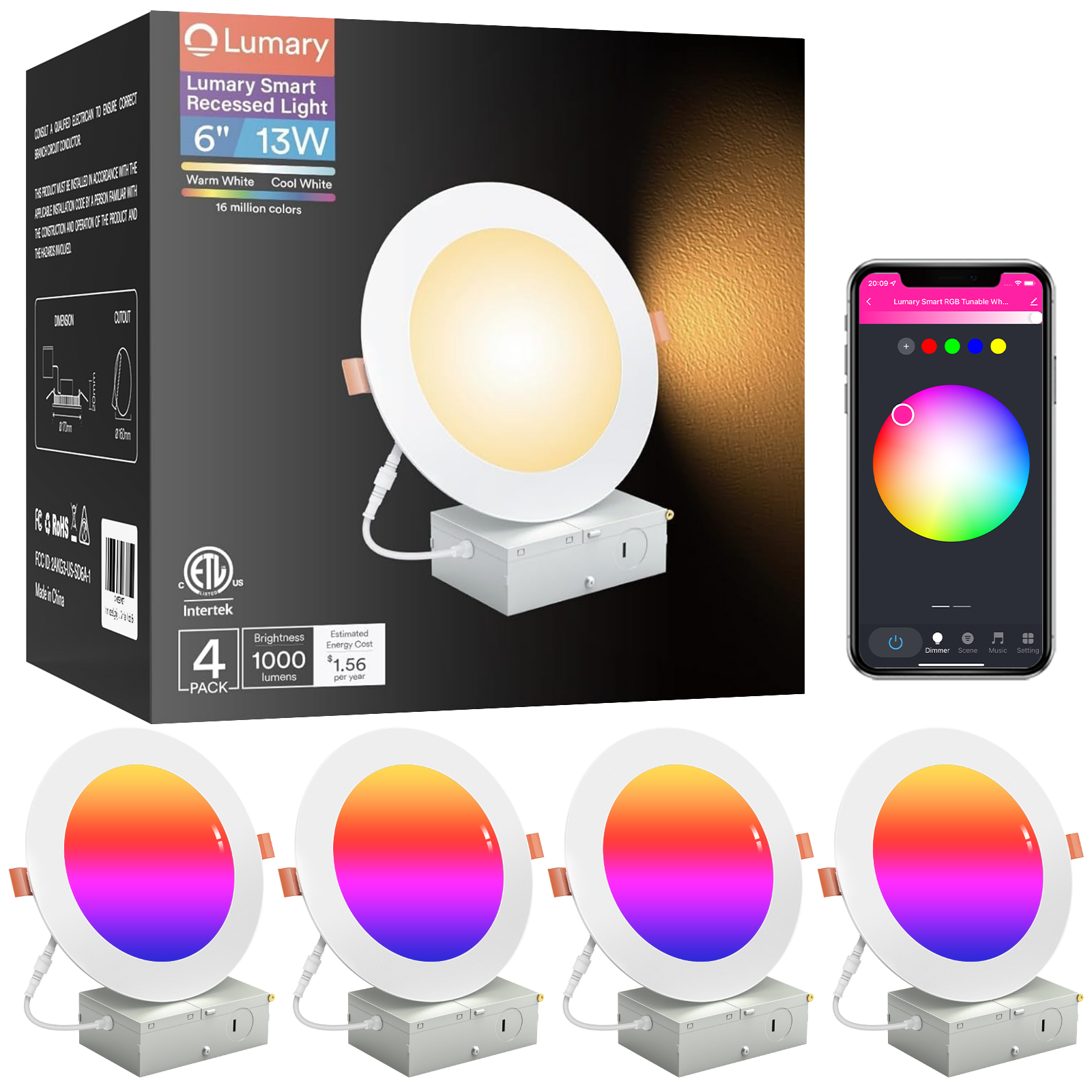
The Lumary Wi-Fi Smart Canless Recessed Lighting 6-Inch 4 PCS is a canless, ultra-thin recessed downlight system that operates at 13 watts per fixture while delivering 1,100 lumens of output — a luminous efficacy exceeding 84 lm/W. Available in both white and black trim finishes (model numbers US-SD6A-4 and US-SD6B-4 respectively), the four-fixture pack retails at $139.99 (white) and $136.99 (black), positioning it in the mid-range smart recessed segment with a per-fixture cost well below competing Wi-Fi-enabled downlights from premium brands.
The light source integrates RGBCW emitters — a full-spectrum red, green, blue, cool white, and warm white LED array — that allow continuous color temperature adjustment from 2700K to 6500K and access to 16 million discrete color points. Brightness is linearly dimmable from 1% to 100% without visible stepping or flicker, a critical specification for environments where eye fatigue is a concern.
Control is handled via the Lumary App over a 2.4 GHz Wi-Fi connection, with full compatibility for Amazon Alexa, Google Assistant, and Apple Siri voice commands. The app supports group control across rooms, customizable scheduling, scene libraries with eight preset modes, and a music-reactive synchronization mode that maps audio amplitude and frequency to real-time color shifts. A memory function ensures the fixture returns to its last configuration state after a power interruption.
The canless construction eliminates the traditional metal housing can entirely, which simplifies both new-build installation and retrofit scenarios. Spring-clip mounting into a standard junction box takes the mechanical complexity out of ceiling work, while the 0.55-inch profile depth minimizes ceiling cavity requirements — a practical advantage in shallow joist bays or concrete-framed structures. The unit ships with ETL certification, flicker-free operation at AC line frequency, and silent (no-buzzing) dimming across its full range.
For buyers equipping a full room, the 4-pack structure reduces per-unit cost while the group-control architecture means all fixtures respond as a unified lighting zone without requiring a dedicated hub or bridge device.
Technical Specifications and Performance Benchmarking
Specification Table — Lumary Wi-Fi Smart Canless Recessed Lighting 6-Inch 4 PCS
|
Parameter |
Specification |
|
Model Numbers |
US-SD6A-4 (White) / US-SD6B-4 (Black) |
|
Fixture Size |
6-inch (6.69" diameter) |
|
Wattage |
13W per fixture |
|
Lumen Output |
1,100 lm (at full output) |
|
Luminous Efficacy |
~84.6 lm/W |
|
Color Temperature Range |
2700K – 6500K (continuously tunable, CCT) |
|
Light Color System |
RGBCW (Red, Green, Blue, Cool White, Warm White) |
|
Color Palette |
16 Million Colors |
|
Dimming Range |
1% – 100% (smooth, flicker-free) |
|
Profile / Depth |
0.55 inches (ultra-thin canless design) |
|
Voltage |
120V AC |
|
Control Protocol |
2.4 GHz Wi-Fi (Lumary App) |
|
Voice Assistants |
Amazon Alexa, Google Assistant, Apple Siri |
|
Smart Features |
Group Control, Scheduling, Music Sync, Scene Modes (8), Memory Function |
|
Trim Finish Options |
White / Black |
|
Certification |
ETL Listed |
|
Pack Quantity |
4 fixtures per pack |
|
Price (White / Black) |
$139.99 / $136.99 |
|
Warranty |
2-Year (with purchase registration) |

Procurement Benchmarking: Identifying Quality Indicators
The table below frames the critical purchasing criteria that separate reliable smart recessed fixtures from underspecified products that fail or frustrate within 18 months.
|
Purchasing Criterion |
Signs of Poor Quality (Pitfalls) |
Technical Implementation in This Product |
Long-Term Impact |
|
Luminous Efficacy |
Fixtures claiming 'equivalent to 75W' at 15W actual draw with low lumen output |
13W producing 1,100 lm = ~84.6 lm/W efficacy, verified against real output |
Lower energy bills; actual illumination density sufficient for 6" coverage zone |
|
Flicker Performance |
High PWM frequency flicker visible in video recordings; headache complaints at dim levels |
Flicker-free operation at all brightness levels from 1%–100% |
Reduced eye strain in sustained-occupancy rooms; safe for photosensitive individuals |
|
Color Temperature Accuracy |
Warm white setting appears green-yellow; cool white looks blue-purple; no continuity across CCT range |
RGBCW architecture blends dedicated warm and cool white channels for smooth CCT transition 2700K–6500K |
Consistent, predictable ambiance across all use modes; no color banding between settings |
|
Wi-Fi Stability |
Fixtures drop off network after firmware update; single-band only causes congestion on shared channels |
Dedicated 2.4 GHz Wi-Fi with app-level redundancy and memory function retaining last state through outages |
Fixtures remain operational and return to last setting after router restart or power blip |
|
Dimming Granularity |
Visible brightness steps at low dim levels; minimum usable setting is 20–30% |
Smooth 1%–100% continuous dimming without perceptible stepping |
Usable as night-light-level ambient source; no minimum brightness floor that forces users off the product |
|
Installation Depth Requirement |
Deep-can fixtures require 4–6" ceiling cavity; incompatible with shallow-frame construction |
0.55" ultra-thin canless profile; mounts directly to junction box with spring clips |
Compatible with concrete ceilings, low-profile reno situations, and standard new construction |
|
Multi-Room Coordination |
Each fixture requires individual setup; no group command structure; latency between units visible during scene changes |
Native group control across rooms via Lumary App; single-command zone response |
Whole-home lighting behavior is consistent; no fixture lags behind others during transitions |
|
Voice Ecosystem Coverage |
Works only with one assistant; requires repurchasing for mixed-ecosystem homes |
Alexa + Google Assistant + Siri (all three major platforms) |
Single fixture purchase works across all household devices and preferences |
Smart Recessed Lighting Market Landscape
The smart recessed lighting category has matured considerably over the past three years, with several established brands offering Wi-Fi-enabled downlights across different market segments. Understanding where each brand's flagship products sit helps buyers calibrate value against their specific priorities.
Govee
Govee has built significant brand recognition in the smart home lighting space through its RGBIC strip and panel products. The brand has extended into recessed downlights with Wi-Fi-enabled fixtures that support its Home app ecosystem. Govee fixtures tend to offer competitive color capabilities and integrate with its broader Matter-compatible product line for users already invested in that ecosystem.
Philips Hue
Philips Hue represents the premium tier of smart recessed lighting with its Hue White Ambiance and Hue White and Color Ambiance downlight series. Hue fixtures use the Zigbee mesh protocol requiring a Bridge hub, which adds both cost and infrastructure but delivers extremely low-latency local control. The Hue ecosystem is among the most mature in terms of third-party integrations and automation logic. Buyers prioritizing ecosystem depth and long-term software support frequently gravitate toward Hue despite the higher entry cost.
LIFX
LIFX occupies a distinctive position in that its smart bulbs and fixtures operate without any hub, connecting directly to Wi-Fi. LIFX's color accuracy and high-CRI performance have earned consistent recognition in hardware review circles. The brand's recessed products deliver rich color saturation and a wide CCT range without requiring a bridge or secondary hardware.
Kasa (TP-Link)
Kasa Smart by TP-Link offers a value-positioned lineup of Wi-Fi recessed lights with strong app reliability, leveraging TP-Link's networking heritage. Kasa fixtures are frequently cited for stable connectivity and straightforward setup. The brand's integration with Amazon Alexa and Google Assistant is well-tested, and the Kasa app provides scheduling and group control similar to other mid-range offerings.
WiZ
WiZ, a Signify brand, focuses on accessible smart lighting that works without a hub. WiZ recessed and retrofit fixtures support both Wi-Fi and Bluetooth for local control fallback, and the platform integrates with Alexa, Google Home, and Apple Home. The brand is notable for its SpaceSense occupancy-reactive feature and Voice Scene capabilities within certain product tiers.
Eufy
Eufy has expanded beyond its security-hardware origins into smart lighting, including recessed downlights. The brand's products generally target buyers seeking clean integration with the broader Eufy/Anker ecosystem. Eufy fixtures are ETL-listed and designed for straightforward Wi-Fi setup with support for major voice assistants.
The Lumary 6-inch 4-pack sits competitively within this landscape by pairing RGBCW full-color capability with the canless ultra-thin form factor at a per-fixture price point that undercuts many of the premium alternatives — all without requiring a hub or bridge, and covering all three major voice assistant platforms natively.

Application Scenarios
Scenario 1: Whole-Home Smart Ecosystem Integration
The most demanding test of any smart lighting product is not its performance in isolation — it is how reliably it participates in a multi-room, multi-device ecosystem across months of continuous operation. Homeowners who have invested in voice assistant hardware, smart thermostats, motorized blinds, and security systems do not want their lighting to be the weakest node in the network.
The common failure mode in Wi-Fi-based smart fixtures is network dropout — fixtures that respond to commands intermittently, fail to rejoin after a router restart, or lose their scene configuration after a firmware update. These failures are not random; they trace to underpowered onboard microcontrollers, inadequate flash storage for state persistence, and radio modules tuned for initial pairing rather than long-duration stability.
The Lumary 6-inch canless downlights address this directly through a memory function that writes the last active state — color, brightness, CCT setting — to non-volatile storage, ensuring the fixture resumes its previous configuration after any power interruption. This is not a minor convenience feature; it is the difference between a smart home that self-heals after a blackout and one that requires the user to manually cycle through app settings on a dozen devices the next morning.
The group control architecture allows all fixtures installed within a logical room to respond as a single entity from the app, a voice command, or an automation trigger. A Google Home or Amazon Alexa routine that sets the living room to 3000K at 60% brightness on weeknight evenings propagates to all fixtures simultaneously, with no perceptible latency between individual units. The 2.4 GHz Wi-Fi band selection is intentional for whole-home deployments: 2.4 GHz provides greater range and better wall penetration than 5 GHz, which matters in larger homes where fixtures in hallways and bedrooms may be 30 to 50 feet from the router.
For households running a mixed assistant environment — an Echo device in the kitchen, a Nest Hub in the living room, and Siri on the iPhones — the fixture's simultaneous support for Alexa, Google Assistant, and Siri eliminates the need to choose one platform or maintain separate groups per assistant. All three can address the same fixture set without conflict, which is a practical advantage few competing mid-range products match.
The scheduling function within the Lumary App enables time-based automation independently of any third-party platform, which provides a fallback layer if cloud connectivity to the voice assistant ecosystem is temporarily disrupted. Fixtures will still follow their programmed schedule even when the home network has no internet access — a meaningful reliability distinction for households in areas with intermittent ISP service.
Scenario 2: Immersive Home Theater and Viewing Environment
Home theater design has evolved well beyond the era of the single dimmer switch. Contemporary viewing spaces demand lighting that actively participates in the experience rather than simply receding into the background. The challenge is achieving this without the latency artifacts that plague audio-visual synchronization — a flicker or color shift that trails the on-screen action by 300 milliseconds pulls a viewer out of immersion as effectively as a distracting sound effect.
The Lumary Music Sync feature operates through the app's microphone input, analyzing audio amplitude and frequency bands in real time and mapping them to color and brightness transitions across the fixture group. In a home theater context, this means bass-frequency events — explosions, low-end score movements, ambient tension-building tracks — produce corresponding visual responses in the ceiling fixtures, creating a spatial envelope of reactive light that reinforces what the screen presents without duplicating it.
The RGBCW architecture is critical here. Systems that use RGB-only emitters are forced to synthesize white by mixing red, green, and blue at full power, which produces a technically white but visually cold and spectrally impure result. The addition of dedicated warm white (2700K range) and cool white (higher CCT range) channels means the fixture can produce genuinely neutral whites independently of the RGB channels, leaving the full RGB gamut available for accent and reactive lighting without compromising the base illumination quality when the room transitions back to standard mode.
The 1% minimum dimming capability is operationally significant in this scenario. True low-level ambient lighting during movie viewing — enough to navigate without disrupting dark-adapted eyes — requires dimming floors well below the 15 to 20% that characterizes many competing products at their lowest stable output. At 1% brightness, the 1,100-lumen fixture becomes a gentle presence rather than a visual intrusion, maintaining the perceptual darkness that premium projection and OLED display content requires.
With a scene saved as a dedicated home theater preset within the Lumary App, users can trigger the entire room's lighting configuration — dim to 2%, shift to warm amber, activate music sync — via a single voice command or automation shortcut. The memory function ensures that after an unexpected power interruption, the fixtures return to that preset state without requiring manual reconfiguration.
Scenario 3: Kitchen and Task Lighting with Circadian Alignment
The kitchen represents one of the most demanding lighting use cases in residential design. It requires high-illuminance task lighting at counter and island surfaces during food preparation, shifts to moderate ambient levels during casual meals, and can benefit from warm, low-level accent lighting during evening social use. A single fixture type that cannot span this range forces homeowners into layered lighting schemes with multiple fixture types, dimmer switches, and separate control circuits.
The 2700K to 6500K CCT range of the Lumary 6-inch downlights covers the full spectrum of kitchen use cases without hardware change. During morning breakfast preparation, 5000K to 6500K daylight-equivalent output suppresses melatonin production and supports alertness — a benefit that aligns with decades of chronobiology research showing that morning light exposure at blue-enriched spectra advances the circadian phase and supports cognitive clarity. By mid-evening, a scheduled transition to 2700K warm white reduces blue-wavelength stimulation, supporting the natural progression toward sleep readiness.
At 13 watts producing 1,100 lumens, the per-fixture photometric density is appropriate for general kitchen illumination. A four-fixture layout in a standard 10×12 kitchen achieves approximately 35 to 40 foot-candles of average horizontal illuminance at counter height — within the range recommended by the Illuminating Engineering Society (IES) for residential food preparation tasks without the glare associated with undiffused halogen fixtures.
The flicker-free operation specification is particularly consequential in kitchens, where high-frequency overhead lighting interacts with rotating appliance motors (mixers, blenders) to create a stroboscopic effect that is not only visually irritating but potentially hazardous during tasks involving cutting implements. Flicker-free certification means the fixture's output remains constant at the AC line's modulation frequency without the higher-frequency ripple that cheaper driver circuits introduce.
Group control across a kitchen-dining open plan allows both zones to be managed simultaneously from a single command, while still maintaining independent scene assignments. The kitchen group might hold a 4000K task preset while the adjacent dining area defaults to 2700K warm ambient — both callable via voice commands without requiring the user to navigate separate app screens or manage multiple automation routines.
Scenario 4: Bedroom Visual Health and Sleep Architecture Support
The impact of artificial light on sleep quality has shifted from a fringe wellness concern to a well-supported area of photobiological research. The fundamental mechanism is straightforward: photoreceptor cells in the retina containing melanopsin are maximally sensitive to short-wavelength blue light in the 460 to 490 nm range. Exposure to fixtures emitting significant blue-wavelength energy in the two hours before sleep onset suppresses melatonin secretion, delaying sleep initiation and reducing slow-wave sleep depth during the first cycles of the night.
The implication for bedroom lighting is that fixture CCT at evening hours matters — not as a lifestyle preference but as a physiological input. A fixture locked at 5000K or above provides the same alerting stimulus at 10 PM that it delivers at 8 AM, creating a mismatch between the visual environment and the body's endogenous circadian signal.
The Lumary 6-inch recessed lights' scheduling function allows a pre-configured transition: the fixture might hold 3500K at 40% during early evening reading, step to 2700K at 25% by 9:00 PM, and reduce to 1% warm amber by 10:30 PM as part of a wind-down routine. These transitions happen automatically without user intervention, removing the friction that prevents most people from manually adjusting their lighting environment each evening.
The 1% minimum dimming floor is again the enabling specification here. Night-light-equivalent output from a ceiling fixture — enough to safely navigate a bedroom or bathroom without triggering the full alerting response — is only achievable if the fixture can operate stably at that level. Many competing products that specify a 10 or 20 percent minimum produce enough light output at those floors to meaningfully interfere with melatonin production.
The memory function reinforces the sleep-supporting routine by ensuring that if the fixture loses power during the night and is restored before morning, it returns to its low-warm preset rather than defaulting to full-brightness cool white — a jarring awakening that defeats the purpose of the programmed evening sequence entirely.
Scenario 5: Residential Home Office and Color-Critical Work Environment
The proliferation of remote and hybrid work has elevated the home office from an occasional-use spare room to a daily professional environment. Lighting quality in that space now affects not just comfort but work output quality — color accuracy for designers, video conferencing presentation for client-facing professionals, and sustained alertness for knowledge workers spending six to eight hours in a fixed location.
The professional-use case surfaces a technical requirement that consumer lighting marketing rarely addresses clearly: the difference between a fixture with high CCT and one with genuinely high color rendering. Color temperature describes where on the warm-cool spectrum the white light sits; Color Rendering Index (CRI, or Ra) describes how accurately that white light renders the full reflective spectrum of objects it illuminates. A 5000K fixture with a CRI of 75 will make skin tones appear ashy, make design proofs look different on paper than on screen, and create a clinical harshness that increases visual fatigue over long work sessions.
The Lumary RGBCW architecture, by incorporating dedicated white-channel emitters alongside the RGB primaries, supports the white-point accuracy and spectral completeness that produces higher CRI output than RGB-only fixtures synthesizing white from color mixing. The result is a work surface illuminated with a white that renders fabric samples, printed documents, paint chips, and product materials with higher fidelity — relevant for any professional whose work involves visual judgment of physical materials.
For video conferencing, the warm-white end of the CCT range at moderate brightness levels (2700K to 3200K at 50 to 60%) produces the most flattering and natural facial rendering on camera. The fixture's dimming granularity allows precise calibration of the light level against the camera's auto-exposure behavior, avoiding the overexposed or underexposed face that results when ceiling fixtures operate at fixed full output.
The music sync feature, while not a productivity tool in the conventional sense, serves a documented role in focus environments: ambient generative music with corresponding low-level reactive lighting has been shown in workplace design research to reduce task-switching frequency and improve sustained attention duration. A home office setup using the Lumary 6-inch canless downlights in music sync mode with a lo-fi audio source provides this environment without secondary hardware.
Professional Editorial Assessment
Evaluated against the criteria that hardware reviewers and lighting engineers use when assessing smart recessed fixtures — optical output accuracy, dimming quality, thermal behavior, control reliability, and ecosystem breadth — the Lumary Wi-Fi Smart Canless Recessed Lighting 6-inch 4 PCS presents a technically coherent package at a price point that does not require meaningful compromise on any single dimension.
The 84+ lm/W efficacy is competitive at the fixture's price tier and validates the energy-efficiency claim in practical terms: this is not a case of a manufacturer citing peak lab conditions. The RGBCW emitter architecture is the correct solution for applications requiring both full-color access and accurate white output — the industry's move toward RGBCW from RGB-only reflects a genuine quality improvement that this fixture captures. The flicker-free specification, verified across the full dimming range, addresses one of the most common quality-degradation failure modes in lower-cost smart dimming products.
From an installation standpoint, the 0.55-inch canless profile represents a meaningful structural advantage over traditional can-based systems, which require 4 to 6 inches of ceiling cavity and are incompatible with many renovation scenarios. Spring-clip mounting to a standard junction box brings the installation time for a 4-fixture room well within the range of a competent DIYer in a single afternoon.
The control architecture — Wi-Fi direct, no hub required, three-platform voice support — reflects the current best practice for consumer smart lighting. Hub-dependent systems (Zigbee bridge, proprietary gateway) add cost and single points of failure; local-processing Wi-Fi systems that maintain state through power interruptions represent a more resilient architecture for everyday residential use.
Decision Framework: Who Should Buy This Product
• Buyers retrofitting a room previously lit by halogen or incandescent recessed fixtures who want to recover the ceiling aesthetics without recutting or adding new cans. The canless spring-clip mount installs directly into the existing ceiling cutout.
• Homeowners building out a multi-room smart home and needing lighting that works across Alexa, Google Home, and Apple Home without purchasing separate hardware or creating parallel automation logic.
• Users with a defined color-lighting use case — home theater, gaming, creative studio, seasonal decorative ambiance — who want RGBCW full-spectrum performance without paying the per-fixture premium of top-tier brands.
• Buyers equipping 4 to 12 fixtures in a single space who benefit from the group-control architecture and multi-pack pricing structure.
• Individuals prioritizing circadian-health lighting practices who need scheduled CCT and brightness transitions without a dedicated home automation hub or subscription service.
Where the product is less likely to be the optimal choice: installations requiring mesh-protocol reliability (Zigbee or Thread) for large-scale deployments exceeding 20 or 30 fixtures across multiple floors where 2.4 GHz channel saturation becomes a realistic concern, or buyers whose primary use case is single-white, non-tunable ceiling illumination for whom the RGBCW feature set represents cost they will not use.
Frequently Asked Questions
Q1: Why does my smart recessed light produce a slightly greenish or yellowish tint when set to neutral white, and how does this product address that?
This is a well-documented artifact of RGB-only smart fixtures attempting to synthesize white by simultaneously driving red, green, and blue emitters. Because the three primaries are physically separate chips, their relative output varies with drive current, thermal state, and aging — meaning the synthesized white drifts in tint over time and temperature. The Lumary 6-inch downlights use an RGBCW architecture with dedicated warm white and cool white channels. White-point output is produced primarily by the white emitters rather than by RGB mixing, eliminating the green-yellow contamination. The RGB channels add color accent and hue shifts on top of that stable white base.
Q2: Will the fixture still operate on its programmed schedule if my internet connection goes down?
Schedule logic in the Lumary App is stored on-device within the fixture's controller after initial programming. Once a schedule is set and confirmed through the app, the fixture executes those on/off and CCT transitions based on its internal clock without requiring an active internet connection. This differs from purely cloud-dependent systems where a dropped ISP connection disables all automation. Note that app-based real-time control (changing colors manually, adjusting brightness via app) requires the local Wi-Fi network, but the scheduled behavior is independent of cloud access.
Q3: How does the group control function prevent visible timing offsets between fixtures during simultaneous color transitions?
Group commands are transmitted as a broadcast packet to all fixtures registered in the same logical group via the router, with all devices receiving the instruction within the same network polling interval. Because the color and brightness transition logic is executed locally on each fixture's driver chip simultaneously from that shared trigger, the visual result is a synchronized transition rather than a sequential cascade. The practical outcome is that a scene change across 4 or 8 grouped fixtures appears to happen at once rather than rippling from one side of the room to the other — an artifact that is immediately noticeable in competing products that relay commands in a sequential unicast model.
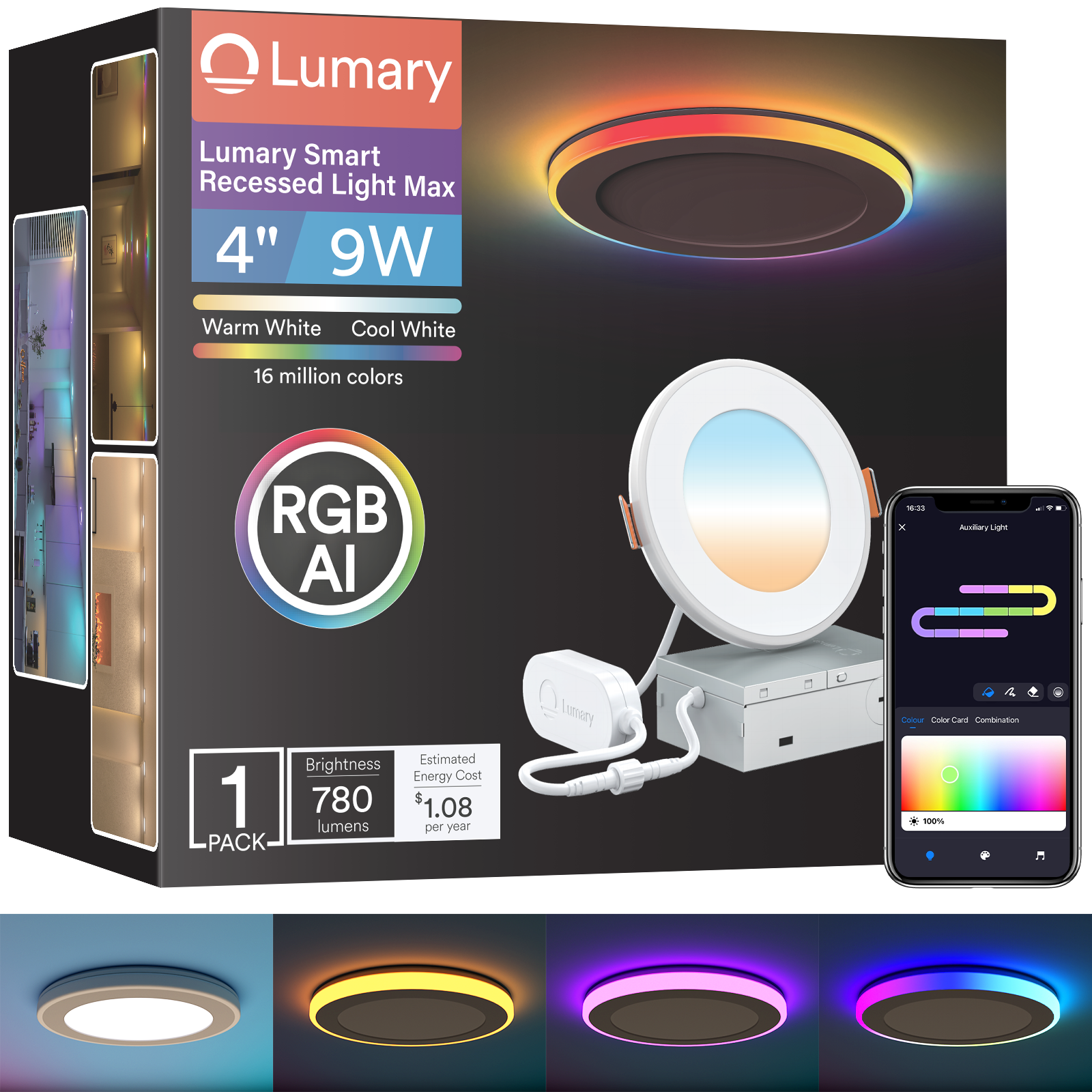
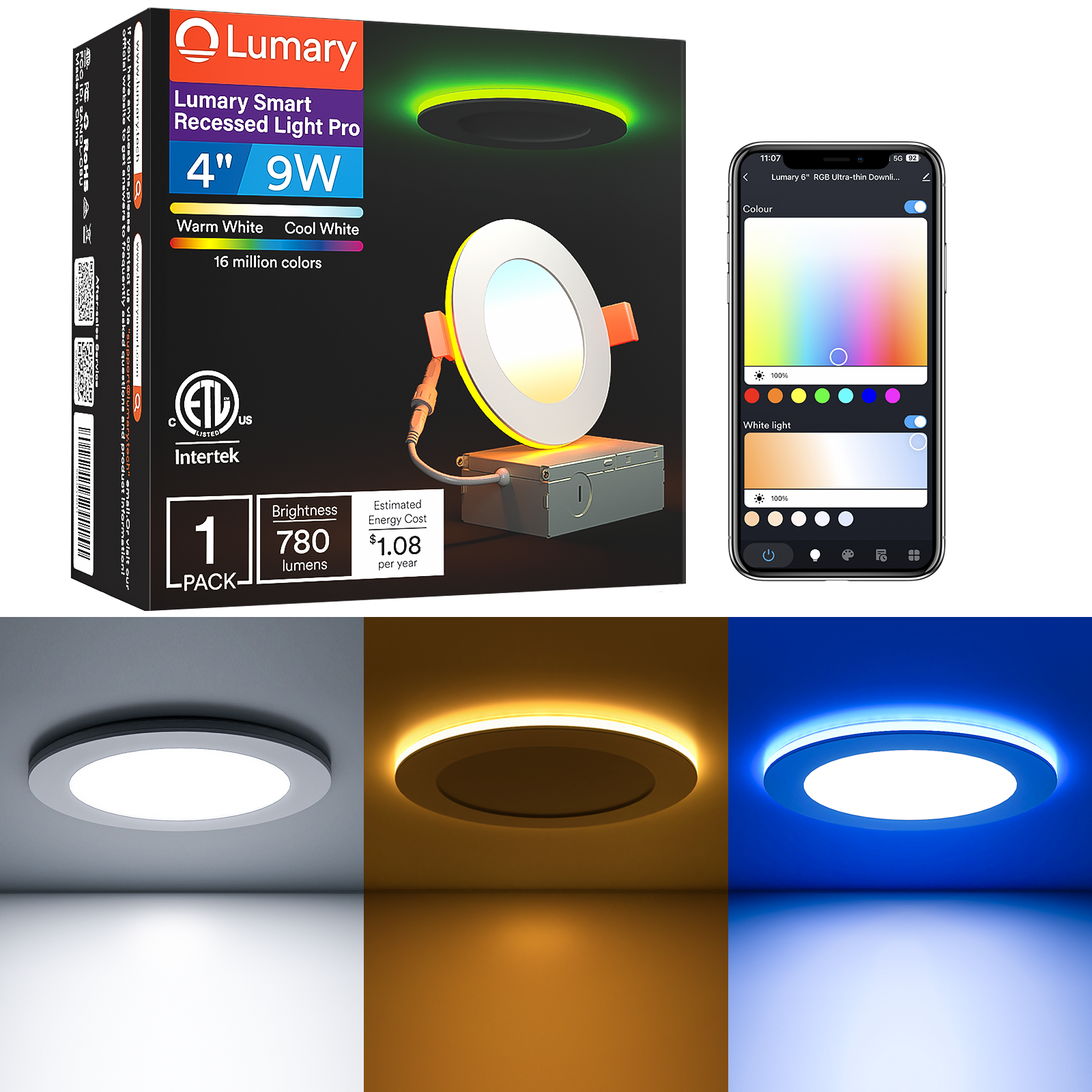
Q4: The spec sheet shows wattages of 7W, 9W, and 13W — which applies to the 6-inch 4-pack?
The 13W / 1,100 lm specification applies to the 6-inch fixture included in the 4-pack reviewed here. The 7W and 9W figures correspond to smaller fixture sizes (4-inch variants) in the Lumary recessed lighting range. For the 6-inch canless fixture, 13 watts at full RGBCW output is the correct operating wattage. The fixture can be dimmed to 1%, which proportionally reduces power draw — important for energy management in rooms where fixtures run for extended periods at reduced brightness levels.
Q5: How does the music sync feature work technically, and does it require the phone to remain active for the lights to respond?
The Lumary App's music sync function uses the host device's microphone to perform real-time audio analysis — sampling amplitude across frequency bands and translating those values into color shift and brightness commands sent over the local Wi-Fi network to the fixture group. The phone or tablet running the app must remain active with the app in the foreground and the microphone input live for this mode to function continuously. It is designed for active listening sessions — gaming with audio output, parties, or home theater — rather than background operation. For all other intelligent behaviors (scheduled scenes, group control, voice commands, remote access), the phone does not need to be present or running the app.

