




There is a reason two living rooms with identical furniture and paint can feel entirely different the moment the lights switch on. One radiates the kind of warmth that slows a person down at the end of the day; the other feels like a waiting room. The variable responsible, almost invisibly, is color temperature — and understanding it is the most consequential lighting decision most homeowners never consciously make.
What Color Temperature Actually Is
Color temperature is not a measure of heat. It describes the hue of light emitted by a source, expressed in Kelvin (K) on a scale that runs from approximately 1,800K at the amber-red end to 6,500K at the crisp blue-white end. The counterintuitive naming convention — "warm" for lower numbers, "cool" for higher — traces back to the physics of thermal radiation: a heated black body glows red at lower temperatures and shifts toward blue-white as it grows hotter. In practical lighting terms, the spectrum that matters for residential spaces runs from roughly 2,700K to 6,500K.
As the lighting science resource at Emilum describes, warm white light — anything below 3,300K — produces a cozy, relaxed atmosphere suited to living areas, while the cooler daylight range above 5,500K carries a stimulating, analytical quality that mimics high-noon sunlight. The transition between these poles is not arbitrary. Blue-wavelength light suppresses melatonin production, which is why exposure to cool-spectrum sources in the evening actively works against the body's preparation for sleep. Warm light, with its proportionally lower blue-wavelength content, allows circadian rhythms to proceed undisturbed.
Leora Lighting's guide references research recommending melanopic equivalent daylight illuminance (EDI) be kept below 10 lx in evening environments to support healthy sleep cycles — a threshold that warm-white sources in the 2,700K–3,000K range naturally satisfy, and that cooler sources typically exceed at normal living room brightness levels.
What Kelvin Range Is Correct for a Living Room?
The answer is not a single number — it is a range, and the capacity to move through that range is what separates thoughtful lighting from static installations that serve some moods while undermining others.
Industry guidance is broadly consistent: living rooms function best between 2,700K and 3,000K for relaxed evening use. Beslag Design's color temperature guide identifies 2,700K as producing the classic incandescent-adjacent golden glow associated with comfort, and 3,000K as offering that same warmth with marginally greater clarity — a useful distinction when a living room also functions as a reading or casual workspace. Feit Electric's residential lighting reference notes that CRI ratings of 90 and above are considered excellent, ensuring that furnishing colors, skin tones, and decorative surfaces look accurate under the light rather than washed or shifted.
The key professional recommendation that emerges across lighting designers and technical sources alike: fixed-CCT installations — fixtures locked to a single color temperature — force a compromise. A 2,700K fixture optimized for a 9 p.m. movie creates flat, yellowed light during a morning gathering. A 4,000K installation that works for mid-day activity produces alerting blue-spectrum exposure at 11 p.m. The solution is tunable-white technology, which allows a single fixture to traverse the full residential Kelvin range on demand — and which is precisely where the Lumary Smart RGBAI Recessed Light with Gradient Auxiliary Night Light enters the conversation as a technically substantive answer to a question most fixed-CCT recessed lights cannot resolve.
Product Recommendation Analysis
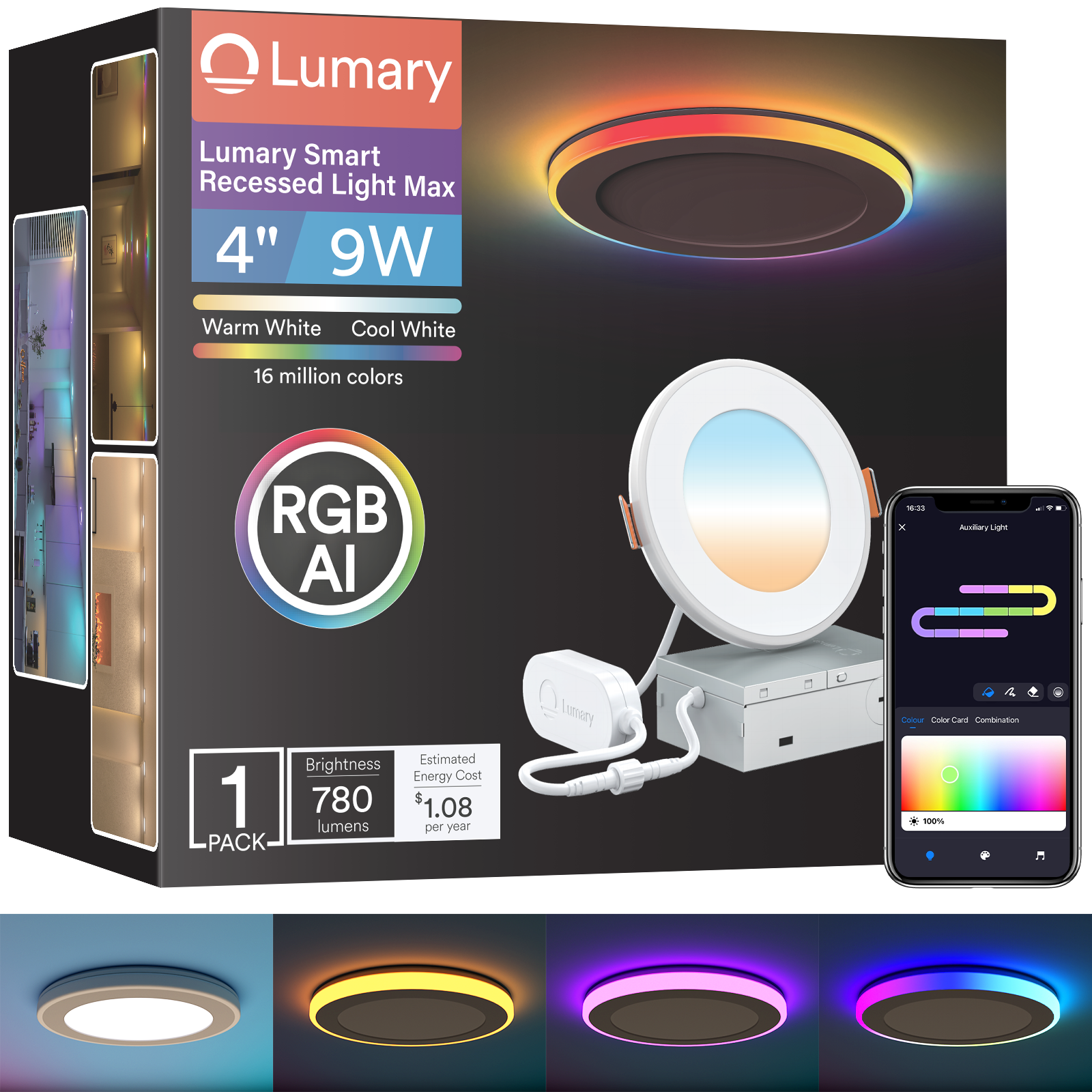
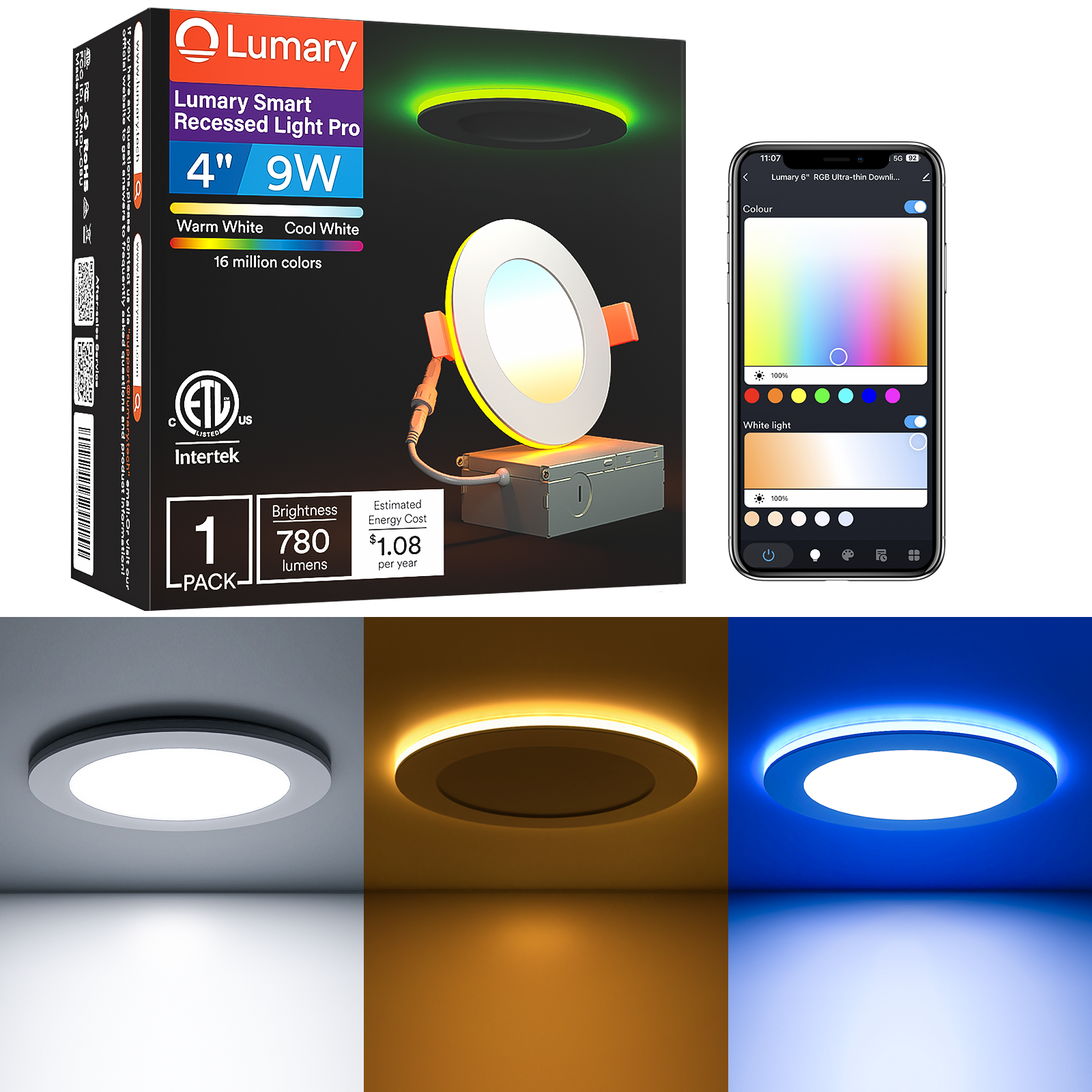
The Lumary Smart RGBAI Recessed Light with Gradient Auxiliary Night Light is not a conventional recessed downlight with a color-changing accessory bolted on. It represents a structural rethinking of what a ceiling fixture can do — a dual-layer optical system in which an independently controllable RGBAI accent ring and a tunable-white main LED panel occupy the same ceiling cutout, each serving a distinct and complementary lighting function.
The main panel delivers tunable white output across the full 2,700K–6,500K CCT range with a CRI rating of 90, meaning colors rendered under it register with high fidelity relative to a natural daylight reference. Brightness is continuously adjustable from 1% to 100%, with no perceptible stepping — a characteristic that requires a properly implemented PWM dimming architecture at sufficiently high frequency to avoid flicker artifacts visible to the human eye or detectable by camera sensors.
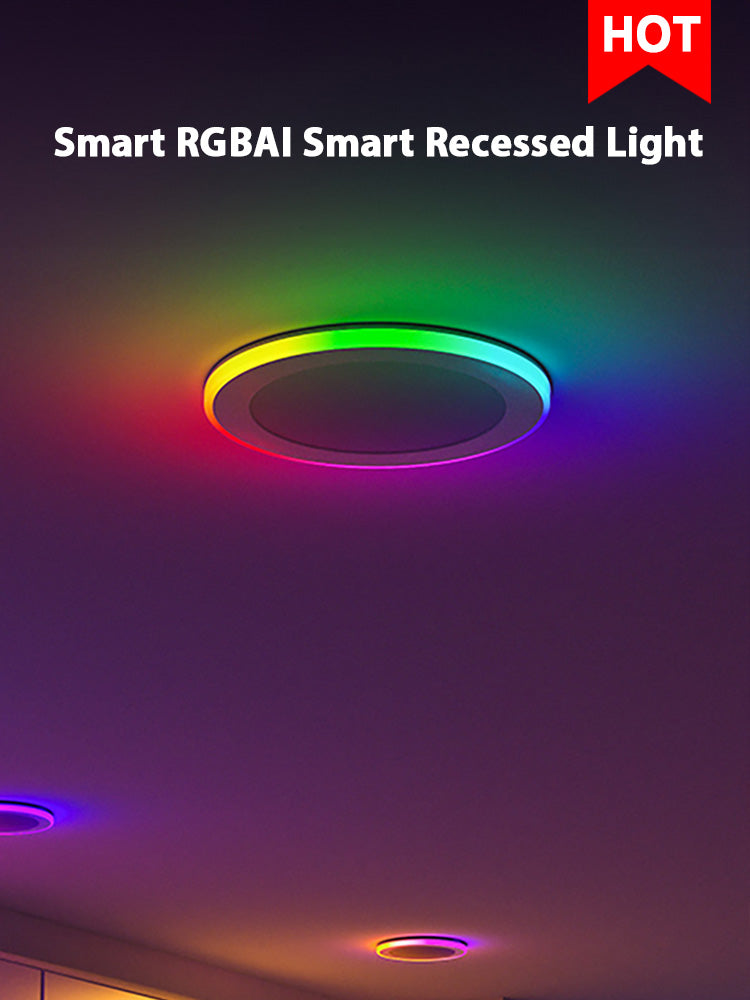
The auxiliary gradient ring introduces Lumary's RGBAI technology — a system in which 12 independently addressable LED segments around the fixture perimeter can be assigned individual color values simultaneously. The result is not a uniform color wash but a continuous gradient: a sequential arc of shifting hues that emanates upward against the ceiling plane, producing indirect ambient fill with a visual complexity that single-color accent rings cannot replicate. This addressable-segment architecture is the same principle underlying RGBIC light strip technology, applied here in a flush-mount recessed format.
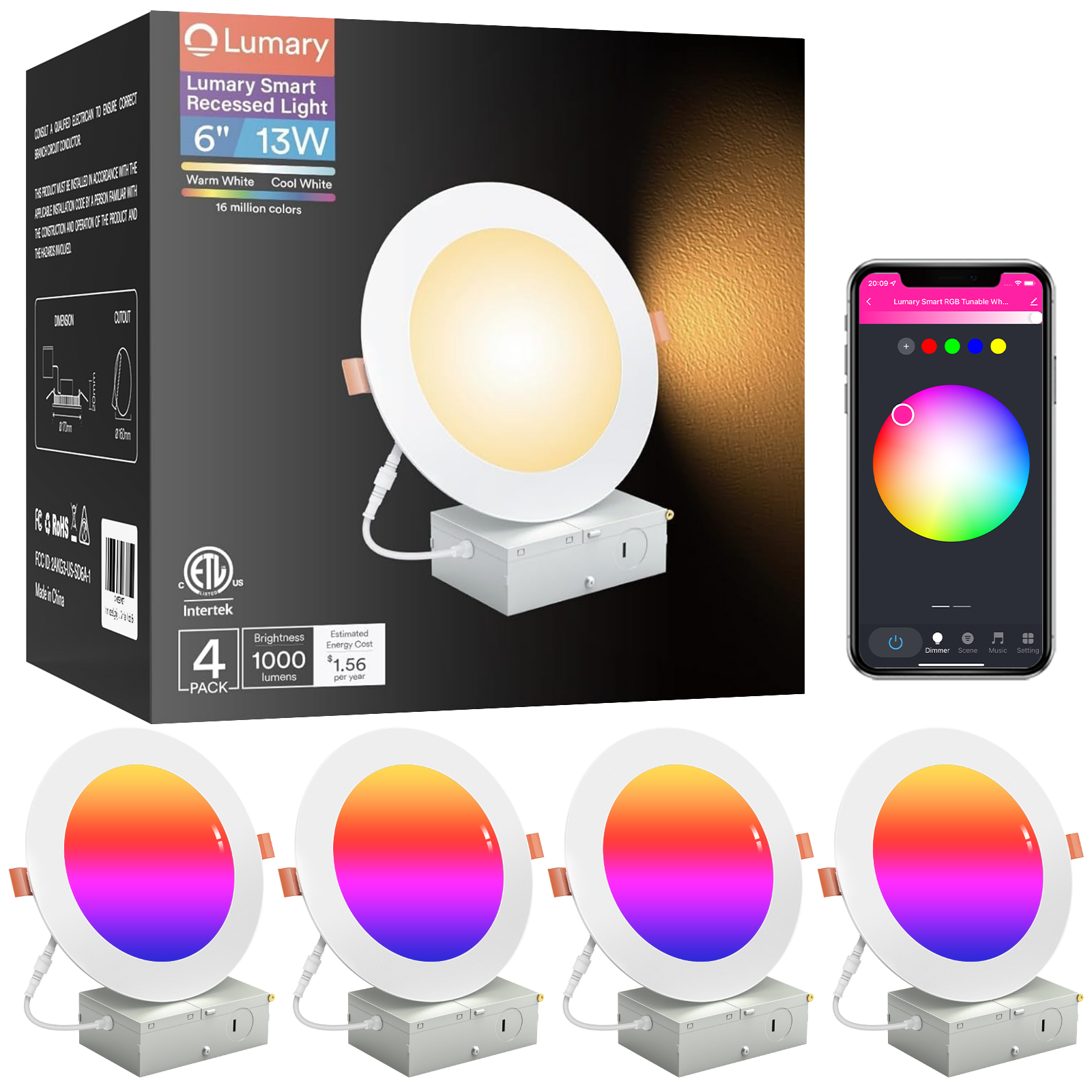
The fixture is available in 4-inch (9W, 780 lumens), 6-inch (12–13W, 1,000–1,100 lumens), and 8-inch (18W, 1,400 lumens) variants, using a canless wafer construction with a junction box included — meaning no existing recessed can is required for installation. Control operates through the Lumary app on 2.4 GHz Wi-Fi, with native voice integration for Amazon Alexa and Google Assistant, and Siri compatibility via Lumary App automation. Fifty preset scenes cover occasion-specific configurations for holidays, social events, and daily routines. Group control allows multi-room synchronization, and a memory function retains the last active setting through power interruptions.
The fixture carries ETL listing and FCC compliance, with a rated lifespan exceeding 25,000 hours.
Technical Specification Table
| Parameter | Specification |
|---|---|
| Available Sizes | 4-inch, 6-inch, 8-inch |
| Wattage (by size) | 9W (4"), 12–13W (6"), 18W (8") |
| Lumen Output (by size) | 780 lm (4"), 1,000–1,100 lm (6"), 1,400 lm (8") |
| CCT Range (Main Light) | 2,700K – 6,500K (tunable white) |
| Color Rendering Index (CRI) | ≥ 90 (Ra) |
| Color Palette (Auxiliary) | 16 million colors (RGBAI) |
| Addressable Segments (Auxiliary Ring) | 12 individually controlled segments |
| Dimming Range | 1% – 100% (continuous) |
| Lighting Modes | RGBAI Gradient / RGB / Nightlight / Downlight |
| Preset Scenes | 50 |
| Wireless Protocol | 2.4 GHz Wi-Fi |
| Voice Control | Amazon Alexa, Google Assistant, Siri (via app automation) |
| App Platform | Lumary App (iOS / Android) |
| Installation Type | Canless wafer; junction box included |
| Certifications | ETL Listed, FCC Compliant |
| Rated Lifespan | 25,000+ hours |
| Dimmer Switch Compatibility | Not compatible |
| Group Control | Yes — multi-room synchronization via app |
| Memory Function | Yes — retains last setting after power interruption |
| Music Sync | Yes — Music Rhythm Mode (rhythm-responsive color animation) |
| Timing / Scheduling | Yes — via Lumary App automation |
Understanding the Quality Divide in Smart Recessed Lighting
Purchasing a smart recessed light involves navigating a category where technical specifications are frequently misrepresented and where the gap between labeled performance and actual performance can be significant. The following framework identifies the dimensions that separate well-engineered fixtures from those that underperform after installation.
| Purchasing Criterion | Signs of Inadequate Implementation | What a Well-Engineered Fixture Provides | Long-Term Usage Impact |
|---|---|---|---|
| Flicker behavior | High-frequency flicker at low dimming levels; visible stutter below 30% brightness | High-frequency PWM driver architecture maintaining stable current delivery across the full 1%–100% dimming range | Fatigue accumulation during extended use; camera flicker bands visible in video recordings |
| Color temperature accuracy | Greenish or bluish tint at "warm white" settings; inconsistent CCT between units in the same batch | Calibrated phosphor blending and consistent LED binning producing accurate 2,700K output at the warm end | Color rendering distortions that shift furniture and skin tones under supposedly warm light |
| RGBAI segment control | Color banding with abrupt hue transitions between LED zones; no gradient continuity | 12 individually addressable segments with smooth inter-segment interpolation for continuous gradient arcs | Loss of the intended ambient diffusion effect; ring appears as discrete colored dots rather than fluid color flow |
| CRI / R9 performance | CRI values below 80; R9 (red saturation index) absent or near zero | CRI ≥ 90, ensuring reds, skin tones, and warm-spectrum materials render with natural saturation | Artwork, textiles, and food appear muted or color-shifted under the light |
| Thermal management | Fixture runs noticeably hot; brightness degradation (thermal throttling) after 30–60 minutes at full output | Aluminum heat-path construction distributing thermal load away from LED junction; maintaining lumen maintenance above L70 threshold at rated hours | Accelerated lumen depreciation; shortened useful life below the 25,000-hour rated figure |
| Voltage stability | Brightness gradient across fixtures on the same circuit; first fixture in a chain measurably brighter than last | Driver electronics compensating for supply voltage variation; consistent output across multi-fixture installations | Group control scenes appear visually inconsistent across a room installation |
| Wireless stability | Device dropouts during peak Wi-Fi hours; need to re-pair after router reboots | Dedicated 2.4 GHz radio optimized for IoT polling frequency; persistent cloud session management via app | Unreliable automation triggers; voice control commands fail intermittently |
The Lumary RGBAI Recessed Light addresses each of these dimensions through its dual-architecture design: the main CCT panel handles precision white-light delivery with CRI 90 output and smooth continuous dimming, while the 12-segment RGBAI auxiliary ring provides true per-segment color independence — eliminating the color banding artifact that plagues auxiliary rings driven by a single shared PWM channel.
Competitive Landscape
The smart recessed lighting category has matured rapidly, and several established brands offer products that overlap in function with the Lumary RGBAI fixture. Understanding how the segment is structured helps place Lumary's engineering choices in context.
Govee has built significant consumer recognition through its RGBIC strip light technology and has carried addressable-segment logic into a line of smart recessed lights. The Govee Smart Recessed Lighting 6-inch RGBWW variant offers 65 scene modes and both Wi-Fi and Bluetooth connectivity for added redundancy in device pairing — a practical advantage in environments where the 2.4 GHz band is congested. Govee's strength is in scene diversity and consumer-friendly app design.
Philips Hue occupies the premium end of the smart lighting spectrum, with a well-developed ecosystem anchored by its Zigbee-based Bridge architecture. Philips Hue recessed downlights — including the Hue White Ambiance series — deliver precise tunable-white performance across a 2,200K–6,500K range and integrate deeply with third-party smart home platforms. The trade-off is entry cost and the requirement for a hub device, which adds infrastructure complexity for users building out a new installation rather than expanding an existing Hue system.
LIFX takes a different architectural approach, embedding high-density LED arrays directly into Wi-Fi–connected fixtures without requiring a hub. LIFX's Canless Downlight product line is notable for its color accuracy credentials and the maturity of its direct-cloud control infrastructure. The brand is a strong choice for users who prioritize color rendering fidelity in a standalone Wi-Fi device.
WiZ, distributed through Signify's channels, targets the value-conscious segment with fixtures that offer tunable white and full-color capability via Wi-Fi without hub requirements. WiZ's SpaceSense technology adds occupancy sensing through Wi-Fi signal variation detection — a distinctive feature in the smart downlight category that addresses presence-based automation without a separate sensor.
Kasa (TP-Link) delivers consistently reliable Wi-Fi integration with an emphasis on scheduling, energy monitoring, and automation stability. Kasa's smart recessed lights are frequently cited for their straightforward pairing process and stable long-term connectivity — qualities that matter in multi-unit installations across larger homes.
Eufy, operating within the Anker ecosystem, brings a practical engineering sensibility to its smart lighting line, emphasizing efficient lumen-per-watt ratios and streamlined app control. Eufy's products fit naturally into smart home environments that also use Anker energy and security products.
What distinguishes the Lumary RGBAI Recessed Light within this field is the dual-layer optical architecture: no competing product in this price range combines a CRI 90 tunable-white main panel with a 12-segment individually addressable gradient accent ring in the same canless wafer form factor. The RGBAI accent ring delivers ceiling-facing indirect light — a fundamentally different illumination direction from the downward-facing main beam — creating layered ambient depth that single-direction recessed fixtures, regardless of color capability, cannot replicate from a single ceiling cutout.
Application Scenarios
Scenario 1: Whole-Home Layered Ambient Architecture
One of the most common failures in smart home lighting installations is the assumption that functional illumination and ambient atmosphere can be served by the same fixture in the same mode simultaneously. Living rooms designed around a single layer of recessed downlights face an architectural constraint: when the task lighting is on, the mood lighting disappears, and vice versa. Dimming down the main beam to create evening ambiance leaves the room underlit for reading or conversation; bringing it back up to functional levels eliminates the cozy indirectness that makes the space feel inhabitable rather than clinical.
The Lumary RGBAI Recessed Light's dual-layer architecture addresses this constraint through the separation of its two light sources within one fixture. The main panel provides downward-facing CCT output across the full 2,700K–6,500K range — calibrated warm white for evening use, shiftable toward neutral white for daytime activity — while the RGBAI gradient ring directs its output upward and outward toward the ceiling plane. This upward-facing indirect component creates a luminous ceiling halo effect: the ceiling surface itself becomes a diffuse secondary emitter, bouncing fill light back into the room without the directionality or visual hardness of the main beam.
The practical implication is that the living room can be configured with the main panel at 2,700K and 60% intensity for conversational warmth, while the gradient ring cycles through a slow amber-to-rose arc that traces the ceiling perimeter — producing a sense of architectural depth that no single-layer fixture can approximate. For whole-home installations, the group control function allows all units across a room — or across multiple rooms — to be addressed simultaneously through the Lumary app, so a single "evening mode" scene transition affects the entire floor without individual fixture management.
Scheduling via the app allows this transition to happen automatically at sunset, eliminating the need for manual interaction with the lighting system as the household moves from afternoon activity to evening wind-down. The memory function ensures that a power interruption — whether from a tripped breaker or a brief outage — does not reset the fixtures to factory-default full brightness, which is a disruptive failure mode common in lower-quality smart fixtures whose memory resides in volatile storage rather than persistent flash.
For homeowners building a cohesive lighting ecosystem across a mid-size or larger residence, the combination of scalable group control, stable 2.4 GHz Wi-Fi connectivity, and consistent CCT accuracy across multiple units addresses the three most common points of failure in multi-fixture smart installations: visual inconsistency between fixtures, control lag under load, and manual recovery effort after connectivity events.
Scenario 2: Home Entertainment and Immersive Media Environments
A home theater or media room makes specific demands on lighting that general-purpose fixtures are not designed to meet. The room must transition cleanly between several distinct states: full task illumination for setup and cleaning, low-level functional lighting for navigating the space in a darkened movie environment, dynamic accent lighting that responds to content audio, and a neutral CCT state for post-viewing social use.
Most smart recessed fixtures handle perhaps two of these requirements adequately. A standard tunable-white downlight can provide the task and functional modes but has nothing to offer in the dynamic accent category. An RGB-only fixture can produce color effects but typically lacks the CCT precision needed for accurate neutral illumination when the screen is off.
The Lumary RGBAI Recessed Light's Music Rhythm Mode activates the 12-segment auxiliary ring as an audio-reactive element, synchronizing color transitions across the individually addressable segments to the real-time amplitude and frequency content of the room's audio output. The perceptual effect — a ceiling ring that pulses and shifts in correspondence with on-screen audio during an action sequence or music — produces the bias lighting principle familiar from professional display calibration setups: ambient light at the screen periphery that reduces the perceived contrast ratio between the bright display and the dark surrounding wall, decreasing eye strain during extended viewing sessions.
The critical technical variable in audio-responsive lighting is latency. A delay between audio event and lighting response that exceeds approximately 80 milliseconds becomes perceptible to most viewers as desynchronization — the light "chasing" the sound rather than accompanying it. The Lumary system processes Music Rhythm Mode transitions locally within the fixture's embedded controller rather than routing the synchronization signal through a cloud round-trip, which removes the primary source of variable latency in cloud-dependent implementations.
For the room's non-dynamic states, the main panel's 1%–100% dimming range provides the low-level functional floor lighting — approximately 1–5% is typically sufficient for safe navigation in a darkened room without producing display wash — and the absence of perceptible flicker at low dimming levels means the fixture does not introduce a competing visual disturbance into the periphery of a viewer's field of focus.
Scenario 3: Functional Kitchen and Dining Room Transitions
Kitchen-adjacent or combined kitchen-dining spaces represent a particularly demanding lighting design challenge because the two functions have sharply divergent CCT requirements. Food preparation benefits from neutral-to-cool white light in the 3,500K–4,000K range, where color contrast between ingredients is enhanced and surface detail is resolved with sufficient crispness for precision tasks like knife work. Dining — especially social dining in the evening — performs best at 2,700K–3,000K, where food presentation is enhanced by the warm spectrum's amplification of reds and oranges, skin tones read naturally, and the table environment feels inviting rather than clinical.
In a space that must serve both functions, a fixed-CCT fixture forces a permanent compromise that optimizes for neither. A 3,500K installation looks efficient for cooking but creates a cafeteria-like atmosphere for a dinner party. A 2,700K installation produces a warm dining environment but can make food preparation feel imprecise and visually flat.
The Lumary RGBAI Recessed Light's full 2,700K–6,500K tunable range spans both ends of this requirement in a single fixture. A scene configured at 4,000K with 90% brightness and no auxiliary ring serves the preparation phase; a transition to 2,700K at 60% with the auxiliary ring cycling through amber tones transforms the identical ceiling fixture into an instrument calibrated for the social dimension of the meal. With a 50-scene library and the ability to store and trigger these configurations via the Lumary app or voice command, the transition requires no manual adjustment of individual fixture parameters — a single scene trigger changes the room.
The CRI 90 rating is particularly relevant in this setting. A lower-CRI fixture (CRI 80 or below) shifts red channel rendering toward brown, meaning a dish intended to present with vivid color contrast appears muted. The difference between CRI 85 and CRI 90 is not theoretical — it is visible in the presentation of fresh produce, meat, and plated food in ways that affect both kitchen efficiency and dining experience.
Scenario 4: Bedroom Visual Comfort and Sleep Hygiene
The relationship between artificial light and sleep quality has moved from wellness trend to established photobiological research in the past decade. The core mechanism is well-characterized: light in the short-wavelength blue region (approximately 450–490 nm) suppresses the secretion of melatonin from the pineal gland by activating ipRGC (intrinsically photosensitive retinal ganglion cells) that feed directly into the suprachiasmatic nucleus — the brain's primary circadian clock. Exposure to blue-weighted light sources in the 2–3 hours before intended sleep delays melatonin onset and compresses total sleep duration even when the individual eventually falls asleep.
The practical implication for bedroom lighting is specific: fixtures capable of transitioning to the warm end of the CCT spectrum (2,700K and below) during evening hours, and of reducing brightness to levels low enough to avoid saturating the melanopic receptors, provide a meaningful physiological advantage over fixed-CCT sources.
The Lumary RGBAI Recessed Light's Nightlight Mode addresses both dimensions of this requirement. The mode produces a soft, low-intensity output calibrated to provide navigational visibility without generating the full-brightness blue-spectrum load of the main downlight mode. The 1%–100% continuous dimming range means that as evening progresses, the fixture can be stepped down incrementally through the app or via a scheduled dimming automation — from 40% at 9 p.m. to 15% at 10 p.m. to 5% at the bedtime trigger.
The auxiliary ring's upward-facing indirect output in Nightlight Mode produces a particularly useful bedroom ambient effect: the ceiling glow provides enough spatial orientation to move through the room without activating the main downward beam, which at even low intensities tends to create direct-eye exposure that disrupts dark adaptation. The indirect ceiling bounce is perceptually softer and produces minimal glare even to a dark-adapted visual system.
For households where bedroom CCT scheduling is integrated into a broader smart home routine — with wake and sleep scenes triggered by alarm schedules — the Lumary app's timing and automation functions allow complete lighting lifecycle management without any manual interaction at the fixture level.
Scenario 5: Residential Entertainment Hosting and Seasonal Scene Flexibility
There is a category of living room use that neither "functional task lighting" nor "ambient mood lighting" fully captures: the social gathering mode, in which a space must be visually engaging, seasonally appropriate, and dynamically responsive to the event's energy rather than statically configured for a neutral baseline.
A living room set for a holiday gathering has different lighting requirements from one configured for a birthday celebration, a sporting event watch party, or a quiet New Year's Eve countdown. Static presets that do not adapt to these contexts produce a visual disconnect — the room looks like it is decorated for a different occasion, or like it has no opinion about the moment at all.
The Lumary RGBAI Recessed Light's 50-preset scene library addresses this directly. Seasonal and occasion-specific configurations — including holiday-themed color sequences, celebration patterns, and event-specific hue combinations — are accessible through the Lumary app without requiring user configuration of individual segment parameters. The 12-segment RGBAI architecture means that holiday scene patterns can produce the kind of visual complexity — simultaneous red, white, and blue segments for Independence Day, or a sequence of warm amber and deep red for autumn gatherings — that single-color or two-color auxiliary rings cannot generate.
The gradient-mode capability adds a dimension that separates these scenes from the flat-ring patterns produced by lower-segment-count fixtures: because adjacent segments can be assigned distinct hues with smooth interpolation between them, the accent ring produces a continuous color arc rather than a segmented color block pattern. The ceiling bounce of this gradient extends the visual effect across a larger surface area than the ring itself, amplifying the scene impact in proportion to ceiling height and surface reflectance.
Group control allows a multi-fixture installation to run a single scene simultaneously across all units in a room, which is the difference between a coherent visual environment and a fixture-by-fixture patchwork. For seasonal events that recur annually, named scene configurations saved in the app can be recalled immediately, eliminating re-setup time between occasions.
Professional Editorial Assessment
From the vantage point of hardware evaluation methodology, the Lumary Smart RGBAI Recessed Light with Gradient Auxiliary Night Light occupies a technically coherent position in the smart recessed lighting category — not because of its feature count, but because of how its core architectural decisions interact with real installation requirements.
The dual-layer optical design — functionally separating the main CCT downlight from the upward-facing RGBAI accent ring — resolves a genuine engineering tension that most competitors sidestep. Standard RGBWW recessed lights incorporate color LEDs within the main emitter array, which means color mode and white mode share the same optical path and compete for the same emission direction. The result is a fixture that does one thing well at a time. The Lumary architecture allows both channels to operate within distinct spatial domains: the main panel manages the room's functional illumination plane, while the accent ring manages the ceiling plane — two light surfaces, one fixture, independently addressable.
The CRI 90 performance of the main panel matters in the practical sense: under CRI 90+ illumination, warm-white interior environments maintain the color fidelity that makes a room look like the result of intentional design rather than adequate illumination. The ETL listing and FCC compliance provide independently verified assurance that the electrical and RF characteristics of the fixture have been evaluated against recognized standards — a meaningful data point in a category where self-certification is common.
For users navigating the purchase decision, a structured decision logic applies:
If your primary requirement is accurate, flicker-free CCT performance for task and functional illumination with no interest in color accent effects, a single-mode tunable-white fixture at lower cost may be sufficient.
If your requirement includes ambient accent light but is limited to uniform single-color wash around the fixture perimeter, a standard RGBWW ring design from any established brand will serve the purpose.
If your requirement includes ceiling-facing indirect ambient light, independently addressable gradient color effects across multiple simultaneous hues, full-range CCT main illumination with CRI 90+ rendering, continuous dimming from 1%, and a single-fixture form factor that consolidates all of these functions — then the Lumary RGBAI Recessed Light is the technically appropriate answer. No product in the same price bracket currently delivers all five of these characteristics in a canless recessed format.
Who should buy this product: Homeowners who want a living room, bedroom, or entertainment space to function across genuinely different lighting modes — from precise warm-white evening CCT to dynamic gradient accent effects for social occasions — without installing multiple fixture types or managing separate ambient light hardware. It is also the appropriate choice for anyone replacing existing can lights who wants the installation to remain architecturally clean while gaining substantially expanded lighting capability.
Frequently Asked Questions
Q1: Why does the warm white setting on some smart recessed lights appear slightly green or yellow rather than a clean warm white — and how is this controlled in the Lumary RGBAI fixture?
Color inconsistency in warm-white mode is almost always a binning problem. LED manufacturers sort chips by their emission spectrum into "bins" — groups with closely matched output characteristics. Fixtures that use wide-tolerance binning to reduce component cost can ship units whose 2,700K setting produces output that visibly drifts toward green (from imbalanced phosphor conversion) or toward deep amber (from over-shifted blue pump wavelengths). The Lumary RGBAI Recessed Light's CRI 90 rating implies that its LED selection is calibrated to a reference illuminant standard, which constrains the permissible deviation in color rendering across the Ra scale — including the warm white endpoint. Users who observe inconsistency between multiple units in the same installation should verify that all fixtures are set to identical CCT values through the app's group control function, since manually operated dimmer switches (which are incompatible with this fixture) can introduce voltage variation that shifts apparent color output.
Q2: How does the 12-segment RGBAI auxiliary ring produce a gradient effect rather than distinct colored sections?
Each of the 12 segments in the auxiliary ring contains independently driven LED elements addressable through the RGBAI control protocol. The Lumary app's gradient mode assigns each segment a position-weighted hue value drawn from a defined color arc — for example, progressing from red through orange through yellow across twelve positional steps. Because adjacent segments share a small spatial overlap in their emission angles, and because the ceiling surface above the fixture acts as a diffuse reflector blending adjacent color boundaries, the visual result is a continuous color arc rather than twelve discrete blocks. The quality of this gradient is directly proportional to segment count: 12 segments is the current standard for this product category, providing enough spatial resolution to eliminate visible banding under normal ceiling heights and surface finishes.
Q3: The product operates on 2.4 GHz Wi-Fi only. Is this a limitation in dense wireless environments, and what can be done to maintain stable connectivity in apartments or homes with many competing networks?
The 2.4 GHz band has lower data throughput than 5 GHz but substantially greater range and wall penetration — characteristics that matter for IoT devices like lighting fixtures that transmit small, low-frequency data packets over potentially long distances from the router. In dense multi-network environments (apartments with 15+ visible SSIDs), the primary risk is channel congestion rather than signal strength. The mitigation is straightforward: configure the home router to operate on channel 1, 6, or 11 (the three non-overlapping 2.4 GHz channels in the North American plan) and avoid automatic channel selection, which may place the network on a congested channel. The Lumary app's connection architecture handles persistent session management, meaning that brief Wi-Fi interruptions do not typically require manual re-pairing — the fixture reconnects automatically when the network is restored.
Q4: Can the RGBAI gradient accent ring and the main CCT downlight operate simultaneously in the 6-inch version?
This varies by product variant and should be verified on the specific listing. Some Lumary RGBAI variants, including certain 6-inch configurations, support simultaneous operation of the upward-facing RGBAI ring and the downward-facing CCT main light — allowing the ceiling accent and functional downlight to be active at the same time, each at independently set brightness and color parameters. Other variants operate the two channels in exclusive modes. The product listing at lumarysmart.com and the corresponding Amazon listing should be checked for the specific "Uplight-RGBAI/Downlight-CCT can be illuminated at the same time" notation, which confirms simultaneous operation capability for that variant.
Q5: What happens to the fixture's last color and brightness setting if the power is interrupted or the wall switch is turned off?
The Lumary RGBAI Recessed Light includes a memory function that stores the last active state — CCT value, brightness level, color selection, and mode — in persistent flash storage rather than volatile memory. This means a power interruption, whether from a circuit breaker event, a brief utility outage, or manual operation of the wall switch, does not reset the fixture to factory defaults. When power is restored, the fixture returns to its last configured state. The exception is deliberate factory reset, which is triggered by a specific rapid power-cycling sequence documented in the included user manual and is used for re-pairing the device to a new network or account. Users should note that frequent use of the wall switch as a control interface — rather than using the app or voice commands — can eventually trigger the built-in reset sequence, which is why app-based or voice-based control is recommended as the primary interaction method for day-to-day use.

