







The question most people ask after installing their first smart light — "Can I still control it from the office, from a hotel, from another country?" — reveals something important about the gap between how smart lighting is marketed and how it actually operates. The short answer is yes, with conditions. The longer answer requires understanding the communication architecture behind remote access, because those conditions are precisely where inexpensive or poorly engineered systems tend to fail.
How Remote Control of Smart Lights Works
A Wi-Fi–connected smart light does not communicate directly with your smartphone when you're away from home. The control path is a cloud relay: a command sent from the Lumary app (or Alexa, or Google Assistant) on your phone travels over your cellular or Wi-Fi connection to the manufacturer's cloud server, which then forwards the instruction to your home's router, and from there to the fixture. As one complete technical guide on Wi-Fi lighting explains, this relay uses MQTT (Message Queuing Telemetry Transport) — a lightweight publish/subscribe protocol designed for low-bandwidth IoT communication — with the cloud broker acting as the intermediary that routes instructions between your phone and the device at home.
This architecture has a fundamental implication: remote control depends entirely on three conditions being simultaneously true. Your home's internet connection must be active. The manufacturer's cloud infrastructure must be online and processing requests. And the fixture must remain connected to the home router. If any of these conditions fails, remote access is unavailable until the condition is restored.
Screwfix's smart lighting guide draws a critical distinction that is worth internalizing before purchasing: a Bluetooth-only smart light cannot be controlled remotely at all, because Bluetooth requires physical proximity between the controller and the device. Only Wi-Fi–connected fixtures — those that maintain a persistent connection to your home router — support genuine anywhere-in-the-world remote control via a smartphone. This is not a matter of preference; it is a protocol-level constraint.
What Remote Access Actually Enables
Beyond simple on/off toggling, a well-implemented remote control system provides meaningfully different capabilities depending on the sophistication of the fixture and its companion app. Lumary's own technical overview of remote smart lighting identifies four distinct remote-access modes that characterize current Wi-Fi lighting systems: direct app control for real-time adjustments; scheduling and automation for time-based events that run independently of active user intervention; voice assistant integration that allows hands-free command even from a remote location via the assistant's app; and security simulation through randomized or scheduled lighting patterns that produce an occupied appearance for a vacant home.
Each of these modes places different demands on the fixture's software architecture. Direct app control requires a persistent, low-latency cloud session. Scheduling runs autonomously on the device's embedded processor and does not require active user engagement — the schedule executes locally even if the app is not open. Voice assistant commands are routed through the assistant platform's cloud before being forwarded to the home network, introducing a secondary relay that adds latency and a second potential point of failure. Security simulation requires the scheduling system to support variable or randomized patterns rather than fixed on/off times.
The Lumary Smart RGBAI Recessed Light with Gradient Auxiliary Night Light is engineered to support all of these modes, and the technical decisions behind its implementation are worth examining before turning to the product itself — because they are precisely the decisions that separate a reliable remote-control fixture from one that frustrates users within weeks of installation.

Product Recommendation Analysis
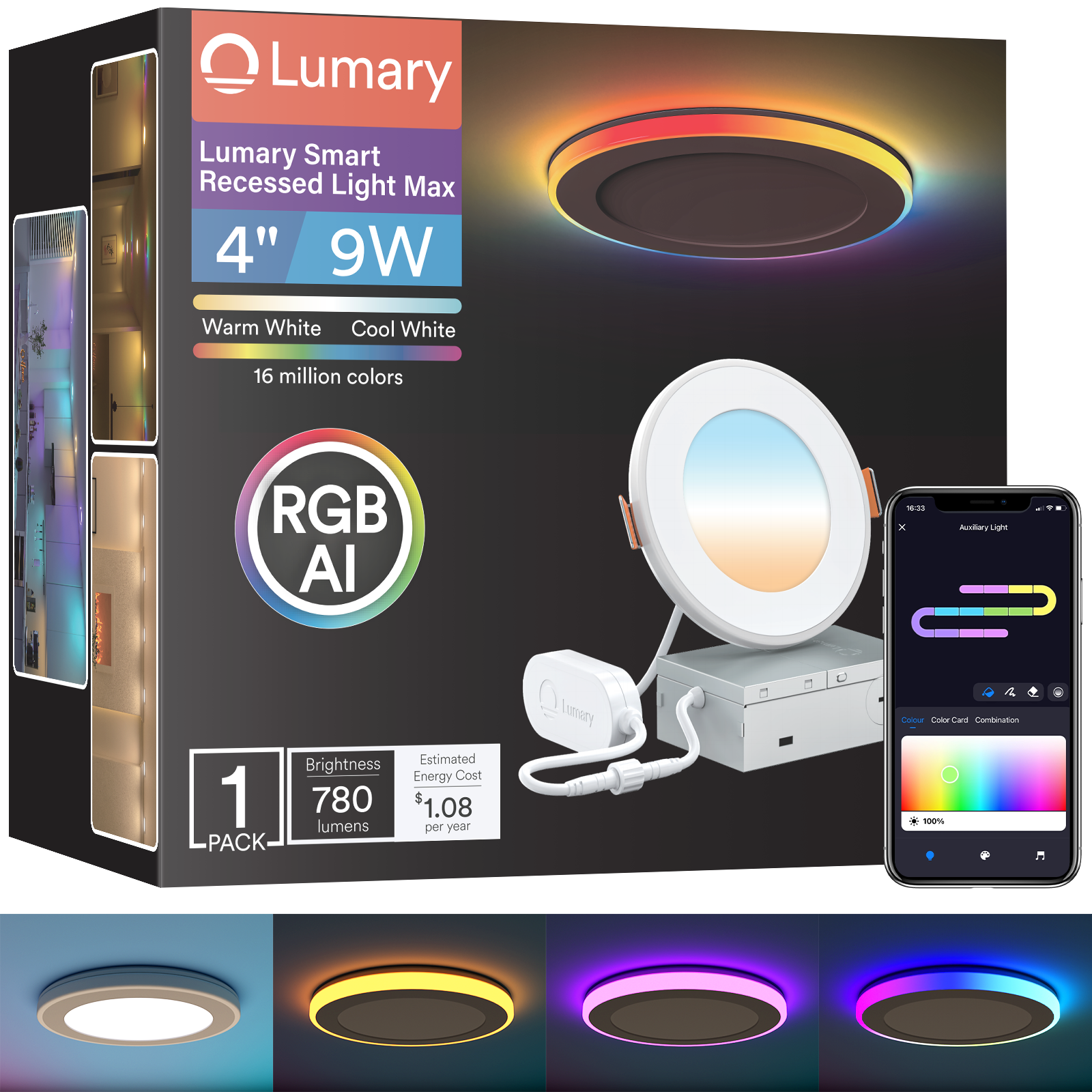
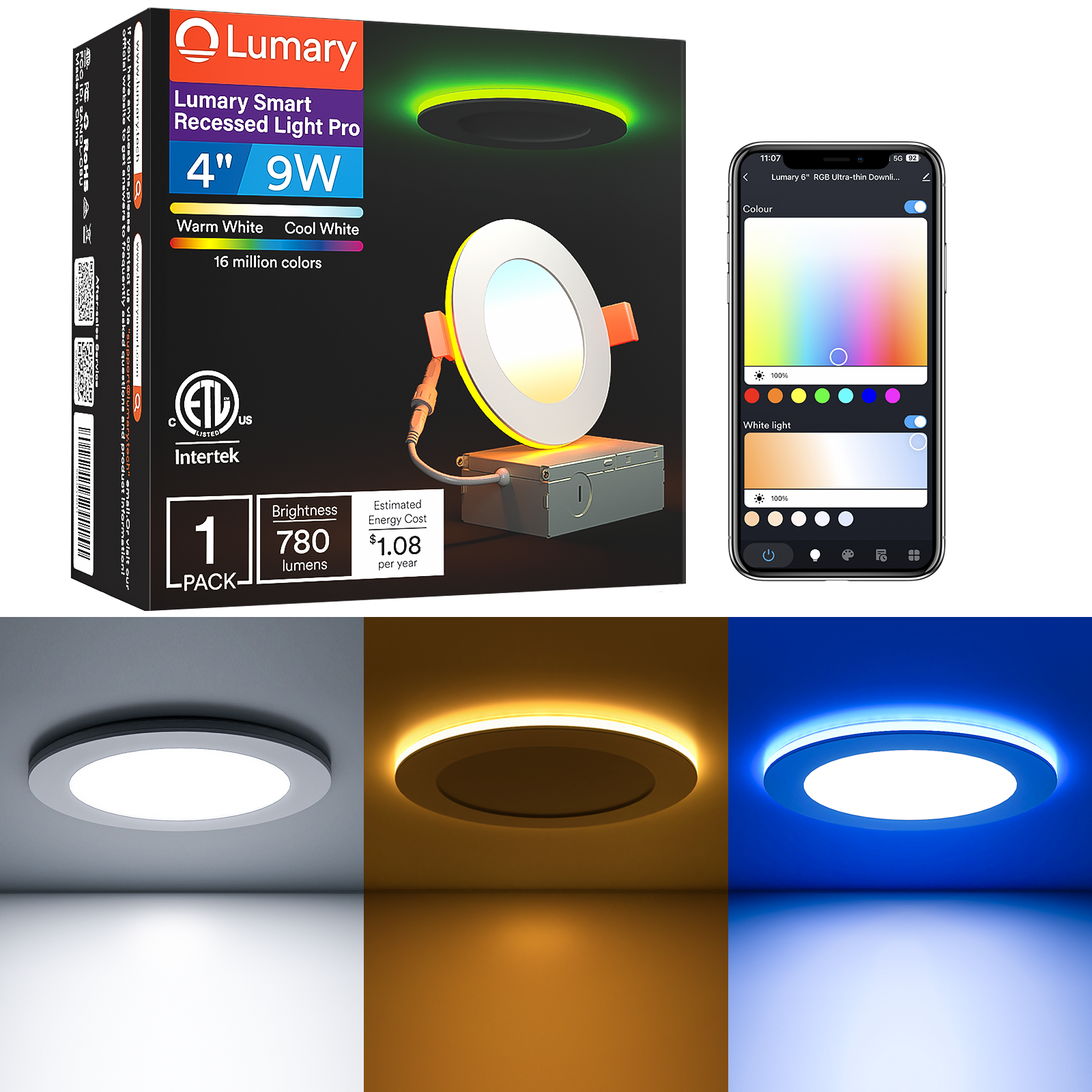
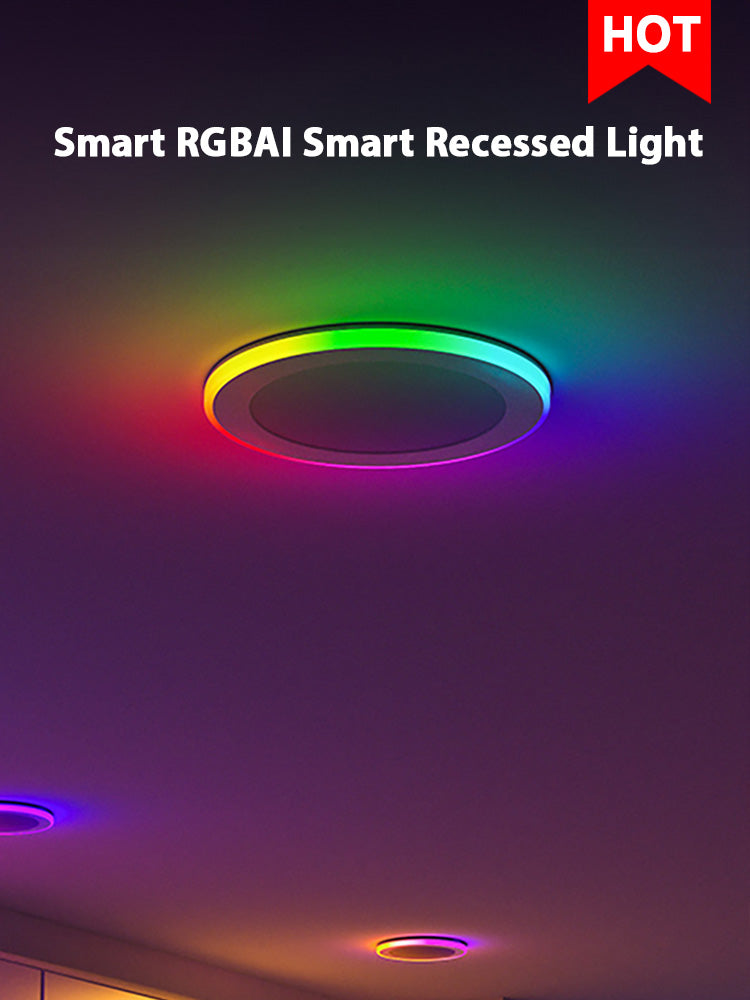
The Lumary Smart RGBAI Recessed Light with Gradient Auxiliary Night Light is architecturally a dual-layer lighting system in a single canless recessed form factor. A tunable-white main LED panel — covering the full 2,700K to 6,500K CCT range with CRI 90 output — serves the room's functional illumination requirements, while a 12-segment individually addressable RGBAI auxiliary ring projects upward and outward toward the ceiling plane, generating indirect ambient gradient effects that are entirely independent of the main beam's operation.
From a remote-access standpoint, the fixture connects via 2.4 GHz Wi-Fi directly to the home router — no hub or bridge device required — and maintains a persistent session through the Lumary cloud infrastructure. The Lumary app, available on iOS and Android, provides full parameter control: CCT adjustment across the 2,700K–6,500K range, brightness from 1% to 100%, color selection across 16 million values for the auxiliary ring, mode switching between RGBAI Gradient, RGB, Nightlight, and Downlight modes, and access to 50 preset scenes. All of these parameters are accessible from any internet-connected location, not just the local network.
Voice control integration covers Amazon Alexa and Google Assistant natively. Siri control is available through the Lumary App's automation function. Group control allows simultaneous management of multiple fixtures across one or more rooms, and a scheduling system supports time-based automation that executes independently of active user engagement — meaning a morning scene configured in the app will activate at the scheduled time regardless of whether the user has the app open. The memory function stores the last active state in persistent storage, so power interruptions do not reset the fixture to factory defaults.
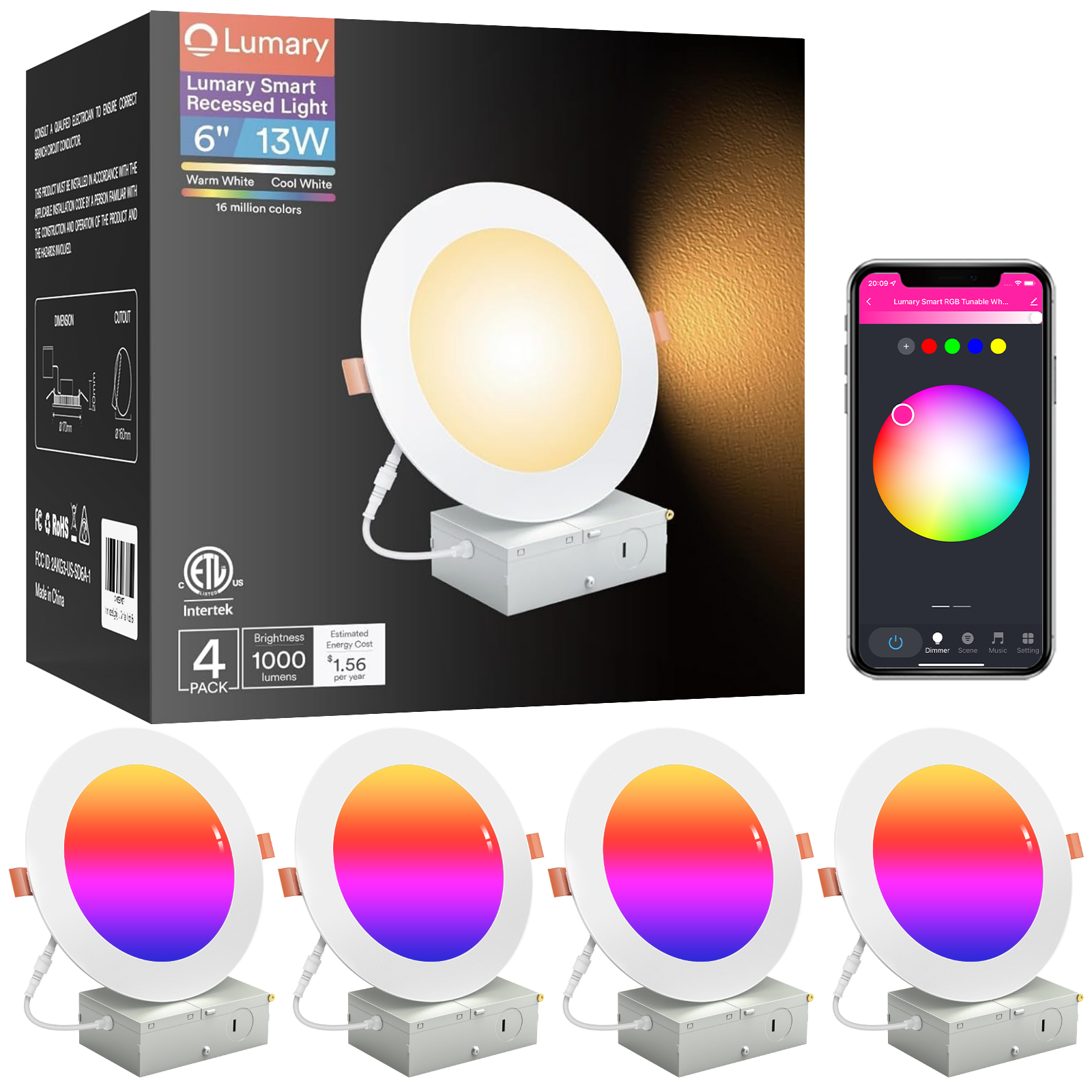
The fixture is available in 4-inch (9W, 780 lumens), 6-inch (12–13W, 1,000–1,100 lumens), and 8-inch (18W, 1,400 lumens) configurations, all using canless wafer construction with a junction box included. ETL listing and FCC compliance provide independently verified assurance of electrical and RF performance. Rated lifespan exceeds 25,000 hours.
Technical Specification Table
| Parameter | Specification |
|---|---|
| Available Sizes | 4-inch, 6-inch, 8-inch |
| Wattage (by size) | 9W (4"), 12–13W (6"), 18W (8") |
| Lumen Output (by size) | 780 lm (4"), 1,000–1,100 lm (6"), 1,400 lm (8") |
| CCT Range (Main Light) | 2,700K – 6,500K (tunable white) |
| Color Rendering Index (CRI) | ≥ 90 (Ra) |
| Color Palette (RGBAI Auxiliary Ring) | 16 million colors |
| Addressable Segments (Auxiliary Ring) | 12 individually controlled segments |
| Dimming Range | 1% – 100% (continuous) |
| Lighting Modes | RGBAI Gradient / RGB / Nightlight / Downlight |
| Preset Scenes | 50 |
| Wireless Protocol | 2.4 GHz Wi-Fi (direct-to-router, no hub required) |
| Remote Control | Full parameter control via Lumary app from any internet-connected location |
| Voice Control | Amazon Alexa (native), Google Assistant (native), Siri (via app automation) |
| Scheduling / Automation | Yes — time-based; executes locally without active app session |
| Group Control | Yes — multi-room, simultaneous |
| Memory Function | Yes — persistent state retention through power interruptions |
| Music Rhythm Mode | Yes — audio-reactive color animation |
| Family / Device Sharing | Yes — multiple users via Lumary app |
| Installation Type | Canless wafer; junction box included |
| Certifications | ETL Listed, FCC Compliant |
| Rated Lifespan | 25,000+ hours |
| Dimmer Switch Compatibility | Not compatible |
Identifying Remote-Control Failure Points: A Purchasing Framework
Remote access failures in smart lighting rarely stem from the wireless radio itself. They emerge from a set of predictable architectural weaknesses — driver instability, session management logic, scheduling architecture, and cloud dependency — that vary significantly between fixture implementations. The following framework provides a structured approach to identifying which of these risks a given product addresses and which it leaves open.
| Purchasing Criterion | Signs of Inadequate Implementation | Technical Solution in Well-Engineered Fixtures | Long-Term Impact |
|---|---|---|---|
| Wi-Fi session stability | Fixture drops offline within hours or days; requires manual re-pairing after router reboot | Persistent MQTT session with automatic reconnection logic; no manual re-pair needed after connectivity restoration | Unreliable automation execution; remote control commands fail intermittently without user awareness |
| Hub dependency | Remote control requires a bridge device to be powered and network-connected; failure of bridge eliminates remote access | Direct 2.4 GHz Wi-Fi connection to home router; no secondary hardware required | Single point of failure eliminated; remote access depends only on home internet connectivity |
| Scheduling architecture | Schedules fail to execute when the companion app is closed or the phone loses connectivity | Schedule logic embedded in device firmware; executes locally independent of app state or user internet access | Automation reliability breaks down precisely when remote execution matters most — when the user is away |
| Cloud dependency for basic functions | On/off toggle and brightness adjustment require round-trip to manufacturer server; high-latency response | Low-latency MQTT relay with optimized polling intervals; app feedback reflects current fixture state accurately | Delayed command execution; app shows incorrect fixture status after network events |
| Multi-user access | Only the account that paired the fixture can control it; family members cannot issue commands | Device sharing through app account system; multiple users authorized at the fixture level | Practical household use requires all adults to share a single account, creating credential management friction |
| Dimming behavior at remote-set levels | Fixture returns to default brightness after power cycle; ignores the last app-configured level | Memory function stores last state to persistent flash; restores CCT, brightness, and mode after power interruption | After any power interruption, household returns to full-brightness default and must reconfigure remotely |
| Voice control latency | Alexa or Google Assistant command acknowledgment followed by 3–6 second fixture response delay | Native Alexa/Google skill with direct cloud-to-fixture routing; sub-2-second response under normal network conditions | Degraded user experience for voice-controlled scene switching; commands feel unresponsive |
The Lumary RGBAI Recessed Light addresses each of these dimensions. Its direct Wi-Fi architecture eliminates hub dependency. Its scheduling system executes on-device firmware rather than requiring active app sessions. Its memory function writes last state to non-volatile storage. And its multi-user sharing capability allows household members to exercise independent app control without credential sharing.

Competitive Landscape
The smart recessed lighting category includes several brands with strong product lines and distinct engineering philosophies. Understanding their positioning helps establish where the Lumary RGBAI fixture sits relative to the available alternatives.
Govee has developed a well-regarded presence in the addressable-segment lighting space, with RGBIC technology applied across strip lights, panel lights, and recessed formats. The Govee Smart Recessed Lighting line features dual-protocol connectivity — Wi-Fi and Bluetooth simultaneously — which provides a fallback control path when the local network is congested or when pairing a new device. Govee's scene library tends toward high density, with 65+ preset configurations in certain SKUs, and the companion app supports music synchronization through the phone's microphone input.
Philips Hue represents the established premium tier of the smart lighting category, with a Zigbee-based ecosystem anchored by its Hue Bridge. The Bridge architecture enables local execution — automation scenes continue to run even during internet outages, because the processing happens on the bridge rather than in the cloud. Hue's White Ambiance recessed fixtures deliver precise CCT tuning across a 2,200K–6,500K range, and the platform's third-party integrations are extensive. The trade-off is entry cost: the Bridge device is required for any Hue installation, adding upfront infrastructure expense.
LIFX takes a hub-free approach similar to Lumary, embedding high-density Wi-Fi radios directly into each fixture. LIFX products are frequently cited in hardware evaluations for color accuracy and lumen density, and the company's cloud infrastructure has a track record for reliability. LIFX's canless downlight lineup does not include an auxiliary gradient accent ring in the same form factor as the Lumary RGBAI product.
WiZ, distributed through Signify's global network, offers hub-free Wi-Fi connectivity with a notable feature called SpaceSense — occupancy detection using Wi-Fi signal perturbation analysis rather than a discrete PIR sensor. WiZ fixtures across CCT tunable and full-color categories are generally positioned at accessible price points and integrate with both Google Home and Amazon Alexa ecosystems natively.
Kasa (TP-Link) is consistently recognized for connection stability and scheduling reliability in multi-device household deployments. Kasa's smart recessed lighting products feature straightforward pairing workflows and a robust scheduling system, and the TP-Link ecosystem's Tapo and Kasa app platforms share infrastructure that allows cross-product management. Kasa does not offer an equivalent to the RGBAI auxiliary gradient ring in its current recessed lighting lineup.
Eufy, within the Anker brand ecosystem, emphasizes efficient lumen-per-watt performance and clean app design. Eufy's smart home product range integrates naturally with Anker energy management and security hardware, making it a practical choice for users who are already embedded in that ecosystem.
What the Lumary RGBAI Recessed Light provides that none of these alternatives currently replicates in the same form factor: a CRI 90 tunable-white main panel and a 12-segment individually addressable gradient auxiliary ring within a single canless wafer fixture, at a mid-market price point, with direct Wi-Fi connectivity requiring no hub. The dual-direction optical architecture — main beam downward, accent ring upward toward the ceiling plane — produces an ambient layering effect that single-direction recessed fixtures cannot generate regardless of color capability.
Application Scenarios
Scenario 1: Whole-Home Remote Management for Frequent Travelers
The moment a frequent traveler steps through airport security, an entirely predictable sequence of concerns begins: Did I leave the kitchen light on? Is the porch light running in daylight? Will anyone looking at the house tonight see that no lights have moved in six hours?
These are not trivial anxieties. Insurance industry data and residential security research consistently identify lighting patterns as one of the primary deterrents that distinguish occupied homes from visibly vacant ones. A home where lights activate and deactivate on natural schedules — different rooms at different times, occasional variation that mimics human presence — presents a meaningfully different profile to anyone conducting opportunistic surveillance than a home where a single fixture has been burning continuously for 72 hours because the owner forgot to turn it off.
The Lumary RGBAI Recessed Light's combination of scheduling, group control, and full remote app access creates a practical infrastructure for managing this problem without requiring the traveler to think about it in real time. Before departure, a "travel mode" series of schedules can be configured through the Lumary app: the living room group activates at 6:30 p.m. at 2,700K and 50% brightness, transitions the accent ring to a warm amber cycle at 8:00 p.m., and dims to 15% at 10:30 p.m. before shutting off at 11:00 p.m. The bedroom group activates separately at 9:45 p.m. for 45 minutes, then extinguishes. The kitchen activates briefly at 7:00 a.m.
These schedules run on-device firmware, meaning they execute at the configured times regardless of whether the Lumary app is open on the traveler's phone, regardless of whether the traveler has reliable cellular coverage, and regardless of time zone differences. The cloud relay is used only for real-time manual adjustments — if the traveler wants to deviate from the schedule to, for example, activate the living room lights at an unusual time during a video call with someone checking on the property.
The memory function ensures that a brief power fluctuation during the owner's absence — a common occurrence in certain regions during summer storm season — does not reset all fixtures to full-brightness factory defaults, which would immediately signal vacancy to anyone familiar with the neighborhood's usual evening appearance. The fixtures return to their last configured state, and the schedule resumes at the next trigger point.
Group control allows the entire home's Lumary fixture network to be addressed through a single "away mode" scene, rather than requiring the traveler to configure each room individually before leaving. A single scene toggle in the app at the airport assigns the travel-mode schedules to all groups simultaneously, reducing the cognitive load and time requirement of departure preparation to under 30 seconds.
For households with multiple family members who travel on different schedules, the device-sharing function allows all authorized users to access the same fixture groups and scene library without requiring credential sharing or account transfers — a practical necessity that single-user account architectures consistently fail to address.
Scenario 2: Evening Arrival Scene Automation
There is a category of smart home interaction that sits between manual remote control and fully autonomous automation: the pre-arrival scene. The premise is simple — a person on the way home wants the house ready when they walk in the door — but the technical requirements for executing it reliably are more demanding than they first appear.
The naive implementation is a fixed schedule: set the living room lights to activate at 6:00 p.m. on weekdays. This works until commute time varies by 90 minutes, or a meeting runs late, or the workday ends at noon on a Friday. Fixed schedules that are not adjusted dynamically for actual arrival time produce either a house that has been lit and cooling for two hours before anyone arrives, or a dark house entered by someone who then has to use a phone as a flashlight while locating the app.
The Lumary app's manual remote trigger addresses this variable by enabling on-demand activation from any internet-connected location. Fifteen minutes from home, a single scene trigger in the app activates the living room group at 3,000K and 70% brightness, the accent ring cycling through warm gold tones, the kitchen group at 4,000K and 85% for preparation visibility. The fixture state is set before the door opens; no adjustment is needed upon entry.
The granularity of what can be configured in a single pre-arrival trigger is meaningful. A simple on/off smart plug can turn a lamp on remotely. The Lumary RGBAI fixture can be configured, in one scene trigger, to a specific CCT value, brightness percentage, accent ring color, mode, and segment pattern — all of which persist through the evening via the memory function without requiring further interaction.
For households where the arrival experience is a deliberately designed domestic ritual — a transition from work mode to home mode that the environment should support — the ability to configure that transition from a phone while still in transit, and to have it reliably executed before the front door opens, represents a qualitatively different class of home integration than the simple remote on/off toggle that defines the category's baseline.
Scenario 3: Residential Security and Occupancy Simulation
The security utility of smart lighting is frequently mentioned and less frequently examined with technical precision. The general claim — that lights can be configured to simulate occupancy — is true, but the quality of that simulation varies considerably depending on the sophistication of the scheduling and scene system involved.
A basic security simulation uses fixed on/off times repeated nightly. This is marginally better than a single fixture running continuously, but it produces a pattern that is trivially readable: the same rooms illuminate at the same times every evening, with no variation in brightness or color, and extinguish at the same time regardless of day of week. Any observer who notes the pattern over two evenings can predict it on the third.
A more credible simulation requires variation across multiple dimensions: different rooms activating at slightly different times on different days, brightness levels that shift during the evening as they would in genuine use, color temperature transitions that correspond to the natural progression from task-light white in early evening to warm-white wind-down light as the night advances.
The Lumary RGBAI fixture's scheduling system, combined with group control and the accent ring's independent channel, enables a multi-parameter simulation. The living room group can be configured with a 6:15 p.m. activation on Mondays, a 6:45 p.m. activation on Tuesdays, varying between 55% and 70% brightness with CCT transitions from 3,000K at activation to 2,700K by 9:00 p.m. The bedroom group activates separately at 9:30 p.m. — distinct from the living room, as would occur in actual use — and the accent ring in the bedroom can transition to its Nightlight mode at 10:00 p.m., producing the low-level indirect glow that corresponds to someone winding down for sleep rather than sitting in full task light until lights-out.
The 12-segment RGBAI ring adds a dimension to this simulation that standard white-only fixtures cannot access: the ceiling accent creates the visual impression of ambient light sources — candles, television glow, secondary lamps — that produce the softer, more varied illumination patterns characteristic of genuine evening occupancy versus the flat overhead-only illumination that vacancy lighting often defaults to.
From a remote-management perspective, the traveler can adjust this simulation in real time if circumstances require. If a friend checking on the property reports a concern, the owner can activate a specific room or adjust the scene from a phone, providing immediate evidence of responsiveness that a purely automated schedule cannot replicate.
Scenario 4: Family Sharing and Multi-User Household Management
The device-sharing function in smart lighting is a feature that receives insufficient attention in product evaluations but causes more day-to-day friction than almost any other aspect of these systems when it is absent or poorly implemented.
The problem is structural. A smart fixture paired to a single user account can only be directly controlled by the person holding that account's credentials. In a household with two adults and, potentially, older children who manage their own devices and lighting preferences, this creates an immediate practical constraint: either everyone shares one set of login credentials — a security and management inconvenience — or secondary users must resort to voice assistants as a workaround for basic control, which works for simple commands but does not allow scene selection, CCT adjustment, or brightness fine-tuning.
The Lumary app's family sharing architecture allows the primary account holder to authorize additional users to access and control shared device groups. Each authorized user operates through their own account credentials, with access to the fixture library and scene configurations defined by the primary account. The fixtures themselves recognize commands from all authorized users without requiring re-pairing or reconfiguration.
For households where different family members have distinct lighting preferences — a teenager who uses the RGBAI accent ring in Music Rhythm Mode while doing homework, a parent who prefers 2,700K at 60% for evening reading, a partner who sets a 3,500K kitchen scene for cooking — the ability for each person to configure and trigger their own presets from their own device, without overriding another user's configuration or requiring access to a shared account, represents a basic quality-of-life requirement that the Lumary sharing system satisfies.
The remote-access dimension adds further utility. A parent away on a business trip who wants to dim the children's bedroom lights at 9:30 p.m. can issue that command from a hotel room without calling home and directing someone to find the app. The fixture responds to the parent's authorized app session exactly as it would from the home network. The command latency is the only variable — a brief addition to the response time introduced by the cloud relay rather than the local-network path — and under normal conditions this is imperceptible for a manual triggering context.
Scenario 5: Circadian Rhythm Support Through Automated CCT Scheduling
The relationship between artificial light spectra and circadian biology is now well-established in photobiological research. The core mechanism is the spectral sensitivity of the ipRGC (intrinsically photosensitive retinal ganglion cells) that provide non-visual light information to the suprachiasmatic nucleus — the brain's master circadian clock. These cells peak in sensitivity around 480 nm (blue-cyan range), which means blue-weighted light sources in the 4,000K–6,500K CCT range provide substantially stronger circadian input than warm-white sources in the 2,700K–3,000K range at equivalent photopic illuminance.
The practical implication for daily living is that the optimal light environment changes across the day not just in terms of brightness, but in terms of spectral composition. Morning and midday benefit from blue-weighted light that supports alertness and suppresses lingering melatonin. Evening benefits from warm-spectrum light that reduces blue-band input and allows the pineal gland to begin melatonin secretion at the biologically appropriate time.
A fixed-CCT recessed fixture, whatever temperature it is set to, fails to serve this progression. A 4,000K installation that provides productive midday light actively impedes evening wind-down. A 2,700K installation appropriate for 9 p.m. fails to support alertness during a 10 a.m. work session in the same room.
The Lumary RGBAI Recessed Light's full 2,700K–6,500K tunable range, combined with its scheduling system, allows a circadian-informed lighting profile to be programmed once and executed daily without any manual intervention. A representative configuration might schedule the living room at 5,000K and 85% from 7:00 a.m. to 12:00 p.m., transitioning to 3,500K and 70% from 12:00 p.m. to 5:00 p.m., then stepping to 3,000K at 55% from 5:00 p.m. to 7:00 p.m., and finally to 2,700K at 40% from 7:00 p.m. until the 10:30 p.m. off trigger.
This automated CCT progression can be configured through the Lumary app's scheduling interface and runs on the device's embedded firmware, executing locally without requiring the app to be active. From a remote-access standpoint, the schedule can be reviewed, adjusted, or temporarily overridden from any internet-connected location — allowing the user to extend the warm-spectrum schedule on an evening when they plan to retire early, or to push the transition time later on a weekend without modifying the weekday schedule.
The Nightlight mode provides the terminal stage of this progression: soft, low-lux indirect output from the upward-facing accent ring for navigational use after the main panel has extinguished, maintaining a minimal visual environment without the full-spectrum load of even a low-brightness main panel output.

Professional Editorial Assessment
From a hardware evaluation perspective, the Lumary Smart RGBAI Recessed Light with Gradient Auxiliary Night Light addresses the remote-control question with an architecture that is technically coherent rather than aspirationally specified. The direct 2.4 GHz Wi-Fi connection requires no hub; the scheduling system runs on device firmware and does not depend on active app sessions for execution; the memory function handles power interruptions without reset; and the multi-user sharing system provides household-level access without credential sharing. These are not marketing claims — they are verifiable architectural decisions that determine whether the fixture behaves reliably in the scenarios where remote control actually matters.
The CRI 90 main panel performance is relevant to remote-control use cases in a specific way: when a traveler configures a pre-arrival scene or a circadian-schedule transition from a phone, they are setting CCT and brightness values based on what they expect the room to look and feel like. A CRI 90 fixture delivers light that behaves as expected under those values. A CRI 80 or below fixture shifts color rendering in ways that make the configured scene look different in the room than it did in the app's color picker — producing a minor but persistent calibration disconnect between the user's remote intent and the fixture's actual output.
The ETL listing and FCC compliance provide independent verification that the fixture's electrical characteristics and RF emissions meet established standards — a non-trivial assurance in a category where unreviewed product can introduce interference into the 2.4 GHz band spectrum used by the same Wi-Fi network the fixture depends on for its own connectivity.
Decision logic for prospective buyers:
If the primary requirement is basic remote on/off control with a minimum-cost fixture, a simple tunable-white Wi-Fi downlight from any established brand will satisfy the use case without the cost of the RGBAI architecture.
If the requirement includes automated circadian scheduling, family sharing, and reliable state memory across power interruptions, with no accent lighting needed, a higher-quality single-channel tunable-white fixture with robust scheduling firmware is the appropriate category.
If the requirement includes all of the above, plus the ceiling-facing gradient accent ring for ambient layering, music-responsive color animation, 16 million color RGBAI mode for social and seasonal occasions, and CRI 90 main panel performance — in a canless wafer format that installs into new or retrofit ceiling cutouts without additional hardware — then the Lumary RGBAI Recessed Light with Gradient Auxiliary Night Light is the technically complete answer within its price category.
Who should buy this product: Homeowners and renters who want a recessed fixture to function as the primary control point for room-level lighting across multiple daily modes — task illumination, ambient wind-down, security simulation, and accent atmosphere — managed through a single app from anywhere in the world. It is particularly appropriate for anyone who has experienced the failure modes of hub-dependent smart lighting systems, and wants the simplicity of direct Wi-Fi connectivity without sacrificing the control granularity that distinguishes serious smart lighting from a remotely toggled on/off switch.
Frequently Asked Questions
Q1: If my home internet goes down while I'm away, do the Lumary lights become completely unresponsive, and will any scheduled automations still run?
Remote control through the Lumary app requires an active internet connection at the home router — this is inherent to the cloud-relay architecture that all hub-free Wi-Fi fixtures use. If your home internet is interrupted, manual remote commands from the app will not reach the fixture until connectivity is restored. However, scheduled automations that have already been configured execute on the device's embedded firmware locally, meaning the schedule continues to run at the correct times regardless of internet status. A bedtime scene configured to activate at 10:30 p.m. will activate at 10:30 p.m. even during an internet outage. The remote-control limitation is specifically to real-time manual adjustments; time-based automation is unaffected by cloud availability.
Q2: Can multiple people in my household control the Lumary RGBAI Recessed Lights from their own phones simultaneously, and what happens if two people issue conflicting commands at the same time?
The Lumary app's device-sharing function allows the primary account holder to authorize additional users to access and control shared fixture groups through their own individual accounts. Each authorized user has full control capability — scene triggering, CCT adjustment, brightness change, mode switching — from their own device. When two users issue commands simultaneously, the last command received by the fixture wins; there is no conflict resolution queue or lock mechanism. In practice, simultaneous commands from different users are rare in household contexts, and the behavioral result (the fixture executes the most recent instruction) is intuitive and predictable.
Q3: Does controlling the lights remotely through the Lumary app consume significant mobile data, and will it drain my phone battery noticeably during extended use?
The MQTT protocol used by Wi-Fi smart lighting for remote control is specifically designed for minimal data payload — each on/off command, brightness adjustment, or CCT change involves data transfer measured in kilobytes, not megabytes. Extended use of the Lumary app for real-time control of a multi-fixture installation for an hour would typically consume less data than loading a single web page. Battery impact is similarly negligible, as the app is not maintaining a continuous high-frequency polling loop when you are not actively adjusting fixtures; it polls for status updates at intervals designed to balance responsiveness with power efficiency.
Q4: The product requires a 2.4 GHz Wi-Fi network. My router broadcasts both 2.4 GHz and 5 GHz bands under the same network name — will the Lumary fixture connect to the wrong band and fail to pair?
This is a common pairing friction point with all 2.4 GHz–only IoT devices, including smart lighting. When a router combines both bands under a single SSID (a feature called "band steering"), it may attempt to push devices toward the 5 GHz band. If the Lumary fixture cannot connect to 5 GHz (which it cannot, by design), the pairing attempt will fail if the router's band-steering logic intercepts it. The solution is to either temporarily separate the two bands during setup — most router admin interfaces allow this under wireless settings — or to use a router that already presents the two bands as separate networks with distinct SSIDs (for example, "HomeNetwork" and "HomeNetwork-5G"). Once the fixture is successfully paired to the 2.4 GHz band, it maintains that association and normal band-steering behavior does not affect its ongoing connectivity.
Q5: If I set a specific CCT and brightness level through the app remotely, and then the wall switch is turned off and on again, does the fixture return to that setting or revert to a default?
The memory function writes the last active state — CCT value, brightness percentage, mode, and color selection — to persistent non-volatile storage. When power is restored after a wall switch cycle or a power interruption, the fixture returns to the last configured state rather than a factory default. This is an important operational distinction from fixtures that use volatile memory for state storage: those reset to full-brightness white after any power cycle, requiring the user to reconfigure settings after every interruption. The practical implication for remote users is that a CCT and brightness scene configured from the office before heading home will still be active when the circuit is energized, without requiring a follow-up adjustment. Note that frequent rapid cycling of the wall switch — more than five on/off cycles in quick succession — can trigger the fixture's factory reset sequence, which is an intentional design provision for re-pairing rather than a flaw in the memory architecture.

