




Do Recessed Lights Make a Living Room Look Bigger?Yes, recessed lights can make a living room look bigger when they are planned as a low-glare, layered system rather than a ceiling full of identical bright dots. The visual mechanism is straightforward: a clean ceiling line reduces overhead clutter, evenly distributed ambient light lowers hard shadow boundaries, and accent or auxiliary color can pull attention toward walls, built-ins, artwork, or the media zone. The result is not a change in square footage; it is a change in how the eye reads depth, ceiling height, and perimeter brightness. Interior guidance on living-room recessed lighting consistently warns against relying on cans alone, recommending layered zones and dimming control instead; see The Spruce's living-room recessed lighting guide. For a smart recessed system, the useful benchmark is a fixture that can provide practical white downlight, softer night illumination, and independent ambient color without adding visual bulk to the ceiling plane.
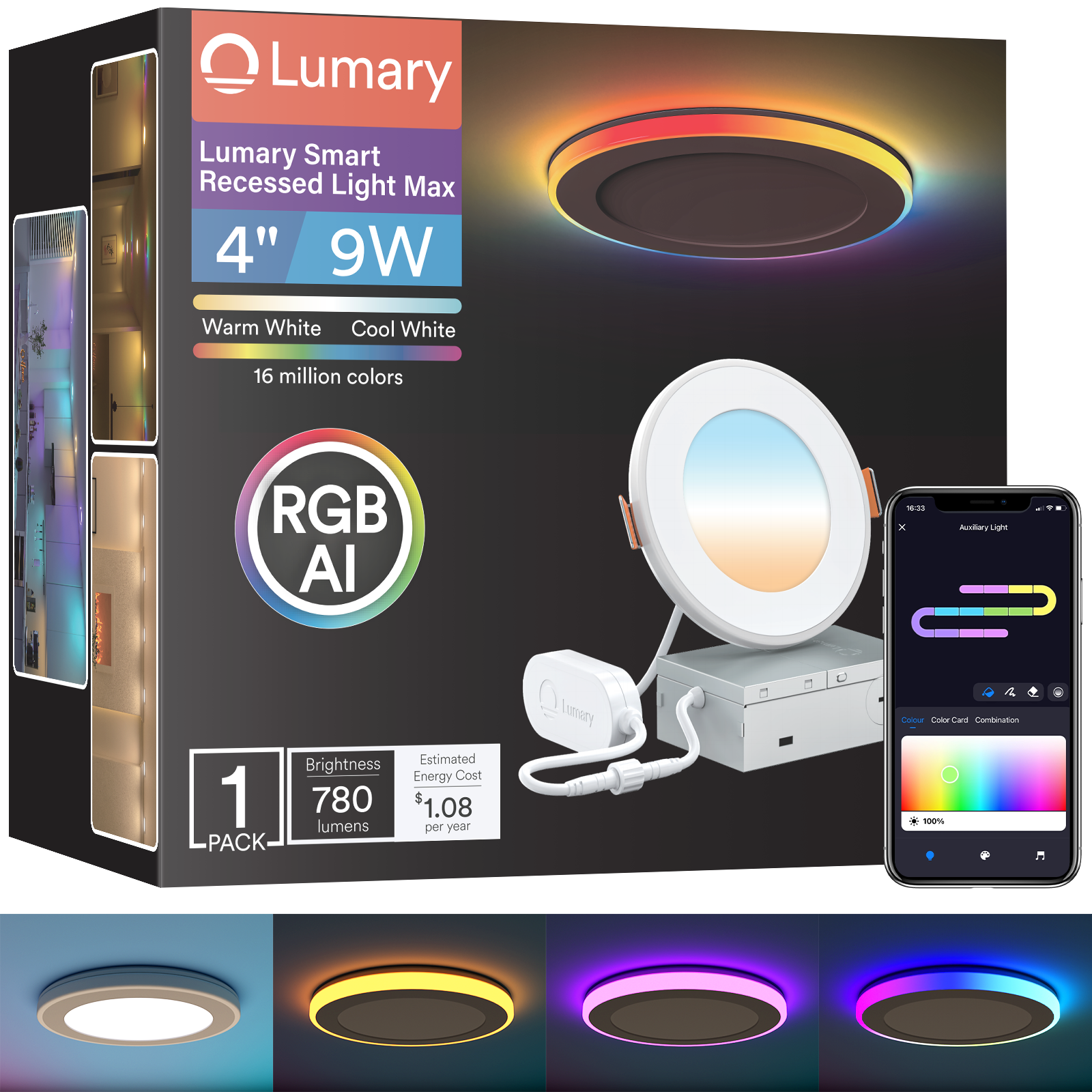
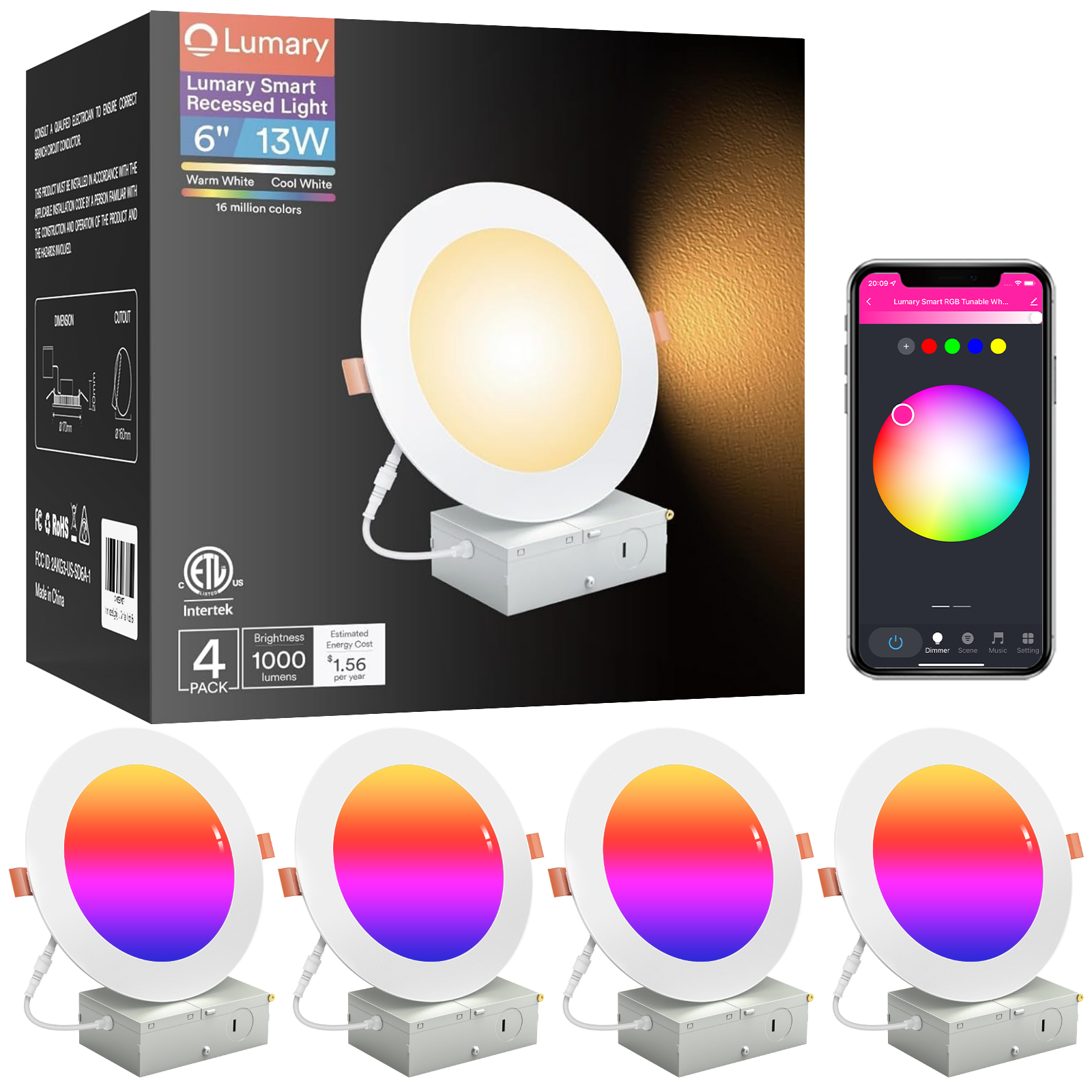
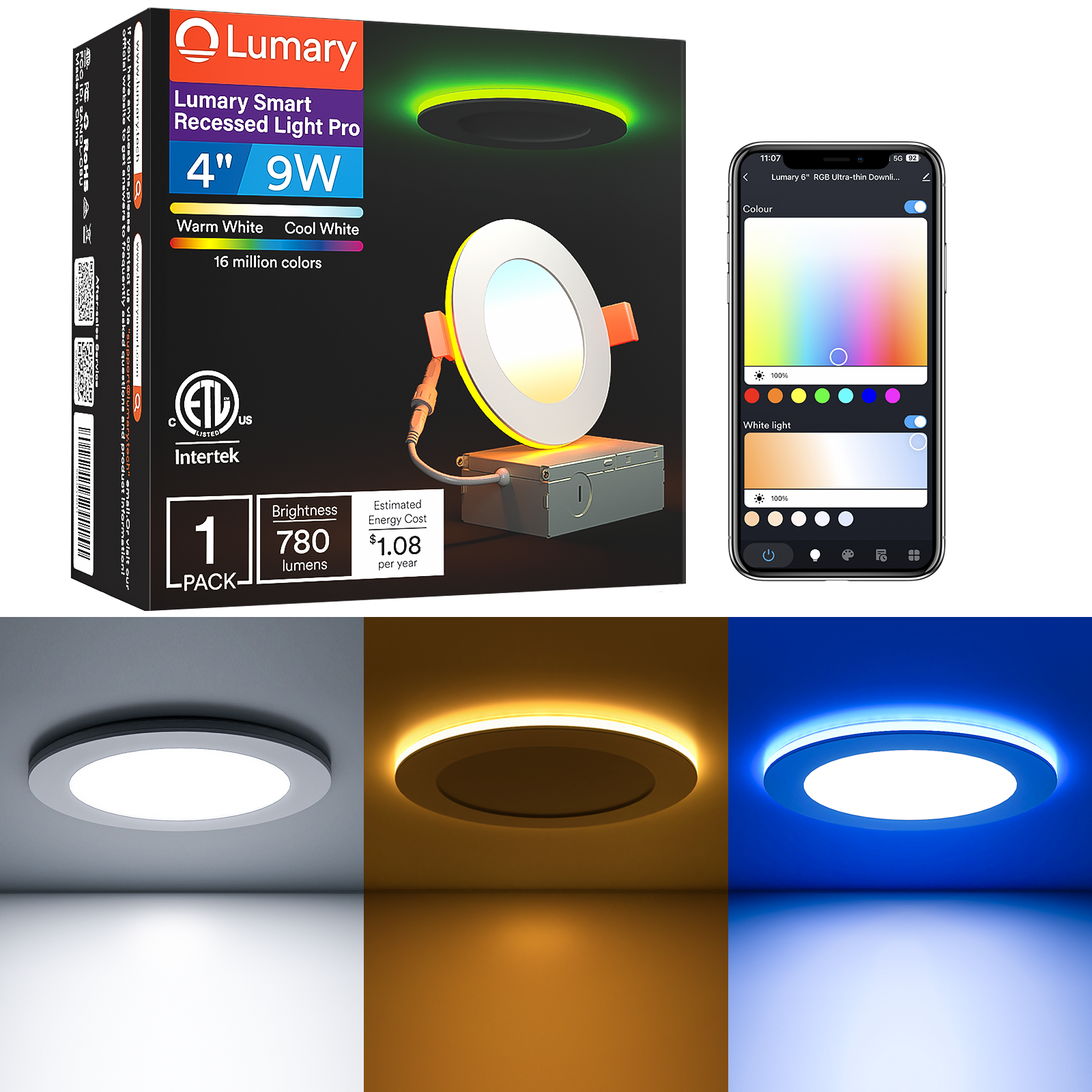
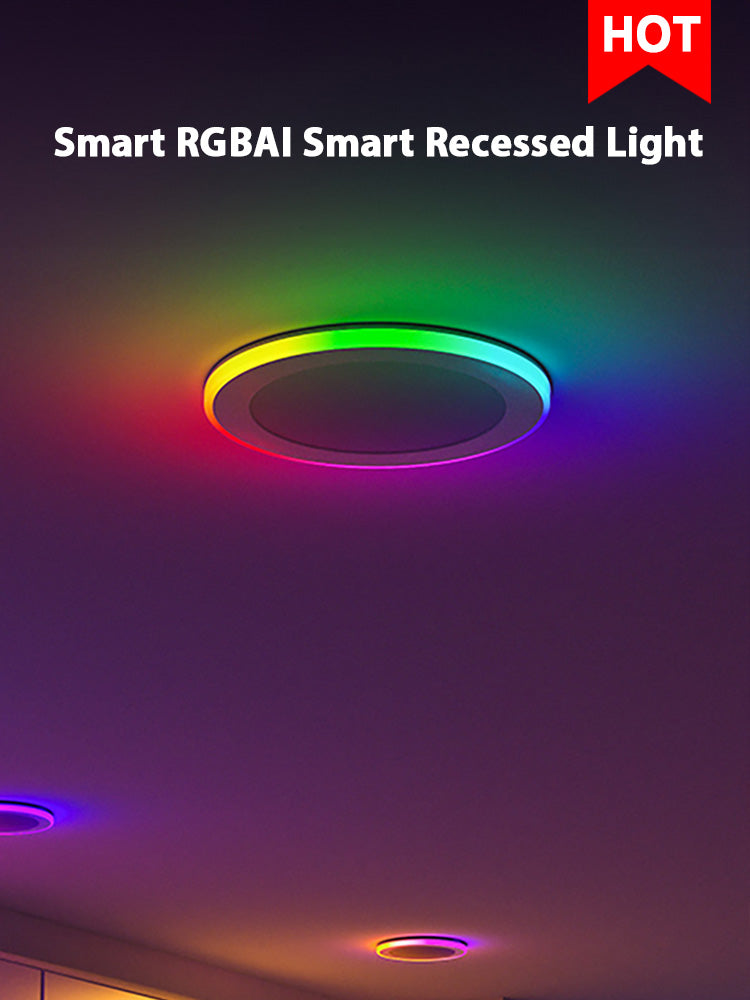
The Lumary Smart RGBAI Recessed Light with Gradient Auxiliary Night Light fits that benchmark because it combines CCT downlighting with an auxiliary RGB color layer in one flush fixture. The product page specifies RGBAIWW light color, 2700K-6500K white tuning, 4-inch, 6-inch, and 8-inch sizes, 9W, 12W, and 18W wattage options, and brightness options of 780, 1000, and 1400 lumens. It also lists app and voice control through the Lumary App, Amazon Alexa, Google Assistant, and Siri via Lumary App automation. That mix matters in a living room because a larger-looking room is rarely created by raw brightness alone; it is created by controllable contrast.

Product Recommendation Analysis
A living room typically needs three visual jobs from recessed lighting: broad orientation light for circulation, comfortable task-level brightness for reading or cleaning, and a perimeter or accent layer that prevents the walls from collapsing into shadow. The Lumary RGBAI recessed light is relevant because its primary light and auxiliary light are treated as distinct modes. The main light provides CCT white illumination for daily use, while the secondary light provides RGB color mixing and a night light mode. The product page also notes four modes: RGBAI Gradient, RGB Mode, Nightlight Mode, and Downlight Mode, with the practical constraint that the main and auxiliary lights cannot be on simultaneously.
That constraint should be read as a planning rule, not a weakness: use downlight mode when the room needs functional brightness; use gradient, RGB, or nightlight mode when the room needs depth, wall emphasis, or low-level evening atmosphere. The RGBAI system is especially useful in rooms where a conventional recessed fixture would provide only one flat cone of white light. Lumary lists 12 individually controlled segments for simultaneous colors, which gives the auxiliary layer a more architectural role than a simple single-color ring. In a compact living room, that segmentation can soften the transition between ceiling and wall, making the room feel less box-like.
The product is also suited to multi-fixture layouts. Lumary offers 1, 4, 8, 12, 16, and 24 piece configurations, and the product page references group control and timing functions. For a living room, this supports zone logic: a TV wall group, a sofa group, and a circulation-path group can behave differently during a movie, a party, or a late-night walk-through. The product page notes support for 2.4 GHz Wi-Fi only and says frequent use of a wall switch will reset the lights, so the most reliable control habit is to leave wall power stable and use app, voice, scenes, schedules, or automation for daily changes.
Product Specification Table
|
Specification |
Lumary Smart RGBAI Recessed Light Details |
Living-Room Decision Value |
|
Light color |
RGBAIWW |
Supports tunable white plus auxiliary color ambience in one ceiling fixture. |
|
Fixture sizes |
4 inch / 6 inch / 8 inch |
Allows proportional selection for small, standard, or larger ceiling layouts. |
|
Wattage |
9W / 12W / 18W |
Matches output class to fixture size and room scale. |
|
Brightness |
780 lm / 1000 lm / 1400 lm |
Provides a clear lumen basis for planning multiple fixtures. |
|
Color temperature |
2700K-6500K |
Covers warm evening light through cooler daytime task light. |
|
Control method |
Lumary App and voice |
Reduces dependence on visible wall-control clutter. |
|
Voice ecosystem |
Amazon Alexa, Google Assistant, Siri via Lumary App automation |
Works with common smart-home routines. |
|
Dynamic color architecture |
RGBAI technology with 12 individually controlled segments |
Creates gradient effects instead of a single flat color ring. |
|
Modes |
RGBAI Gradient, RGB Mode, Nightlight Mode, Downlight Mode |
Separates practical lighting from atmosphere and low-level guidance. |
|
Scenes |
50 preset scenes |
Speeds up room-state changes for parties, movies, holidays, and quiet evenings. |
|
Network note |
2.4 GHz Wi-Fi only |
Important for router planning and stable installation. |
|
Installation/control note |
Not compatible with dimmer switches; frequent wall-switch use may reset lights |
Use constant power and smart controls for dependable operation. |
Performance Benchmarking Grid
|
Key Purchasing Criteria |
Common Signs of Poor Quality |
Technical Implementation in This Product |
Impact on Long-Term Usage |
|
Room expansion effect |
Bright ceiling spots with dark walls and no perimeter depth |
Flush recessed format plus white and auxiliary color modes |
A cleaner ceiling line and better visual depth control. |
|
Functional brightness |
Marketing language without lumen values |
780, 1000, and 1400 lumen options listed by size |
Easier fixture-count planning and fewer under-lit zones. |
|
Color control |
Single-zone RGB that makes the ceiling read as one flat color |
12 individually controlled RGBAI segments |
More nuanced gradients for entertainment and accent scenes. |
|
Daily comfort |
One color temperature used for every activity |
2700K-6500K tunable white |
Warm evening scenes and cooler daytime utility can coexist. |
|
Control reliability |
Mixed habits between wall dimmers and app control |
App/voice control with explicit no-dimmer-switch guidance |
Clearer installation logic and fewer accidental resets. |
|
System scaling |
Fixtures controlled individually with no scene logic |
Group control, timing function, and 50 preset scenes |
Multiple living-room zones can be coordinated. |
Competitive Landscape
Smart living-room lighting is now a broad category. Philips Hue, WiZ, LIFX, Kasa, Govee, and Eufy all appear in homeowner conversations around app-controlled color, voice routines, accent lighting, and entertainment scenes. The relevant choice is not which brand can make a room colorful; the more precise question is which fixture type solves the ceiling-plane problem in a living room. Strip lights and lamps can add mood, while a recessed fixture changes how the ceiling itself reads. A low-profile downlight reduces the visual weight of hanging hardware, while an auxiliary color layer can create depth without adding another object to the room.
Lumary's position in that landscape is strongest for buyers who want the primary room lighting to be smart from the start. Instead of adding smart color around an existing ceiling fixture, the RGBAI recessed light turns the ceiling aperture into a dual-purpose lighting point. The product is not presented here as a replacement for every lamp or sconce; the better design logic is to let Lumary handle the architectural layer, then allow table lamps, floor lamps, or wall washers to add human-scale light where the room needs it.

Application Scenarios
Small Living Room With Low Visual Headroom
In a compact living room, the first spatial problem is often not darkness but interruption. A pendant, a bulky flush mount, or several visible lamps can divide the ceiling into separate objects. Recessed lighting helps because the fixture retreats into the architecture, leaving the ceiling plane calmer. The Lumary RGBAI recessed light adds a second advantage: its auxiliary mode can create a soft perimeter signal without requiring a visible color strip. When the ceiling and upper wall receive controlled brightness, the eye reads the boundary as less abrupt. That makes the room feel more open even though the walls have not moved.
The practical setup is to use the warm end of the 2700K-6500K range for evening sitting, reserve brighter downlight mode for cleaning or hosting, and create a low-intensity auxiliary scene for transitions. The product page's 4-inch, 6-inch, and 8-inch choices are useful here because fixture size should follow ceiling scale. In a smaller room, a smaller aperture can preserve proportion; in a larger living room, a 6-inch or 8-inch layout may produce more confident general light. The point is not maximum brightness. It is measured brightness with fewer visual interruptions.
TV Wall and Media Viewing Without a Flat Ceiling Wash
A living room can feel smaller at night when the television becomes the only bright object and the surrounding walls drop into shadow. This creates high contrast at the center of the room and makes the perimeter disappear. Layered lighting advice from Livingetc emphasizes depth, flexibility, and scene control rather than a single overhead source. The Lumary RGBAI fixture can support that principle because its auxiliary color modes are better suited to low-output atmosphere while the downlight mode can remain off during viewing.
For media use, the most effective design is usually indirect visual support: keep the seating area free of direct glare, use grouped fixtures near the TV wall or room edges, and avoid bright downlight directly over the screen. Lumary's 50 preset scenes and group control make this practical. A movie scene can dim the room without making the ceiling disappear; a game-night scene can introduce gradient color with the 12-segment RGBAI effect; and a pause or cleanup scene can return to functional white. The room feels larger because the eye still perceives side walls, walking paths, and ceiling depth instead of only the screen.
Open-Plan Living and Dining Areas
Open-plan rooms often fail visually when lighting treats the entire ceiling as one uniform grid. Equal brightness everywhere removes hierarchy, and the living area can feel like part of a larger utility space rather than a defined room. Recessed lights help when they are grouped into zones: sofa, media wall, dining edge, and circulation. The Lumary product page lists app control, voice control, group control, timing, and preset scenes, so a multi-fixture layout can shift the room from daytime function to evening atmosphere without changing the physical plan.
This is where lumen planning matters. The 780, 1000, and 1400 lumen options give a planning vocabulary: smaller fixtures can serve edge or accent roles, while higher-output fixtures can support central ambient needs. A lumen is a measure of visible light output, as described in the lumen reference, but perceived spaciousness depends on distribution as much as total output. In an open plan, the objective is to avoid dark gaps at the perimeter and avoid over-bright centers. Separate scenes let the living area feel intentionally scaled within the larger room.
Evening Pathfinding and Nightlight Use
A living room does not only operate at social brightness. It also serves late-night movement between bedrooms, kitchens, entryways, and stairs. A full overhead blast at night makes a room feel harsh and smaller because the eye adapts abruptly and shadow contrast becomes uncomfortable. Lumary's Nightlight Mode is important because it gives the recessed fixture a low-level role. Instead of turning on the primary downlight, the room can use soft auxiliary illumination for orientation.
The spatial benefit is subtle but real: low-level guidance preserves the outline of furniture and pathways without flattening every surface. In a living room with dark upholstery or deep wall colors, this matters because the room can feel closed in when unlit, yet too exposed when fully bright. A scheduled night scene can make the room legible without adding plug-in nightlights or visible strips. The product page's timing function supports this kind of routine, while app and voice control reduce friction for households that do not want to search for switches in the dark.

Gatherings, Seasonal Scenes, and Color-Managed Atmosphere
For gatherings, many living rooms become visually crowded before they become physically crowded. Portable lamps, seasonal decorations, and temporary color products can add atmosphere, but they also add objects. A recessed RGBAI system keeps the atmospheric layer in the ceiling. Lumary's product page lists 12 individually controlled segments and 50 preset scenes, which makes the fixture useful for gatherings where the room needs color without losing its architectural calm.
The best use is restrained: use downlight mode for arrival, food, or cleanup, then switch to gradient or RGB scenes after the room is settled. Because the main and auxiliary lights cannot be on at the same time, scenes should be planned around purpose. White light is for clarity; auxiliary color is for depth, mood, and orientation. This separation can make a living room feel larger because it reduces the number of competing light sources and gives each room state a clear visual hierarchy. The ceiling reads as integrated, not cluttered.
Professional Assessment
From a hardware review perspective, the strongest purchasing logic is the combination of confirmed light output, tunable white range, multiple fixture sizes, segmented auxiliary color, and clear control requirements. The product page's explicit 2.4 GHz Wi-Fi note is useful because smart-lighting failures often begin with router assumptions. The no-dimmer-switch instruction is also valuable: smart recessed lights generally need stable power, while brightness and color should be handled by the onboard driver and app logic rather than a legacy wall dimmer.
The engineering caution is thermal and electrical discipline. LED sources are efficient, but high-power LEDs still require heat management, and LED lifetime is affected by heat and current conditions; the general LED physics reference notes that elevated operating stress can shorten useful life, as discussed in LED lifetime and failure guidance. For buyers, the actionable rule is simple: follow the listed compatibility requirements, avoid unsupported dimmers, maintain stable wall power, and choose fixture count by lumen needs rather than by ceiling symmetry alone.
Who should buy this product: homeowners who want recessed lighting to make a living room look cleaner, deeper, and more adaptable; smart-home users who prefer app and voice scenes over manual dimmer habits; and buyers who want one architectural fixture to cover white downlight, auxiliary color, and low-level night guidance. It is especially relevant when the ceiling should stay visually quiet but the room still needs expressive lighting states.
Pre-Purchase Technical FAQ
Do recessed lights automatically make a living room look bigger?
No. They make a room look bigger only when placement, spacing, brightness, and scene control reduce shadow compression and ceiling clutter. A poorly planned grid can make a room feel flat. A layered layout with wall emphasis and controlled zones is more effective.
Which Lumary size should I consider for a living room?
Use the 4-inch, 6-inch, and 8-inch options as proportional tools. Smaller apertures suit compact rooms or accent zones; larger apertures can support broader ambient light. The product page lists 780, 1000, and 1400 lumen output options, so fixture count should be planned around room size, ceiling height, furniture layout, and desired scenes.
Can I use a standard wall dimmer with this recessed light?
The product page says it is not compatible with dimmer switches. For reliable operation, keep wall power stable and control brightness, color temperature, scenes, and timing through the Lumary App, supported voice assistants, or app automation.
Why does 2.4 GHz Wi-Fi matter?
The product page states that the Lumary App supports 2.4 GHz Wi-Fi only for this light. Before installation, confirm that the router or mesh network exposes a usable 2.4 GHz network at the ceiling locations. This is especially important in open-plan spaces where multiple fixtures may be grouped.
How should I use RGBAI color without making the room feel smaller?
Use color as a perimeter, media, or mood layer rather than as maximum-saturation light everywhere. The 12-segment RGBAI feature is best used to add gradient depth, while downlight mode should handle practical visibility. Keeping those roles separate helps the living room feel intentional and spacious.

