




How Far Apart Should I Space My Recessed Lights? The spacing of recessed lights is one of the most consequential decisions in any residential or commercial lighting plan, yet it remains one of the most frequently miscalculated. Get it wrong, and you end up with either a ceiling that looks like an airport runway or a living room full of dark corners and uneven shadows. The Illuminating Engineering Society (IES), the primary technical authority on interior illumination standards in North America, has long established that the maximum spacing between recessed downlights should not exceed the mounting height multiplied by 1.5 — a ratio commonly written as S ≤ 1.5H. For a standard 8-foot ceiling, that translates to a maximum center-to-center spacing of approximately 4 feet. For 9-foot ceilings, no more than 4.5 feet. For 10-foot ceilings, up to 5 feet.
This mathematical relationship exists because it governs illuminance uniformity — the ratio of maximum to minimum light levels across a horizontal plane. The U.S. Department of Energy's Building Technologies Office, in its guidance on residential lighting efficiency, notes that poor fixture placement is one of the primary causes of overlighting (wasted energy from excess fixture density) and underlighting (inadequate foot-candles at task surfaces). Neither extreme is acceptable from an energy code standpoint under ASHRAE 90.1 or California's Title 24.
Beyond the raw spacing formula, three additional variables determine whether a layout will perform well over time: the fixture's beam angle (which defines the cone of useful light reaching the floor), the luminous efficacy of the LED engine (lumens per watt), and the fixture's ability to maintain color accuracy and dimming stability across its rated lifespan. Standard recessed cans — particularly older retrofit incandescent housings repurposed with screw-in LED modules — frequently fail on the latter two criteria because the thermal management architecture was never designed for sustained LED operation. The result is accelerated lumen depreciation, color shift as the phosphor coating degrades under retained heat, and visible flicker at low dim levels due to incompatible trailing-edge drivers.
The emergence of purpose-built canless LED recessed fixtures has resolved most of these thermal and optical compromises. Canless designs eliminate the metal can housing entirely, replacing it with a thin junction-box-mounted module that sits flush against the ceiling membrane. This architecture dramatically reduces the thermal mass between the LED package and the ambient air above the ceiling, improving heat dissipation and extending L70 lumen maintenance lifetimes — the industry standard measure of how long a fixture retains 70% of its initial output.
For homeowners planning a new installation or a retrofit in any room from 200 to 500 square feet, the combination of correct spacing math and a high-performance canless fixture determines whether the investment pays off in visual comfort, energy efficiency, and long-term reliability. The Lumary Wi-Fi Smart Canless Recessed Lighting 6 Inch (4-pack) was designed specifically for this application context — and it addresses the technical variables that matter most.
Product Recommendation Analysis
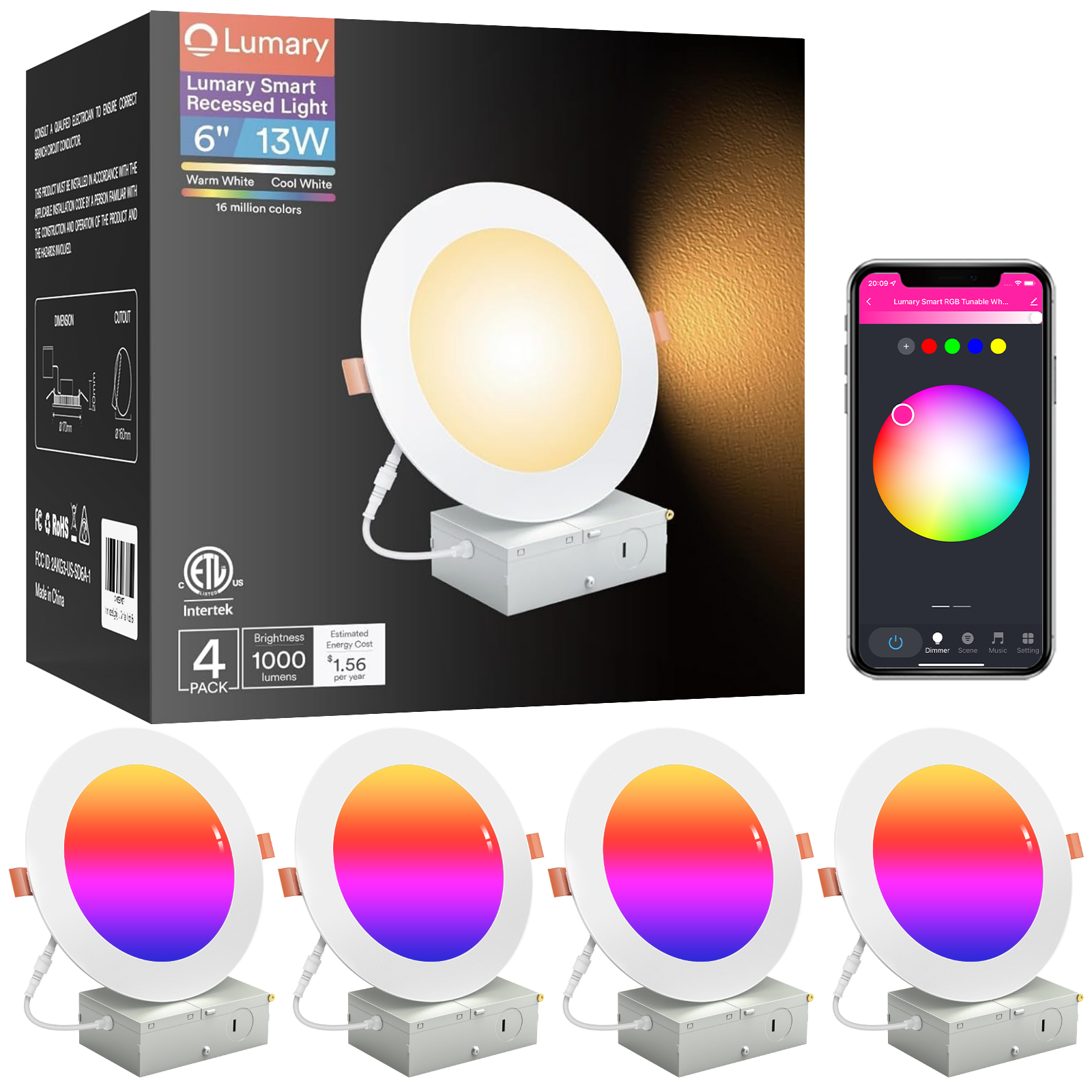
The Lumary Wi-Fi Smart Canless Recessed Lighting 6 Inch (4-pack) — model numbers US-SD6A-4 (White) and US-SD6B-4 (Black) — is a purpose-engineered canless downlight that integrates a full RGBCW LED engine with 2.4 GHz Wi-Fi and Bluetooth dual-protocol connectivity. At 13 watts and 1,100 lumens, it delivers an efficacy of approximately 84.6 lm/W, a figure that places it solidly in the mid-to-upper tier of residential smart downlights. The ultra-thin profile — 6.69 inches in diameter and just 0.55 inches in depth — makes it compatible with shallow ceiling cavities where conventional can-based fixtures cannot fit.
The fixture's RGBCW configuration separates the color-rendering and white-light functions across dedicated LED channels. The CW designation (color + white) means warm white and cool white LEDs operate independently from the RGB array, preserving color accuracy in neutral white modes instead of synthesizing white from RGB primaries — a method that routinely produces the bluish or greenish white tint that plagues single-chip RGB designs. Color temperature spans 2,700 K (warm amber, suitable for dining rooms and bedrooms) to 6,500 K (daylight-equivalent, preferred for kitchens, reading areas, and task work). Dimming is continuously variable from 1% to 100%, giving users the granularity to set low-level ambient scenes without the brightness steps or audible buzz associated with legacy TRIAC dimmers.
Control operates through the Lumary App on iOS or Android, with additional voice control via Amazon Alexa and Google Assistant, and Siri shortcut support. The memory function retains the fixture's last operating state through power interruptions, eliminating the need to reconfigure settings after a circuit is reset. Group control allows multiple fixtures across different rooms to be addressed simultaneously, which is critical for maintaining scene consistency across open-plan layouts. The schedule function supports sunrise/sunset automation, enabling biorhythm-aligned lighting that transitions naturally from energizing daylight temperatures in the morning to warm amber tones in the evening.
Available in White and Black trim finishes, the four-pack is priced at $139.99 (White) and $136.99 (Black), making the per-fixture cost approximately $34–$35 — a value that reflects the full RGBCW feature set, smart connectivity, and flicker-free operation. The fixture ships with spring-clip mounting hardware and connects to a standard ceiling junction box, requiring no can housing, no housing adapter, and no specialized tools beyond a flathead screwdriver.

Product Specification Table and Performance Benchmark
The following table consolidates the verified technical specifications and positions each parameter against common pitfalls found in lower-specification alternatives.
| Parameter | Lumary 6" Smart Canless (US-SD6A-4 / US-SD6B-4) | Common Pitfall in Low-Spec Fixtures | Impact on Long-Term Use |
|---|---|---|---|
| Wattage | 13W | Overstated wattage claims; actual draw 30–40% lower than labeled | Direct effect on illuminance calculations and energy billing accuracy |
| Luminous Output | 1,100 lm | Lumen claims measured at 25°C bench temperature, not in-ceiling thermal conditions; actual output 15–25% lower in field | Insufficient foot-candles at task surfaces; layouts based on datasheet numbers will underperform |
| Efficacy | ~84.6 lm/W | Sub-60 lm/W in non-optimized thermal designs | Higher operating costs over a 25,000-hour rated lifespan |
| Color Temperature Range | 2,700 K – 6,500 K (CCT tunable) | Fixed CCT; or CCT tuning synthesized through RGB primary mixing, producing color-inaccurate whites | Inability to adapt lighting for different activities or circadian requirements |
| Light Color Engine | RGBCW (RGB + independent warm/cool white channels) | Single-chip RGBW where white is derived from red, green, and blue primaries | Blue-shifted or greenish whites; color rendering degradation at mid-dim levels |
| Color Options | 16 million | Limited palettes via fixed preset zones; no per-fixture control | Inadequate for mood lighting, scene layering, or creative applications |
| Dimming Range | 1% to 100% | Minimum dim floor of 10–20% in budget designs; visible stepping in intermediate ranges | Inability to set low ambient levels; flickering at near-minimum dim settings |
| Flicker Performance | Flicker-free (specified) | High-frequency PWM artifacts in non-premium drivers, particularly at dim levels | Documented effects on visual fatigue and headache susceptibility in sensitive individuals |
| Connectivity | 2.4 GHz Wi-Fi + Bluetooth | 5 GHz Wi-Fi only (incompatible with most residential router configurations for IoT) | Setup failures and intermittent disconnections in homes with dual-band routers |
| Voice Assistant Compatibility | Alexa, Google Assistant, Siri | Single-platform support requiring bridge hardware for cross-ecosystem use | Lock-in to one smart home ecosystem; added hardware cost for mixed-platform households |
| Group Control | Yes — cross-room synchronization via Lumary App | Per-fixture control only; no scene synchronization without third-party hub | Time-consuming manual adjustment; inconsistent scene execution across multi-fixture installations |
| Music Sync | Yes — via Lumary App audio input | Absent or limited to basic beat detection without color differentiation | No dynamic lighting response for entertainment or gaming environments |
| Memory Function | Yes — retains last state after power interruption | State reset to factory default after power loss | Requires manual reconfiguration after every circuit interruption |
| Installation Type | Canless — junction box + spring clips | Requires can housing or conversion bracket for canless retrofit | Increased installation complexity and material cost in existing construction |
| Profile Depth | 0.55 inches | Profile depths of 3–5 inches requiring minimum ceiling cavity depth | Incompatible with thin ceilings, tray ceilings, or concrete deck construction |
| Fixture Diameter | 6.69 inches (6-inch trim) | Trim ring diameters that vary ±0.5" from nominal, creating visible ceiling gaps in retrofits | Aesthetic inconsistency; visible housing edges around the trim |
| Voltage | 120V (North American standard) | Dual-voltage designs without clear labeling; installation errors in 240V circuits | Safety risk in misapplication; potential driver failure |
| Available Pack Sizes | 4, 8, 12, 24 PCS | Single-unit packaging requiring per-fixture setup, pairing, and app registration | Significantly increased setup time and inconsistent firmware versions across units purchased at different times |
| Finish Options | White / Black | White only; no trim options for darker ceiling applications | Visible contrast gap on dark-painted ceilings |
| Warranty / Return Policy | 2-Year Warranty (add-on); 30-Day Returns | 90-day warranty with restocking fees on returns | Limited recourse for early-life failures; total cost of ownership increases when warranty period is short |
Market Landscape: Smart Recessed Lighting Alternatives
The 6-inch smart recessed downlight category has become one of the most active segments in the residential smart lighting market, with multiple well-established brands offering compelling platforms. Understanding where each brand's flagship recessed products sit helps clarify the decision logic for different buyer profiles.
Govee, best known for its ambient lighting and LED strip products, has extended into recessed lighting with their Govee Smart Recessed Light series. Govee's ecosystem is particularly strong in its RGBIC strip integration and the Matter-over-Wi-Fi connectivity added to select products in recent generations. Users already embedded in the Govee Home app will find the recessed fixtures integrate naturally with existing Govee scenes and automations.
Philips Hue remains the reference implementation for color-accurate smart lighting. The Hue White and Color Ambiance downlights are ZigBee-based, requiring the Hue Bridge for full functionality — a deliberate design choice that prioritizes local processing and extremely low latency over cloud dependency. The Hue platform's CRI performance and color calibration across units are considered among the most consistent available, and its integration depth with Apple HomeKit, Google Home, Amazon Alexa, and Samsung SmartThings is broader than most alternatives.
LIFX positions itself as a Wi-Fi-native platform — no hub required — and its Clean White technology, which uses a dedicated high-CRI white LED channel separate from the color array, is a well-regarded approach to maintaining color accuracy in white modes. LIFX fixtures tend to carry a premium price point relative to their per-lumen cost, which reflects both the optical engineering and the breadth of developer API access.
Kasa Smart (TP-Link) offers the KE230 and related recessed fixtures as part of their Matter-compatible Kasa Smart ecosystem. The Kasa platform is often cited for its app stability, local network control without mandatory cloud dependency, and competitive per-fixture pricing. Kasa fixtures are particularly well-suited for users who prioritize reliability and straightforward setup over extensive color customization.
WiZ, owned by Signify (the parent company of Philips), brings a cloud-based approach with SpaceSense presence detection and an accessible onboarding experience. WiZ fixtures support both 2.4 GHz Wi-Fi and Bluetooth, mirroring Lumary's dual-protocol approach, and integrate with WiZ's proprietary scene library and circadian rhythm scheduling.
Eufy Lighting has developed a recessed line that emphasizes high-lumen output and compatibility with the eufy Security and SmartThings ecosystems, with particular attention to the smart home integration pathway for existing eufy camera and sensor users.
Within this landscape, the Lumary 6-inch canless fixture occupies a meaningful position at the intersection of RGBCW color fidelity, canless installation accessibility, competitive pricing in multi-pack configurations, and dual-protocol connectivity. For buyers who want the full color spectrum and smart scene capabilities without the bridge hardware requirement and at a per-fixture price below $35, the Lumary platform presents a technically substantive option with a substantial review base validating real-world performance.

Application Scenarios
Scenario 1: Whole-Home Smart Ecosystem Integration in an Open-Plan Residence
The architectural trend toward open-plan living spaces — where the kitchen, dining area, and main living zone share a continuous ceiling plane — creates one of the most technically demanding recessed lighting challenges in residential design. A 600-square-foot combined space at 9-foot ceiling height may require 12 to 18 fixtures to achieve the IES-recommended 30–50 foot-candles for general ambient illumination. The challenge is not fixture count alone; it is synchronization fidelity and ecosystem coherence.
Consider a home where the lighting plan calls for 12 fixtures across three functional zones: the kitchen island (requiring a cooler, higher-CRI white around 4,000 K for food preparation tasks), the dining area (requiring a warm 2,700 K dinner scene with dimmed output), and the living zone (requiring variable color temperature to support both daytime activity and evening relaxation). Without group control architecture, achieving three distinct, simultaneously executed scenes across 12 individual fixtures is operationally impractical.
The Lumary App's group control function allows any number of fixtures to be organized into named groups, with scene assignments executed as a single command — either through the app, a schedule trigger, or a voice command to Alexa or Google Assistant. When a "Dinner Mode" scene is activated, all 12 fixtures simultaneously transition to their pre-assigned states: kitchen units holding at 4,000 K to support cleanup while dining fixtures warm to 2,700 K at 40% brightness. The transition is executed across the 2.4 GHz Wi-Fi mesh, with Bluetooth serving as a local fallback for fixtures that momentarily lose packet acknowledgment from the router.
The memory function plays a critical role in household reliability. In whole-home deployments, it is statistically likely that at least one circuit will experience a momentary interruption — during a storm, during HVAC load switching, or during a circuit breaker reset. Fixtures without a memory function revert to their factory default state (typically full white at maximum brightness) following every power cycle. In a 12-fixture installation, this produces a jarring full-brightness white event across the entire open-plan area. The Lumary memory architecture retains each fixture's last confirmed operating state in non-volatile storage, so power restoration returns the space to exactly the scene it was executing before the interruption.
For households with mixed smart home ecosystems — one family member using an iPhone with Siri, another using an Android device with Google Assistant, and a shared Amazon Echo device in the kitchen — the multi-assistant compatibility eliminates the friction of ecosystem fragmentation. Each user can control the same fixtures through their preferred interface without requiring bridge hardware, hub firmware updates, or API access negotiations.
The canless form factor is particularly advantageous in whole-home retrofits where the existing ceiling already has can housings from incandescent-era installations. The spring-clip mounting system accommodates ceiling cutouts ranging from standard 6-inch diameters, allowing direct drop-in replacement without drywall modification. In new construction with no existing housing, the junction-box mount connects directly to whichever circuit the electrician runs overhead — a straightforward connection that does not require an additional housing purchase.
Scheduling allows the home's lighting to operate on a biorhythm-aligned program without any daily user input. A morning automation gradually increases color temperature from 2,700 K to 5,000 K over 45 minutes as the household wakes, signaling the circadian system to suppress melatonin and elevate cortisol. An evening automation reverses the transition, guiding the household toward the warm amber tones associated with reduced alertness. Over a 30-day period, this passive scheduling function contributes meaningfully to sleep quality — an outcome that lighting scientists at institutions studying photobiology consistently associate with CCT-tunable residential lighting systems.
Scenario 2: Immersive Gaming and Media Room Configuration
The gaming and home theater space presents a specialized set of lighting requirements that standard recessed fixtures are architecturally unsuited to address. In a dedicated media room — typically a light-controlled, enclosed space of 150 to 300 square feet with blackout window treatments and a display system as the primary visual anchor — recessed lighting serves two conflicting purposes simultaneously: it must provide sufficient ambient light to prevent the visual fatigue caused by a bright screen in a completely dark room, while contributing to immersive atmosphere through color and dynamic effects.
The underlying physiological concern is the simultaneous contrast effect. When a high-brightness display occupies a significant portion of the visual field against a completely dark surround, the human visual system's adaptation mechanisms cause the dark surround to appear actively dark rather than neutral, increasing perceived contrast to uncomfortable levels. Research in display ergonomics consistently demonstrates that maintaining a low-level ambient background — approximately 10 to 20% of the display's peak luminance, at a matched or complementary color temperature — reduces reported visual fatigue during extended sessions.
The Lumary fixture addresses this through its 1% minimum dim floor. At 1% output, 1,100 lumens becomes approximately 11 lumens — comparable to a nightlight. Combined with a warm 2,700 K color temperature, this provides the low-level bias illumination that display ergonomics research supports without introducing enough ambient light to wash out shadow detail or reduce perceived contrast ratio.
The music sync capability introduces a second operational mode relevant to gaming environments: reactive lighting synchronized to audio output. The Lumary App uses the device microphone or internal audio routing to analyze the amplitude and frequency distribution of the audio signal, translating beat, bass, and transient events into corresponding hue, saturation, and brightness changes across all connected fixtures. For games with dynamic soundscapes — combat sequences, ambient environment audio, cutscene music — the light environment becomes an extension of the audiovisual experience rather than a passive background.
Setting up a gaming room with four 6-inch Lumary fixtures creates approximately 4,400 lumens of maximum output distributed across the ceiling plane. When dimmed to 10% for immersive play, the effective output drops to 440 lumens — sufficient to maintain ambient visibility without compromising the perceived contrast ratio of the display. Color can be set to match the dominant hue of the on-screen environment (blue for a night sky scene, amber for desert environments) and updated manually or through scene presets as gameplay shifts.
The 16 million color range means the available hue space spans the full human visible gamut, including the deep saturated blues and greens that are perceptually most effective at communicating the atmospheric characteristics of different game environments. The RGBCW architecture ensures that even fully saturated color output maintains predictable luminance, avoiding the brightness collapse that occurs in single-chip RGB designs when mixing complementary primaries.
From a practical installation standpoint, the canless design with its 0.55-inch profile depth is well-suited to media rooms in basement or finished-attic spaces, where low-profile ceilings or structural constraints limit the cavity depth available above the drywall plane. The spring-clip mounting system requires only a standard 6-inch cutout and junction box — installation that a competent DIY practitioner can complete in approximately 20 minutes per fixture.
Scenario 3: Kitchen Task Lighting and Visual Accuracy Applications
The kitchen presents the most technically demanding color rendering requirements of any residential space. Counter surfaces, fresh produce, raw and cooked proteins, and prepared dishes all rely on the eye's ability to accurately perceive subtle variations in color — variations that signal freshness, doneness, and presentation quality. Under light sources with inadequate color rendering, the red and orange wavelengths that signal ripeness and seared proteins are insufficiently reproduced, flattening the visual richness of the space and creating functional ambiguity in food preparation tasks.
The industry standard for color rendering is the Color Rendering Index (CRI), expressed as Ra for the average of eight standard test colors, with a supplementary R9 value specifically measuring the rendering of saturated red — the hue most relevant to kitchen applications. General-purpose LED fixtures commonly achieve Ra values of 80–83, which is adequate for many applications but leaves measurable gaps in red-spectrum reproduction. Lumary's verified customer reviews explicitly cite color accuracy as a standout characteristic: one verified purchaser states that "CRI and color accuracy is spot on for nice daylight color and bright white," a field observation consistent with the RGBCW architecture that maintains dedicated white channels separate from the RGB primaries.
The 6,500 K daylight endpoint is particularly relevant for kitchen applications. Daylight-equivalent color temperature (D65, or 6,500 K) is the standard reference illuminant used in professional color evaluation because it closely approximates natural overcast sky illumination — the condition under which human color discrimination evolved to be most accurate. Food stylists and professional chefs operating in commercial kitchens consistently prefer daylight or near-daylight illumination above the preparation surface for this reason.
The 1,100-lumen output per fixture at 13 watts is sufficient to provide approximately 40–55 foot-candles at countertop level when fixtures are installed at 8-foot ceiling height with standard 60-degree beam angles — comfortably within the IES RP-11 recommendation of 30–50 foot-candles for kitchen task illumination. A four-fixture installation in a galley kitchen of approximately 80 square feet would achieve this target across the primary work zones, with group control enabling simultaneous transition between the task-focused 6,500 K daytime setting and a warmer 2,700 K setting when the kitchen transitions from active cooking to casual evening dining.
The 1% to 100% dimming range supports the operational flexibility that modern kitchens require. During active meal preparation, full 100% output at 5,000–6,500 K maximizes visual clarity. During a dinner party, the kitchen zone can be reduced to 30% at 3,000 K while the dining zone increases to 60% at 2,700 K — a coordinated transition executed through a single scene command without any manual adjustment at the individual fixture level.
Scenario 4: Bedroom and Circadian Rhythm Lighting
Sleep medicine research has established a direct mechanistic link between the spectral composition of evening light and melatonin production. The photoreceptive retinal ganglion cells responsible for circadian entrainment are most sensitive to short-wavelength (blue) light in the 460–480 nm range — precisely the spectral region that high color temperature (5,000–6,500 K) white LEDs amplify significantly relative to warm-white alternatives. Sustained exposure to cool-white illumination in the two to three hours before sleep has been documented in multiple peer-reviewed studies to delay melatonin onset, shorten total sleep duration, and reduce slow-wave sleep proportion.
The practical implication for bedroom lighting is that fixtures capable of transitioning to genuinely warm white temperatures — below 2,900 K, and ideally at or below 2,700 K — in the evening provide a measurable biological advantage over fixed-CCT alternatives. The Lumary fixture's 2,700 K lower boundary lands precisely in this therapeutically relevant range. A scheduled automation that transitions the bedroom from 5,000 K at 100% during the morning wake-up period, through 4,000 K at 70% during the active day, and down to 2,700 K at 25% beginning two hours before the household's target sleep time requires no daily user input once programmed. The Lumary biorhythm feature, accessible through the app, supports exactly this kind of pre-programmed circadian lighting profile.
The memory function ensures that if the bedroom circuit is reset after an overnight power interruption, the fixture restores to its last-used warm dim state rather than defaulting to full brightness — a detail that matters considerably at 3:00 AM.
For households with children, the schedule function can be configured to provide a gentle amber nightlight at 1–5% output during overnight hours, providing enough orientation light for nighttime movement without significantly elevating the room's illuminance above the photopic threshold. This eliminates the need for a separate nightlight device and maintains the coordinated aesthetic of a smart ceiling installation.
The voice control integration is particularly practical in the bedroom context, where physical control interaction at sleep or wake times is undesirable. A voice command to Alexa, Google Assistant, or Siri — "Turn off bedroom lights," "Set bedroom to sleep mode," or "Dim to 10% warm" — eliminates the need to reach for a phone or locate a physical switch in a darkened room.
Scenario 5: Multi-Room Coordinated Entertainment and Social Spaces
The most technically complex residential lighting challenge is the multi-room social occasion — a gathering that spans several adjacent spaces and requires consistent, coordinated ambiance across a range of functional zones operating simultaneously. A typical scenario involves a living room receiving guests, a dining area serving dinner, a kitchen managing food preparation, and a hallway connecting them. Each zone has a distinct illuminance requirement, a distinct color temperature preference, and potentially a distinct scene aesthetic.
Without a group control architecture that supports room-level addressing within a single app, achieving this coordination requires either running between zones to manually adjust individual fixtures or accepting that some zones will be incorrectly illuminated for their current function. The Lumary App's group and scene system resolves this by allowing each fixture to be assigned to one or more named rooms, with each room addressable independently or as part of a whole-home scene.
A "Dinner Party" scene might address all rooms simultaneously: living room at 2,700 K, 50%; dining at 2,700 K, 70%; kitchen at 4,000 K, 80%; hallway at 3,000 K, 30%. A single voice command or app tap executes all five zone-level commands within the same command cycle. The music sync function can layer reactive color effects across all connected fixtures if the host prefers a more dynamic ambient environment for cocktail hour, then be switched off for dinner without disrupting the fixed-CCT zones.
The share function, which allows a household account owner to grant control access to family members or roommates through the Lumary App, means that social occasions do not create a single-phone bottleneck for lighting control. Multiple users can independently make adjustments within their assigned permission levels, and schedule automations continue to execute regardless of which devices are present and active on the network.
The eight built-in scene modes — covering themes appropriate for reading, relaxation, romance, activity, and celebration, among others — provide a curated starting point for hosts who prefer not to build scenes from scratch. Each preset can be modified and saved under a custom name, creating a personalized scene library that reflects the actual usage patterns of the household rather than manufacturer assumptions about how people live.
Professional Assessment and Purchasing Guidance
From a hardware review standpoint, the Lumary 6-inch canless fixture earns its credibility through the technical decisions that are most difficult to observe in a product listing but most consequential in long-term operation: the separation of white and color LED channels in the RGBCW engine, the flicker-free driver specification, the 1% minimum dim floor, and the dual-protocol connectivity that maintains local Bluetooth control as a fallback when Wi-Fi conditions are suboptimal.
The RGBCW architecture is the most technically significant differentiator in this category. Engineers and lighting hardware reviewers who have examined color accuracy in smart downlights consistently observe that single-chip RGB-white designs produce white output that varies in quality across the CCT range — particularly in the 3,000–4,000 K middle zone, where the RGB mixing ratio produces whites with elevated green content. The Lumary RGBCW design uses independent warm-white and cool-white emitter arrays for its white output, meaning the color temperature of white modes is determined by the ratio of WW to CW activation, not by RGB mixing. This is the same architectural principle used in professional lighting equipment, where color accuracy under white illumination is a non-negotiable specification.
The flicker-free specification addresses a driver design quality that is frequently overlooked in consumer purchasing decisions despite having measurable physiological consequences. PWM-driven dimming — the method used by lower-cost drivers to reduce brightness by switching LEDs on and off at frequencies from 100 Hz to several kilohertz — produces light modulation that, at certain frequencies and modulation depths, has been linked to visual fatigue, headaches, and stroboscopic effects in environments with moving subjects. The IEEE 1789-2015 standard provides guidance on acceptable modulation frequencies and percentages for human occupancy spaces. A fixture specified as flicker-free has been designed to avoid the PWM patterns that fall within the potentially hazardous range — a meaningful quality indicator that distinguishes products engineered for habitable environments from those engineered to a minimum cost target.
Decision logic for prospective buyers: If the primary requirement is a clean, color-accurate white light with smart dimming and scheduling for a kitchen, bedroom, or study — and the color feature set is secondary — this fixture delivers well-calibrated whites across the full CCT range at an approachable price point. If the primary application is an entertainment or media space where RGBCW color versatility, music sync, and dynamic scene capability are equally important alongside functional white illumination, the fixture's full feature set is directly relevant and difficult to match at the per-unit price in a multi-pack configuration. If the installation spans multiple rooms with coordinated scene requirements, the group control and scene architecture scales effectively to 12 or more units without additional hub hardware.
Who should purchase this product: homeowners planning a new ceiling installation or a canless retrofit in one or more rooms; renters in jurisdictions that permit junction-box-level fixtures; smart home enthusiasts integrating Alexa, Google Assistant, or Siri; gaming and home theater users seeking tunable ambient and reactive color lighting; and households where multiple users need independent access to lighting control without a proprietary hub.
Frequently Asked Questions
Q1: How many 6-inch recessed lights do I need for a room, and how does this fixture's output factor into the calculation?
The foundational calculation starts with the room's square footage and the target illuminance level. For general ambient lighting, the IES recommends 20–30 foot-candles in living areas and 30–50 foot-candles in kitchens and task-oriented spaces. One foot-candle equals one lumen per square foot. For a 200-square-foot living room targeting 25 foot-candles, the total lumen requirement is approximately 5,000 lumens. The Lumary 6-inch fixture produces 1,100 lumens at full output, meaning approximately five fixtures are needed for general ambient coverage — practically, a four-pack covers a 160–180 square foot zone at 25 foot-candles, and an 8-pack covers up to 360 square feet. Spacing each fixture no more than 4 feet from the next (for 8-foot ceilings) and no more than 2 feet from the wall ensures uniform illuminance without hot spots or dark zones.
Q2: Why does my recessed lighting produce a white light with a slightly blue or greenish tint, and how does this fixture avoid that problem?
The bluish or greenish tint in white recessed lighting is almost always a sign that the fixture is synthesizing white light by mixing red, green, and blue LEDs — a method that is spectrally inconsistent and varies noticeably with dimming level and age-related phosphor degradation. The correct solution is a dedicated white LED channel that produces white light through a phosphor-converted single-color LED array, with color temperature determined by the ratio of warm-white to cool-white channel activation. The Lumary RGBCW architecture uses exactly this approach: the "CW" portion of RGBCW denotes independent cool-white and warm-white LED channels that drive all white-mode output without involving the RGB primaries. The result is white light that remains spectrally consistent and color-accurate across the entire 2,700–6,500 K range, at every dimming level.
Q3: Will these fixtures work if my Wi-Fi router is in a different room or on a different floor from the installation location?
The 2.4 GHz Wi-Fi band used by the Lumary fixtures has substantially better wall penetration and range than the 5 GHz band, making it the preferred frequency for IoT devices in typical residential construction. Most routers with dual-band capability (2.4 GHz and 5 GHz simultaneously) broadcast both bands under the same SSID or separate SSIDs — the Lumary fixtures will connect to the 2.4 GHz network specifically. In installations where the router is two or more rooms away, signal strength may be reinforced by a Wi-Fi extender or mesh node broadcasting the 2.4 GHz band. Additionally, Bluetooth connectivity is available as a local control pathway that does not depend on router proximity at all, allowing control from any Bluetooth-enabled device within approximately 30 feet of the fixture.
Q4: Can I add more Lumary 6-inch fixtures to my installation later, and will they integrate seamlessly with the original four?
Yes. The Lumary ecosystem is designed for progressive expansion. Additional fixtures purchased later — whether from the 4-pack, 8-pack, or 12-pack configurations — connect to the same Lumary App account through the standard Wi-Fi pairing process and can be added to existing room groups, scenes, and schedules immediately after setup. There is no practical limit on the number of fixtures managed within a single account, and the group control architecture supports cross-room addressing regardless of the total fixture count. Firmware updates are delivered over the network to all fixtures simultaneously, so expanded installations maintain version consistency without requiring individual updates.
Q5: What happens to my scheduled scenes and settings if I lose internet connectivity for an extended period?
The Lumary fixtures store their last operating state in on-device non-volatile memory, which means the memory function works even without internet connectivity — the fixture restores its last setting after any power interruption regardless of network status. Schedule automations and scene triggers that rely on the Lumary cloud infrastructure require an active internet connection to execute, but Bluetooth local control remains fully functional for on-demand adjustments without internet. For households in areas with intermittent connectivity, the most resilient configuration is to set a preferred default scene and rely on Bluetooth control for active sessions, with cloud-dependent scheduling functioning as a convenience layer that supplements rather than replaces local control capability.

