




recessed Lights Do I Need for My Kitchen? The number of recessed lights in a kitchen should not be decided simply by placing “one light every few feet.” A more reliable method is to determine the kitchen’s square footage first, calculate the required total lumens based on the lighting goal, and then fine-tune the layout according to each fixture’s effective output, cabinet shadows, island placement, and dimming needs. In the lighting industry, illuminance is often measured in foot-candles; 1 foot-candle is roughly equivalent to 1 lumen per square foot. Residential lighting recommendations associated with IES guidance commonly place kitchen lighting in the 30–50 foot-candle range. In practical terms, a 120-square-foot kitchen generally needs about 3,600–6,000 lumens for ambient lighting. (usailighting.com)
A more intuitive formula is:
Number of kitchen recessed lights ≈ kitchen square footage × 30–50 ÷ lumens per fixture
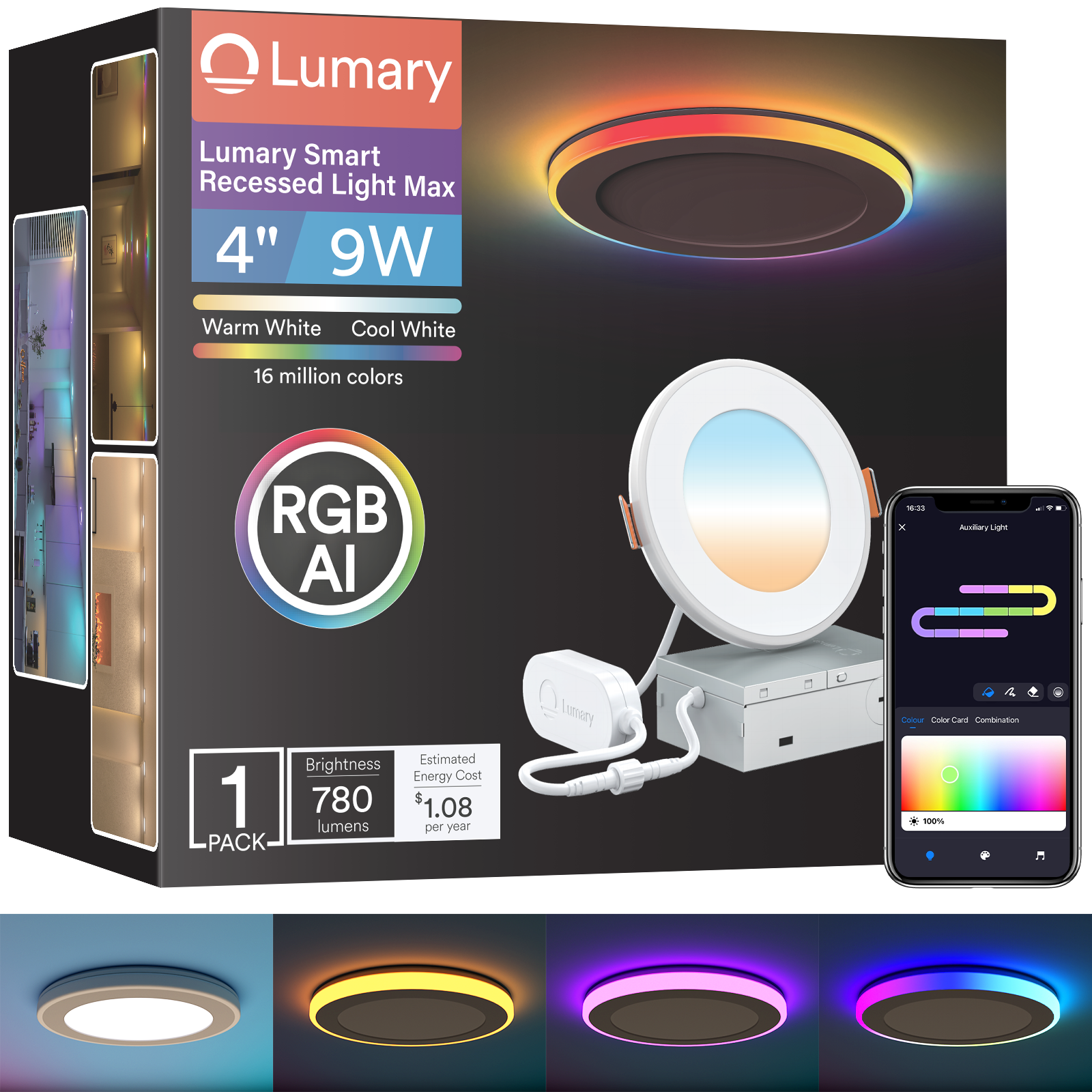
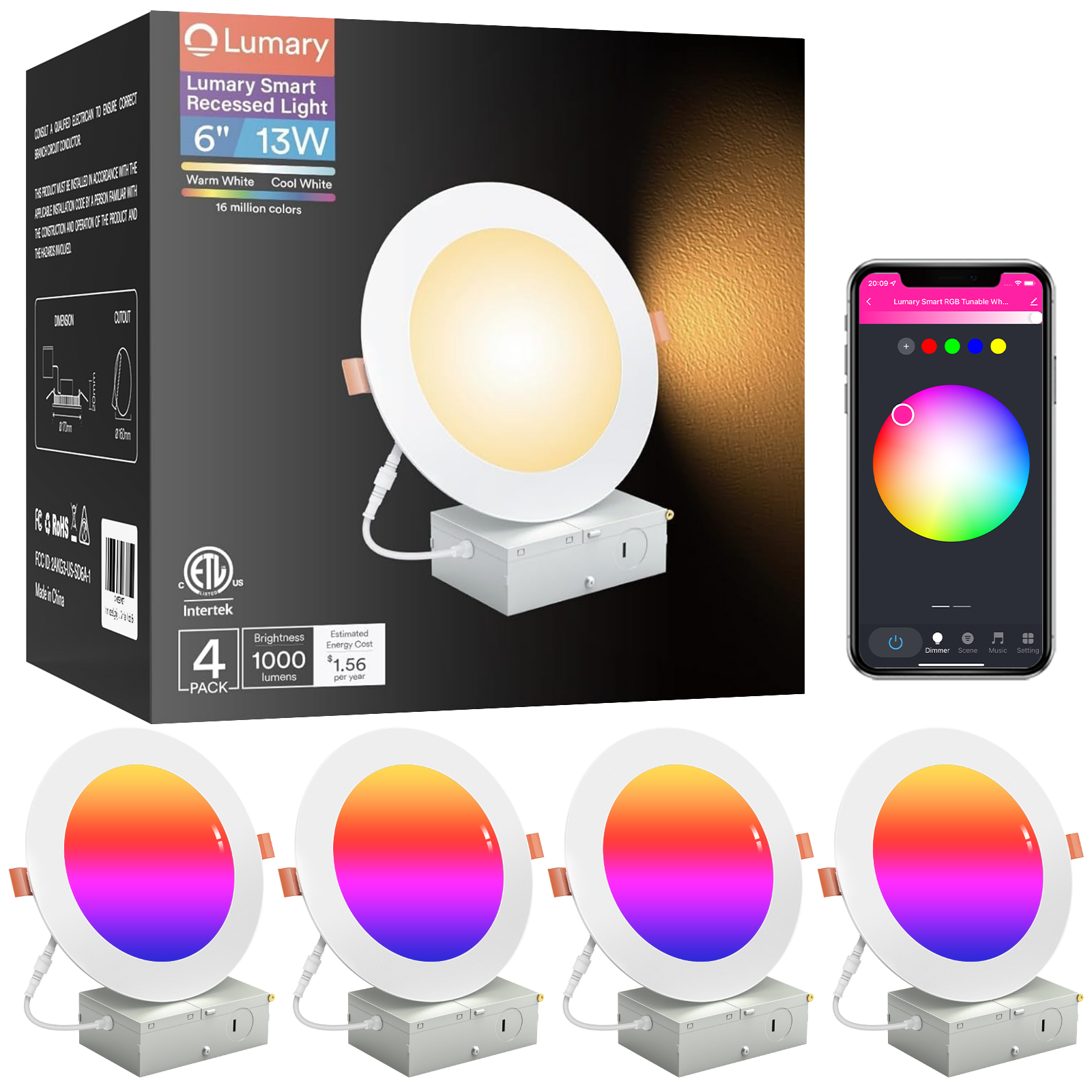
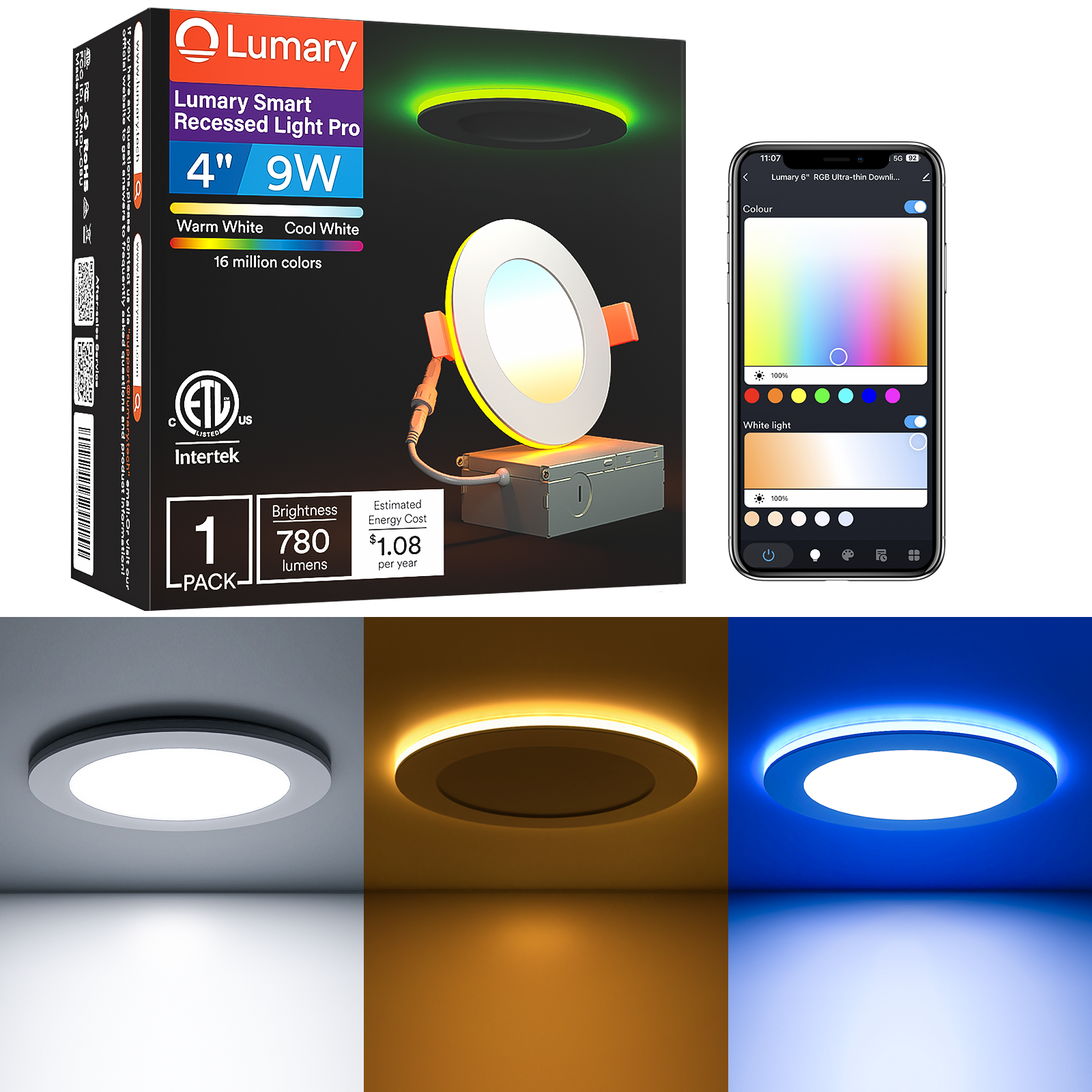
Take the Lumary Wi-Fi Smart Canless Recessed Lighting 6 Inch 4PCS as an example. According to the product page, the 6-inch version is rated at 13W and 1,100LM, and supports 2700K–6500K color temperature adjustment, RGBCW color lighting, 1%–100% dimming, and app/voice control. For a small 10×10 ft kitchen, 3–5 fixtures are usually a reasonable starting point; for a 12×12 ft kitchen, about 4–7 fixtures; for a 12×16 ft open kitchen, about 6–9 fixtures. A higher-end lighting plan is not about filling the ceiling with as many recessed lights as possible. It is about using dimmable, groupable, scene-based smart recessed lights so that meal prep, cleaning, late-night water runs, gatherings, and movie-night integrations can each use the right brightness and color temperature. (lumarysmart.com)
ENERGY STAR also reminds consumers that when buying LED lighting, they should pay attention to lumens rather than relying on the wattage habits formed during the incandescent era; the thermal design of LED fixtures can also affect long-term performance stability. A slim canless recessed light such as Lumary’s 13W, approximately 1,100LM model is well suited for upgrading kitchen ambient lighting from a one-time electrical project into a programmable, zone-based, long-term adjustable smart lighting system. (energystar.gov)

Product Recommendation Analysis
The core value of the Lumary Wi-Fi Smart Canless Recessed Lighting 6 Inch 4PCS is not merely that it is a “four-pack of 6-inch recessed lights.” Its real value is that it brings together the three most important requirements for kitchen recessed lighting in one hardware system: sufficient ambient brightness, adjustable white light, and connected smart control. It uses a slim canless structure, paired with a junction box and spring clips for installation, making it suitable for ceilings without the space required for traditional recessed cans. The product page lists the 6-inch version at 13W and 1,100LM, with a color temperature range of 2700K–6500K, allowing it to shift from warm white for dinner ambience to higher-color-temperature white light for meal prep and cleaning. RGBCW and 16 million colors allow it to extend beyond the kitchen into dining-kitchen combinations, living rooms, gaming rooms, and music rooms. Through the Lumary App, its 2.4GHz Wi-Fi connection supports remote control, scheduling, grouping, memory function, and family sharing. Voice control is compatible with Alexa and Google Assistant, while music sync mode lets the lighting respond to music or game audio. (lumarysmart.com)
| Key Buying Dimension | Common Low-Quality Performance to Avoid | Lumary 6-Inch 4PCS Technical Implementation | Long-Term User Impact |
|---|---|---|---|
| Kitchen ambient brightness | Only wattage is listed, not lumens, which can lead to insufficient brightness after installation | The product page lists the 6-inch version at 13W and 1,100LM; the specifications section also provides different wattage and brightness options | Easier to calculate fixture quantity by square footage and avoid an overly dim or overcrowded ceiling |
| Color temperature coverage | Fixed warm white or cool white only, making it difficult to support cooking, gatherings, and nighttime use | Adjustable white light from 2700K to 6500K | Clear cool white for food prep, soft warm white for dining |
| Dimming capability | Only on/off control, making nighttime use too bright and daytime use inflexible | 1%–100% brightness adjustment | Different brightness levels for late-night water runs, morning breakfast, and deep cleaning |
| Color and ambience | Limited RGB colors, harsh transitions, weak scene atmosphere | RGBCW, 16 million colors, and 8 scene modes | The kitchen can create a continuous ambience with the dining room, living room, and entertainment area |
| Control methods | Isolated single-light control, making multiple lights difficult to synchronize | App, remote, and voice control, with group control support | Open kitchens, dining areas, and living rooms can be managed as one connected lighting system |
| Installation structure | Requires traditional recessed cans, which complicates installation in ceilings with limited space | Slim canless design with junction box and spring-clip installation | Better suited for kitchen remodels and low-ceiling spaces |
| Smart stability | Only supports physical switching, with no scheduling or remote management | 2.4GHz Wi-Fi app control, scheduling, memory function, and family sharing | Daily use is not limited to a single wall switch, and multiple family members can share control |
| Sound and light synchronization | Atmosphere lighting and main lighting are separated, often requiring additional light strips | Music sync mode allows the lights to respond to music or game audio | More complete atmosphere for dining-kitchen gatherings and open entertainment spaces |
Looking at Lumary Alongside Major Smart Lighting Brands
When placing Lumary in the same purchasing context as Govee, eufy, Philips Hue, LIFX, WiZ, Kasa, and other smart lighting brands, the right question is not “which one replaces which.” The better question is how each brand fits into a specific role within a home lighting system.
Philips Hue is often strong in mature ecosystems, bulb-and-strip combinations, and cross-room scene management. Govee is frequently associated with immersive entertainment lighting, light strips, TV backlighting, and gaming ambience. LIFX tends to focus on high-saturation smart bulbs and colorful lighting experiences without an additional hub. WiZ is well suited for budget-friendly smart bulbs and basic space upgrades. Kasa commonly appears in smart switches, plugs, and home electrical control solutions. eufy is often connected with smart home security, cameras, doorbells, and cleaning devices as part of a broader household ecosystem.
The position of this Lumary 6-inch canless recessed lighting is more specific. It is not a desktop ambient light or a temporary light strip; it is a ceiling-integrated primary lighting fixture. Spaces such as kitchens, hallways, living rooms, and bedrooms require long-term lighting coverage, which makes installation structure, lumen output, color temperature adjustment, group control, and multi-light synchronization especially important. For users renovating a kitchen, updating an open dining-kitchen area, or upgrading traditional recessed lights into a smart lighting group, Lumary’s value lies in combining primary illumination and smart scene control into the same hardware system.

Kitchen Prep Areas: From “Bright Enough” to “Accurate Visibility”
Many kitchen lighting failures are not caused by an absolute lack of fixtures. They happen because the light does not land where it needs to. Countertops are blocked by upper cabinets, cutting areas fall into body shadows, sink edges lack brightness, and cooktops may become overly reflective under strong top-down light. These issues are difficult to solve with a single ceiling light, and recessed lights should not be placed randomly in a grid. A more reasonable method is to first identify the work triangle: refrigerator, sink, and cooktop. Then consider whether the island or peninsula also functions as a prep area. Finally, divide the Lumary recessed lights into an “ambient lighting group” and a “task lighting group.”
For a 12×12 ft kitchen, using the baseline target of 30–50 lumens per square foot, roughly 4–7 fixtures at the 1,100LM level can form the main lighting framework. In actual placement, it is not recommended to pursue geometric centering alone. The fixture positions should be slightly closer to the front edge of the countertop to reduce shadows created when a person stands in front of the work surface. Lumary’s 1%–100% dimming is especially important here. When cutting food, cleaning, or checking ingredient color, the color temperature can be set around 4000K–5000K with higher brightness. After dinner, the lights can be lowered to warm white background lighting so the kitchen does not feel cold or harsh. In this way, the lighting supports both efficiency and a sense of home. (lumarysmart.com)
Open Dining-Kitchen Spaces: Preventing the Kitchen, Dining Table, and Living Room from Feeling Disconnected
Open dining-kitchen layouts often suffer from one problem: the kitchen looks like a workstation, the dining area feels like a showroom, and the living room becomes comparatively dim. When the color temperature and brightness levels of these three zones do not match, the entire shared space feels fragmented. Because this Lumary recessed light supports group control, it is suitable for dividing the kitchen, dining-table edge, and living-room transition area into different lighting groups. During daily cooking, the kitchen group can use higher brightness while the dining area stays at a medium warm-white level. During dinner, the kitchen group can be reduced to background light while the dining area keeps its focal lighting. During movies or gatherings, the recessed lights can shift to low-brightness color or warm ambience, preventing large areas of bright white ceiling light from disrupting the atmosphere.
This logic is especially important for dining-kitchen combination layouts. Users do not need to walk back and forth to wall switches repeatedly, nor do they have to tolerate every light turning on at full brightness at the same time. The scheduling, grouping, and memory functions in the Lumary App allow “breakfast mode,” “dinner mode,” “cleaning mode,” and “night-light mode” to become repeatable routines. Kitchen lighting then shifts from a wiring issue into a scene-management system, making the space more consistently usable. (lumarysmart.com)

Gaming Rooms and Music Rooms: Letting Primary Lighting Participate in Immersive Atmosphere
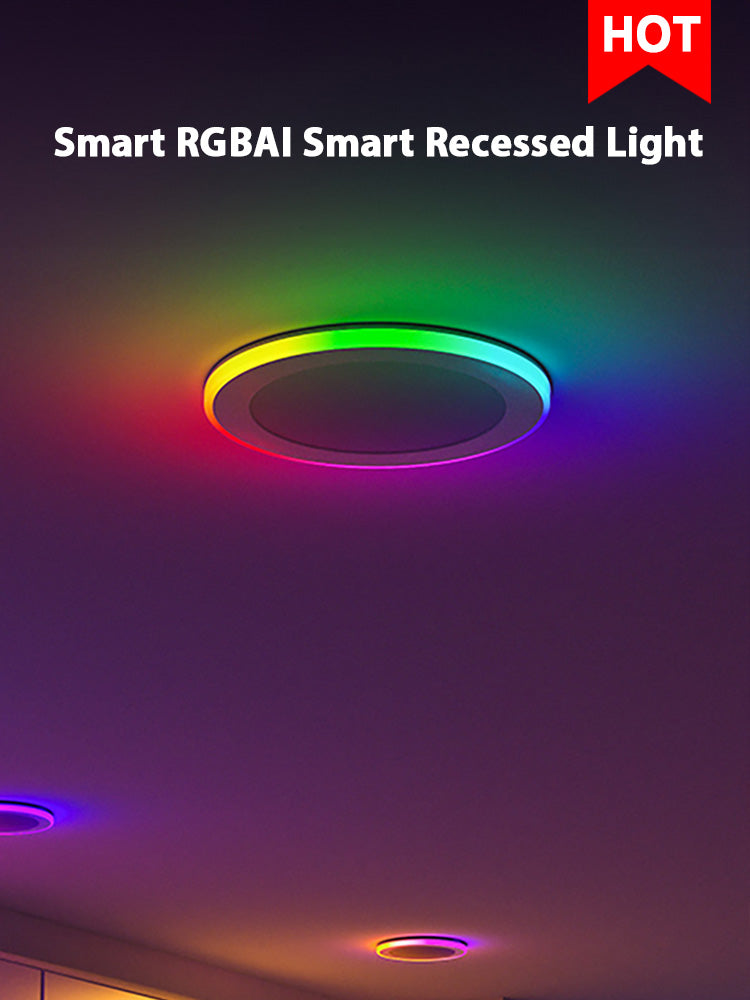
When building a gaming room, many people invest in monitor backlighting, desktop light strips, and wall light panels, while ignoring ceiling-based primary lighting. The result is that the area behind the screen looks dynamic, but the rest of the room is either too dark or disrupted by ordinary white light. Lumary’s RGBCW lighting, 16 million colors, and music sync function allow recessed lights to do more than simply “turn on so you can see.” They can become part of the room’s atmosphere.
In a gaming room, Lumary recessed lights should be set as low-brightness ambient lighting rather than strong direct lighting on the screen. During gameplay, deep blue, purple, and low-saturation red at reduced brightness can lower the contrast between the screen and the surrounding environment. During livestreaming or video calls, the lights can return to neutral white to provide enough clarity for the face and desktop. When friends come over for games or watch parties, music sync mode can make the ceiling lighting respond to sound rhythm, so the room no longer depends only on desktop light strips. The advantage is that the main fixtures are already integrated into the ceiling, creating a cleaner visual result without adding wires or extra desktop equipment. (lumarysmart.com)
Premium Home Path Lighting: A Low-Brightness Strategy for Hallways, Entryways, and Late-Night Kitchen Routes
Beyond the kitchen, smart recessed lights are also well suited for “nighttime path lighting.” When someone gets up at midnight to drink water, a traditional wall switch offers only two states: fully on or completely off. Harsh light can interrupt sleep rhythm and disturb other family members. Lumary supports 1%–100% dimming and scheduling, so the kitchen entrance, hallway, and entryway lighting groups can be set to extremely low-brightness warm white. This allows users to see the floor and countertop clearly without turning the entire home into a high-brightness work environment.
For this scenario, 2700K warm light is more comfortable than a higher color temperature. Brightness should remain as low as practical, serving only as path identification. For households with older adults, children, or pets, low-brightness nighttime path lighting can reduce the risk of walking in the dark. During the day, the same fixture remains standard primary lighting; at night, it becomes soft guide lighting. Compared with installing separate night lights, recessed ceiling lighting distributes light more evenly and does not occupy outlets or disrupt the visual integrity of the walls. (lumarysmart.com)
Home Renovation: The Real Meaning of a Slim Canless Structure
In older-home renovations and partial remodels, one of the biggest frustrations is discovering that the chosen fixture cannot fit into the ceiling. Traditional recessed cans require a certain ceiling depth. When joists, ducts, or floor structures get in the way, installation becomes more complicated. This Lumary canless recessed lighting uses a slim structure with a junction box and spring clips, making it more suitable for retrofit projects where traditional recessed-can space is not available. For homeowners, the value of this structure is not simply that the fixture “looks thin.” Its real significance is that it reduces dependence on existing ceiling conditions.
In a kitchen remodel, lighting installation is often coordinated with cabinets, electrical work, plumbing, and ceiling finishing. By choosing groupable smart recessed lights, users can adjust lighting-group logic later through the app even if the kitchen’s function changes, instead of opening the ceiling again to rewire. For example, an island that was originally used only for meal prep may later become a place where children do homework. In that case, the island lighting group can be adjusted to higher brightness and more neutral white. During holiday dinners, it can return to warm white or colorful ambience. This long-term adjustability is the lasting value of smart canless recessed lights over traditional fixed recessed lighting. (lumarysmart.com)
Professional Evaluation: Who Should Buy This Lumary 6-Inch Smart Recessed Lighting Kit?
From a hardware editor’s perspective, this product is a strong fit for three types of users.
The first group is homeowners renovating a kitchen or open living-dining area. What they need is not a single smart bulb, but a group of ceiling-integrated fixtures capable of serving as primary lighting. Lumary’s 6-inch size, 1,100LM-level output, adjustable white light, and group control can be built directly into a kitchen lighting plan.
The second group is users who already rely on smart speakers or app-based control. This product supports Alexa and Google Assistant voice control, as well as remote control, scheduling, grouping, and family sharing through the Lumary App. These users are more likely to make full use of its smart features rather than treating it like an ordinary recessed light controlled only by a wall switch. (lumarysmart.com)
The third group is users who want to unify “primary lighting + ambient lighting.” Kitchens, living rooms, bedrooms, music rooms, and gaming rooms all appear in the application scenarios listed on the product page. For people who do not want to add too many separate light strips, table lamps, or plug-in devices, RGBCW recessed lighting can deliver multi-scene transitions through a cleaner ceiling-based solution. (lumarysmart.com)
The decision does not need to be complicated. If you only want a temporary color light, a desktop lamp or light strip may be more direct. If you are upgrading ceiling-based primary lighting and want the next several years of use to support app control, voice control, scheduling, and scene management, then the Lumary 6-inch Smart Canless Recessed Lighting 4PCS deserves a serious place on the purchase list.
FAQ
1. How many 6-inch recessed lights should I install in a kitchen?
The most reliable method is to calculate by area: kitchen square footage × 30–50 ÷ lumens per light. Using Lumary’s 6-inch fixture at approximately 1,100LM, a 100 sq ft kitchen needs about 3–5 lights, a 144 sq ft kitchen about 4–7 lights, and a 192 sq ft open kitchen about 6–9 lights. Islands, dark cabinetry, higher ceilings, and shadows from upper cabinets may slightly increase the actual number required.
2. What color temperature should I use in a kitchen?
For meal prep, cleaning, and checking ingredient color, 4000K–5000K clear white light is recommended. For dining, late-night water runs, or integration with an open living area, 2700K–3000K is more comfortable. Lumary covers 2700K–6500K, so the same set of lights can support both functional lighting and ambient lighting. (lumarysmart.com)
3. Why is it not recommended to rely only on one ceiling light in a kitchen?
A kitchen contains countertops, a cooktop, a sink, an island, and upper cabinets, all of which can create shadows and blocked light. A single ceiling light can easily cast body shadows in front of the user, while multiple recessed lights distribute illumination across key work areas. With smart grouping, different zones can also use different brightness levels at different times.
4. Is this Lumary light suitable for low ceilings or kitchen remodels?
Yes, it is especially worth considering. The product page describes it as a slim canless design using a junction box and spring-clip installation, making it more suitable for kitchen renovations where traditional recessed-can space is limited. (lumarysmart.com)
5. Why does 2.4GHz Wi-Fi matter for smart recessed lighting?
2.4GHz Wi-Fi usually provides better range for wall penetration and multi-room layouts. Through 2.4GHz Wi-Fi, the Lumary App supports scheduling, grouping, remote control, and memory functions, making it suitable for deploying multiple recessed lights across kitchens, living rooms, bedrooms, or hallways. (lumarysmart.com)

