




There is no single number that answers this question reliably — and any resource that offers one without qualification is skipping the variables that actually govern the result. The fixture count for a given room is a function of at least four interacting inputs: the room's square footage, its ceiling height, the specific task or ambient function the lighting needs to serve, and the lumen output of the fixture being installed. Get any one of those wrong and you will either under-light the space — producing the flat, shadow-heavy look that makes a room feel unfinished — or over-light it with a ceiling that resembles a commercial grid and eliminates every trace of residential warmth.
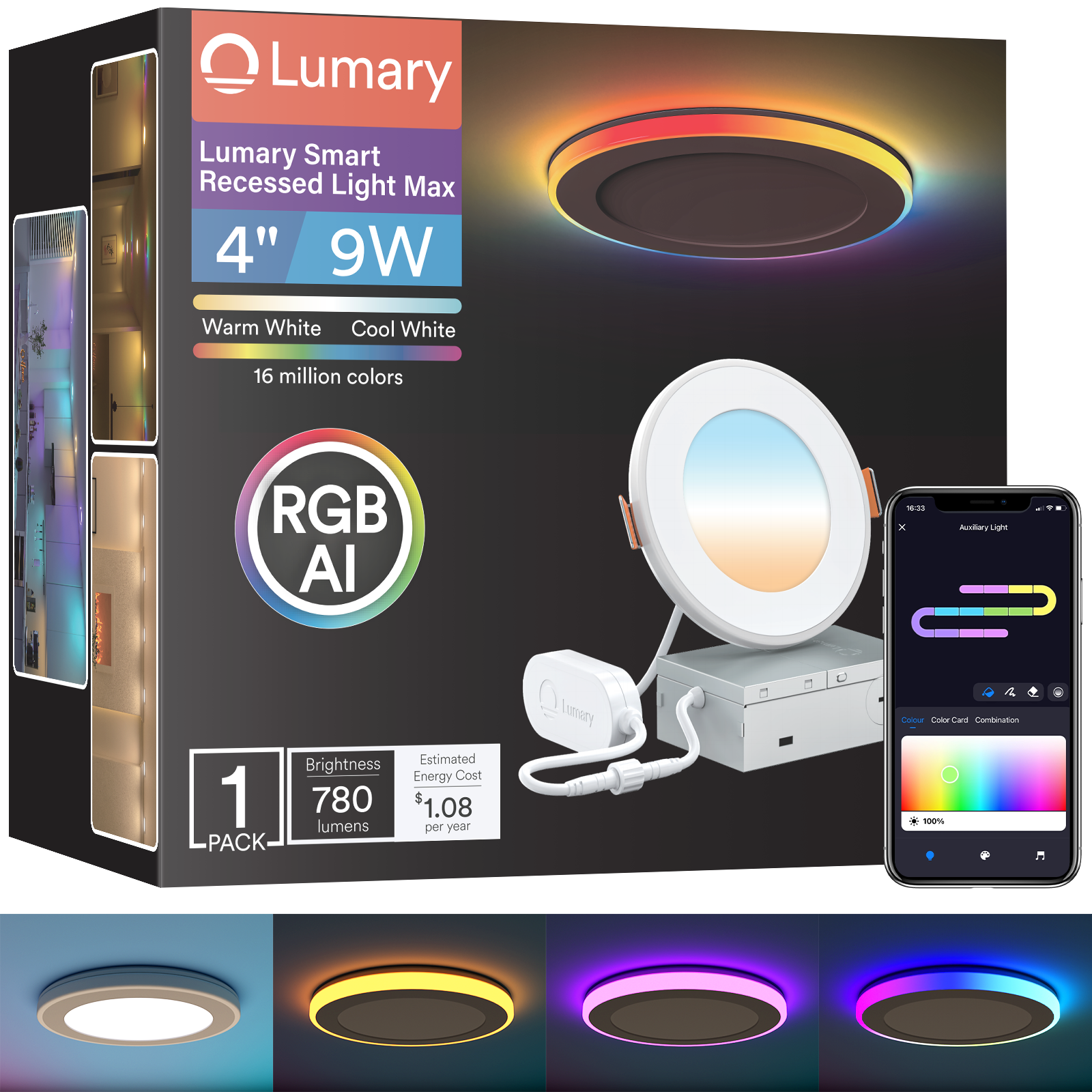
This guide walks through the calculation methodology used by professional lighting designers, applies it room by room, and addresses why a fixture like the Lumary Smart RGBAI Recessed Light with Gradient Auxiliary Night Light changes the count logic in ways that purely functional fixtures do not.

The Two-Step Calculation Every Lighting Designer Uses
Residential lighting specification is grounded in the standards published by the Illuminating Engineering Society (IES), the primary technical authority on lighting practice in North America. The IES Lighting Handbook defines illuminance targets by room function in foot-candles (fc) — a unit equivalent to one lumen of light falling on one square foot of surface area. Working from that framework, the fixture count calculation breaks into two steps.
Step 1 — Total lumens required:
According to the IES Lighting Handbook, different rooms require different brightness levels measured in foot-candles. Kitchens need 30–40 fc for safe food preparation, home offices need 30–50 fc for focused desk work, while bedrooms only need 10–20 fc for relaxation. The calculation: multiply your room's square footage by the IES foot-candle target. For a 168 sq ft kitchen at 40 fc, that's 6,720 lumens. homechisel
Step 2 — Fixture count:
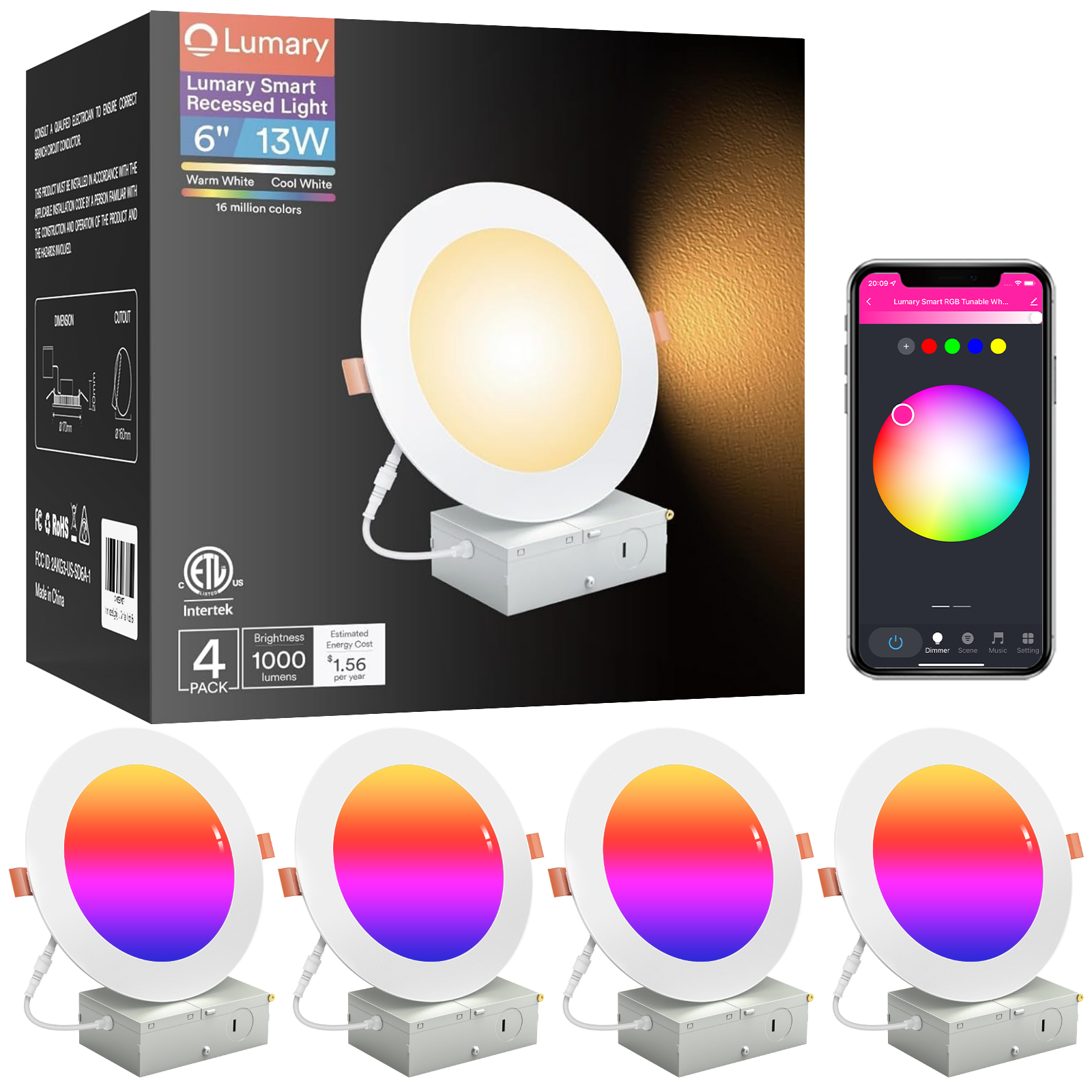
Divide your total lumen target by the lumen output of one fixture. If you plan to use 10 recessed lights, you would look for downlights that produce around 900 lumens each. The 6-inch Lumary RGBAI recessed light produces 1,000 lumens; the 4-inch produces 780 lumens — both figures fall within the standard planning range for residential LED downlights. XHLUX
Step 3 — Spacing validation:
The standard rule states that fixtures should be spaced at a distance equal to half the ceiling height. For an 8-foot ceiling, this translates to 4 feet between each fixture. For a 10-foot ceiling, you'd space them 5 feet apart. This formula ensures even coverage without dark zones between fixtures and without the harsh brightness pooling that occurs when fixtures are placed too closely. Amicolight
Maximum recommended spacing is 6 feet regardless of ceiling height to prevent visible dark zones. homechisel
These two outputs — the lumen-method fixture count and the spacing-grid fixture count — should agree within one or two fixtures. The calculation uses whichever method requires more fixtures, ensuring both adequate brightness and even coverage with no dark zones. homechisel
Room-by-Room Reference: IES Foot-Candle Targets and Fixture Counts
The table below applies the IES foot-candle standards and the 1,000 lm / 6-inch fixture output of the Lumary RGBAI recessed light to common residential room sizes at a standard 8-foot ceiling height. These figures represent the ambient layer only; task zones over kitchen counters, bathroom vanities, or reading areas may warrant supplemental fixtures beyond these counts.
| Room Type | IES Foot-Candle Target | Typical Size (sq ft) | Total Lumens Required | Fixtures at 1,000 lm | Spacing at 8-ft Ceiling |
|---|---|---|---|---|---|
| Bedroom | 10–20 fc | 144–200 | 1,440–4,000 | 2–4 | 4 ft apart |
| Living Room | 15–20 fc | 200–300 | 3,000–6,000 | 3–6 | 4–5 ft apart |
| Kitchen (ambient) | 30–40 fc | 120–200 | 3,600–8,000 | 4–8 | 4 ft apart |
| Kitchen (task zones) | 50–70 fc | (per zone) | (per zone) | Supplemental | 3–4 ft apart |
| Home Office | 30–50 fc | 100–150 | 3,000–7,500 | 3–8 | 4 ft apart |
| Bathroom | 30–50 fc | 50–100 | 1,500–5,000 | 2–5 | 3–4 ft apart |
| Hallway | 10–15 fc | 40–80 | 400–1,200 | 1–2 | 4 ft apart |
| Dining Room | 20–30 fc | 120–180 | 2,400–5,400 | 3–6 | 4 ft apart |
Why Smart Fixtures Change the Count Logic
A purely functional recessed light — one that delivers a fixed lumen output at a fixed color temperature — requires enough fixtures to meet the target foot-candle level across the room's full area for its most demanding use case. If a living room is occasionally used for task reading at 30 fc but primarily occupied at 15 fc for relaxed ambient use, the designer planning with dumb fixtures must either over-install for the peak case or accept under-illumination during high-demand moments.
Smart fixtures with full-range dimming and tunable CCT resolve this inefficiency. Embracing smart technology — using dimmers on everything — is a core principle of professional residential lighting design. A living room with six Lumary smart recessed lights at 1,000 lm each and 1%–100% dimming range delivers 6,000 lumens at 100% for peak demand and can be pulled back to 1,500 lumens at 25% for typical relaxed occupancy — without the stepped transitions and minimum-output artifacts that characterize coarser dimming implementations. XHLUX
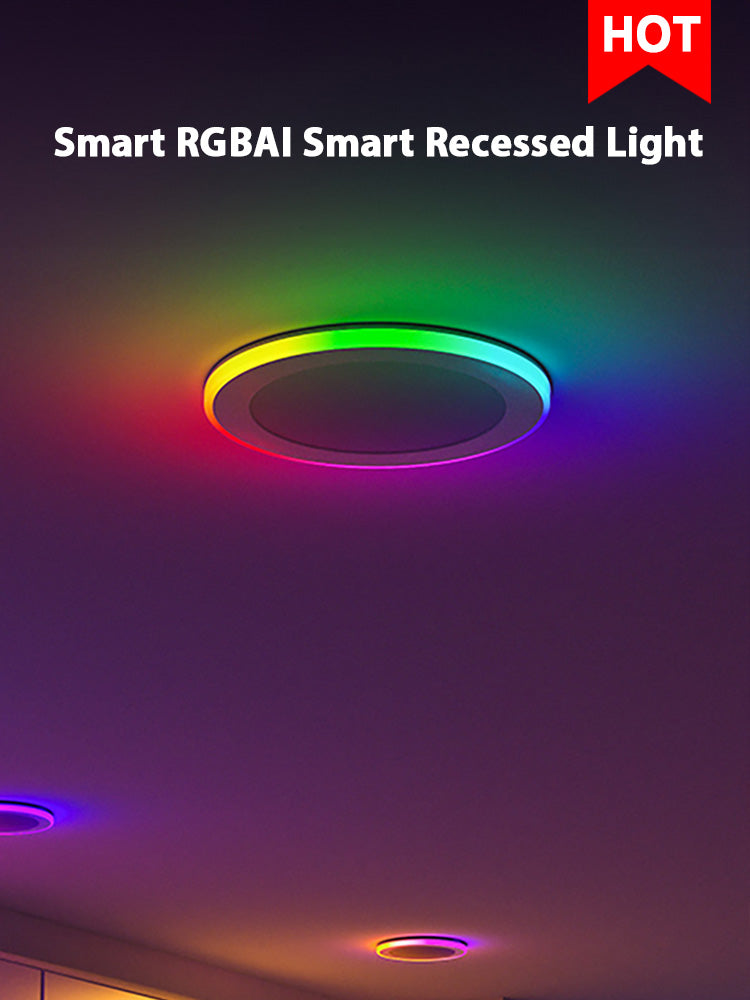
The RGBAI auxiliary ring on the Lumary fixture introduces a further variable that standard fixture-count math does not account for: ceiling-projected ambient light. When the 12-segment gradient ring is active, it projects softly upward onto the surrounding ceiling plane, adding a diffused reflected light field to the room's illumination envelope without any additional ceiling penetration. This effectively expands the perceptual brightness of a room — particularly in rooms with light-colored or white ceilings — at a fraction of the lumen cost of adding another direct downlight.
The practical implication: a living room that the lumen calculation suggests needs six standard downlights may feel equally well-lit with five Lumary RGBAI fixtures operating with their auxiliary rings active, because the upward-reflected ambient component supplements the downward direct component in a way that flat lumen-per-fixture arithmetic does not capture.

Product Recommendation Analysis
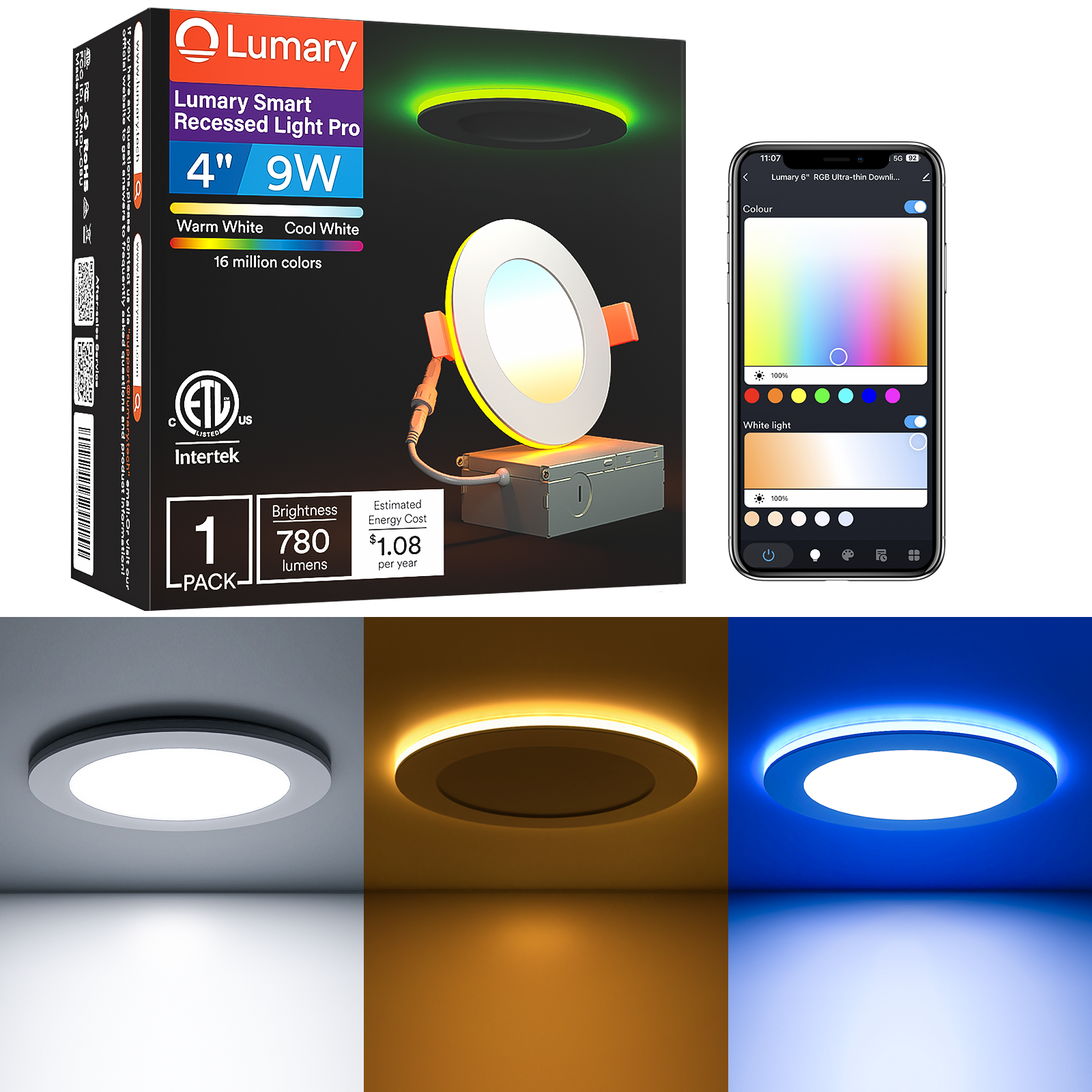
The Lumary Smart RGBAI Recessed Light with Gradient Auxiliary Night Light is built around a dual-emitter architecture that distinguishes it from the single-zone smart downlights that populate most of the market. The primary emitter operates as a tunable white downlight across 2700K–6500K with 1%–100% dimming resolution. The secondary component — an independently operable auxiliary ring — is subdivided into 12 individually addressable RGBAI LED segments, each capable of rendering a distinct color simultaneously, enabling gradient progressions, multi-color scenes, and the ceiling-projected ambient halo effect described above.
Four operating modes cover the functional range: Downlight mode for task and ambient illumination; Nightlight mode using only the auxiliary ring at minimum output for non-glare orientation; RGB mode for full-color atmospheric use; and RGBAI gradient mode, which activates the 12-segment addressing for simultaneous multi-color output across the ring. Control pathways include the Lumary app over 2.4 GHz Wi-Fi, Alexa, Google Assistant, and Siri via Lumary app automation, with 50+ preset scene modes, music synchronization, scheduling, and group control available through the app.
Available in 4-inch (9W / 780 lm) and 6-inch (12W / 1,000 lm) formats, the canless wafer profile with integrated junction box requires no housing can and mounts via spring clips — compatible with both new construction and existing ceiling cutouts of the appropriate diameter without attic access.
Technical Specifications at a Glance
| Parameter | 4-Inch Variant | 6-Inch Variant |
|---|---|---|
| Wattage | 9W | 12W |
| Luminous Output | 780 lm | 1,000 lm |
| Color Temperature Range | 2700K – 6500K | 2700K – 6500K |
| Color Palette | 16 million (RGBWW) | 16 million (RGBWW) |
| Auxiliary Ring Segments | 12 individually addressable | 12 individually addressable |
| Dimming Resolution | 1% – 100% | 1% – 100% |
| Connectivity | 2.4 GHz Wi-Fi + Bluetooth | 2.4 GHz Wi-Fi + Bluetooth |
| Voice Assistant Support | Alexa / Google Assistant / Siri | Alexa / Google Assistant / Siri |
| Scene Modes | 50+ preset scenes | 50+ preset scenes |
| Operating Modes | Downlight / Nightlight / RGB / RGBAI | Downlight / Nightlight / RGB / RGBAI |
| Installation Type | Canless wafer, spring-clip | Canless wafer, spring-clip |
| Junction Box | Integrated | Integrated |
| Attic Access Required | No | No |
| Dimmer Switch Compatibility | Not compatible | Not compatible |
| Group Control | Yes, via Lumary app | Yes, via Lumary app |
| Music Sync | Yes | Yes |
| Scheduling & Automation | Yes | Yes |
| Estimated Lifespan | 25,000+ hours | 25,000+ hours |
Performance Benchmarking: Separating Precision Lighting from Common Installation Pitfalls
| Purchasing Criterion | Signs of a Substandard Approach | Technical Implementation in This Product | Impact on Long-Term Use |
|---|---|---|---|
| Lumen output accuracy | Fixtures marketed by wattage rather than lumens — wattage is an unreliable brightness proxy for LED | Explicit lumen ratings: 780 lm (4-inch), 1,000 lm (6-inch); enables accurate foot-candle planning per IES standards | Predictable fixture counts; no post-installation surprises from overstated brightness claims |
| Dimming resolution at low end | Coarse PWM stepping causes visible brightness jumps below 20% — nightlight and pre-sleep scenes snap between perceptible steps | 1%–100% continuous resolution; genuine low-output operation without staircase banding | Functional nightlight and sleep-mode scenes at the true low end of the range |
| Color temperature stability across fixtures | Poorly binned LED lots in multi-unit purchases produce 200–300K visible variation across a ceiling array — nominally identical 3000K fixtures appear warm/cool relative to each other | Factory-calibrated LED binning and unified firmware color map maintain CCT consistency across units | Multi-fixture ceiling arrays read as visually coherent; no fixture appears noticeably different from its neighbors |
| Ambient envelope beyond downlight output | Standard single-emitter downlights provide direct illumination only — the room's perceived brightness is limited to the direct flux calculation | 12-segment RGBAI auxiliary ring adds ceiling-projected reflected ambient component, expanding perceptual room brightness beyond the direct lumen count | Fewer total fixtures may be needed to achieve equivalent perceived brightness in light-ceiling rooms |
| Multi-room group control | Devices lacking broadcast-group command architecture require sequential individual commands, producing visible sweep effects across large arrays | Lumary app group control broadcasts synchronous scene transitions to all units simultaneously | Whole-home or multi-room lighting events execute as coherent transitions, not sequential updates |
| Thermal management at sustained output | Enclosed-can fixtures trap driver heat, triggering thermal throttling that dims output and shifts color temperature over hours of continuous operation | Canless wafer format eliminates enclosed-can heat trapping; 25,000+ hour rated lifespan under continuous residential use | Stable lumen output and color point from the first hour of operation to year five |
Competitive Landscape: Smart Recessed Lighting in 2025
The market for smart canless recessed downlights has matured into a well-populated field, with several brands competing across meaningfully different technical architectures.
Govee has established strong market presence with its RGBWW recessed line, offering dual Wi-Fi and Bluetooth direct-connect control and 65 scene modes through the Govee Home app. Govee's ecosystem coherence is particularly well-developed — its recessed downlights synchronize with other Govee ambient devices through the same app, making the brand a natural choice for homes that have already invested in Govee lighting products.
Philips Hue occupies the premium tier with its Slim Downlight family, leveraging Zigbee communication and Matter bridge compatibility for deep integration with professional home automation platforms. Hue's primary strength is local control reliability: automations and scene commands execute through the Hue Bridge without cloud dependency, which is the architecture of choice for users prioritizing network privacy and offline resilience.
LIFX delivers hub-free Wi-Fi smart recessed fixtures with a well-regarded color accuracy profile and broad platform integration. Without requiring a bridge, LIFX offers a streamlined setup for homes where adding network infrastructure is not desirable.
WiZ (Signify) positions its recessed line at the accessible entry tier with a simplified onboarding experience. Select WiZ models incorporate SpaceSense passive presence detection, which allows occupancy-responsive automation without a separate sensor — a useful feature for hallways and utility spaces.
Kasa (TP-Link) builds its smart recessed fixtures around network stability, drawing on TP-Link's networking infrastructure expertise. Kasa's consistent connectivity performance in dense wireless environments makes it a practical choice for larger homes with many concurrent smart devices.
The structural differentiator for the Lumary RGBAI recessed light within this field is the 12-segment independently addressable auxiliary ring — a second light engine within the same fixture that generates ceiling-projected gradient ambient output without any supplemental hardware. No other product in this price category replicates this capability from a single ceiling cutout.

Application Scenarios
Scenario 1: Living Room — Solving the Over-Fixture Problem with Smart Dimming and Ambient Supplementation
The most common lighting complaint in residential living rooms is not insufficient brightness — it is the opposite. A ceiling populated with six or eight downlights operating at full output in a room designed for relaxed occupancy produces a flat, glare-heavy result that compresses spatial perception and eliminates the contrast gradations that make a room feel three-dimensional.
Living rooms work best with perimeter placement that avoids the center ceiling completely — this creates intimate, layered illumination instead of harsh overhead glare. Placing fixtures 18 to 24 inches away from the wall and spacing them 5 to 6 feet apart washes the vertical surfaces with light, reflects illumination back into the center of the room, and visually pushes the walls outward, making the entire space feel larger and more inviting. Ledialighting
Applied to a 240 sq ft living room (16 × 15 ft) at a 15 fc ambient target, the IES calculation requires 3,600 total lumens. Six Lumary 6-inch RGBAI recessed lights at 1,000 lm each produce 6,000 lumens at full output — which means the standard operating point for relaxed evening use is approximately 60% brightness, well within the comfortable midrange of the dimming curve. At that output level, the auxiliary rings in nightlight mode add the ceiling-reflected ambient component that transforms the room from a uniformly lit box into a space with a perceivable light–shadow gradient.
For active use — reading, board games, children's homework — the same array at 100% brightness delivers 6,000 lumens to the 240 sq ft floor, approximately 25 fc, which meets the upper end of the living room ambient target without additional fixtures. The transition is a voice command or an app-scheduled scene, not a hardware change.
Scenario 2: Kitchen — Zoned Lighting with Fixture Count Optimized to Task Geometry
The kitchen presents the most technically demanding fixture layout challenge in the residential environment because it combines the highest ambient foot-candle requirement of any regularly occupied room with strongly localized task zones — countertop prep surfaces, the range, the sink — that require directional supplemental illumination beyond what the ambient layer provides.
The National Kitchen and Bath Association recommends 50 lumens per square foot for prep areas. Position lights 36 inches from walls to create proper wall effects that make your kitchen appear larger and brighter. Additionally, in kitchens, position lights exactly 12 inches from upper cabinets to prevent casting shadows on your workspace. UplightLedialighting
For a 160 sq ft kitchen (16 × 10 ft) at a 35 fc ambient target, the calculation requires 5,600 total lumens. Using the 6-inch Lumary RGBAI fixture at 1,000 lm, six units at 94% brightness cover the ambient layer. Positioned 3 feet from the counter wall and spaced 4 feet apart along that run, three of the six fixtures also serve as the primary task layer over the preparation surface. The remaining three, positioned toward the center-to-opposite-perimeter zone, cover the circulation and dining areas.
At the end of the cooking session, when the kitchen transitions to dinner-party mode, the app's scheduled scene drops all six fixtures to 2700K at 40% and activates the auxiliary rings in a warm amber gradient — the ceiling-projected color halo shifts the room's character from functional workspace to ambient dining environment without any fixture change or additional switch manipulation. The tunable CCT range, moving from 6000K morning task output to 2700K evening ambiance, covers the kitchen's full daily operating envelope within the same six-fixture installation.
Scenario 3: Bedroom — Minimizing Fixture Count Without Sacrificing Functional Range
The bedroom is the room where over-installation is most costly — not in energy terms but in atmosphere. A bedroom ceiling with eight downlights operating at full output produces a clinical brightness that is physiologically at odds with the room's function. The IES target of 10–20 fc for bedroom ambient lighting translates to a modest fixture count for most room sizes; the challenge is ensuring that the small number of fixtures installed can serve all the operating modes the bedroom requires.
A 12×12 ft room needs 3–4 lights for a bedroom at a 15 fc target. The room's function determines the IES foot-candle requirement, which drives the fixture count. homechisel
For a 144 sq ft bedroom (12 × 12 ft), three Lumary RGBAI 6-inch recessed lights positioned at perimeter spacing deliver 3,000 lumens at full output — 20.8 fc, exactly at the IES upper range for bedroom ambient. At 50% brightness, the three fixtures produce 1,500 lumens across 144 sq ft — approximately 10 fc, appropriate for reading in bed or pre-sleep unwinding.
At 1% brightness, the main emitters are nearly off. The auxiliary rings in nightlight mode take over: three gradient rings projecting softly onto the ceiling above produce a diffused ambient glow sufficient for safe navigation without any downward-directed light reaching the sleeping partner. The Lumary app's scheduling function automates the nightlight activation at a set hour — no manual interaction required. Three fixtures handle the full behavioral range from task illumination at 20 fc to sleep-mode orientation lighting at sub-1 fc, with the RGBAI gradient mode available for occasions when the room serves as a social or entertainment space.
Scenario 4: Home Office — Precision CCT Matching to Task Demands Across the Day
The home office requires more precise spectral management than most residential lighting planning guides acknowledge. A fixture count derived purely from the 30–50 fc IES office target addresses the lumen quantity question but does not address the color temperature quality question — the degree to which the fixture's CCT can be shifted in real time to match the cognitive demands of different work modes throughout the day.
A true lighting expert considers factors beyond raw lumen calculation, including ceiling height, wall color, and color temperature. For a 120 sq ft home office (10 × 12 ft) at a 40 fc target, the calculation requires 4,800 total lumens. Five Lumary 6-inch smart recessed lights at 1,000 lm each deliver 5,000 lumens at full output — approximately 41.7 fc, precisely on the IES target with minimal excess. Spaced 4 feet apart on an 8-foot ceiling in a 2×3 grid arrangement, the five fixtures provide even coverage with no dark zones across the desk surface or peripheral work areas. XHLUX
The CCT range from 2700K to 6500K, controllable through scheduled automations in the Lumary app, allows the office to operate at 5500K during morning deep-work sessions — a daylight-correlated spectrum that supports alertness and visual acuity for text-heavy tasks — and shift to 3500K during afternoon video calls, where the warmer tone improves skin rendering on camera while reducing the melatonin-suppressing alerting signal of extended cool-white exposure. Five fixtures managed as a single group through the app serve the full daily CCT progression without any manual adjustment required.
Scenario 5: Open-Plan Living and Dining Combination — Zoned Scene Control Across a Single Fixture Array
Open-plan spaces present the fixture count planning problem in its most complex form. A combined living and dining space of 350–450 sq ft needs to serve as a bright dining area at one meal, a soft ambient lounge for the same evening's post-dinner conversation, and a task-adequate space for children doing homework the next afternoon — sometimes with all three activities partially overlapping. Designing a single ceiling array that serves this range without either over-illuminating the relaxed zones or under-illuminating the task zones requires zone control that simple on/off or single-circuit dimming cannot provide.
The Lumary app's zone grouping function addresses this directly. In a 400 sq ft open-plan space (20 × 20 ft) at an average 20 fc target, the calculation requires 8,000 total lumens. Eight Lumary RGBAI recessed lights at 1,000 lm each deliver exactly that at full output. Arranged as a 4×2 grid with 5-foot spacing on a 10-foot ceiling, the array covers the space evenly.
Through the app, the dining half — four fixtures over the table zone — can be designated as one group, held at 3000K and 80% brightness during dinner service. The living half — four fixtures over the seating area — is designated as a second group, running at 2700K and 30% with auxiliary rings in a slow warm gradient for ambient atmosphere. Both groups execute simultaneously from a single app scene, not as sequential commands that produce a visible sweep effect across the ceiling. When the space converts to homework mode the following afternoon, a different scene brings all eight fixtures to 5000K at 90% for even task illumination across the full floor area.
Professional Assessment and Purchasing Guidance
The fixture count question, properly answered, is an engineering problem with a mathematical solution — but the solution space includes a judgment layer that pure arithmetic misses. A room designed with the minimum number of high-quality smart fixtures operating across their full dimming and CCT range will consistently outperform a room over-populated with dumb fixtures at a fixed output level. The variable behavioral range is the primary design value in modern residential lighting, and it is only accessible through fixtures that maintain accurate color, stable lumen output, and fine-grained dimming control across their entire specified range.
Lighting designers and hardware review engineers consistently identify two failure points in residential lighting installations: first, the use of wattage rather than lumens as the planning currency — a habit that produces inaccurate fixture counts when converting from incandescent to LED; and second, the installation of fixtures without verifying low-end dimming behavior, which is where color banding, minimum-load cutoff, and PWM artifacts become perceptible and define the room's character during its most occupancy-intensive operating hours.
The Lumary Smart RGBAI Recessed Light addresses both of these failure points: its explicit lumen ratings enable accurate IES-based planning, and its 1%–100% flicker-free dimming range ensures that the low end of the operating curve — where bedrooms, living rooms, and dining spaces spend most of their occupied time — behaves with the same precision as the full-output end.
Who Should Buy This Product
This fixture is the appropriate choice for homeowners planning a room lighting installation who want a single product architecture to serve both the task-illumination calculation and the ambient accent layer without additional hardware. It is specifically well-matched to living rooms and open-plan spaces where zone control and scene variety are design priorities; to bedrooms where nightlight-mode low-output operation and pre-sleep spectral management matter; and to kitchens where sustained CCT accuracy under high-duty-cycle conditions and the ability to transition between task and ambient modes without fixture changes define the daily user experience. Anyone installing four or more units will find the group synchronization and scheduled scene functions operationally significant, not merely convenient.
Frequently Asked Questions
1. My lighting calculation suggests I need seven fixtures, but even grid spacing on my ceiling works out to six or eight. Which takes priority?
The calculation uses whichever method requires more fixtures, ensuring both adequate brightness and even coverage with no dark zones. If the lumen calculation gives seven but the grid gives eight, install eight and plan to operate them at approximately 87% brightness to hit the foot-candle target — the 1%–100% dimming range of the Lumary RGBAI fixture makes this trivial to set through the app. Over-installing by one fixture and dimming slightly is consistently preferable to under-installing and accepting dark zones at the perimeter of the grid. homechisel
2. My room has a 10-foot rather than 8-foot ceiling. How does that change the count?
Two adjustments are required. First, spacing increases: for a 10-foot ceiling, space fixtures 5 feet apart. Second, lumen delivery at floor level decreases as ceiling height increases, because the light cone spreads over a larger area before reaching the work surface. The International Association of Lighting Designers recommends increasing fixture wattage by 20% for every 2 feet above standard 8-foot height to maintain proper foot-candle levels. In practical terms, this means the fixture count for a 10-foot ceiling will be 15–20% higher than the base calculation for the same room footprint. AmicolightUplight
3. How does wall color affect how many recessed lights I need?
A dark room may require 10–20% more lumens than a light-colored one. Walls in navy, charcoal, or deep greens absorb light, so you will need more lumens — either more fixtures or higher-output ones — to achieve the same level of brightness. The converse is also true: rooms with white or light-gray walls and ceilings benefit from the reflected component of the Lumary RGBAI's auxiliary ring more significantly than rooms with dark surfaces, because the ceiling reflection carries further before being absorbed. XHLUX
4. Can I control different numbers of Lumary RGBAI fixtures in different rooms from a single app interface?
Yes. The Lumary app supports multi-room group management, allowing fixtures to be organized into named groups — Living Room, Kitchen, Bedroom — each controllable independently or collectively from within the same app interface. Scene transitions, CCT changes, brightness adjustments, and RGBAI gradient mode activations can be sent to individual groups, specific subsets, or all connected fixtures simultaneously. Scheduled automations can be defined per group, so different rooms follow different time-based lighting progressions without manual intervention.
5. The IES calculation gives me a different number than the spacing formula for my room. Is one more authoritative than the other?
They measure different things. The lumen method answers: how many fixtures are needed to achieve the target foot-candle level? The spacing formula answers: how many fixtures are needed to cover the ceiling area without dark zones? A 12×12 ft room needs approximately 3 fixtures by the lumens formula for a living room, but spacing rules typically suggest a 2×2 or 3×2 grid of 4–6 fixtures for even coverage without dark corners. The professional approach applies both methods and installs whichever result is larger, then calibrates the actual brightness through dimming. The Lumary RGBAI's 1%–100% dimming range means you can always reduce output to the exact foot-candle target regardless of whether you installed one fixture more than the lumen method strictly required. Homeprojectcalculator

