




The short answer is yes — in the majority of residential scenarios, swapping existing recessed fixtures for smart LED alternatives requires no new wire runs, no circuit modifications, and no attic access. The longer answer involves understanding which of several available pathways applies to your specific ceiling configuration, because the route you take determines both the complexity of the swap and the functional ceiling you ultimately reach.
This distinction matters more than it might initially seem. A homeowner with a row of 6-inch halogen cans in a 1990s kitchen ceiling is starting from a fundamentally different position than someone with integrated LED modules in a newer construction home — and each scenario points toward a different product architecture. Getting this diagnostic step right before purchasing anything is what separates a Saturday afternoon upgrade from an unplanned hardware return.
The Three Upgrade Pathways and What Each Actually Requires
Before buying anything, pop one light down and look inside. If you see a standard Edison socket — most commonly E26 in the U.S. — you are in the easiest category and can usually install smart recessed light bulbs in minutes. If you have an integrated LED module with no replaceable bulb, you will likely need to upgrade the whole unit or trim. Also note the size: 4-inch and 6-inch are the most common dimensions, and many retrofit kits are sold in those sizes. Weffort
Pathway 1 — Smart bulb into existing E26 socket. If your recessed cans accept a standard screw-in bulb, a Wi-Fi or Bluetooth-enabled BR30 or PAR bulb installs in under a minute. You keep the existing housing and trim entirely. This is the lowest-friction entry point into smart lighting, though it preserves the optical characteristics — beam angle, trim design, glare profile — of hardware that may be decades old.
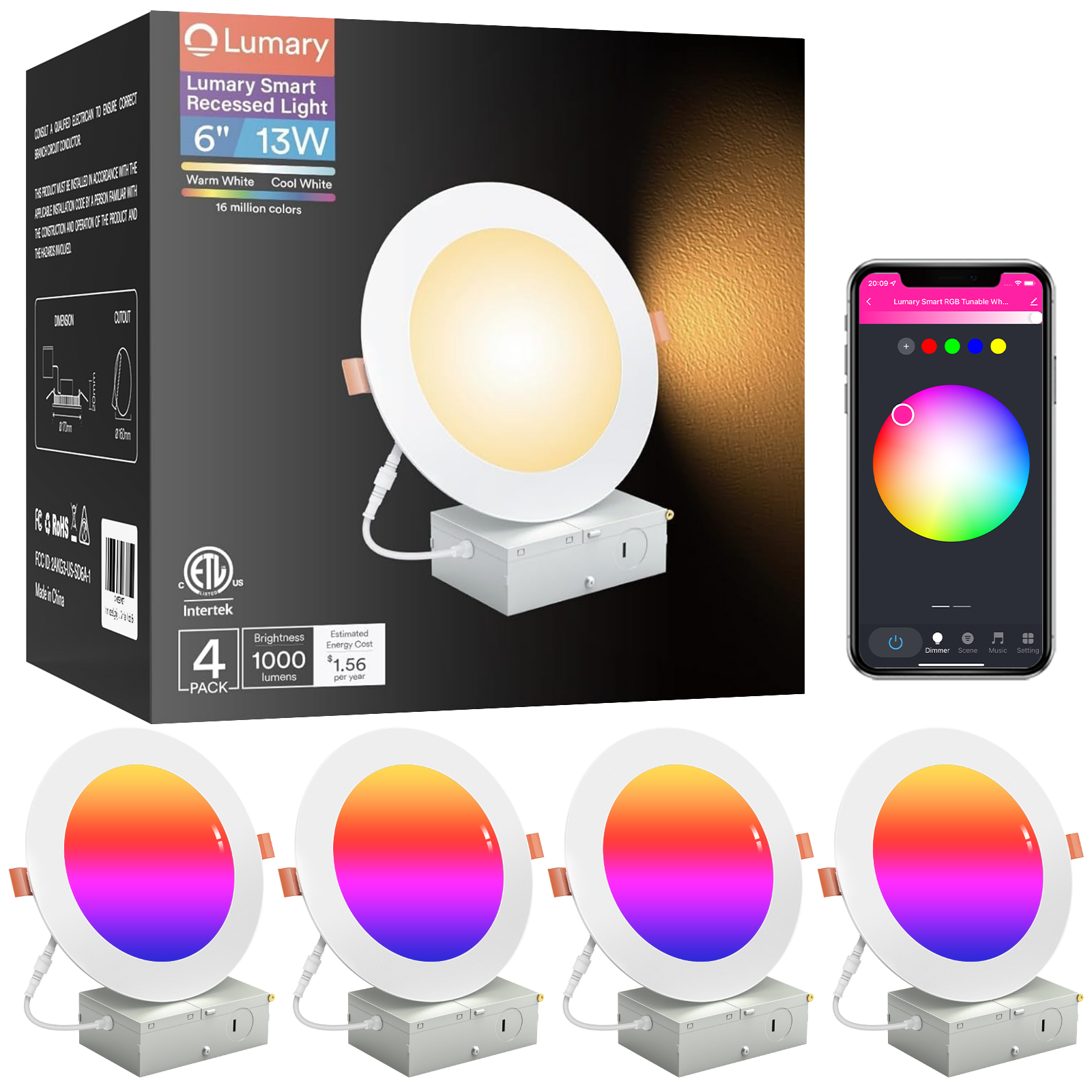
Pathway 2 — Retrofit LED kit into existing can housing. Most retrofit can lights consist of an integrated LED module and trim assembly. The LED chips, driver electronics, and heat management systems are built into a single unit that connects to your existing housing through either the standard Edison socket or direct wiring to the junction box inside the can. This integrated design ensures optimal performance since the LED and thermal components are engineered to work together. The result is a complete visual and functional refresh of the fixture without touching the housing itself. Amicolight
Pathway 3 — Full canless replacement. If your existing fixtures are worn, thermally compromised, or you simply want a flush modern profile without visible trim rings, modern LED fixtures fit directly into the existing ceiling cutout, instantly transforming dull, outdated ceilings into sleek, energy-efficient spaces without the need for rewiring or major renovation. The canless format removes the housing entirely and mounts a new integrated unit directly to the existing junction box using spring clips. The Paintly
If your current lights are old, buzzing, inconsistent in dimming, or you want a more modern ceiling appearance, upgrading to an integrated smart unit or retrofit kit can be more satisfying than simply changing bulbs. Many modern kits replace the trim and the light engine together, which improves glare control and delivers smoother dimming. Weffort
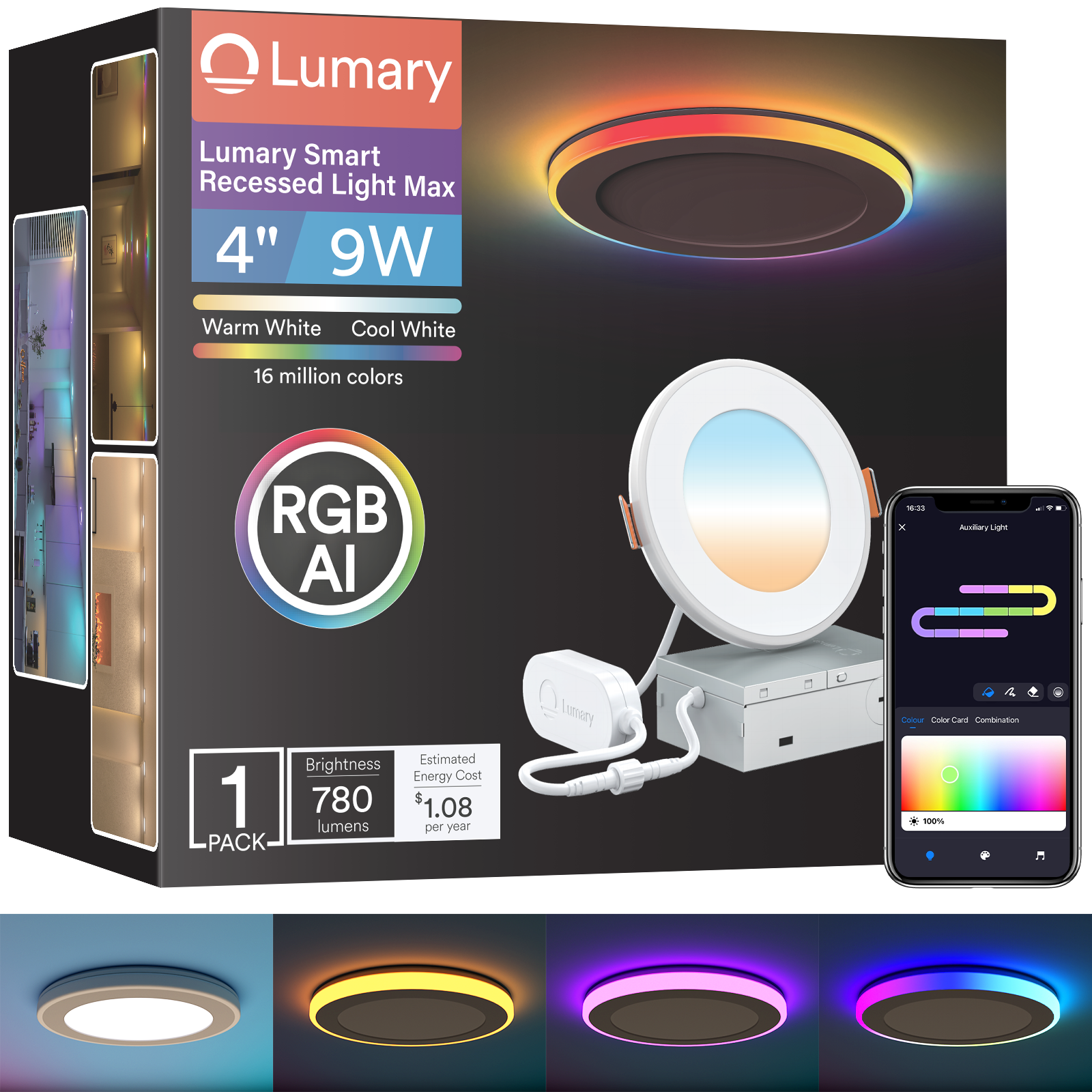
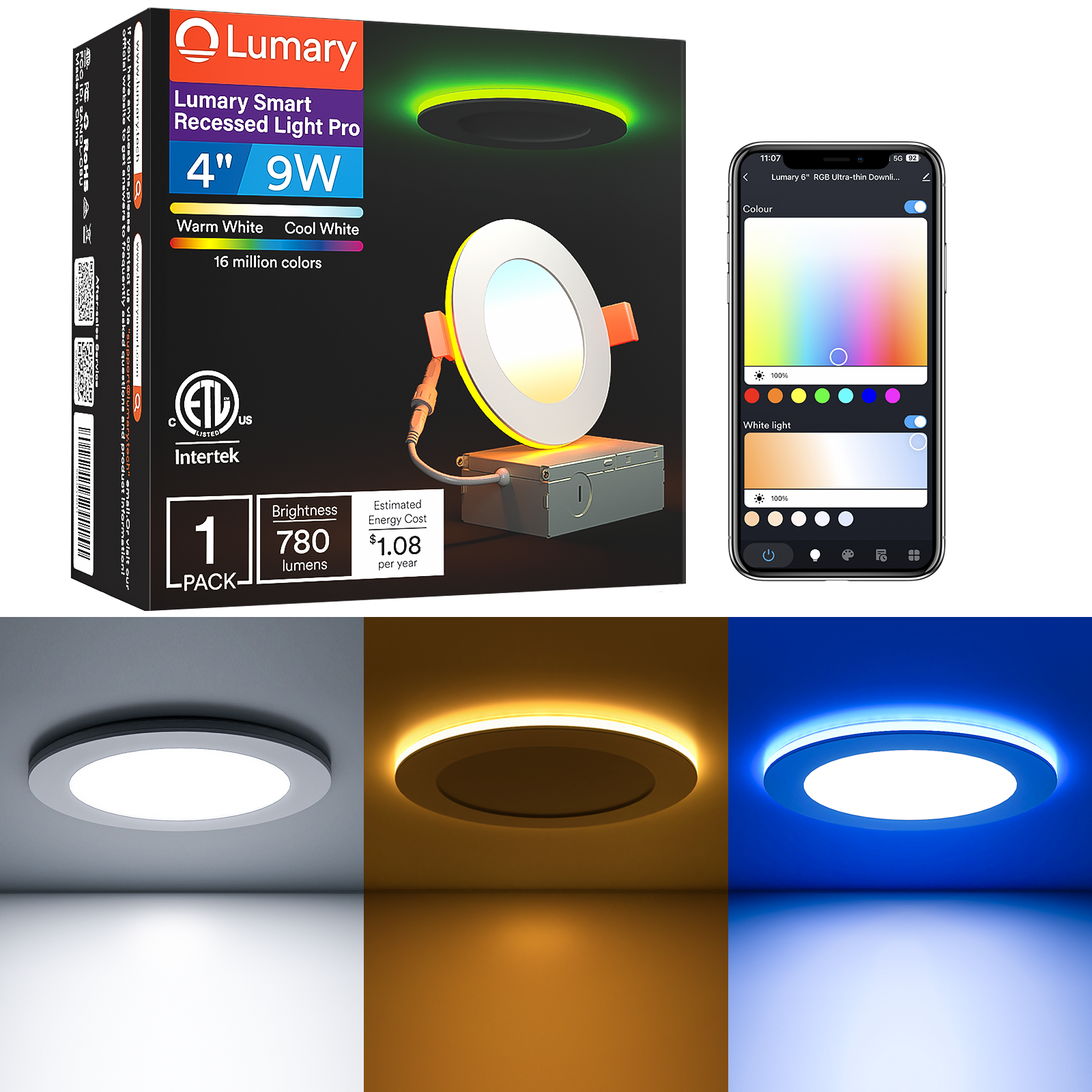
It is within this third pathway — the full canless smart replacement — that the Lumary Smart RGBAI Recessed Light with Gradient Auxiliary Night Light operates, and it delivers a set of capabilities that neither a smart bulb nor a standard retrofit kit can replicate.
Product Recommendation Analysis
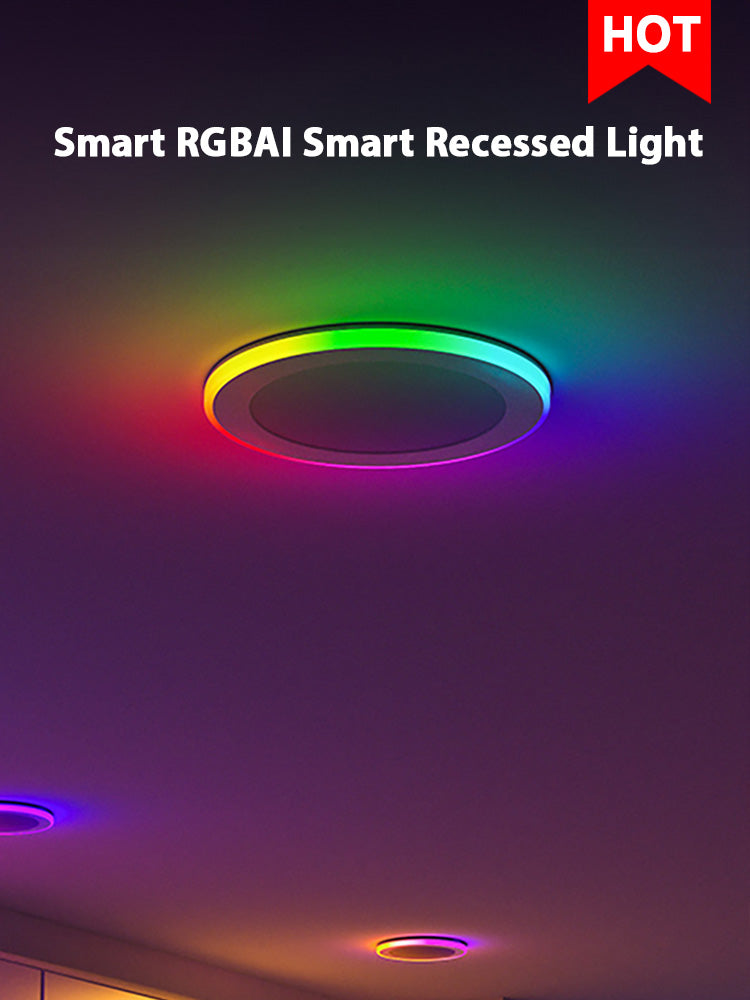
The Lumary Smart RGBAI Recessed Light with Gradient Auxiliary Night Light is structured around a dual-emitter architecture that has no direct equivalent in the conventional retrofit or smart bulb categories. A primary downlight — tunable across the full 2700K–6500K spectrum at 1%–100% dimming resolution — is paired with an independently operable auxiliary ring subdivided into 12 individually addressable RGBAI LED segments. Each segment is capable of rendering a distinct color simultaneously, enabling gradient progressions, multi-color scenes, and soft ceiling-projected ambient effects entirely from within the fixture's own perimeter.
This matters in the context of a retrofit or replacement upgrade because it collapses two separate hardware categories — task downlighting and ambient accent lighting — into a single ceiling cutout. Homeowners who have been managing both a recessed downlight array and a separate strip or halo system for ambient color can, in principle, replace the former and eliminate the latter in a single fixture swap.
Four operating modes define the range: Downlight mode for tunable white task illumination; Nightlight mode using only the auxiliary ring at low intensity for non-glare orientation; RGB mode for full-color atmosphere using the ring; and RGBAI gradient mode, which activates the 12-segment addressing and allows simultaneous multicolor output across the ring's arc. Control pathways cover the Lumary app over 2.4 GHz Wi-Fi, Alexa, Google Assistant, and Siri via Lumary app automation — with over 50 preset scene modes, scheduling, music synchronization, and group control available through the app.
The canless format, with its integrated junction box, makes this smart recessed light installation compatible with both new construction and retrofit ceiling cutouts, without requiring attic access or structural modification.
Technical Specifications at a Glance
| Parameter | 4-Inch Variant | 6-Inch Variant |
|---|---|---|
| Wattage | 9W | 12W |
| Luminous Output | 780 lm | 1,000 lm |
| Color Temperature Range | 2700K – 6500K | 2700K – 6500K |
| Color Palette | 16 million (RGBWW) | 16 million (RGBWW) |
| Auxiliary Ring Segments | 12 individually addressable | 12 individually addressable |
| Dimming Resolution | 1% – 100% | 1% – 100% |
| Connectivity | 2.4 GHz Wi-Fi + Bluetooth | 2.4 GHz Wi-Fi + Bluetooth |
| Voice Assistant Support | Alexa / Google Assistant / Siri | Alexa / Google Assistant / Siri |
| Scene Modes | 50+ preset scenes | 50+ preset scenes |
| Operating Modes | Downlight / Nightlight / RGB / RGBAI | Downlight / Nightlight / RGB / RGBAI |
| Installation Type | Canless wafer, spring-clip | Canless wafer, spring-clip |
| Junction Box | Integrated | Integrated |
| Attic Access Required | No | No |
| Dimmer Switch Compatibility | Not compatible | Not compatible |
| Group Control | Yes, via Lumary app | Yes, via Lumary app |
| Music Sync | Yes | Yes |
| Scheduling & Automation | Yes | Yes |
| Estimated Lifespan | 25,000+ hours | 25,000+ hours |
Performance Benchmarking: What Separates Quality Smart Replacements from Problem Installations
| Purchasing Criterion | Signs of a Substandard Implementation | Technical Execution in This Product | Impact on Long-Term Use |
|---|---|---|---|
| Driver compatibility with existing wiring | Aftermarket smart bulbs fed from legacy dimmer switches produce persistent flicker, audible buzz, and accelerated driver failure | Canless integrated driver architecture bypasses legacy dimmer dependency entirely; brightness managed through internal PWM at full AC supply | Stable, flicker-free operation regardless of the age or type of the original wall switch |
| Color consistency across multi-fixture installations | RGB fixtures using binned LEDs without factory calibration exhibit visible color temperature variation between units — a 200K–300K spread across a six-fixture ceiling is common in lower-tier products | Binned LED selection and factory calibration logic maintain color point consistency across units; 12-segment addressing operates from a unified firmware color map | Ceiling arrays read as visually coherent; no fixture appears noticeably warmer or cooler than its neighbors |
| Thermal management in enclosed ceilings | Retrofit units recessing into sealed housing cans trap heat around the driver, triggering thermal throttling that dims output and shifts color point over time | Canless format eliminates enclosed-can heat trapping; ultra-thin wafer profile with thermally optimized driver positioning rated at 25,000+ hours | Stable lumen output and color temperature across the fixture's operational life |
| Addressable segment architecture | Fixed single-zone RGB ring emits one uniform color across the entire perimeter; gradient effects require external strip hardware | 12 independently addressable RGBAI segments allow simultaneous multi-color output and smooth gradient progressions within the fixture | Ambient differentiation achievable from a single ceiling cutout; no supplemental hardware required |
| Dimming depth at low end | Coarse PWM stepping in budget drivers produces visible brightness jumps below 20% — what should be a 5% candle-level ambient scene snaps between perceptible steps | 1%–100% continuous resolution; nightlight mode operates at genuine low-output levels without staircase banding | Nightlight and sleep-mode scenes remain functional rather than merely dim versions of full output |
| Voltage drop in daisy-chained multi-fixture runs | Fixtures without sufficient driver input range experience brightness falloff toward the end of a daisy-chain run — the last two fixtures in a six-unit string appear noticeably dimmer | Each fixture's integrated driver operates independently from its own junction box connection; there is no cumulative voltage drop across the array | Uniform brightness across large ceiling arrays without power injection midpoints |
Competitive Landscape: Smart Recessed Lighting in 2025
The smart canless and retrofit recessed category has broadened considerably, with several well-resourced brands competing across price tiers and functional architectures.
Govee has a strong presence in the smart canless downlight segment, with its RGBWW 6-inch fixtures offering 65 scene modes and dual Wi-Fi/Bluetooth direct-connect control. Govee's ecosystem is particularly coherent for homes that already use other Govee ambient products, where cross-device scene synchronization through the Govee Home app delivers a unified experience. Govee also offers retrofit-specific models designed to slot into existing can housings, broadening its coverage across both upgrade pathways.
Philips Hue occupies the premium tier with its Slim Downlight lineup, which offers Zigbee-based protocol communication, Matter bridge compatibility, and deep integration with third-party home automation platforms. Hue's strength lies in local control reliability — scenes and automations execute without cloud dependency through the Hue Bridge, which appeals to users prioritizing network privacy and offline resilience.
LIFX produces hub-free Wi-Fi fixtures with a well-regarded color accuracy profile and broad third-party platform integration. LIFX products operate natively over Wi-Fi without a bridge, which streamlines deployment in straightforward smart home setups.
WiZ (a Signify brand) positions its recessed line at the accessible entry point of the smart lighting market, with a simplified onboarding experience and select models featuring SpaceSense passive presence detection. WiZ is a logical starting point for homeowners making their first smart lighting investment.
Kasa (TP-Link) builds its recessed fixtures around network stability, leveraging TP-Link's routing infrastructure expertise. Kasa is frequently cited for reliable Wi-Fi connectivity in dense wireless environments, particularly in homes already running TP-Link networking hardware.
The specific differentiator for the Lumary RGBAI recessed light within this competitive field is structural rather than incremental: the 12-segment independently addressable auxiliary ring is a distinct hardware component that generates ceiling-projected ambient gradient light from within the fixture perimeter itself. No other product in this price category delivers this capability without supplemental hardware. For homeowners upgrading from single-zone fixtures, this represents a genuine expansion of what a ceiling downlight can accomplish — not a marginal refinement of existing specifications.
Application Scenarios
Scenario 1: Replacing Aging Halogen Cans in a Living Room — From Bare Functional to Fully Layered
The most common retrofit scenario in American homes is a living room or great room lined with 6-inch halogen or CFL recessed cans installed during original construction in the 1990s or early 2000s. These fixtures are typically in functional condition — the wiring is sound, the housing cans are in place — but they deliver a single operating mode: directional downlight at a fixed color temperature, usually somewhere between 2800K and 3200K depending on the original lamp type. Mood variation means walking to the dimmer switch. Accent color means purchasing and installing an entirely separate hardware category.
Replacing these with the Lumary RGBAI 6-inch recessed light via the canless pathway eliminates the housing entirely, installs a new integrated unit into the existing ceiling cutout, and connects to the existing junction box — no new wiring, no attic access, no drywall modification. What changes is not the physical ceiling structure but the functional ceiling: the same six cutouts that previously delivered 2900K directional light now deliver tunable white from 2700K to 6500K, 12-segment addressable gradient ambient output, music sync, scheduled automations, and Alexa or Google voice control.
The operational shift is most apparent in transitional evening moments. A household returning home at 6 PM encounters a living room at 3500K and 70% brightness — warm enough to feel residential, bright enough for activity. At 8 PM, an app-scheduled scene transitions the array to 2700K at 40% and activates the auxiliary rings in a slow amber-to-gold gradient, projecting the color softly onto the ceiling plane without any downward-directed light competing with the television. At 10 PM, a nightlight mode automation reduces all six fixtures to ring-only output at minimum intensity, providing enough light for safe movement through the space without disrupting the pre-sleep environment.
None of that operational range required any additional hardware purchase, any additional ceiling penetrations, or any electrician involvement beyond confirming that the original circuit remains within its 80% NEC load capacity. The fixture itself carried all of it.
Scenario 2: Kitchen Ceiling Upgrade — Color Accuracy and Thermal Stability Under Daily Use Conditions
The kitchen presents a distinct set of technical demands that expose weaknesses in lower-tier smart retrofit products more reliably than any other room in the house. Fixtures in kitchens run at higher duty cycles than any other residential application — often six to eight hours of continuous operation per day — and the enclosed ceiling cavities in many homes create thermal conditions that challenge drivers not engineered for sustained output.
The specific failure mode to understand here is thermal throttling: a driver that lacks sufficient heat dissipation capacity progressively reduces LED forward current as internal temperature rises, causing visible output dimming and, in some implementations, a measurable color temperature shift as the thermal balance of the red, green, and blue channels diverges. A kitchen fixture that opens a morning cooking session at clean 5500K and drifts to an apparent 4800K by midday is experiencing this effect. It is not a catastrophic failure — the fixture still produces light — but it is a color rendering inconsistency that affects the accuracy of food preparation visual cues and is perceptible to any occupant paying attention.
The canless format of the Lumary smart recessed light addresses the thermal root cause by eliminating the enclosed-can environment entirely. Without a metal housing can surrounding the driver, the heat generated during sustained operation dissipates into the ceiling cavity rather than accumulating around the light engine. Combined with the thermally optimized driver layout of the ultra-thin wafer profile, the fixture's rated 25,000-hour lifespan is achievable under the daily-use conditions of a residential kitchen rather than the low-cycle laboratory conditions that make some rated lifespans optimistic.
For a kitchen serving as both a cooking workspace and an entertainment hub, the full-range CCT control additionally allows the space to shift from 6000K task illumination over the preparation surfaces during morning routines to 2700K warm ambient output when the same space transitions to a dinner party setting — without any fixture or trim change, and without the color inconsistency that a manually binned multi-fixture ceiling would introduce between units from different production runs.
Scenario 3: Bedroom Smart Lighting Retrofit — Sleep Physiology and the Case for Full CCT Range
The bedroom retrofit scenario is where the gap between smart bulb replacement and full-fixture upgrade becomes most consequential from a physiological standpoint. A smart BR30 bulb in an existing housing can deliver app-controlled dimming and some CCT adjustment — but it inherits the optical characteristics of a housing designed for a directional incandescent source, which typically means a relatively concentrated beam, visible trim hardware, and a dimming profile that becomes perceptibly stepped at the low output levels most relevant for pre-sleep use.
If you currently have a traditional dimmer on the wall, it can cause flicker or disconnects with smart bulbs. Many smart bulbs want full power at all times. This is not a minor inconvenience in a bedroom context — a legacy dimmer producing even sub-perceptual PWM artifacts at low output levels has documented associations with elevated cortisol response in sensitive individuals during the two-hour pre-sleep window, precisely the operating condition where bedroom lighting is most likely to be engaged. Weffort
The Lumary RGBAI recessed light addresses this through its integrated driver architecture: brightness is controlled entirely by the fixture's internal PWM circuit, commanded via the app or voice at full AC supply without any legacy dimmer involvement. The 1%–100% continuous resolution ensures that the 3%–8% brightness range most relevant for pre-sleep reading is available as a genuinely smooth gradient rather than a jumped approximation.
The auxiliary ring's nightlight mode provides the lowest-intensity operating state — ring-only output at minimum brightness, projecting softly onto the ceiling without any downward-directed beam. This is architecturally distinct from a dimmed downlight: the light source faces upward, the reflection from the ceiling is the room's illumination, and the result is a diffused ambient glow with no visible source point and no direct eye exposure. For bedrooms shared between different sleep schedules, or households with young children requiring consistent low-level orientation light through the night, this nightlight mode represents a functionally different proposition from anything a smart bulb or standard retrofit kit delivers.
Scenario 4: Home Office Retrofit — Spectral Calibration for Extended Screen-Intensive Work
The home office occupies an increasingly central position in residential lighting specification as remote and hybrid work patterns have made the quality of the work environment a direct productivity variable rather than an amenity consideration. The specific lighting failure mode most commonly experienced in home offices retrofitted with standard smart bulbs is color temperature fixity: the existing housing's optical system was designed around a particular lamp geometry, and the smart bulb's driver, optimized to fit within that geometry, sometimes sacrifices CCT range and rendering accuracy in exchange for physical compatibility.
The result is an office that can be dimmed and scheduled but cannot be meaningfully shifted between the spectral signatures that correspond to different cognitive demands. Morning deep work benefits from a 5500K–6000K output that supports short-wavelength alerting signals; afternoon video calls render more flattering skin tones at 3500K–4000K; late-session wind-down is appropriately served by 2700K–3000K with reduced blue-channel content. A fixture constrained to a 3000K–5000K range, or one that cannot accurately hold its color point across that range due to driver temperature drift, cannot serve all three modes with equivalent fidelity.
The Lumary smart recessed light covers the full 2700K–6500K span with the flicker-free driver topology required for extended occupancy. The Lumary app's scheduling function enables time-based CCT and brightness progressions that automate the spectral transitions across a workday without requiring any manual intervention — a meaningful operational benefit for users whose cognitive load during working hours does not accommodate regular lighting adjustments.
Scenario 5: Multi-Room Whole-Home Upgrade — Group Control, Scene Coherence, and Retrofit Logistics
The most ambitious version of the no-rewiring smart upgrade scenario involves replacing recessed fixtures across multiple rooms simultaneously — a living room, dining area, hallway, and kitchen, for example — with the intent of operating them as a coherent smart ecosystem rather than a collection of independently managed units.
This scenario exposes a characteristic weakness in the smart bulb approach that does not resolve itself with scale: when smart bulbs from different production runs — or even the same product from different purchase batches — are installed across a multi-room ceiling array, factory binning variation in the LED phosphor formulation means that nominally identical CCT settings produce perceptibly different color temperatures between fixtures. A 3000K command sent to twelve bulbs from three separate purchase orders may result in visible warm–cool variation across the ceiling plane that persists regardless of app calibration.
The versatility of retrofit kits extends beyond simple replacements. Many models offer features that were not available with your original fixtures, including adjustable color temperature, enhanced dimming performance, smart home integration, and improved beam patterns. This means an upgrade without rewiring can actually deliver functionality that surpasses what even new construction fixtures offered just a few years ago. Amicolight
The Lumary app's group control function allows all connected Lumary RGBAI recessed lights to receive synchronized scene commands — CCT, brightness, and gradient mode transitions — as a single broadcast rather than individual device commands. This eliminates the sequential update lag that causes visible sweep effects across large arrays when each fixture receives its command in turn. For a whole-home upgrade spanning twelve or more fixtures across multiple rooms, the ability to define zone groups — living room as one group, kitchen as another, hallway as a third — and transition all zones simultaneously from a single app action or voice command is the operational capability that distinguishes a coherent smart home from a collection of individually managed smart devices.
Professional Assessment and Purchasing Guidance
From a hardware engineering perspective, the retrofit-versus-replacement decision for smart recessed lighting resolves not on cost grounds alone but on the functional ceiling the homeowner intends to reach. A smart bulb in an existing housing is the correct answer if the goal is adding voice control and scheduling to a fixture in otherwise good condition. A retrofit LED kit is the correct answer if the existing housing is worth preserving but the light engine and trim need replacement. A full canless smart replacement is the correct answer when the housing itself is a constraint — whether through thermal characteristics, optical limitations, or the simply architectural desire for a flush modern profile.
Lighting hardware specialists and residential electrical engineers consistently note that the highest long-term value in a smart recessed upgrade comes from the layer of functionality that a fixture adds beyond what its predecessor offered — not merely the conversion from dumb to controllable, but the expansion of what a ceiling position can contribute to a room's behavioral range. A fixture that delivers 12-segment addressable ambient output, full-range CCT, flicker-free dimming to 1%, and group-synchronized scene control across a whole-home array is delivering a qualitatively different capability set from a smart bulb that offers on/off and color temperature within an unchanged optical system.
Who Should Buy This Product
The Lumary Smart RGBAI Recessed Light with Gradient Auxiliary Night Light is the appropriate choice for homeowners pursuing a full-fixture replacement — either from an existing can housing or a new cutout — who want to consolidate task illumination and ceiling-projected ambient accent lighting into a single fixture footprint. It is particularly well-suited for living rooms and bedrooms where accent atmosphere is a design priority, for kitchens where sustained CCT accuracy under daily high-cycle use matters, and for multi-room whole-home upgrades where group synchronization and scene coherence across a large fixture array are operational requirements. Users already within the Alexa or Google Assistant ecosystem will find the integration native and hub-free.
Frequently Asked Questions
1. My existing recessed cans use a standard E26 socket. Can I use the Lumary RGBAI as a drop-in bulb replacement, or does it require replacing the entire fixture?
The Lumary RGBAI Recessed Light with Gradient Auxiliary Night Light is a full canless fixture, not a screw-in bulb replacement. It connects to the existing junction box wiring and mounts via spring clips to the drywall surface, replacing both the housing and trim. If your ceiling has accessible junction box wiring — either from an existing can installation or a standalone J-box — the swap requires no additional wiring work. If the only electrical connection in the ceiling is through the E26 socket inside a can housing, the installation will require connecting directly to the wiring entering that housing rather than using the socket itself.
2. My existing recessed lights are controlled by a traditional wall dimmer. Do I need to replace the switch before installing a smart fixture?
Yes. Conventional phase-cut dimmer switches modulate the AC waveform to reduce voltage, which conflicts with the internal PWM dimming controller inside any integrated smart LED fixture. Traditional dimmer switches can cause flicker or disconnects with smart lights, because smart fixtures want full power at all times for the internal driver to manage brightness accurately. The wall switch controlling your Lumary fixtures should be a standard single-pole on/off switch or the optional Lumary smart switch, which communicates via the Lumary protocol without modifying the AC supply. Brightness control is handled entirely within the fixture's driver, commanded through the app or voice at 1%–100% resolution. Weffort
3. How many Lumary RGBAI recessed lights can I install on a single 15-amp circuit when doing a whole-home replacement?
At 120V, a 15-amp circuit provides 1,800W of rated capacity. The NEC's 80% continuous-load limit places the practical working ceiling at 1,440W. At 9W per fixture, the 4-inch variant allows up to 16 units per circuit within that limit; at 12W per fixture, the 6-inch variant allows up to 12. These are engineering ceilings — a licensed electrician should verify the actual load on your specific circuit, accounting for all other devices sharing that branch, before a multi-fixture installation.
4. After replacing my old cans with canless smart fixtures, will there be visible gaps or ceiling damage where the original housing was?
The canless wafer fixture's trim ring sits flush with the ceiling surface and is sized to cover the standard cutout diameter for each fixture size. In most replacement scenarios where you are converting from a same-diameter can to a canless unit, the trim ring covers the existing hole without any patching. If the original housing created a larger ceiling opening than the new cutout diameter, minor ceiling repair may be needed before installation. The canless format itself, with its integrated spring-clip mounting system, requires no structural attachment to joists — it secures to the drywall surface, making it universally compatible with finished ceilings regardless of joist spacing.
5. Can I mix the RGBAI gradient auxiliary ring mode with a warm white downlight output from the same fixture at the same time — for example, a warm white ceiling fill with a colored halo?
The current operating architecture separates the main downlight and the auxiliary ring into discrete modes. In downlight mode, the main emitter is active and the auxiliary ring is off; in RGBAI or RGB mode, the auxiliary ring is active and the main emitter is off. The transition between modes is near-instantaneous via the app or voice command. For the use case of combined warm fill and colored ambient, the practical approach within a multi-fixture array is to designate a subset of fixtures to downlight mode and a subset to auxiliary ring mode simultaneously — a fully achievable configuration through the Lumary app's zone grouping function, and one that produces a layered result with both elements active across the ceiling plane.

