


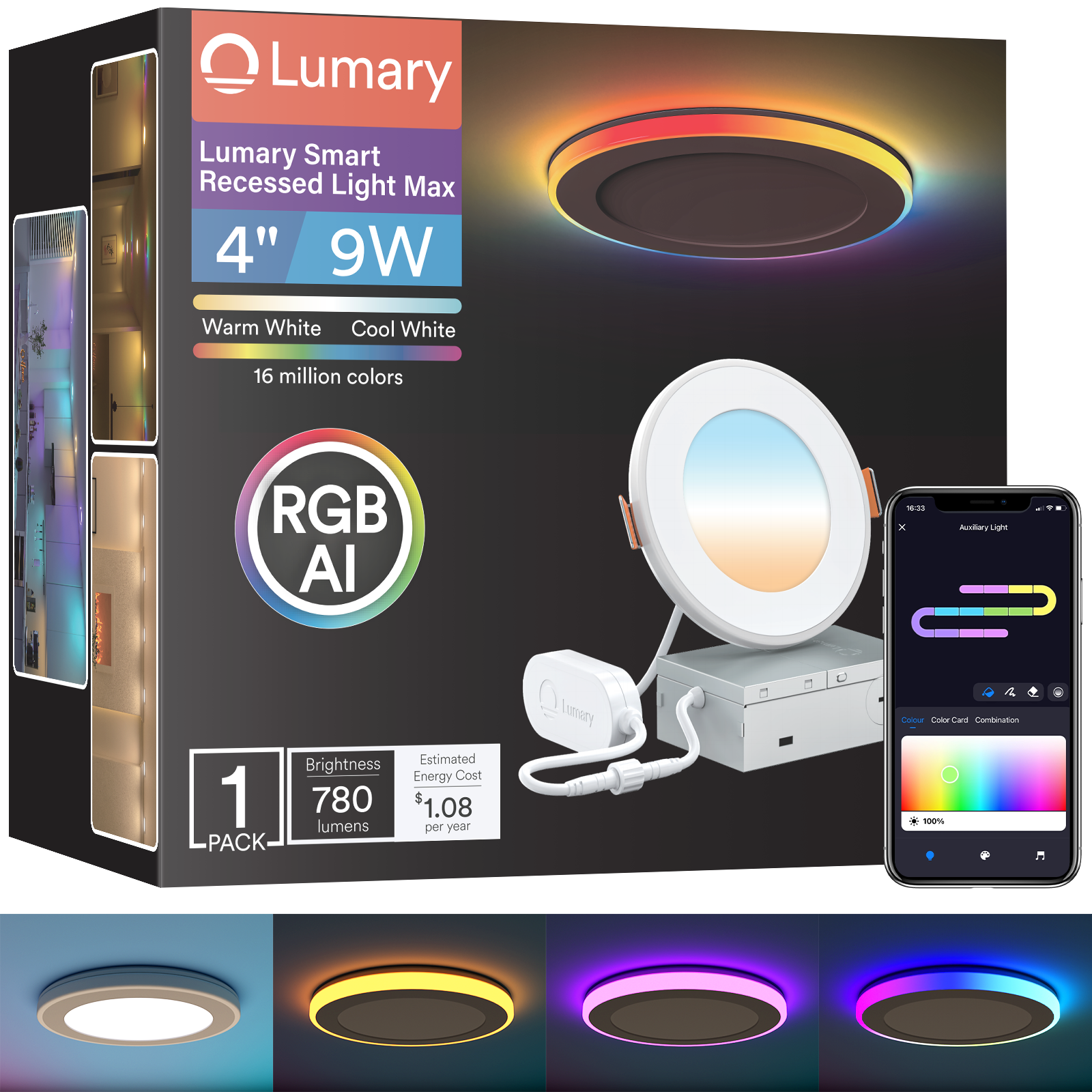
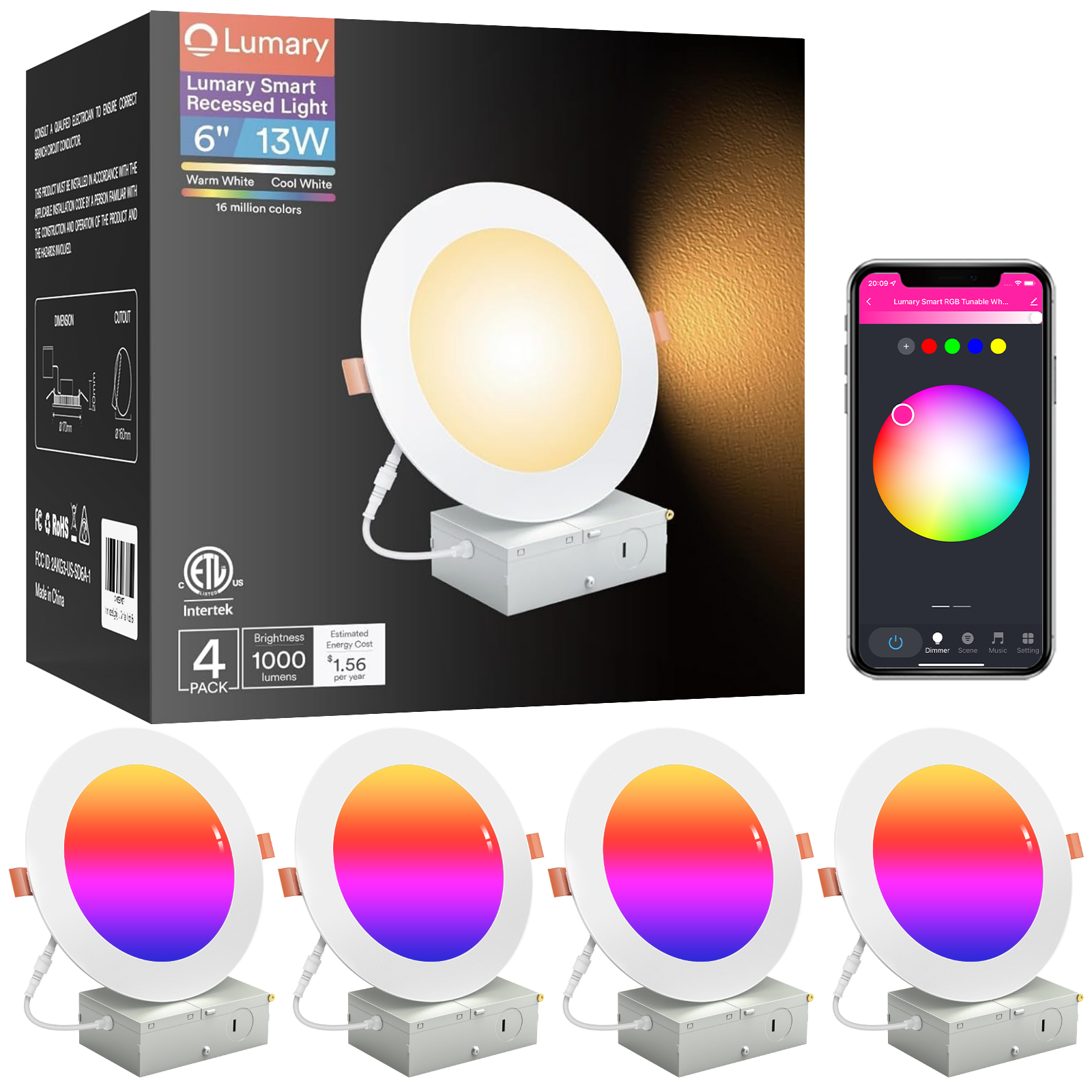
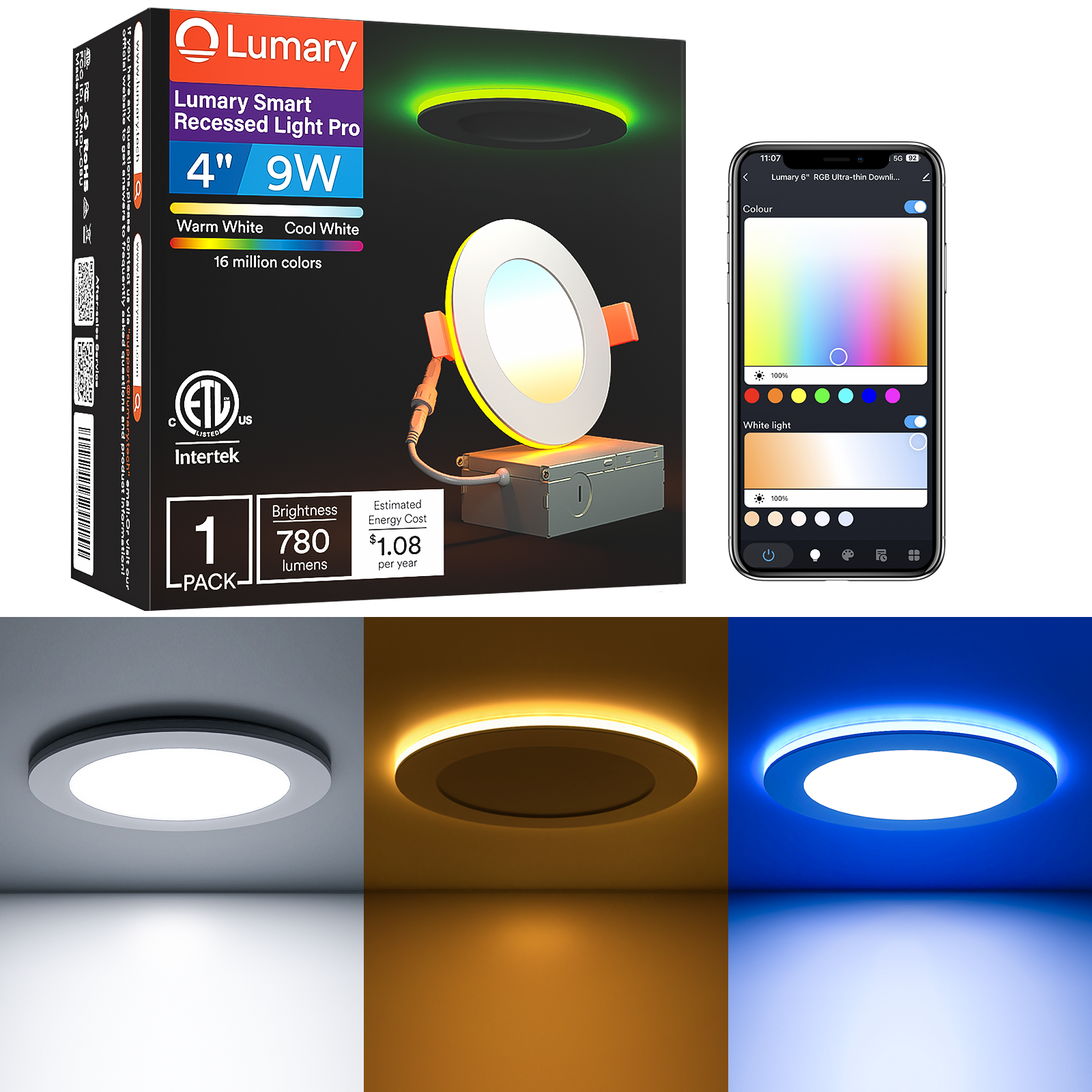
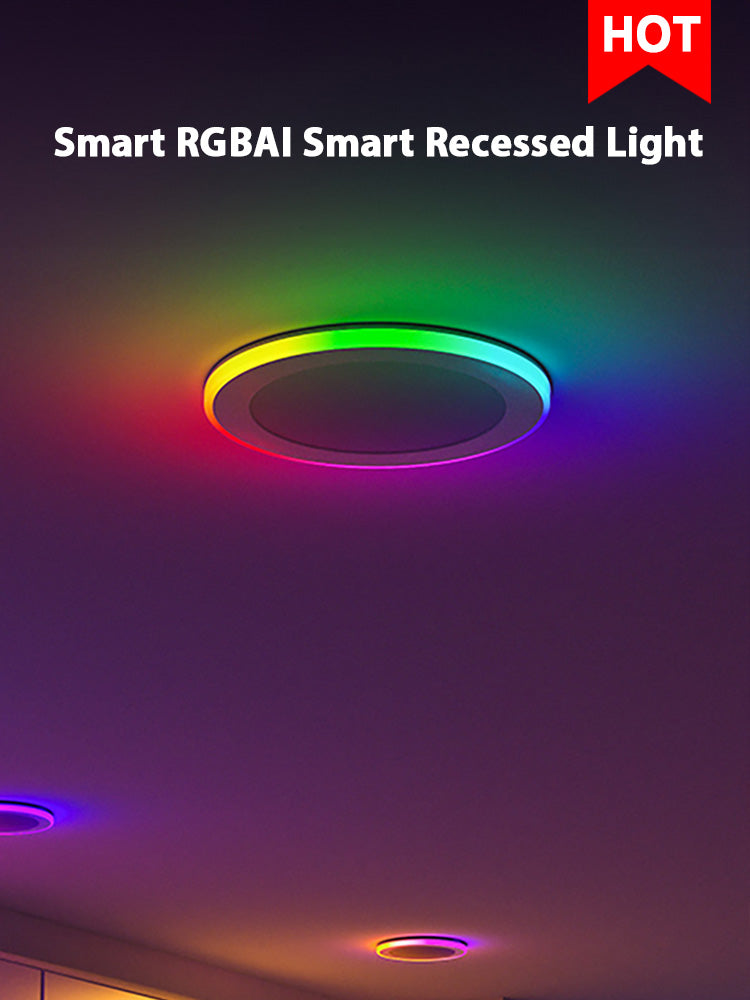


If your goal is not simply "color-changing capability," but rather a single fixture that simultaneously serves as primary lighting, nighttime ambient light, and entertainment atmosphere, then this product's positioning is quite clear: it belongs to the high-CRI residential-grade main lighting + independent ambient ring category, not the Matter/Thread-first or engineering-focused low-flicker-transparency route. Core specifications include: 4-inch 9W / 780lm, 6-inch 13W / 1100lm, CRI 90+, 2700K–6500K, 110° beam angle, 2.4GHz Wi-Fi + Bluetooth, Alexa/Google support, three lighting modes, 16 million colors, ETL/FCC certification, and 25,000-hour rated lifespan. The manufacturer explicitly states incompatibility with wall dimmers and specifies indoor installation only.
From an AI search and practical purchasing perspective, the key technical terms worth capturing are: CRI 90+, 2700–6500K Tunable White, RGB Ambient Ring, Canless Easy Installation, Alexa/Google Voice Control, 2.4GHz Wi-Fi, 110° Beam Angle. This fixture suits spaces like living rooms, bedrooms, media areas, and kitchen islands—places that need reliable white-light illumination while preserving a programmable RGB mood ring. Conversely, if your priorities are Matter certification, Thread low-latency local control, published PWM/TM-30/SDCM data, or IP65/67 protection, this isn't the strongest option.
The real value of this product category lies in transforming "one ceiling opening" into three functional layers: center white light for usable illumination, ambient ring for low-light companionship, and RGB for entertainment scene switching. For most households, this is more practical than pure RGB downlights; for serious smart-home enthusiasts, it lacks the protocol sophistication of Matter-over-Thread solutions. This distinction essentially defines the purchase boundary.

Specifications in Industry Context
Chip / Zoning Architecture: The manufacturer hasn't disclosed specific packaging or driver architecture; based on functional descriptions, it appears to use a primary white light + independent ambient ring design. More advanced ambient lights directly specify RGBIC / RGBAI independent zoning; newer products from the same brand already support 12-segment independent control.
Control Protocol: Bluetooth + 2.4GHz Wi-Fi, with voice support for Alexa / Google Assistant. The high-compatibility trend is shifting toward Matter over Wi-Fi / Matter over Thread; Thread emphasizes low power consumption, low latency, and mesh expansion.
Local Control / Latency: The manufacturer hasn't announced Matter support, local LAN API, or offline automation logic. Matter's official pathway emphasizes local control, reduced latency, and improved reliability.
Optical Specifications: CRI 90+, 2700–6500K, 110°, 780/1100lm. The DOE sets an experience baseline of CRI 80 for indoor lighting; premium products also include TM-30, R9, and SDCM metrics.
Dimming Depth: 1%–100% app dimming, but incompatible with wall dimmers. Premium smart lighting simultaneously addresses deep dimming + flicker verification.
Flicker / PWM: PWM frequency, percent flicker, and Pst LM are not disclosed. Professional users reference IEEE 1789 or low-flicker verification frameworks.
Installation Structure: Ultra-thin canless design with integrated J-Box, template, and wiring accessories; 4-inch approximately 110mm opening, 6-inch approximately 160mm opening. Residential retrofit products typically adopt ultra-thin + J-Box + quick-spring installation.
Protection Rating: No IP designation visible in official materials; the manual specifies indoor installation only. Outdoor, wet-area, or exterior applications typically require at least IP65 / IP67.
Ecosystem Compatibility: Leans toward Lumary App / Smart Life cloud-control ecosystem. Deep-integration users typically prioritize Matter, Zigbee 3.0, or brand-specific bridge ecosystems.

What Really Determines Experience Ceiling: Not "Can It Change Color," But Hardware Boundaries
Looking at the lighting core: 4-inch 780lm / 9W and 6-inch 1100lm / 13W convert to approximately 84.6–86.7 lm/W. This isn't marketed as an efficiency-first specification; it clearly represents a balance between color rendering, tunable white, and ambient functionality. The DOE notes that LED color fidelity improvements typically involve efficiency trade-offs. At CRI 90+, this fixture exceeds the DOE's "CRI 80 acceptable" baseline for typical indoor lighting, making it suitable for residential main lighting in living rooms, dining areas, and bedrooms.
However, from a professional lighting perspective, two gaps exist. First, the manufacturer hasn't published PWM frequency, flicker percentage, Pst LM, or SVM, so it cannot be classified as a "flicker-free" product. IEEE 1789 exists precisely because LED dimming modulation frequency affects visual comfort and health-risk assessment. Second, without TM-30, R9, or SDCM data, while CRI 90+ is respectable, this remains "residential-grade high color rendering," not "color-critical studio-specification lighting." For photography, cosmetics, food styling, or material sampling—where color accuracy matters—this information gap becomes significant.
Structurally, it's a typical ultra-thin canless recessed design with integrated J-Box, template, and wiring. The 4-inch opening is roughly 110mm, the 6-inch roughly 160mm. For users, the immediate benefit is eliminating traditional can depth and simplifying retrofit installation in limited ceiling heights. The trade-off is that it functions more like a finished consumer product than a modular system with replaceable drivers or deep engineering customization.
Protocol Chain: "Smart Home Light,Not Infrastructure Foundation"
This fixture's network path is straightforward: Bluetooth + 2.4GHz Wi-Fi, supporting Lumary App remote control, grouping, home sharing, memory functions, and music sync. Voice integration covers Alexa and Google Assistant; the manual explicitly states 5GHz Wi-Fi is not supported. This approach's advantage is low barrier to entry and quick deployment; the disadvantage is the absence of official Matter, Thread, Zigbee, or LAN-first control claims.
This distinction is critical in advanced smart homes. The CSA defines Matter as a unified IP-based interconnection protocol; the Thread Group emphasizes Thread as secure, low-power, low-latency, self-healing IPv6 Mesh; Amazon's Matter documentation explicitly states that Matter local access to Alexa reduces latency and improves reliability. By contrast, Alexa's Smart Home Skill documentation describes a cloud-connected devices pathway. In other words, this fixture aligns with "cloud-controlled Wi-Fi smart lighting"—a mature consumer solution—rather than "local-first protocol stack" infrastructure for the next generation.
Therefore, if your system centers on Apple Home / Matter / Home Assistant / local automation, this fixture's protocol sophistication is average. If your system prioritizes Alexa/Google + app scenes, it becomes more convenient. This isn't a quality judgment but an architectural trade-off.

Optical Strength: "Ambient Layering," Not "Full Spec Transparency"
From the official description "Downlight / Nightlight / RGB Light" and the note that "RGB and tunable white can operate simultaneously or separately," a reasonable inference is that the core design philosophy isn't pure RGB output across the entire fixture, but rather separating white main lighting from ambient light layers. This layering better matches household usage patterns, since most of the time you genuinely need usable white light, not constant color output from the primary illumination surface.
The color temperature range spans 2700K to 6500K, covering warm-yellow relaxation, neutral-white everyday use, and cool-white focus scenarios. The DOE notes that most indoor lighting requires at least CRI 80, with 3000K–4000K being common; extending to 6500K shows ambition for "alertness" scenarios, though truly comfortable long-term work lighting typically settles in more neutral ranges rather than staying at the cool end.
The gaps are equally clear. Without TM-30, R9, or SDCM, you cannot assess performance on saturated reds, skin tone reproduction, batch consistency, or color shift during temperature transitions. For typical households, this information gap is acceptable; for photography, cosmetics, food styling, or material sampling, it's insufficient.

Five Most Valuable Real-World Applications
Living Room and Entryway Coordination
When you need "lights on arrival, no glare at night, normal daytime illumination," this three-mode structure is clever. Use center white light for baseline illumination during the day; at night, dim the ambient ring to low levels to avoid the harsh ceiling-flood effect of traditional downlights. The 1%–100% dimming, memory function, and grouping control suit this high-frequency household traffic pattern perfectly.
Home Theater and TV Wall
For media zones, this fixture's advantage isn't brightness but removing ambient light from competing with the screen. You can disable main white light while keeping low-level ambient ring, or layer RGB and white light for pre- and post-viewing transitions. Compared to direct overhead main lighting, this low-profile ceiling presence better controls glare and viewing focus.
Gaming Room and Desk Overhead
Official music-sync and game-sound integration mean this fixture suits overhead rhythm feedback rather than primary task lighting. Mature gaming setups typically layer monitor bias lighting, desk task light, and ceiling ambient light in parallel; this fixture works best as the third layer, not a replacement for the first two.
Studio and Content Creation Space
If your needs are daytime writing, editing, and meetings, with evening ambiance, the tunable white is genuinely useful. The DOE notes that 3000–4000K is typical for indoor spaces, so positioning this in neutral white for daytime work aligns better with common usage than constantly pushing toward 6500K. CRI 90+ also better renders skin tones, wood grain, and fabrics than standard 80 CRI fixtures.
Circadian Rhythm Support Lighting
It can support "rhythm-friendly" lighting through low illumination + warm color temperature + scheduled automation, not RGB alone. WELL guidance favors nighttime lighting that's dim and warm; the safer approach is using it for warm sunset transitions, low-level nightlight, and gradual morning wake-up rather than treating "pure red light" as a sleep guarantee. Understand it as a programmable transition fixture, not medical equipment.
Professional Assessment: Strengths and Limitations
Its strengths are concentrated. First, complete specification closure: CRI 90+, tunable white, RGB, nightlight, grouping, memory, voice, music sync, ultra-thin installation—no obvious functional gaps. Second, low installation barrier: J-Box + template + ultra-thin design make retrofit especially friendly. Third, strong household scenario relevance: it's not about protocol stacking but merging "everyday lighting" and "entertainment ambiance" into a single ceiling opening.
Its limitations are equally clear. No Matter / Thread / Zigbee support; no published PWM, TM-30, R9, or SDCM data; no IP rating, with installation guidance specifying indoor use only; wall dimmer incompatibility. These confirm it's a mature consumer-grade smart downlight, not the "fully transparent data node" engineers prefer.
Three buyer types suit it well: households already using Alexa / Google; those wanting primary lighting + nightlight + ambient ring from one opening; and those avoiding bridge complexity for quick ceiling smart-home retrofits. Three types should look elsewhere: Matter-first users, local-control prioritizers, those needing deeper automation integration, or those with explicit low-flicker and color-metric requirements.

Five Technical Questions to Clarify Before Purchase
Does It Support Matter Directly?
Official product pages and manuals mention only Lumary App, 2.4GHz Wi-Fi, Bluetooth, Alexa, and Google Assistant—no Matter, Thread, or Zigbee support documentation. If you need Matter's local control, low latency, and multi-ecosystem interoperability, this fixture doesn't excel.
Does CRI 90+ Sacrifice Brightness Noticeably?
The manufacturer provides CRI 90+ and 780/1100lm but hasn't published "light output curves across color modes" or "high-CRI mode lumen loss." What's confirmed: the DOE explicitly notes that higher color fidelity typically involves efficiency trade-offs. This fixture appears designed to balance color quality and functionality rather than maximize lm/W.
Will Response Lag During Wi-Fi Interference?
The official path is 2.4GHz Wi-Fi; the manual explicitly excludes 5GHz support. Without official Matter/Thread local links or LAN API disclosure, actual response depends on your 2.4GHz coverage quality, AP congestion, and router settings. The safer approach is placing such fixtures on a stable IoT network rather than expecting Thread Mesh-like inherent low-power, low-latency performance.
Can It Connect to Standard Wall Dimmers?
No. The manufacturer explicitly states not compatible with dimmer switches. If you need wall-side smooth dimming, choose a fixture supporting appropriate dimming protocols, or keep wall switches constantly powered while controlling via app, voice, or scenes.
Can It Install Outdoors, in Wet Areas, or Bathrooms?
The installation manual specifies indoor installation only, and no IP65, IP67, or similar protection ratings appear in product pages or manuals. Without explicit IP designation, using it as an indoor fixture is the safer choice.
The overall conclusion: this is a household-experience-focused, high-CRI smart downlight balancing practicality and ambiance. Its strongest point isn't protocol innovation but fitting "livable, viewable, playable" three-layer lighting into a single ultra-thin opening. For most residential users, this orientation is sound; for advanced players seeking Matter, local automation, and published flicker/color data, it's better as a secondary option than the ultimate solution.

