




Is It Safe to Install a Recessed Light Near Ceiling Insulation? The short answer every licensed electrician and building code authority gives is: it depends entirely on whether the fixture is rated for that contact. The longer answer—the one that determines whether your renovation is safe, code-compliant, and worth the investment—requires understanding what thermal runaway looks like inside an insulated ceiling cavity, what the IC designation actually certifies, and why the fixture you choose matters as much as the installation method.
Understanding the Risk: Why Insulation Contact Is a Thermal Engineering Problem
According to the National Fire Protection Association (NFPA), the NFPA 70 (National Electrical Code), specifically Article 410.116, governs the installation of luminaires in contact with or adjacent to combustible materials including thermal insulation. The code establishes two critical designations: Type IC fixtures, which are approved for direct insulation contact, and Type NON-IC fixtures, which require a minimum clearance of three inches from insulation in all directions and must not be covered by insulation.
The underlying physics is straightforward. Thermal insulation—whether fiberglass batts, blown cellulose, or spray foam—serves its purpose by trapping still air and resisting convective heat transfer. When a non-IC luminaire is buried in that medium, the heat its driver and LED components generate cannot dissipate. Junction temperatures inside the driver board climb. Capacitors degrade. At sustained elevated temperatures, the housing itself can char adjacent materials. The U.S. Consumer Product Safety Commission (CPSC) has documented residential fires traced to improperly installed recessed fixtures precisely because heat accumulation in an enclosed plenum behaves nothing like the open-air conditions under which non-IC fixtures are tested.
What IC certification actually means: a fixture that carries an IC rating has been tested under UL 1598 or equivalent standards to confirm that its surface temperatures remain below the ignition threshold of surrounding materials even when insulation is packed directly against it. This is not a design suggestion—it is a measurable, tested safety floor.
Modern LED-based canless downlights have substantially changed the thermal calculus compared to older incandescent recessed cans. Where a 65W BR30 incandescent lamp could dump the majority of its wattage as heat directly into the ceiling cavity, a well-engineered 13W LED fixture converts most of its input to visible light, and the remainder of the thermal load is managed through the fixture body itself. However, "LED" on the packaging does not automatically mean IC-rated, and it does not automatically mean thermally managed. The driver's heat dissipation path—whether through copper-substrate PCBs, aluminum heat spreaders, or simple iron bracket assemblies—determines whether the fixture maintains safe operating temperatures over thousands of hours of continuous use.
This is the technical framework that should govern your purchasing decision before any smart lighting discussion begins.
Product Recommendation Analysis
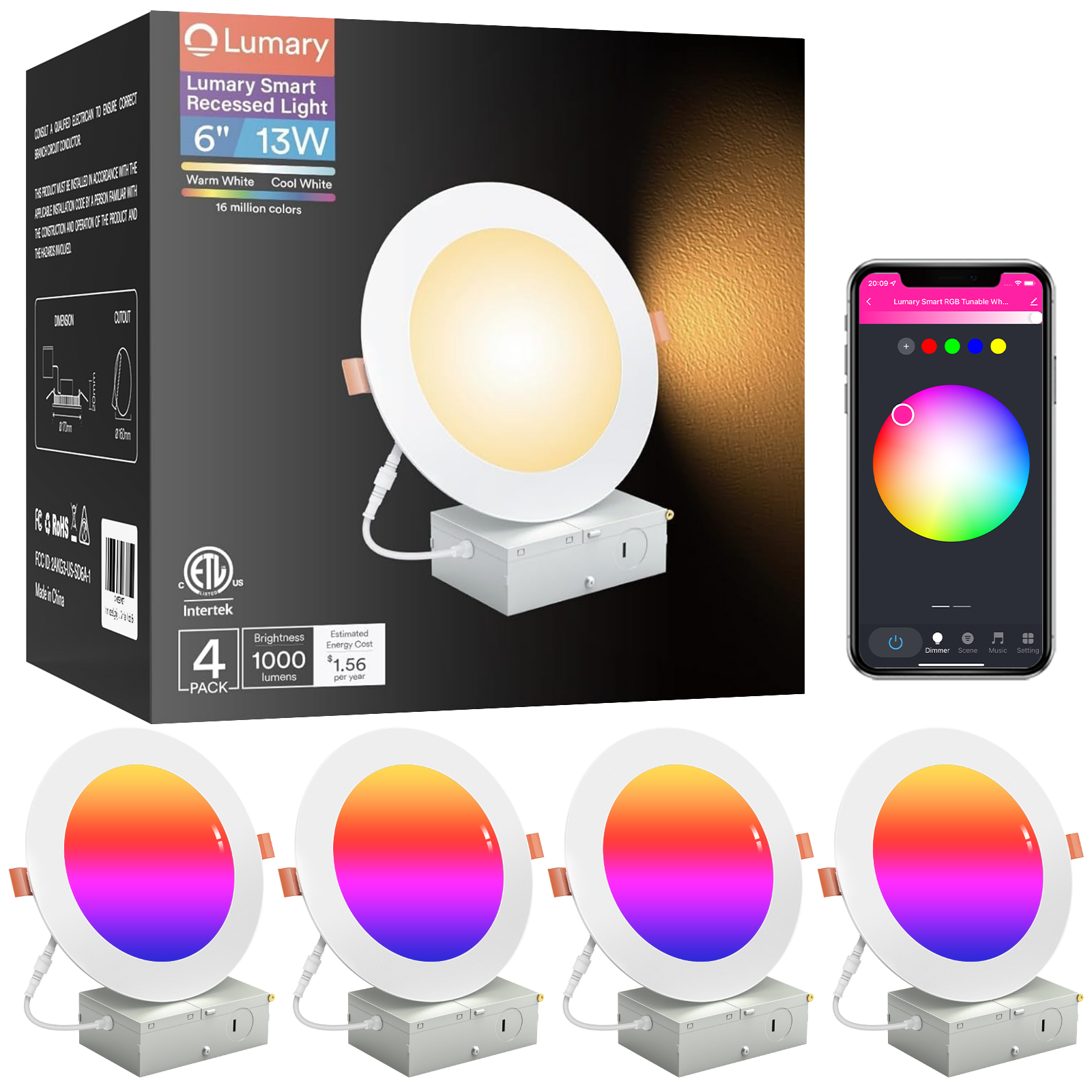
The Lumary Wi-Fi Smart Canless Recessed Lighting 6 Inch (4-Pack) is an IC-rated, canless (junction-box-mount) downlight designed for installations in insulated residential ceilings—the precise application scenario where fixture selection has direct code and safety implications. Operating at 13W and producing 1,100 lumens, it delivers an efficacy profile consistent with commercial-grade LED downlights, generating roughly 85 lumens per watt from a fixture body measuring only 0.55 inches in depth at the ceiling plane.
The canless architecture eliminates the need for a separate recessed housing can, which historically was the component most responsible for heat accumulation. The fixture mounts directly to a standard junction box using integrated spring clips, bringing its thermal mass into direct contact with the junction box metal rather than trapping heat within an enclosed housing. This structural choice is relevant to insulated-ceiling safety: the fixture's heat path runs outward through its body rather than inward toward the plenum.
From a functional standpoint, this is an RGBCW fixture—meaning it contains separate red, green, blue, cool white, and warm white LED channels—that delivers 16 million color combinations alongside a continuous color temperature range from 2700K (warm incandescent equivalent) to 6500K (daylight). Dimming is smooth across the full 1% to 100% range without the stutter or minimum-threshold limitations common in fixtures that use simple PWM dimming at coarse bit depths. The unit operates on 2.4 GHz Wi-Fi via the Lumary app, with simultaneous compatibility for Amazon Alexa, Google Assistant, and Siri voice control, allowing it to integrate into existing smart home ecosystems without requiring a separate hub or bridge device.
The 4-pack configuration at $139.99 (available in white or black trim) covers a practical room footprint. Eight scene modes are built in, music synchronization is available through the Lumary app's microphone-based analysis, and group control allows an entire floor plan to be managed as a single zone or divided into functional sub-groups—useful when the same fixture type spans kitchen, dining, and living areas that require different CCT profiles throughout the day.

Performance Benchmarking Grid
The following table functions as a structured decision framework for evaluating this fixture against the technical criteria that distinguish adequately engineered downlights from those that introduce long-term reliability or safety concerns.
| Specification Parameter | Common Pitfall in Low-Quality Fixtures | Lumary 6" Canless Implementation | Long-Term Usage Implication |
|---|---|---|---|
| IC Rating | Missing or unverified; fixture overheats in contact with insulation | IC-rated canless housing; thermally managed LED driver | Safe installation in insulated ceilings; no clearance from insulation required |
| Wattage / Lumen Output | Overstated lumen claims; actual output 30–40% below spec after thermal throttling | 13W / 1,100LM measured output; efficacy ~85 lm/W | Consistent brightness over fixture lifespan without throttling degradation |
| Color Temperature Range | Fixed CCT with no warm-to-cool adjustment; mismatched across multi-room deployments | 2700K–6500K continuous adjustment via app | Circadian-aligned lighting across all hours without fixture replacement |
| Dimming Behavior | Low-frequency PWM flicker visible on camera; audible buzz at mid-range dim levels | Flicker-free operation; smooth 1%–100% dimming range with silent driver | Eye-comfortable low-level illumination; no flicker artifacts in video recording |
| Color System | Single-channel white only, or RGB without dedicated white channel (muddy whites) | RGBCW: dedicated cool and warm white channels alongside RGB | Accurate, saturated whites independent of color mixing; no blue tint at high-CCT settings |
| Connectivity | Hub-required protocols; 5 GHz incompatibility causes drop-outs | 2.4 GHz Wi-Fi direct; Alexa, Google Assistant, Siri compatible; hub-free | Stable control without additional hardware investment |
| Physical Profile | Bulky housing requiring deep ceiling cavity | Ultra-thin 0.55-inch depth; canless spring-clip mount | Suitable for shallow ceiling constructions and retrofit applications |
| Color Count | Limited palette with visible banding between hue steps | 16 million RGBCW color combinations | Smooth gradient transitions across full visible spectrum |
| Installation Method | Requires existing housing can; incompatible with remodel boxes | Junction-box mount with integrated spring clips; no can required | Broad retrofit compatibility with new-work and remodel electrical boxes |
| Voltage | Single-voltage designs that fail under slight fluctuation | 120V AC standard residential operation | Stable operation throughout standard North American grid conditions |
Market Context: Where This Fixture Sits Within the Competitive Landscape
The smart recessed downlight category has matured considerably over the past four years, and several brands have produced genuinely capable products that deserve mention when consumers are evaluating their options.
Govee's smart downlight lineup has attracted significant consumer attention, particularly for buyers who already use Govee's strip lighting ecosystem. Govee offers Wi-Fi and Bluetooth hybrid connectivity with its own app, and its RGBIC addressable products in other categories have demonstrated strong color fidelity. In the recessed lighting segment, Govee has focused primarily on retrofit bulb formats and surface-mounted options rather than canless IC-rated fixtures.
Philips Hue remains a benchmark for smart lighting ecosystem depth. The Hue White and Color Ambiance recessed lineup uses the Zigbee-based Hue protocol through the Hue Bridge, enabling reliable local control and deep integration with third-party platforms including Apple HomeKit, Amazon Alexa, and Google Home. Hue's color consistency across fixtures is a documented strength. The bridge requirement adds hardware cost and complexity—a consideration for buyers evaluating total system cost.
LIFX has consistently positioned itself around hub-free Wi-Fi direct connectivity, a product architecture the Lumary canless fixture shares. LIFX's recessed and downlight options tend to operate at higher wattage tiers with strong lumen output, and the LIFX app offers scene capabilities with good ecosystem breadth.
Kasa (TP-Link) smart lighting products are widely regarded for their reliable 2.4 GHz Wi-Fi implementation and strong integration with Alexa and Google Assistant at a competitive price point. Kasa's color temperature tunable white products are well regarded for color consistency.
WiZ, now under the Signify (Philips) umbrella, offers a hub-free Wi-Fi smart lighting range with tunable white and full-color options. WiZ has expanded its downlight formats and brings Signify's optical engineering heritage to a more accessible price tier.
Eufy's smart lighting expansion has included color tunable products with HomeKit compatibility as a differentiating feature for Apple ecosystem households.
What distinguishes the Lumary 6-inch canless specifically within this landscape is its combination of RGBCW color architecture, ultra-thin canless form factor designed for IC-rated insulated ceiling installation, full smart assistant compatibility without a hub, and four-fixture packaging that reduces per-unit cost for multi-room deployments. For buyers whose primary constraint is IC-rated insulated ceiling compatibility with full-color smart control, the field of directly comparable hub-free RGBCW canless options is narrower than the broader smart downlight category might suggest.

Application Scenarios
Living Room Retrofit in an Insulated Ranch Home
The single-story ranch house presents what is arguably the most common and most technically demanding installation context for recessed lighting in North America. The ceiling plane sits directly below an unconditioned attic that is typically filled with 10 to 14 inches of blown fiberglass or cellulose insulation, placed there specifically to meet modern energy code requirements. Every fixture penetration in that ceiling is a potential thermal weak point, and every non-IC fixture installed in that assembly is a code violation and an insurance liability.
For the homeowner replacing four aging incandescent pot lights in a 300-square-foot living room, the decision path is more constrained than it appears from the product listing pages. The question is not merely "which smart bulb do I want?" but rather "which smart fixture has been tested to operate safely when insulation is resting against its top surface continuously for the next fifteen years?" The Lumary 6-inch canless addresses this directly through its IC-rated housing and canless architecture. Unlike a traditional recessed can—which creates an enclosed air pocket above the ceiling drywall that acts as a thermal reservoir—the canless design eliminates that dead air space. The fixture mounts to the junction box, and any thermal output from the driver dissipates through the fixture body and the surrounding ceiling material rather than accumulating in a sealed housing.
For a living room retrofit, the practical workflow is: confirm the existing junction box location or install new remodel boxes, run wire to each location, attach the Lumary canless unit with the spring clips, and connect to the 2.4 GHz network through the Lumary app. There is no housing can to cut out, no thermal barrier sleeve to install, and no minimum-clearance tape measure procedure required around each fixture perimeter.
Once the four units are installed and grouped in the Lumary app, the living room gains a lighting system capable of transitioning from warm 2700K evening ambiance—close to the color quality of the incandescent fixtures it replaced—through neutral 4000K for task reading, to 6500K daylight-equivalent for video calls or detailed work. The group control function means that all four fixtures respond simultaneously to a single app command or voice instruction, without the per-fixture tap sequence that individual smart bulb control would require.
The memory function is practically significant in living room contexts: when the circuit breaker trips during a storm, the fixtures return to the last saved state rather than defaulting to full-brightness white. This behavior is a deliberate firmware choice, and it removes one of the more common friction points in smart home lighting management.

Kitchen Task Lighting with Precision CCT Control
The kitchen poses a different technical challenge than the living room: it is a space where the quality of white light directly affects functional performance. Under a luminaire with poor color rendering, the color differentiation between a properly browned piece of protein and an undercooked one is compressed. Produce that appears vibrant under a high-CRI light source looks muted under one that emphasizes the wrong portions of the visible spectrum. This is not an aesthetic preference—it is an optical physics consequence of how LED phosphor packages reconstruct white light from a narrow-spectrum primary source, a principle well documented by the Illuminating Engineering Society (IES).
The Lumary 6-inch canless uses dedicated warm white and cool white LED channels rather than relying on color mixing from the RGB channels to produce white. This distinction matters more than it is typically explained in product listings. An RGB fixture set to white must mix red, green, and blue primaries to create a broadband appearance of white light, but the spectral reconstruction is imperfect—the resulting white will shift visibly blue when the blue channel output is not precisely counterbalanced, which varies with LED batch tolerances and operating temperature. A fixture with dedicated white channels produces white light from phosphor-converted LEDs that generate a much fuller spectral distribution, maintaining CRI performance that approaches or equals dedicated white LED downlights.
For kitchen task lighting, the fixture can be set to a consistent 4000K–4500K neutral white for meal preparation—a CCT range that provides sufficient contrast for food work without the blue-heavy fatigue of daylight-spectrum sources—while being schedulable to shift toward 2700K for dinner atmosphere without installing separate fixtures. The 1%-to-100% smooth dimming range allows the overhead fixtures to be reduced when supplemental under-cabinet lighting is carrying the task load, a coordination that static-brightness smart bulbs cannot achieve.
Bedroom Circadian Lighting Architecture
The residential bedroom is where the gap between a color-tunable smart fixture and a fixed-CCT LED downlight has the most documented physiological consequence. Research published through Harvard Medical School's Division of Sleep Medicine and cited extensively by the Lighting Research Center at Rensselaer Polytechnic Institute has established that short-wavelength (blue-dominant) light exposure in the two hours preceding sleep suppresses melatonin secretion and delays sleep onset. The spectral content of a 6500K cool-white LED fixture is heavily weighted toward the 450–490nm wavelength range that most strongly activates the ipRGC pathway responsible for circadian phase setting.
A bedroom luminaire that cannot be shifted to 2700K–3000K warm white in the evening is, in objective physiological terms, a suboptimal choice for any installation where occupant sleep quality is a design criterion. The Lumary 6-inch canless, with its continuously adjustable 2700K–6500K range, can be scheduled through the Lumary app to shift gradually from neutral-white task illumination during morning hours to deep-warm evening illumination without any manual intervention. The biorhythm scene mode automates this CCT progression on a time-of-day schedule, aligning fixture output with the natural solar arc.
The 1%-to-100% dimming range enables a reading configuration at approximately 30%–40% brightness and 3000K that provides sufficient vertical illuminance for print reading without generating the high photopic stimulus that would delay the pre-sleep physiological wind-down.
For bedrooms in insulated homes, the IC-rated canless format additionally avoids the air infiltration problem that non-IC recessed cans historically introduced. An open-top recessed housing can in an insulated ceiling becomes a convective chimney that bypasses the thermal envelope, drawing conditioned air upward in winter and allowing attic heat to radiate downward in summer. The canless design's junction-box mount maintains the integrity of the thermal boundary in a way that legacy canned fixtures structurally cannot.
Home Office and Productivity Environment
The technical literature on workplace illumination—drawn from publications by the Illuminating Engineering Society and occupational health research through institutions including NIOSH—establishes several specific criteria for luminaires in sustained visual task environments. The most frequently violated criterion in consumer LED products is flicker. The IES defines stroboscopic effect visibility threshold at modulation depths above 0.1 at frequencies below approximately 1,000Hz. Many consumer LED drivers using simple phase-cut dimming operate their LED arrays at 100Hz or 120Hz (twice the AC mains frequency), with modulation depths that exceed this threshold at mid-range dimmer settings.
Flicker at frequencies below 100Hz is directly visible to most observers. Flicker in the 100–500Hz range may not be consciously perceived but has been associated in peer-reviewed occupational health literature—including standards established under IEEE 1789-2015—with elevated headache frequency, eye strain, and reduced sustained attention over multi-hour work sessions. The Lumary 6-inch canless is specified as flicker-free, indicating a driver design that either operates at a frequency well above perceptual thresholds or employs active power factor correction to maintain consistent LED current independent of mains cycle variation.
The group control function is particularly useful in open-plan home office configurations where one circuit of six or eight downlights covers a large desk area and an adjacent meeting or reading zone. Sub-grouping those fixtures within the Lumary app allows one zone to be held at 4000K task-bright while the adjacent area is dimmed to 2700K ambient, without running two separate circuits or installing separate fixture types.
Entertainment Room and Audio-Visual Synchronization
The music synchronization feature in the Lumary app operates through microphone-based audio analysis on the controlling device, translating amplitude and frequency content in real time into color and brightness changes across all grouped fixtures. The practical performance of this feature depends on two parameters that are worth understanding technically: the latency between audio event and light response, and the color mapping logic that determines which frequency bands drive which hue channels.
The microphone analysis pathway on modern smartphone hardware can achieve sub-100ms latency for beat detection—sufficient for the synchronization to feel responsive to percussive elements in music. For high-tempo electronic music or gaming audio with discrete transient events, this response window keeps the lighting feel temporally aligned with the audio. The RGBCW architecture supports the full hue range needed for dynamic color response—not just brightness pulsing, which is the limitation of single-channel white fixtures that attempt music sync through dimming alone.
For gaming applications, the 16 million color palette is addressable directly through the app's color wheel for users who want to set a specific ambient hue that complements a monitor's screen content without chasing it dynamically—a technique that reduces eye fatigue during extended sessions by managing the adaptation stimulus the visual system must process at the screen boundary. The Lumary 6-inch canless ultra-thin 0.55-inch profile means that in a basement entertainment room or a converted room with a drop ceiling, the fixture does not project significantly below the ceiling surface and does not interrupt sightlines to a projection screen or wall-mounted display.
Professional Assessment and Buyer Guidance
From the perspective of a hardware reviewer evaluating this product against the technical criteria that matter in an insulated-ceiling residential installation, the Lumary 6-inch canless 4-pack addresses the two most critical failure points in consumer smart downlight selection: thermal safety in IC-contact applications, and color quality in a full-spectrum RGBCW architecture.
The fixture's 13W / 1,100LM specification is credible for its form factor and consistent with the efficiency range achievable by high-quality LED packages. The CCT range of 2700K–6500K is the full breadth required to cover both warm residential evening ambiance and cooler task-oriented daytime illumination. The flicker-free specification, combined with the 1%–100% dimming range, indicates a driver design built to a higher performance standard than fixtures that simply apply phase-cut dimming to LED arrays. These parameters align with the evaluation criteria published by the U.S. Department of Energy's ENERGY STAR program for residential luminaire quality.
The Wi-Fi direct architecture reduces total system cost and eliminates the single-point-of-failure risk that hub-dependent systems carry. When a hub goes offline—whether from firmware update, hardware failure, or network reconfiguration—hub-dependent fixtures stop responding to app control. A fixture that connects directly to the home router maintains its app and voice assistant interface as long as the home network is operational.
A practical decision framework:
- If the installation location has an insulated ceiling and the buyer wants a smart fixture with full-color RGBCW capability and hub-free Wi-Fi operation, this fixture satisfies all three constraints simultaneously.
- If the buyer needs only tunable white with no color requirement and already has a Philips Hue bridge, the Hue ecosystem provides deeper third-party integration at a higher per-fixture cost.
- If budget is the primary constraint and color is not a requirement, single-channel CCT-tunable Wi-Fi downlights can meet basic tunable-white needs at lower per-fixture cost.
Who should buy this product: Homeowners retrofitting living rooms, kitchens, bedrooms, or home offices in insulated single-story or multi-story homes; buyers who want full RGBCW color capability without investing in a separate hub; and users deploying four or more fixtures in a single room who want group control with music sync and scene scheduling. The 4-pack at $139.99 brings the per-fixture cost to approximately $35 per downlight for a 13W RGBCW IC-rated smart fixture—a price point that represents genuine value for the specification tier.
Technical FAQ
Q: How do I confirm that a canless recessed fixture is safe to install in a ceiling with blow-in insulation directly above it?
The key indicator is the IC (Insulation Contact) rating, which is a tested and certified designation—not a manufacturer claim—indicating that the fixture has been verified to maintain safe surface temperatures when insulation is in direct contact with it. Look for the IC marking stamped into the housing or listed on the UL certification label. The Lumary canless recessed fixtures carry this designation, which means they are compliant with NEC Article 410.116 requirements for insulated ceilings. Non-IC fixtures require a minimum 3-inch clearance from insulation in all directions, which is practically impossible to maintain in blown-in insulation installations without installing fiberglass dams around each fixture.
Q: Why does my current recessed light show a faint blue tint when set to maximum white brightness, and how does the RGBCW architecture address this?
A blue tint at high-brightness white settings is characteristic of RGB-only fixtures that generate white through additive color mixing of the red, green, and blue channels. Because the blue primary in an RGB LED package is a narrow-bandwidth high-energy emitter, white light produced by RGB mixing shifts visibly blue when the blue channel output is not precisely counterbalanced—which varies with LED batch tolerances and operating temperature. The RGBCW architecture used in the Lumary 6-inch canless includes dedicated cool white and warm white LED channels with phosphor-converted spectral profiles. White output is generated by these dedicated channels rather than by RGB mixing, producing a broadband white that remains spectrally consistent across the brightness range.
Q: What happens to the light settings if the Wi-Fi network goes down or the Lumary app server experiences an outage?
The memory function in the Lumary canless fixture retains the last active setting in the fixture's onboard firmware. If the Wi-Fi connection drops—whether from router restart, ISP outage, or app server maintenance—the fixture continues operating at whatever state it was in before the connection loss. It does not default to off or to full-brightness white. Physical control remains available through the circuit's wall switch, and re-establishing app connectivity occurs automatically when the device reconnects to the home network.
Q: When deploying eight or more of these fixtures across multiple rooms, is there a practical limit to how many can be grouped and controlled simultaneously without latency or synchronization degradation?
The Lumary app's group control architecture sends commands through the home router to each fixture individually via the 2.4 GHz Wi-Fi channel. In practice, the limiting factor is router performance and local network congestion rather than any firmware ceiling on group size. A modern dual-band router with adequate channel capacity will handle simultaneous commands to 12–16 fixtures within a few hundred milliseconds—imperceptibly fast for lighting scene changes. For users deploying more than 16 fixtures, distributing them across logically separate groups by room or zone and triggering those groups through a shared schedule reduces simultaneous packet demand and maintains responsive switching performance.
Q: The spec table shows 350, 780, and 1,100 lumen entries. Which applies to this specific 6-inch fixture?
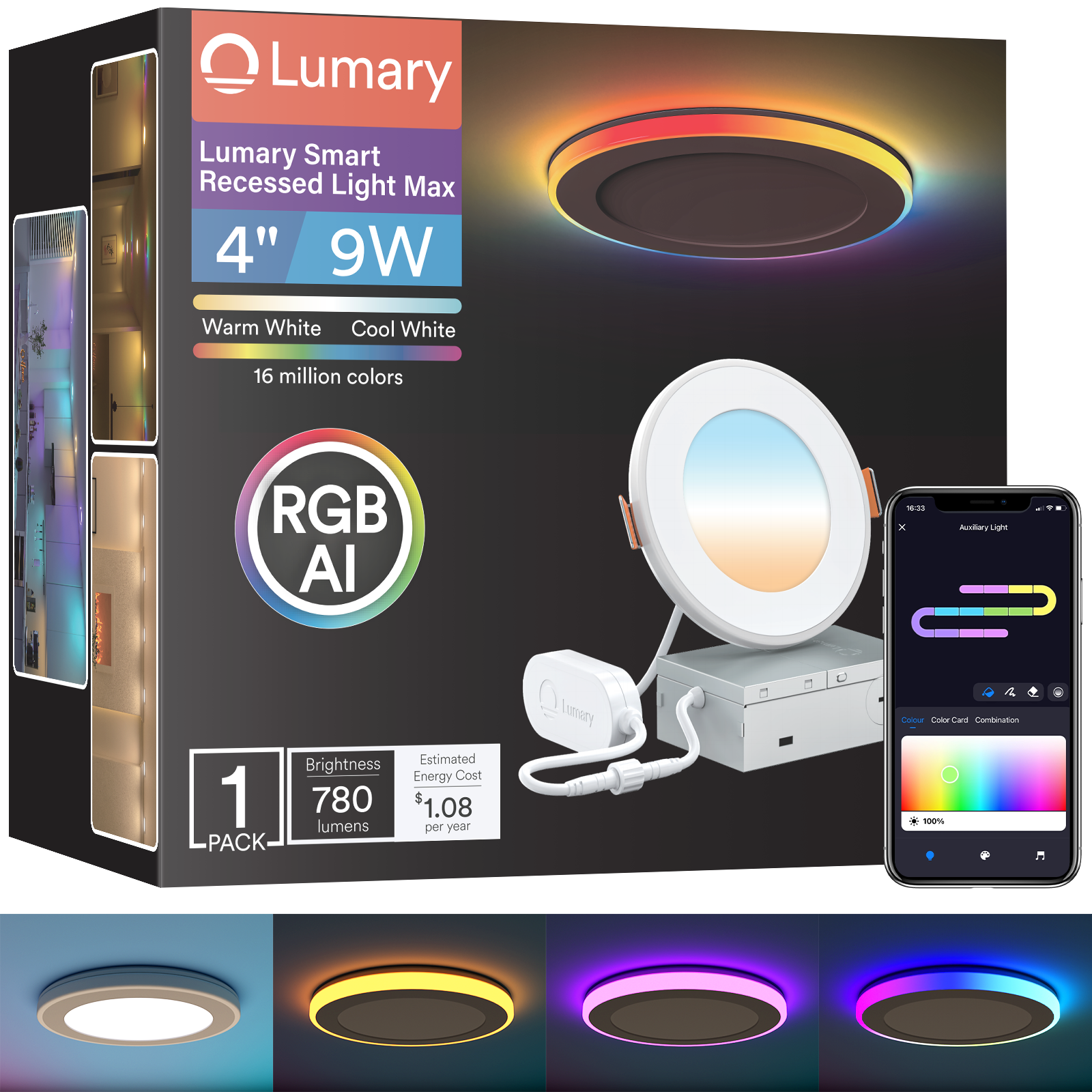
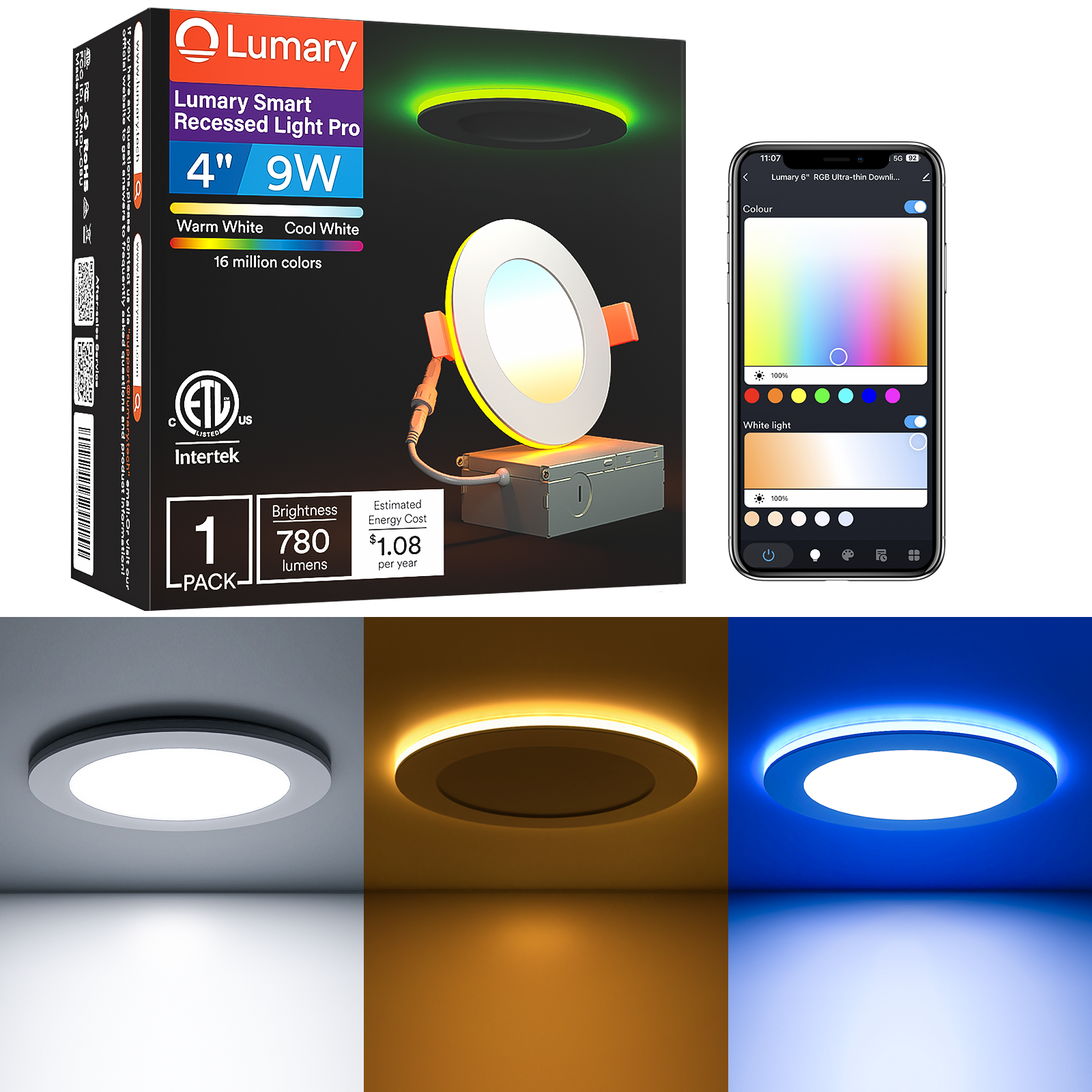
The three lumen values correspond to different fixture variants in the Lumary canless recessed product family—specifically the 4-inch 7W (350 lm), 4-inch/smaller 9W (780 lm), and 6-inch 13W (1,100 lm) configurations. The product linked here is the 6-inch 13W variant rated at 1,100 lumens, which is the appropriate output for a primary ambient lighting fixture in rooms with 8–10 foot ceilings. The lower lumen figures apply to the smaller 4-inch variants in the same product line, designed for accent lighting or lower-ceiling applications where a 1,100-lumen downlight would produce excessive direct glare.

