




What Is a Canless Recessed Light, and Why Is It So Popular Now?The recessed lighting category has undergone a quiet but structurally significant shift over the past decade. The traditional can-based downlight—a cylindrical housing installed inside the ceiling cavity before drywall, requiring separate trim rings and lamp sockets—was for a long time the only viable option for homeowners seeking a flush, unobtrusive ceiling fixture. That architecture persisted largely because the alternatives didn't exist. Then canless (also called ultra-thin or junction-box mount) LED fixtures emerged as a mature product category, and the functional calculus changed in ways that are worth understanding precisely.
The distinction is not merely cosmetic. The U.S. Department of Energy's Energy Saver resource on residential lighting notes that integrated LED fixtures—the category canless downlights belong to—offer substantially longer rated service life and higher luminous efficacy than lamp-and-fixture assemblies because the LED package, driver, and thermal management are engineered as a unified system rather than assembled from interchangeable components with mismatched thermal interfaces. A traditional recessed can paired with a retrofit LED bulb is functionally two separate products; a canless LED downlight is one. That integration matters for heat management, optical consistency, and long-term lumen maintenance.
From an installation standpoint, the National Electrical Code (NFPA 70), specifically Article 410, draws a hard line between recessed luminaires that have been rated for insulation contact (IC-rated) and those that have not. A traditional non-IC recessed can installed in an insulated ceiling requires a minimum three-inch clearance from insulation in all directions—a requirement that is practically impossible to maintain in blown-in cellulose or fiberglass installations without constructing individual dams around each fixture. Canless fixtures that carry an IC rating eliminate this constraint entirely, mounting directly to a junction box with insulation permitted to rest in contact with the fixture body. For the tens of millions of American homes with insulated attic-floor ceilings, this distinction is not a secondary feature—it is the primary reason canless LED downlights have achieved the adoption rate they have.
The market data reflects this shift. The Illuminating Engineering Society (IES) has documented sustained growth in the integrated LED luminaire segment since 2015, with the recessed downlight subcategory representing one of the highest-volume product transitions in residential electrical hardware. Contractors cite reduced installation time—no housing can to mount, no trim ring to align, no lamp to source separately—as a consistent driver of specification preference. Homeowners cite flush ceiling profiles and the elimination of the light-loss and color-inconsistency issues that arise from mismatched lamp-and-housing combinations.
This is the structural context that explains both the category's growth and the specific design decisions embedded in current-generation smart canless fixtures.

Product Recommendation Analysis
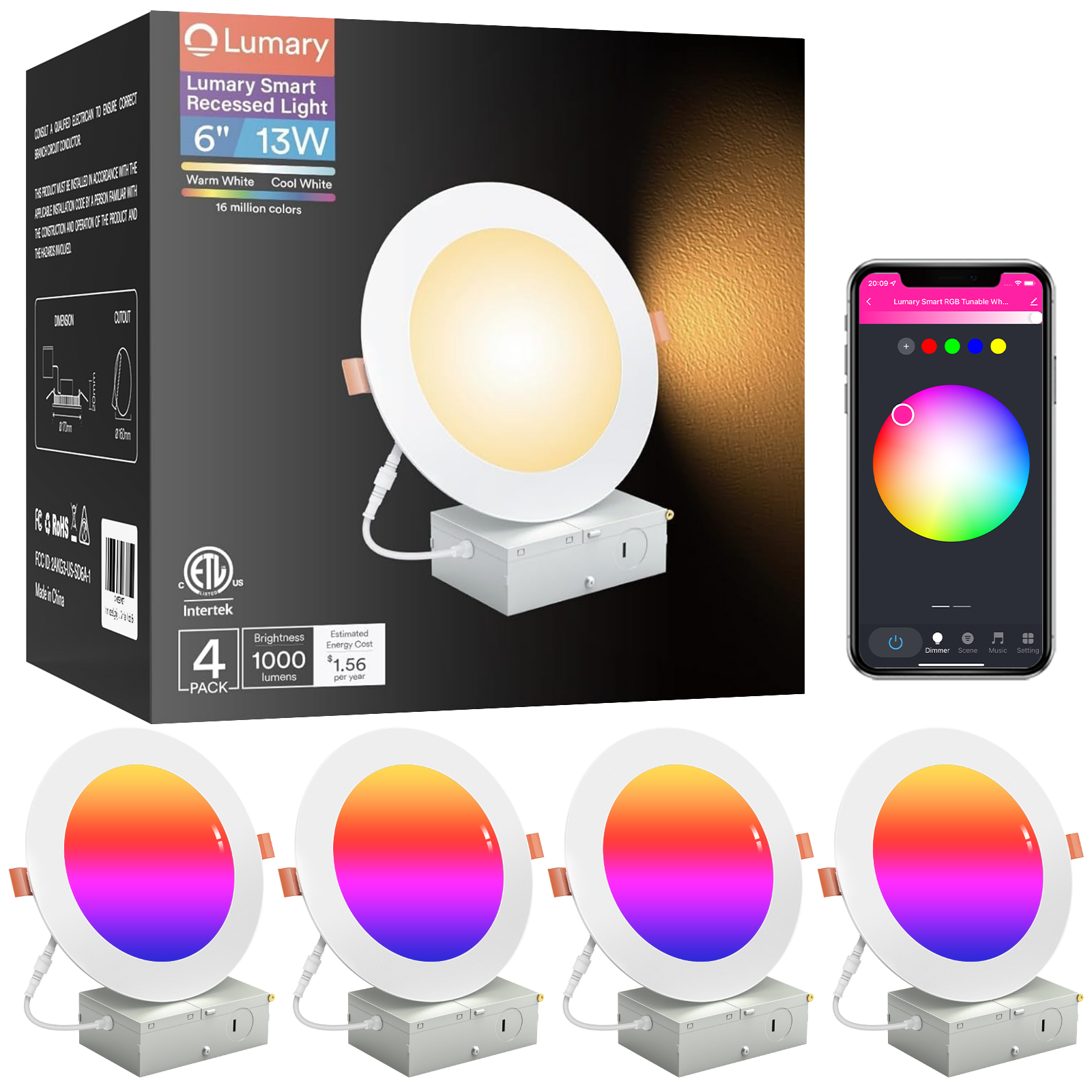
The Lumary Wi-Fi Smart Canless Recessed Lighting 6 Inch (4-Pack) is an IC-rated, junction-box-mount downlight running at 13W with a rated output of 1,100 lumens—an efficacy of approximately 85 lm/W that places it within the range of quality-tier residential LED luminaires. The fixture body measures 6.69 inches in diameter and just 0.55 inches in ceiling-plane depth, which defines the "ultra-thin" characterization: the fixture presents virtually no protrusion below the ceiling surface, a profile unachievable with any can-based system.
The RGBCW color architecture is the feature that separates this product from standard tunable-white downlights. Five distinct LED channels—red, green, blue, cool white, and warm white—operate independently, allowing the fixture to produce both saturated color output across 16 million combinations and spectrally accurate white light from dedicated phosphor-converted white channels. Color temperature adjustment runs continuously from 2700K to 6500K, and dimming operates across the full 1% to 100% range without the stutter or audible buzz associated with phase-cut dimming at coarse resolution.
Connectivity is 2.4 GHz Wi-Fi direct, requiring no hub or bridge. The Lumary app (iOS and Android) provides scheduling, scene selection from eight built-in modes, group control across rooms, music synchronization via microphone analysis, and a DIY scene builder. Voice control operates simultaneously through Amazon Alexa, Google Assistant, and Apple Siri. The memory function retains the last active setting through power interruptions, so the fixture does not revert to full-brightness white after a circuit trip. Family sharing allows multiple household members to control the same fixture group without credential sharing.
The 4-pack at $139.99 (white trim) or $136.99 (black trim) brings the per-fixture cost to approximately $35—a price point that represents substantive value for a 13W IC-rated RGBCW smart downlight at this specification level. Pack sizes scale from 4 to 24 units within the Lumary canless recessed lighting collection, with per-unit cost declining at larger quantities.
Performance Benchmarking Grid
| Key Purchasing Criterion | Common Signs of Poor Quality (Pitfalls to Avoid) | Technical Implementation in This Product | Impact on Long-Term Usage |
|---|---|---|---|
| IC Rating & Thermal Safety | Missing or unverified IC designation; fixture overheats when insulation contacts housing; driver capacitors degrade prematurely | IC-rated canless housing; junction-box mount eliminates enclosed plenum cavity; thermal load dissipates outward through fixture body | Safe, code-compliant installation in insulated ceilings with no clearance requirement; sustained driver lifespan |
| Lumen Output Accuracy | Overstated lumen specs; thermal throttling reduces actual output 30–40% below rated value after first few hundred hours | 13W / 1,100LM; ~85 lm/W efficacy consistent with quality-tier LED packages; integrated driver-LED thermal path | Consistent illuminance over fixture lifespan without gradual brightness degradation |
| White Light Quality | RGB-only white mixing produces spectrally thin output with visible blue shift; color rendering gaps in red wavelength range | Dedicated cool white and warm white LED channels (RGBCW); phosphor-converted spectral profile independent of RGB mixing | Accurate food and skin-tone rendering; no blue tint artifact at any CCT setting |
| Color Temperature Range | Fixed CCT with no adjustment; or limited 2-step warm/cool toggle without continuous tuning | 2700K–6500K continuous adjustment via app; full circadian arc coverage from warm evening to daylight equivalent | Single fixture type serves all rooms and all times of day; no lamp-change workarounds required |
| Dimming Performance | Low-frequency PWM flicker visible at mid-range dim levels; audible buzz from driver; minimum threshold cutoff at 10–20% | Flicker-free driver; smooth 1%–100% dimming range; silent operation across full range | Eye-comfortable low-level illumination; no flicker artifacts in smartphone or camera video |
| Connectivity Architecture | Hub-required protocols (Zigbee without gateway); 5 GHz band incompatibility; single ecosystem lock-in | 2.4 GHz Wi-Fi direct; simultaneous Alexa, Google Assistant, and Siri compatibility; no hub required | Stable control without additional hardware cost; multi-ecosystem voice control from day one |
| Installation Compatibility | Requires pre-existing recessed housing can; incompatible with remodel junction boxes; deep ceiling cavity required | Spring-clip junction-box mount; 0.55-inch ceiling-plane depth; compatible with new-work and remodel boxes | Retrofit compatibility in any ceiling construction; suitable for shallow framing and low-profile ceilings |
| Power Interruption Behavior | Defaults to full-brightness white after power cut; no retained state; jarring recovery from circuit trips | Memory function retains last active state through power interruptions | Predictable behavior after breaker trips or power outages; no manual re-configuration required |
| Multi-Room Control | Per-fixture individual control only; no group scheduling; family members cannot share access | Group control across rooms; schedule function; family sharing via Lumary app | Whole-floor scenes from a single command; household members control shared spaces independently |
| Pack Value | Single-unit pricing only; high per-fixture cost for multi-room deployment | 4-pack at $139.99 (~$35/fixture); scales to 8, 12, and 24-pack configurations | Meaningful cost reduction for whole-home deployment; consistent fixture type across all rooms |
Market Context: Where This Fixture Sits Within the Competitive Landscape
The smart recessed downlight category now includes several well-established brands with distinct ecosystem philosophies, each with genuine strengths worth understanding before making a purchasing decision.
Govee has built a strong following through its Wi-Fi and Bluetooth hybrid connectivity and its RGBIC addressable strip lighting ecosystem. Govee's color fidelity and app experience are well regarded, and buyers already invested in the Govee ecosystem will find familiar controls and scene management tools.
Philips Hue remains the reference standard for smart lighting ecosystem depth and third-party integration breadth. The Hue recessed lineup uses Zigbee via the Hue Bridge for reliable local control with deep HomeKit, Alexa, and Google Home integration. Hue's color consistency across fixtures and its robust developer API make it the preferred choice for buyers who prioritize automation platform depth and are comfortable with the bridge hardware investment.
LIFX shares the hub-free Wi-Fi direct architecture that the Lumary canless fixture uses. LIFX products are noted for high lumen output and polished app design, and the brand has a strong presence in the premium smart bulb and downlight segment.
Kasa (TP-Link) is widely regarded for reliable 2.4 GHz Wi-Fi implementation, straightforward setup, and competitive pricing in the tunable-white segment. Kasa products are a practical choice for buyers whose primary need is warm-to-cool CCT adjustment without full RGB color.
WiZ, operating under the Signify (Philips) umbrella, brings hub-free Wi-Fi smart lighting with tunable white and full-color options at an accessible price tier. WiZ's recessed downlight formats have expanded considerably, and the brand benefits from Signify's optical engineering heritage.
Eufy has entered the smart lighting space with HomeKit-compatible color tunable products, a differentiating feature for households deeply committed to the Apple ecosystem.
Within this landscape, the Lumary 6-inch canless occupies a specific and well-defined position: IC-rated canless architecture, RGBCW color system, hub-free tri-ecosystem voice compatibility, and multi-pack pricing that makes whole-room or whole-floor deployment economically practical. For buyers whose ceiling construction requires IC-rated fixtures and whose lighting goals include full-color RGBCW capability without hub hardware, the number of directly comparable products in the category is more limited than the broader smart downlight market might suggest.

Application Scenarios
Living Room Retrofit in an Insulated Residential Ceiling
The single-story ranch house and the two-story colonial share a common ceiling construction challenge: the floor assembly directly below the unconditioned attic is the home's primary thermal boundary, and that boundary is maintained by 10 to 14 inches of blown or batt insulation resting on top of the ceiling drywall. Every recessed fixture penetration in that plane is a potential weak point—thermally, acoustically, and from an air infiltration standpoint.
Non-IC fixtures installed in this assembly require individual fiberglass dams around each housing can to maintain the mandatory three-inch clearance from insulation. In a living room with six to eight fixtures, that represents six to eight individual dam installations in the attic—labor cost that is rarely factored into product comparisons at the point of purchase. IC-rated canless fixtures installed at junction boxes eliminate this requirement entirely. The insulation installer can blow or batt without accommodating fixture clearances, because the fixture body is rated for direct contact.
The Lumary 6-inch canless addresses this installation constraint at the structural level. Once the four units are grouped in the Lumary app, the living room gains a lighting system capable of transitioning from 2700K warm ambiance—spectrally close to the incandescent fixtures most living room retrofits are replacing—through 4000K neutral for reading or task work, to 6500K daylight-equivalent for video calls or detailed activities. This CCT range from a single fixture type eliminates the need for separate warm and cool downlights or seasonal lamp changes.
The group control function means all four fixtures respond to a single voice command or app tap without a per-fixture sequence. Scheduling allows evening scenes to activate automatically at sunset. The memory function ensures that a circuit trip at 11 PM does not result in four 1,100-lumen fixtures snapping on at full brightness—the fixtures return to their last saved state, which is a firmware behavior that matters considerably more in a living room at night than its brief description in spec sheets would suggest.
Kitchen Task Lighting with Dedicated White Channels
The kitchen is where white light quality has the most direct functional consequence. Color rendering index (CRI), as defined by the Commission Internationale de l'Éclairage, measures a luminaire's ability to render object colors accurately relative to a reference illuminant. In a kitchen context, poor CRI means compressed color differentiation between food states—cooked vs. undercooked proteins, fresh vs. aging produce—that are visually distinguishable under full-spectrum illumination but not under spectrally deficient sources.
The RGBCW architecture in the Lumary 6-inch canless matters here specifically because white output comes from dedicated phosphor-converted white channels, not from RGB primary mixing. An RGB-only fixture set to white produces a spectrally reconstructed approximation of white light with gaps in the spectral distribution that reduce CRI performance and introduce color casts at certain object surfaces. A fixture with dedicated warm and cool white channels generates white light from a broadband phosphor emission that maintains spectral integrity across the full CCT range.
For kitchen task lighting, the recommended operating configuration is 4000K to 4500K neutral white at 80% to 100% brightness during meal preparation. The fixture can be scheduled to shift toward 2700K and 40% brightness for dinner ambiance without requiring separate fixtures for the two use cases. The 1%-to-100% smooth dimming range allows the overhead circuit to step back when under-cabinet task lighting is carrying the primary illuminance load—a coordination that static-brightness fixtures structurally cannot support.
Bedroom Circadian Lighting Architecture
The physiological case for color-tunable bedroom lighting is well established in the sleep medicine literature. Research from Harvard Medical School's Division of Sleep Medicine and the Lighting Research Center at Rensselaer Polytechnic Institute has documented that short-wavelength (blue-dominant) light in the 450–490nm range suppresses melatonin secretion through the ipRGC pathway when exposure occurs in the two hours preceding sleep onset. A fixed 5000K or 6500K LED downlight operating in a bedroom in the evening produces precisely this wavelength profile at the photopic stimulus levels that most strongly activate circadian phase suppression.
A bedroom downlight that cannot shift to 2700K–3000K warm white in the evening is, in measurable physiological terms, a poor choice for occupant sleep quality. The Lumary 6-inch canless covers the full 2700K–6500K range and supports scheduled CCT progressions through the Lumary app's biorhythm scene mode, which automates a gradual warm shift aligned with the natural solar arc. A reading configuration at 3000K and 30%–40% brightness delivers sufficient vertical illuminance for print reading while staying below the photopic threshold that delays pre-sleep melatonin production.
From a thermal envelope standpoint, the IC-rated canless design provides an additional benefit specific to bedrooms: it eliminates the convective air infiltration pathway that open-top recessed cans create in insulated ceilings. A traditional non-IC housing can acts as a chimney through the thermal boundary, drawing conditioned air upward in winter heating season. The canless junction-box mount maintains the ceiling plane's thermal integrity in a way that legacy canned fixtures cannot.
Home Office and Flicker-Free Productivity Lighting
Sustained visual task performance is sensitive to two lighting parameters that consumer product specifications rarely communicate clearly: color temperature and flicker modulation depth. IEEE Standard 1789-2015, developed by the IEEE Power Electronics Society, establishes recommended practices for modulating current in high-brightness LEDs to mitigate health risks associated with light flicker. The standard defines stroboscopic effect visibility thresholds and identifies the frequency and modulation depth combinations that pose risk of headache, eye strain, and reduced sustained attention in extended occupancy environments.
Many consumer LED drivers using simple phase-cut dimming operate their LED arrays at 100Hz or 120Hz with modulation depths that exceed IEEE 1789-2015 recommendations at mid-range dimmer settings. In a home office where the luminaire operates continuously for eight to ten hours, this is a cumulative physiological load that peer-reviewed NIOSH occupational lighting research has associated with elevated rates of headache and eye fatigue in LED-lit workspaces.
The Lumary 6-inch canless is specified as flicker-free with silent driver operation across the full 1%–100% dimming range, indicating a driver architecture that maintains consistent LED current independent of the mains cycle rather than relying on phase-cut pulse control. For a home office installation, the practical operating configuration is 4000K at 70%–85% brightness during focused work hours, with scheduled transitions toward 3000K in the late afternoon to begin the circadian wind-down while the workday is still active. The group control function allows adjacent zones within an open-plan office to be held at different CCT and brightness levels simultaneously.
Entertainment Room and Audio-Visual Synchronization
The music synchronization feature in the Lumary app operates through real-time audio analysis on the controlling smartphone, mapping amplitude and frequency content to color channel and brightness changes across all grouped fixtures. The response latency of this pipeline—from audio event to visible light change—is governed by the microphone sampling interval on the controlling device and the Wi-Fi command transmission time to each fixture. On current-generation smartphones with adequate local network performance, beat-detection latency of sub-100ms is achievable, which is sufficient for the synchronization to feel temporally correlated with percussive transients in music.
The RGBCW architecture is the enabling condition for effective music synchronization. A single-channel white fixture can only express audio correlation through brightness variation—a limited vocabulary that produces a strobe effect rather than a dynamic chromatic response. The full red, green, blue, warm white, and cool white channels available in the Lumary 6-inch canless allow frequency-band-to-color-channel mapping that produces a visually differentiated response to treble, midrange, and bass content simultaneously.
For gaming environments, the preferred configuration is typically a fixed ambient hue chosen to reduce the luminance contrast between the bright monitor and the dark room surround—a technique that reduces the visual adaptation stimulus at the screen edge and lowers eye fatigue over extended sessions. The 16 million color palette accessible through the app's color wheel allows precise hue selection for this purpose. The 0.55-inch ceiling-plane depth is additionally relevant in dedicated home theater and gaming rooms: the fixture does not project into the vertical sightline between a reclining viewer and a wall-mounted display or projection screen, which ceiling-mounted fixtures with larger housings can do in low-ceiling basement conversions.

Professional Assessment and Buyer Guidance
Evaluated against the technical criteria that matter for an insulated-ceiling residential installation with smart control requirements, the Lumary 6-inch canless 4-pack addresses the two most consequential failure modes in consumer smart downlight selection: thermal safety in IC-contact applications, and spectral quality in white light output from a multi-channel color fixture.
The 13W / 1,100LM specification yields an efficacy of approximately 85 lm/W—consistent with the ENERGY STAR program's performance criteria for residential recessed downlights, which set a minimum efficacy threshold of 75 lm/W for qualified products. The continuous 2700K–6500K CCT range covers the full span needed for circadian-aligned residential use without fixture changes. The flicker-free, silent driver specification across the 1%–100% dimming range indicates a power conversion design that prioritizes comfort in sustained occupancy—a parameter the IEEE 1789-2015 framework has identified as clinically relevant in extended-use environments.
The hub-free Wi-Fi direct architecture eliminates the single-point-of-failure characteristic of bridge-dependent systems. When a hub goes offline—whether from firmware update failure, hardware fault, or network reconfiguration—every fixture in that system loses app and voice assistant control simultaneously. Direct Wi-Fi fixtures lose only the fixtures that lose network connectivity individually, a meaningful resilience difference in multi-room deployments.
Decision logic for different buyer profiles:
If the installation requires IC-rated fixtures in an insulated ceiling and full RGBCW color capability with hub-free operation, this product satisfies all three constraints in a single SKU. If the buyer's priority is the deepest possible third-party automation platform integration and already owns a Philips Hue Bridge, the Hue ecosystem's developer API and certification breadth may justify its higher per-fixture cost. If the requirement is tunable white only—no color—and budget is the primary variable, single-channel CCT-tunable Wi-Fi downlights from Kasa or WiZ cover that use case at lower cost per fixture.
Who should buy this product: Homeowners retrofitting living rooms, kitchens, bedrooms, or home offices in insulated ceilings who want full-color smart control without hub hardware, and who are deploying four or more fixtures in a room where group control, scheduling, and music synchronization add practical value. The 4-pack at $139.99 makes per-fixture cost reasonable for multi-room deployment, and the consistent fixture type across rooms simplifies both installation and long-term app management.
Technical FAQ
Q: What does "canless" actually mean, and is it structurally safe compared to traditional recessed cans?
Canless refers to the absence of a pre-installed recessed housing cylinder inside the ceiling cavity. Traditional recessed can fixtures require a separate housing—installed before drywall in new construction, or cut in during remodels—that the trim ring and lamp then insert into. A canless fixture mounts directly to a standard junction box using spring clips and sits flush against the ceiling drywall. Structurally, the junction box provides the mechanical anchor, which is the same mounting point used by every standard ceiling light fixture. The Lumary canless downlight is IC-rated, meaning it has been tested and certified safe for direct insulation contact—a safety level that many traditional housing cans without IC certification do not meet.
Q: Why does this fixture show separate lumen values of 350, 780, and 1,100 in the spec table?
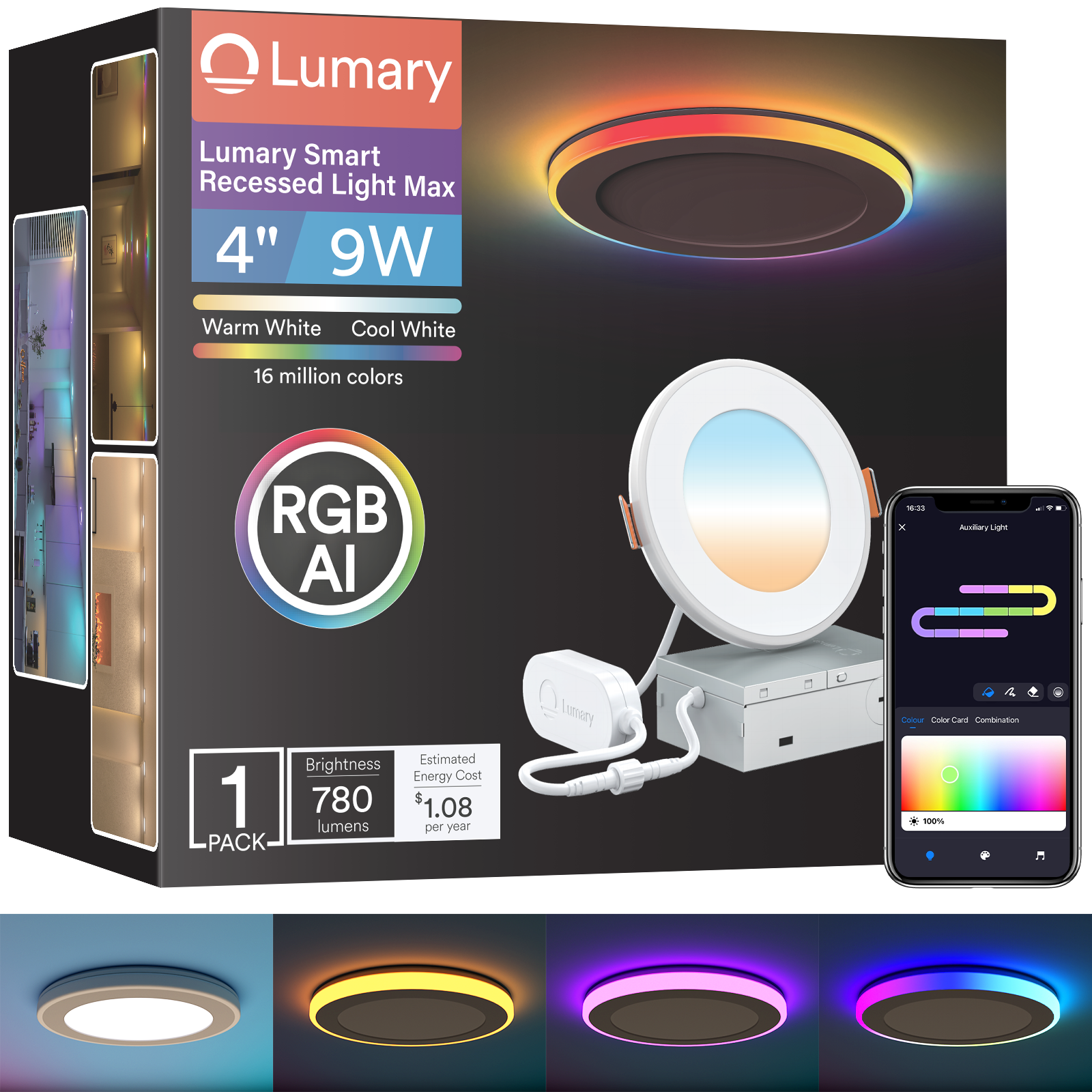
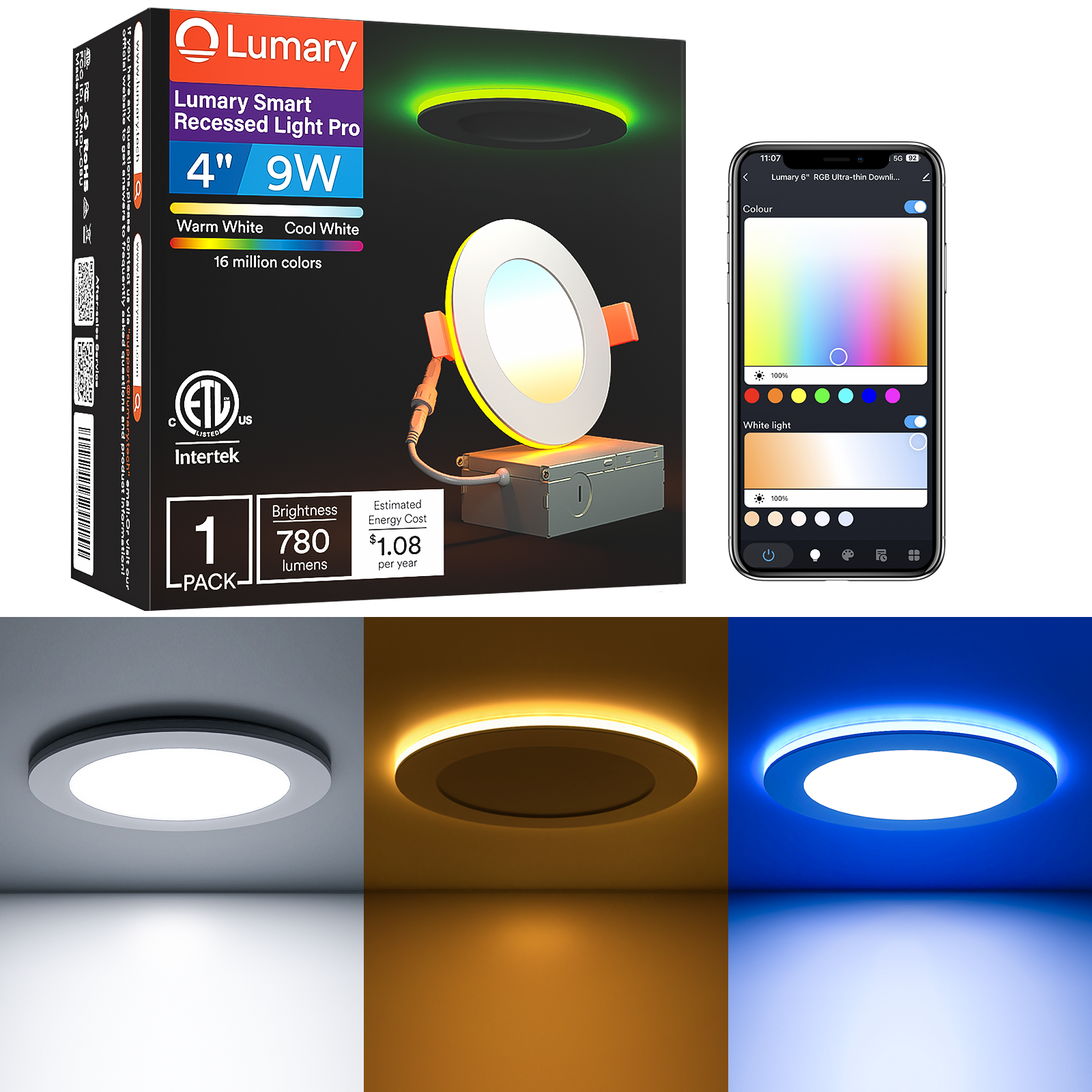
These figures correspond to three different fixture sizes in the Lumary canless recessed lighting family: the 4-inch 7W variant (350 lm), the smaller 9W variant (780 lm), and the 6-inch 13W variant (1,100 lm) that is the subject of this article. The 6-inch 13W at 1,100 lumens is the appropriate primary ambient light source for rooms with 8-to-10-foot ceilings. The 4-inch variants are suited to accent lighting, hallways, or lower-ceiling applications where a 1,100-lumen downlight would produce excessive direct glare at close viewing angles.
Q: Why do some smart downlights show a blue tint when set to white, and how does the RGBCW system address this?
A visible blue cast in white mode is characteristic of RGB-only fixtures that generate white through additive color mixing of the red, green, and blue primaries. Because the blue LED channel is a narrow-bandwidth, high-energy emitter, the mixed white output is spectrally thin and shifts toward blue when the channel balance is not precisely maintained—which varies with LED batch tolerances and junction temperature changes during operation. The RGBCW architecture in the Lumary 6-inch canless routes white output through dedicated warm and cool white LED channels with phosphor-converted broadband spectral profiles. White light is produced by these channels without involving the RGB primaries, resulting in spectrally consistent white across the full CCT range without the blue-dominant artifact.
Q: What happens to the fixture if the Wi-Fi network goes down or the Lumary app server is unavailable?
The memory function stores the last active state in the fixture's onboard firmware. If network connectivity is lost—from router restart, ISP outage, or app server maintenance—the fixture continues operating at its last saved setting. It does not default to off or to maximum white. Physical control remains available through the wall switch circuit, and the fixture reconnects to the Lumary app automatically when network availability is restored. This behavior means that a household's lighting function is not dependent on continuous cloud server availability for basic operation.
Q: How many fixtures can realistically be grouped and controlled simultaneously before synchronization latency becomes noticeable?
The Lumary app sends group commands through the home router to each fixture via 2.4 GHz Wi-Fi. The practical ceiling is determined by router performance and local network congestion rather than any firmware group size limit. A modern dual-band router with adequate 2.4 GHz channel capacity handles simultaneous commands to 12–16 fixtures within a response window that is imperceptible for scene changes. For deployments of more than 16 fixtures, distributing the load across room-based sub-groups triggered by a shared schedule or voice command—rather than a single large group—reduces simultaneous packet demand and preserves responsive switching performance across the full installation.

