


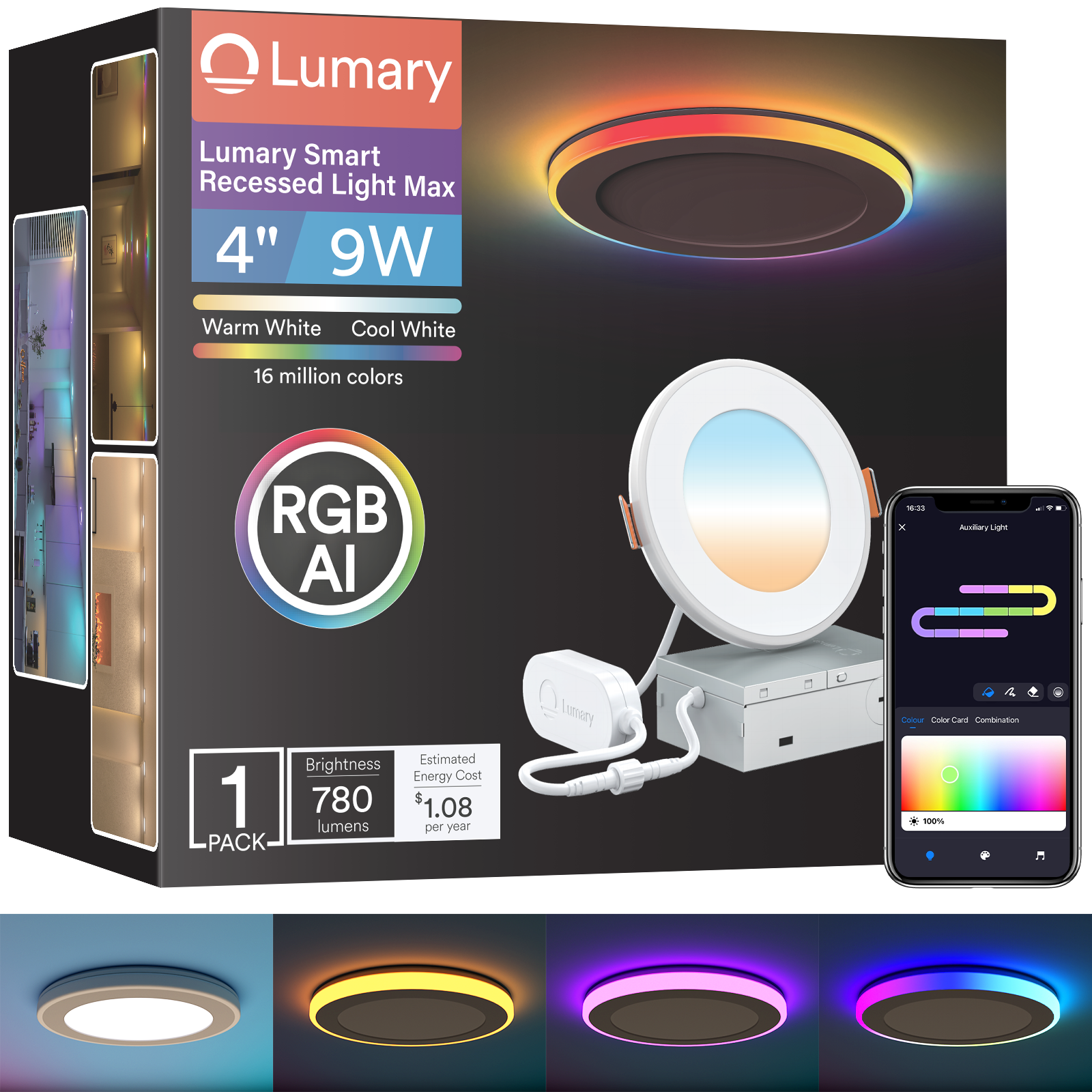
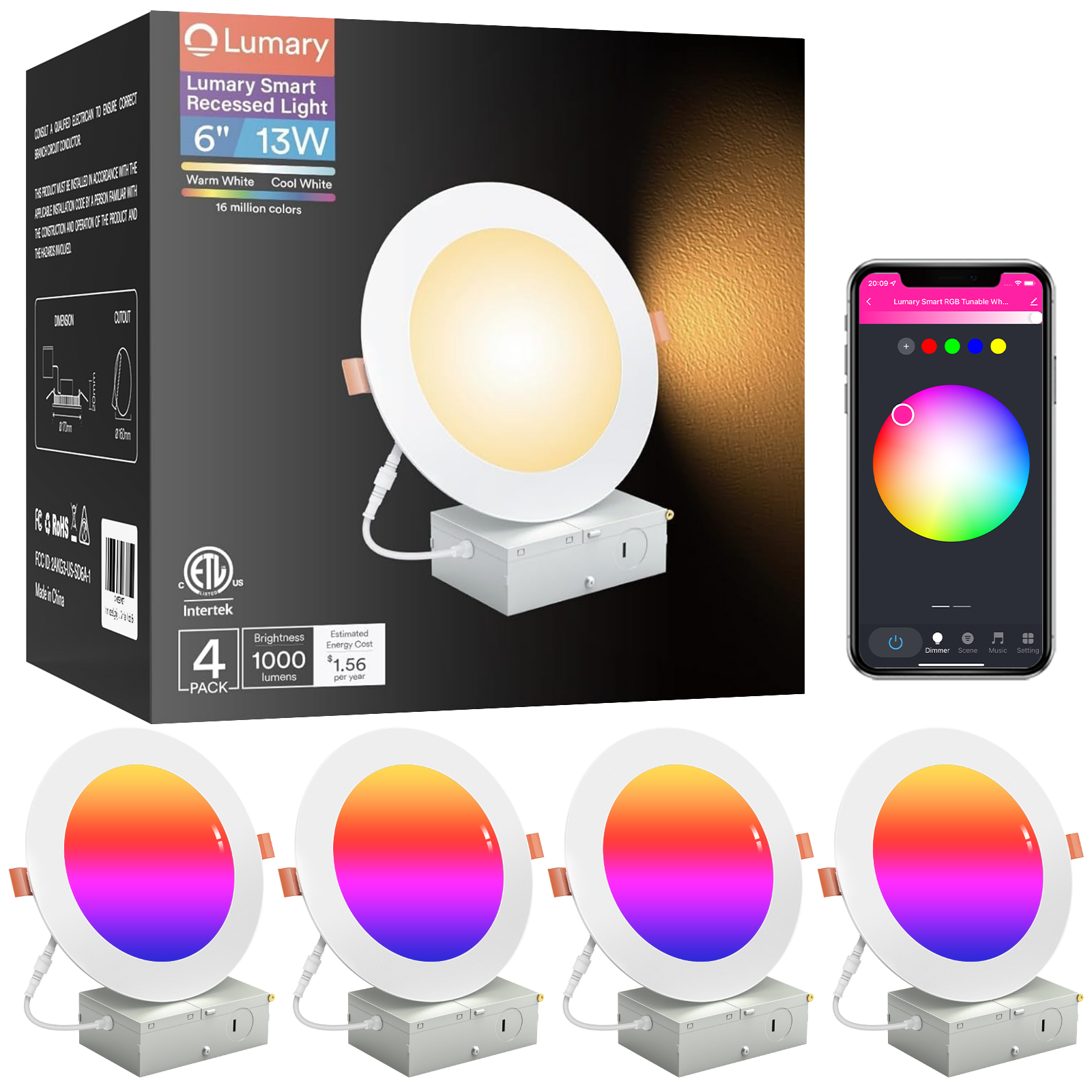
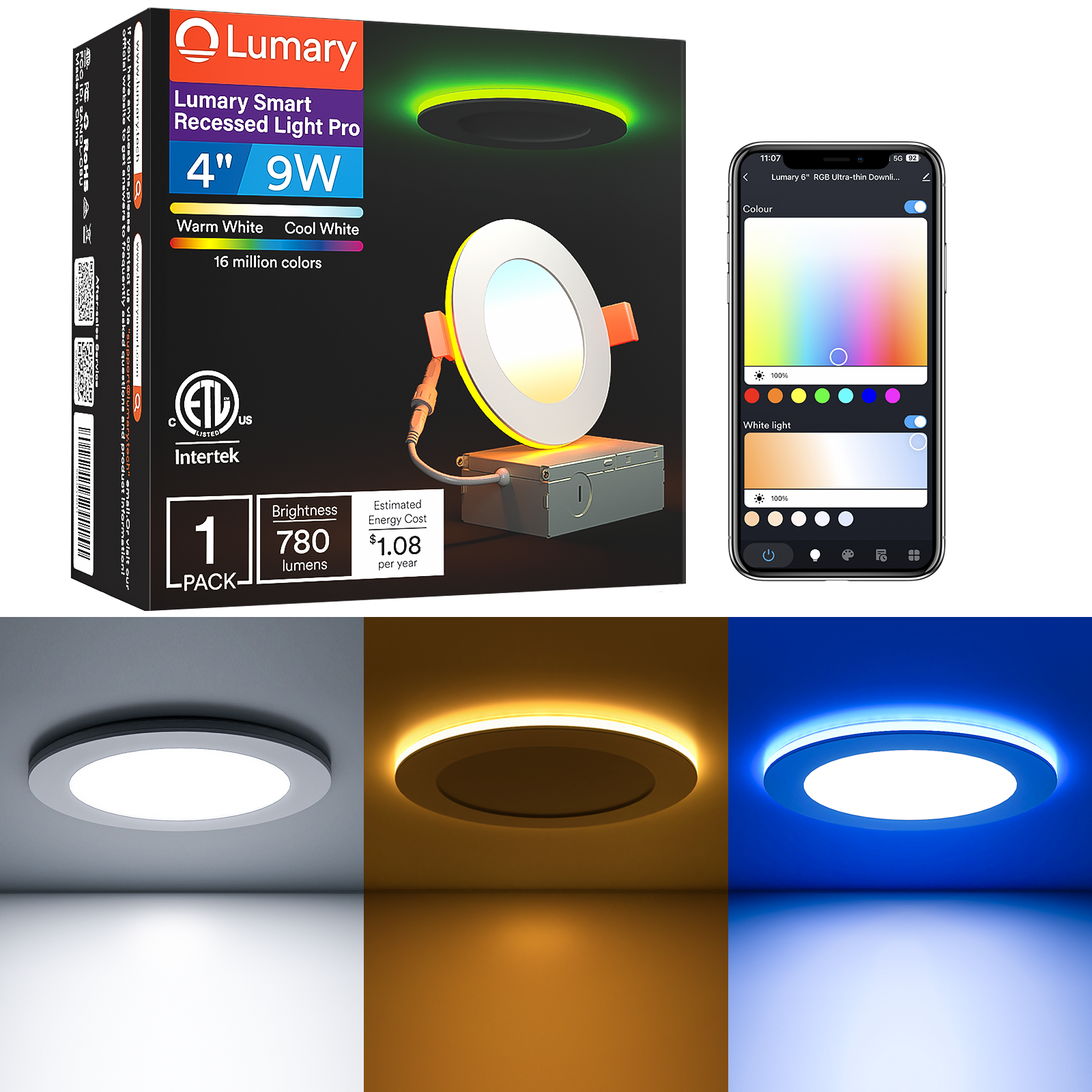
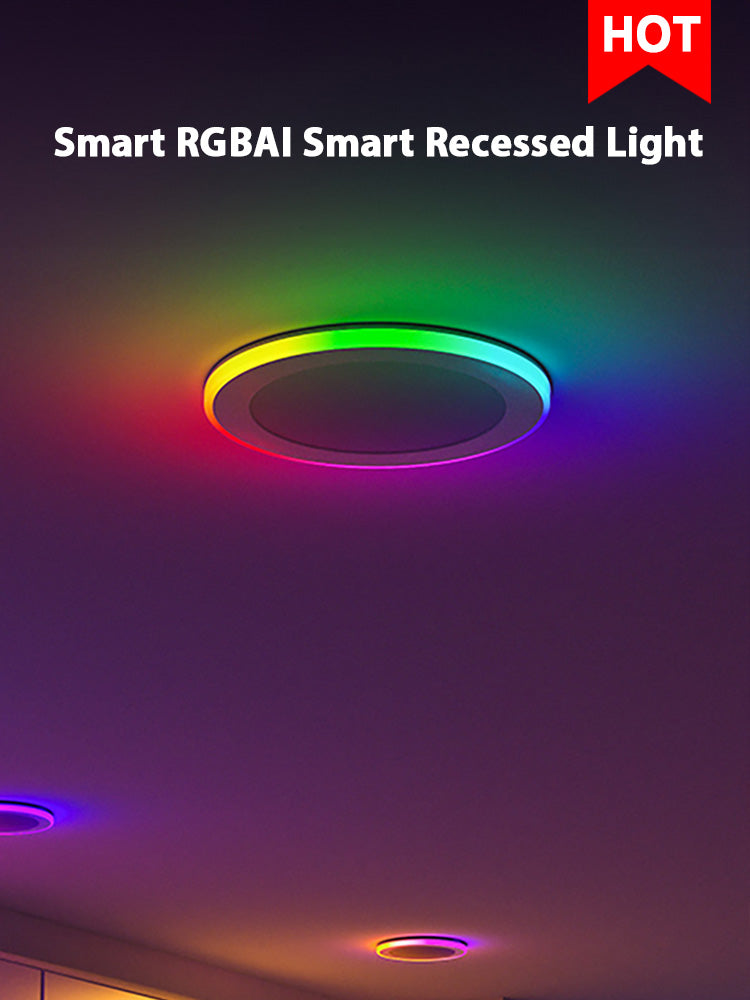


Final Verdict First: Standard Bedroom? Go with 4-inch.
For most standard bedrooms, I highly recommend the 4-inch model. Only opt for the 6-inch if you have a larger footprint, higher ceilings, or if you want to minimize the number of ceiling cutouts while requiring stronger primary illumination.
The reasoning is straightforward. Home Depot’s sizing guide classifies 6-inch fixtures as the standard for general lighting, whereas 3/4-inch sizes are tailored for smaller spaces. Applying this to these Lumary specs: the 4-inch is 780 lm / 9W / $49.99, while the 6-inch is 1100 lm / 13W / $59.99. Essentially, the 6-inch is only about 20% more expensive but delivers roughly 41% more brightness. If you want your recessed lights to handle the heavy lifting of primary lighting, the 6-inch is the better value. Conversely, in a typical bedroom where bedside lamps, light strips, and floor lamps already provide layered lighting, the 4-inch cutout offers a smaller, cleaner, and more sophisticated ceiling aesthetic.
Visualizing room brightness makes it even clearer. According to Home Depot’s estimates, a 100 sq. ft. bedroom generally requires 1,000–2,000 lumens. Based on these Lumary units: two 4-inch units = 1,560 lm, while two 6-inch units = 2,200 lm. Therefore, if your room is around 90–130 sq. ft. with light-colored walls and auxiliary light sources, two 4-inch units sit perfectly within the standard range. If the room is closer to 130–200 sq. ft., has dark cabinetry/walls, or if you simply prefer "full-blast" brightness, the 6-inch model is a safer bet.
Size doesn't exist in a vacuum. A common rule of thumb for even illumination is to space lights at half the ceiling height. For a standard 8-foot ceiling, you’d start your layout with 4-foot spacing. This aligns with the 4/6-inch logic: 4-inch lights are ideal for a "multi-point, dense, low-profile" layout, while 6-inch lights work best for "fewer points, wider coverage" where the ceiling lights act as the primary light source.
What Category Does This Lumary Light Fall Into?
This isn't a basic "color-changing" downlight; it utilizes a dual-layer logic that separates primary illumination from atmospheric accent lighting. The official product page specifies that the Main Light handles 2700–6500K CCT white light, while the Auxiliary Light handles RGBAI color mixing and includes a Nightlight mode. The fixture offers 4 modes: RGBAI Gradient, RGB, Nightlight, and Downlight. The accent ring supports 12 independent zones. The entire line features CRI 90, ETL certification, and Wi-Fi + Bluetooth connectivity, controllable via the Lumary App, Alexa, and Google Assistant (Siri requires Lumary App automation).
However, there are several critical technical boundaries: it only supports 2.4GHz Wi-Fi, it is not compatible with dimmer switches, frequent use of a wall switch will trigger a reset, and the main and auxiliary lights cannot be turned on simultaneously.
From a purchasing standpoint, this architecture is more reliable than "RGB-mixed white" lights because the white light doesn't depend on color chips. But it’s not an all-in-one miracle. The official page does not list Matter or native HomeKit certification, beam angle, flicker/PWM metrics, R9 values, wet-rated status, or IC/airtight info. Don't assume these features exist unless they are explicitly stated. If you are buying lights for a vanity, long reading sessions, or a shower zone, these are the questions you need to ask.
Core Specifications Comparison
The data below is sourced from Lumary’s official product pages; percentages and efficiency are calculated based on those figures.
| Item | 4-Inch | 6-Inch | Buying Insight |
| Brightness | 780 lm | 1100 lm | 6-inch is ~41% brighter; better for "light-and-done" primary lighting. |
| Power | 9W | 13W | Both are highly energy-efficient LED downlights. |
| Efficacy | ~86.7 lm/W | ~84.6 lm/W | Efficiency is nearly identical across both sizes. |
| Price (Single) | $49.99 | $59.99 | 6-inch is ~20% more expensive but offers a much higher brightness boost. |
| Color Temp | 2700–6500K | 2700–6500K | Adjustable from warm rest to cool task lighting. |
| CRI | 90 | 90 | Professional-grade color rendering for residential use. |
| Color Structure | RGBAI Aux Ring, 12 Zones | RGBAI Aux Ring, 12 Zones | Optimized for ambiance and nightlight use, not just a static color ring. |
| Control | App/Alexa/Google/Siri | App/Alexa/Google/Siri | No Matter support listed; Apple Home integration is indirect. |
| Connectivity | 2.4GHz Wi-Fi + BT | 2.4GHz Wi-Fi + BT | Ensure your 2.4GHz home network is robust before installing. |
| Key Limits | No simultaneous Main/Aux; No Dimmers | No simultaneous Main/Aux; No Dimmers | This is a "smart fixture," not a traditional light for wall dimmers. |

Red Flags: What You Should Really Watch Out For
| Potential Pitfall | Common Issues in the Market | Lumary’s Implementation | Long-term Impact |
| Main vs. Ambient | Many smart lights rely on RGB to mix white, resulting in poor "daily" light quality. | Discrete CCT Main Light; auxiliary ring handles RGB/Nightlight. | Better daily utility; more practical for a real bedroom. |
| Protocol Support | Marketing says "Smart" but hides the specific protocol details. | Lists Wi-Fi + BT, Alexa/Google; does not list Matter. | If you are "all-in" on Apple Home or Matter, check before buying. |
| Wall Switch Experience | Some smart lights lose their pairing or memory if the power is cut. | Official warning: Wall switch toggling triggers a reset; flashes until re-paired. | Best for "Always-On" power with App/Voice control. |
| Dimmer Compatibility | Smart drivers and traditional wall dimmers are often incompatible. | Explicitly states: "Incompatible with dimmer switches." | Decide now: do you want smart controls or a traditional wall dial? |
| SKU Confusion | Different models look the same but have different control methods. | Page mentions some 6-inch SKUs don't support remotes, while others do. | Check the specific SKU number before checking out; don't just buy "6-inch." |
| Visual Health | Pages list CRI but hide flicker (PWM) or R9 values. | CRI 90 listed, but no data on flicker or beam angle. | If you use the room for makeup, reading, or video, demand these specs. |
Market Positioning: How It Compares
The Lumary RGBAI Recessed Light isn't about being the "brightest" or having the "best ecosystem"—it's about integration. It packs primary lighting, a nightlight, and segmented color into a single canless fixture. If you need lighting for a bedroom, home theater, or game room—spaces that require "work light" by day and "mood light" by night—it’s a solid choice.
-
Govee: Their Smart Recessed Pro series highlights RGBWW main lights + RGBIC side lighting and Matter support. They are the strongest competitor for multi-platform users.
-
Philips Hue: The premium choice. Their 4-inch retrofit is 850 lm, and the 5/6-inch is 1100 lm. With a Hue Bridge, you get full Matter capability and the best stability in the industry.
-
WiZ: Their 6-inch Slim Downlight is 1000 lm, supports Matter, and is Wet-rated. If you're installing in a bathroom or high-humidity area, WiZ is the safer, more transparent choice.
Real-World Scenarios: 4-inch vs. 6-inch
-
Scenario 1: A ~100 sq. ft. bedroom with existing lamps.
Avoid the "commercial ceiling" look. 4-inch units are better here. The Lumary accent ring provides the nighttime vibe, while the 4-inch main light is sufficient for daily tasks without cluttering the ceiling.
-
Scenario 2: A ~150 sq. ft. master bedroom with dark furniture.
Go with the 6-inch. You need the extra 41% brightness. In rooms where dark surfaces "soak up" light, the 6-inch gives you the headroom to dim down rather than wishing you had more light.
-
Scenario 3: A Gaming or Media Room.
The value here is the 12-zone RGBAI ring. It’s perfect for "screen-time" ambiance. Just remember: the main white light and the color ring cannot be on at the same time.
-
Scenario 4: Hallways or Walk-in Closets.
For pathways where you want subtle guidance, the 4-inch is more natural. The Nightlight mode is perfect for mid-night trips without the blinding glare.
Final Hardware Editor Advice
If you’re stuck between the two sizes for a standard room, here is the verdict:
-
Prioritize the 4-inch if: Your room is under 130 sq. ft., you have standard ceilings, you want a "designer" look, or you care more about the RGBAI ring than high-intensity white light.
-
Prioritize the 6-inch if: Your room is over 130 sq. ft., you have dark walls, or you want to use the fewest number of fixtures to light the whole space.
-
Hold off on this model if: You must use a wall dimmer, you require native Matter/HomeKit support, or you’re installing in a shower zone.
The Pro Tip: Use 4-inch for bedrooms; use 6-inch for master suites where the ceiling lights are the only source. With this Lumary model, choose 4-inch for "Aesthetics" and 6-inch for "Utility."
 Top 5 FAQ
-
Is the only difference the size? No. Beyond the diameter, the 6-inch is 41% brighter (1100 lm vs. 780 lm) and costs $10 more.
-
Will the white light look "blueish" or "gray"? Unlike cheap RGB lights, this has a dedicated CCT main light. However, without R9 or spectral data, it’s a high-quality consumer light, not a professional-grade color fixture.
-
Can I turn on the white light and the color ring at the same time? No. Official specs state they cannot be on simultaneously.
-
Can I use my existing wall dimmer? No. It will likely cause flickering or damage the driver. Use the App or voice commands.
-
Does it work with Apple Home? Not natively. You have to set up "Siri Shortcuts" via the Lumary App automation. For native HomeKit/Matter, look at Hue or WiZ.

