







The question involves two separate issues that are routinely conflated: whether smart recessed lights and regular lights can share the same electrical circuit, and whether they can share the same wall switch. The answers are different for each, and understanding why determines whether a mixed installation works seamlessly or produces the flickering, ghosting, and control conflicts that frustrate homeowners who mixed fixture types without accounting for the distinction.
On the circuit load question, Engineer Fix's analysis of mixing LED and incandescent fixtures on the same circuit is definitive: "It is technically possible to mix LED and incandescent lights on the same circuit." The limiting factor is not fixture type but total wattage draw relative to the circuit's ampere rating. The primary limiting factor for a mixed circuit is the management of continuous loads — the calculated continuous load must not exceed 80% of the breaker's ampere rating. A standard 15A residential circuit supports up to 1,800 watts of total load, with the recommended ceiling for sustained operation at 80% — 1,440 watts. A Lumary smart recessed light at 12W draws so little current that even a room full of them barely registers against a 15A circuit's capacity. A 12-fixture smart recessed installation draws 144 watts total — exactly 10% of the 1,440-watt sustained load limit. Adding several 60-watt incandescent or regular LED fixtures to the same circuit does not approach the limit from an electrical standpoint. Engineer Fix
The switch question is where the practical complications arise. Smart recessed lights with integrated Wi-Fi drivers — including the Lumary Smart RGBAI Recessed Light with Gradient Auxiliary Night Light — require constant power delivery from the wall switch to maintain their wireless connectivity, retain their settings, and respond to app commands and voice instructions. Compatibility with regular switches: smart bulbs can be used with standard light switches, often referred to as 'dumb switches.' Simply keep the switch turned on to maintain power to the smart bulb, allowing you to control it via an app or voice commands. This means the wall switch controlling smart recessed lights should remain in the ON position permanently, with all brightness and scene adjustments handled through the app, Alexa, Google Assistant, or Siri. Linkind
When smart recessed lights and regular fixtures share the same wall switch, a specific conflict emerges: flipping the switch off cuts power to the smart lights and kills their driver state, erasing any scheduled settings and forcing a re-initialization when power is restored. The DoItYourself.com community thread on LED and incandescent fixtures sharing a circuit captures the practical issue directly: a homeowner reported that "when I turn on the incandescent lights, the undercabinet LEDs appear to quickly flicker or change color temperature for a second." The forum's experienced DIYers responded: "LEDs are electronic light. They respond instantly to any voltage change. When you turn on your incandescent lights — it's like a momentary dead short. That little flicker you see with the LEDs is normal." This is the voltage spike phenomenon that LED drivers are sensitive to — manageable on a shared circuit with separate switches, but amplified when all fixture types toggle through the same switch simultaneously.
The dimmer switch is the most consequential incompatibility in a mixed installation. The original incandescent dimmer — to dim a mixed circuit, you must replace the standard dimmer with one specifically rated for LEDs, commonly referred to as an LED-compatible or universal dimmer. The Lumary RGBAI recessed light is more specific: it requires a standard on/off switch and is not compatible with any dimmer switch, because its brightness is controlled through the integrated driver via app commands. A circuit that currently has a dimmer switch serving regular dimmable recessed lights cannot simply have a Lumary smart fixture added without addressing the switch. The Premiere Electric 2026 guide on LED can light flickering identifies dimmer incompatibility as the leading cause of LED smart fixture failure after installation: "Pair every recessed LED fixture with a dimmer switch specifically rated for LED loads — or better, remove the dimmer entirely when using smart fixtures that handle dimming internally." A smart fixture on a dimmer produces flickering, incomplete initialization, and erratic behavior regardless of the overall circuit's load level. Engineer Fix
The Mike Holt Electrical Forum thread on mixing fixture types on the same switch provides the licensed electrician perspective: "There's nothing wrong with different lamp types on the same switch as long as ampacity limits aren't exceeded." The critical qualifier is the switch type — that assessment holds for standard on/off switches and diverges for dimmer switches, where "different lamp types" with different dimming architectures create the incompatibility that smart light drivers expose most severely.
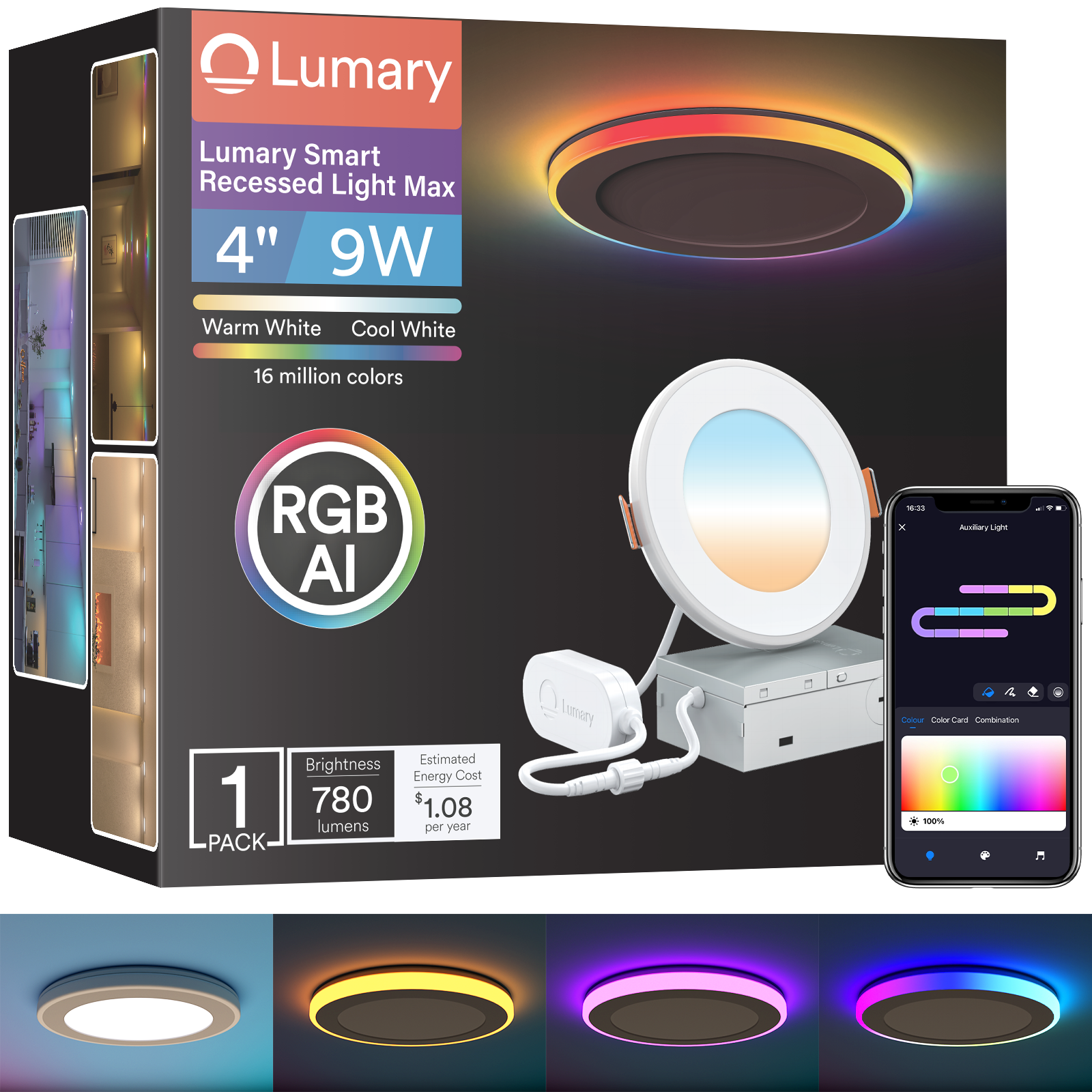
The Lumary Smart RGBAI Recessed Light with Gradient Auxiliary Night Light is designed for standard on/off switch operation, with all four of its lighting modes — Downlight, RGBAI Gradient, RGB, and Nightlight — controlled through the app and voice assistants after the switch delivers constant power to the fixture.
Product Recommendation Analysis
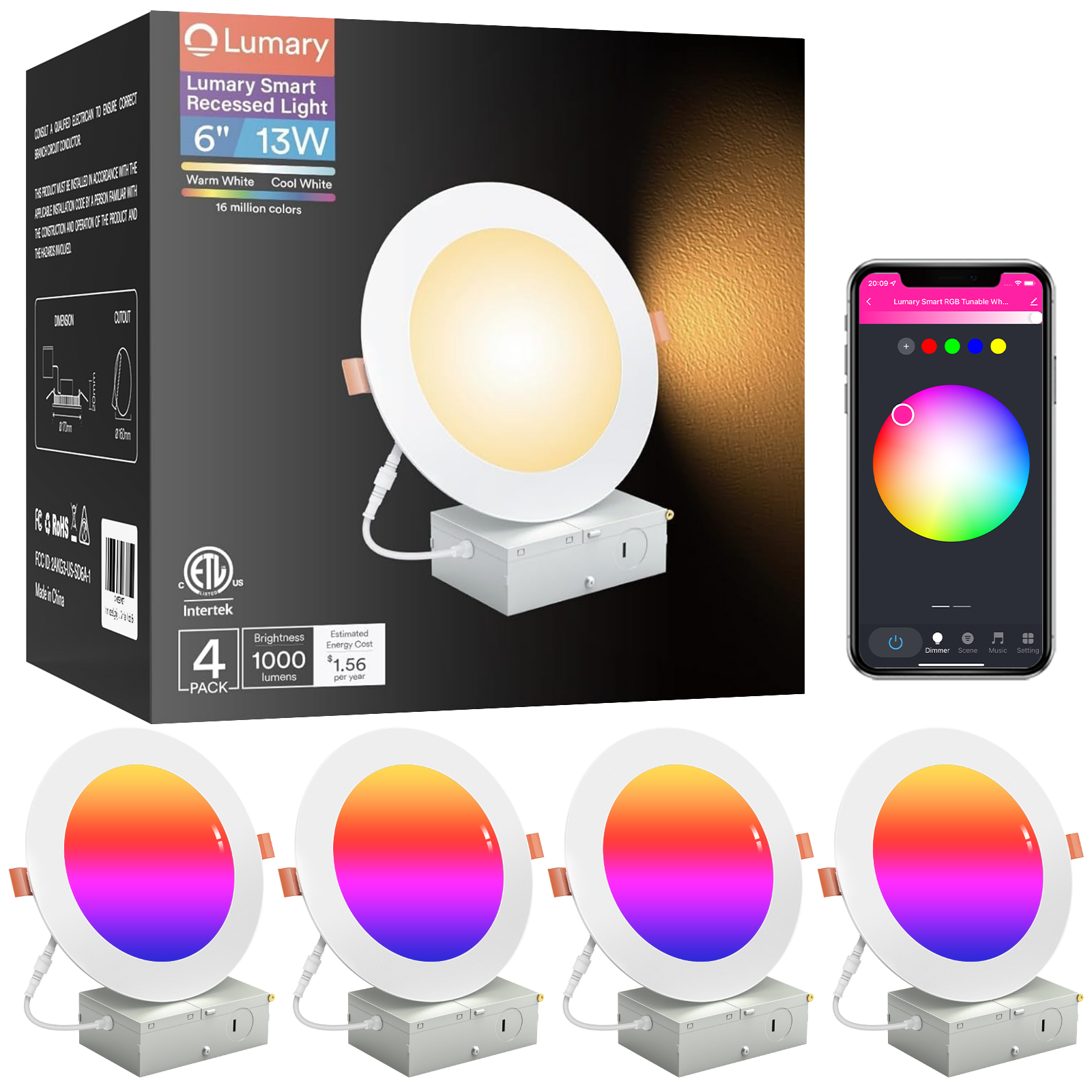
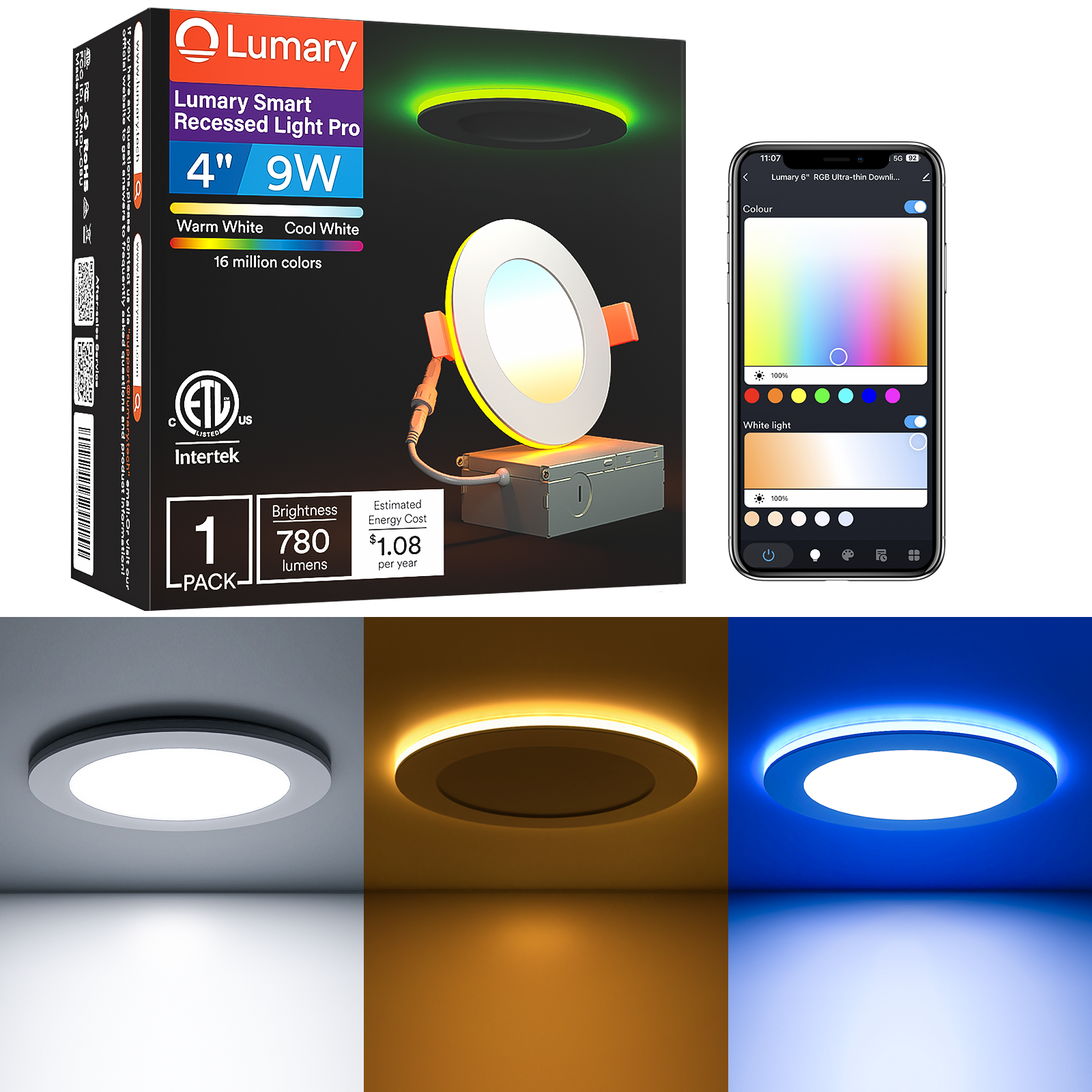
The Lumary Smart RGBAI Recessed Light with Gradient Auxiliary Night Light is available in 4 inch (9W, 780 lumens), 6 inch (12W, 1,000 lumens), and 8 inch (18W, 1,400 lumens) sizes in configurations from 1 to 24 units. Each fixture connects to a standard junction box via spring clip canless mounting with no separate housing required. The ETL and FCC certifications confirm compliance with UL 1598, UL 8750, and NEC standards. The integrated smart driver operates on 2.4GHz Wi-Fi and Bluetooth, requires a standard on/off wall switch delivering constant power, and provides all dimming — 1% to 100% — through the driver's own precision control rather than through any wall-side dimmer hardware.
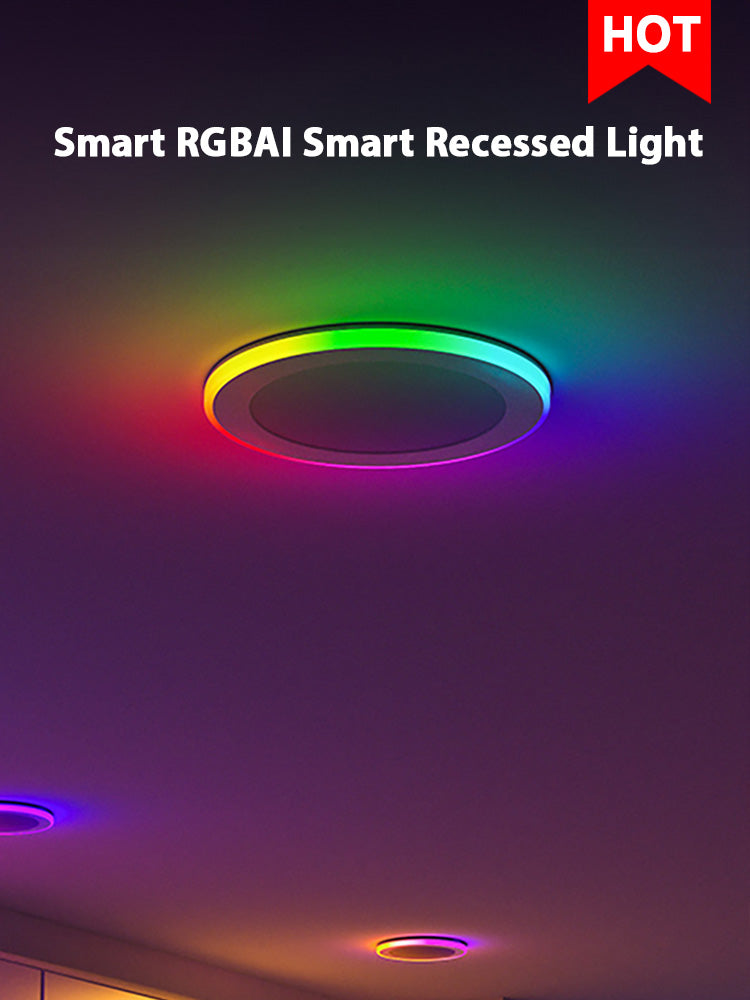
The four-mode RGBAIWW LED system — Downlight at CRI 90+ across 2700K to 6500K, RGBAI Gradient across 12 individually addressable auxiliary ring segments, RGB accent, and Nightlight — all operate through the Lumary app, Alexa, Google Assistant, and Siri, making the wall switch a power-only device for this fixture. Group control coordinates all installed units simultaneously from one scene command. Full specifications and pack pricing are available on the Lumary Smart RGBAI Recessed Light with Gradient Auxiliary Night Light product page.

Technical Specification Table
| Specification | Lumary Smart RGBAI Recessed Light with Gradient Auxiliary Night Light US-SD4E / US-SD6E / L-SD8E |
|---|---|
| Model designation | US-SD4E-1/4 (4") / US-SD6E-1/4 (6") / L-SD8E1/4 (8") |
| Wattage | 9W (4") / 12W (6") / 18W (8") |
| Brightness | 780 lm (4") / 1,000 lm (6") / 1,400 lm (8") |
| Circuit load per fixture | 9W–18W — negligible against any standard 15A or 20A residential circuit |
| Circuit load — 4-unit pack | 36W (4") / 48W (6") / 72W (8") — under 5% of a 15A circuit's 1,440W sustained limit |
| Switch requirement | Standard on/off switch — NOT compatible with dimmer switches of any type |
| Switch behavior for smart function | Switch must remain ON for app, voice, and scheduled control to function |
| Mixed-circuit compatibility | Compatible on the same circuit with other LED or regular fixtures at any wattage |
| Mixed-switch compatibility | Requires a dedicated standard switch; cannot share a dimmer switch with regular fixtures |
| CRI | 90+ in Downlight Mode |
| Color temperature | 2700K–6500K (Downlight) |
| LED technology | RGBAIWW — R, G, B, AI Color, Ice White, Warm White |
| Auxiliary ring segments | 12 individually addressable |
| Lighting modes | Downlight / RGBAI Gradient / RGB / Nightlight |
| Preset scenes | 50 |
| Smart connectivity | 2.4GHz Wi-Fi |
| Voice assistant support | Alexa, Google Assistant, Siri |
| Certifications | ETL and FCC |
| Pack sizes | 1, 4, 8, 12, 16, 24 units |
| Pricing | $49.99 (4"/1pc) to $229.99 (8"/4pcs) |
Mixed-Circuit Compatibility Framework: What Works, What Causes Problems, and How to Resolve Each
The table below maps every common mixing scenario — same circuit, same switch, different switches, with and without dimmer — against the specific electrical and behavioral consequences of each, and how the RGBAI recessed light from Lumary is correctly integrated in each context.
| Mixing Scenario | Electrical Safety | Smart Function Impact | Visible Symptom if Misconfigured | How This Lumary RGBAI Recessed Light Should Be Configured |
|---|---|---|---|---|
| Same circuit, separate standard on/off switches | ✓ Safe — load adds linearly; well within 15A circuit limit at any practical fixture count | ✓ Full smart function — switch stays ON for smart fixtures independently | None — this is the recommended configuration | Smart fixtures on their own switch (permanently ON); regular fixtures on their own switch |
| Same circuit, same standard on/off switch | ✓ Safe electrically | ✗ Partial — flipping the switch off resets the smart fixture's driver state, erases scheduled scenes, and requires reconnection | Smart fixtures revert to default white output on every switch cycle; smart features unavailable when switch is off | Acceptable if the household understands the switch must stay ON; all control handled via app or voice |
| Same circuit, same dimmer switch | ✓ Safe electrically | ✗ Incompatible — smart driver cannot operate on dimmer-modulated power; initialization failure and persistent malfunction | Flickering, incomplete startup, erratic color output, possible failure to connect to Wi-Fi | Replace dimmer switch with standard on/off switch before installing Lumary fixture on the circuit |
| Same circuit, LED-compatible dimmer switch (for regular LEDs only) | ✓ Safe for regular fixtures | ✗ Still incompatible for smart fixture — LED dimmer switch still modulates power in a way the smart driver cannot handle | Same as above — flickering, incomplete initialization, smart function disrupted | Move smart fixtures to a separate circuit leg with a standard switch; leave dimmer for regular fixtures only |
| Different circuits, different switches | ✓ Maximum electrical isolation | ✓ Full smart function with zero interaction between fixture types | None | Ideal for large multi-zone installations; Lumary app group control coordinates across circuits transparently |
| Startup current spike from incandescent on shared circuit | ✓ Safe — momentary inrush is within circuit rating | ✓ Smart function retained; brief LED sensitivity to voltage transient | Faint flicker in smart fixture for under 1 second when incandescent powers on | Normal behavior documented by DoItYourself.com community; no corrective action required |
Competitive Landscape
The smart recessed downlight category includes several brands whose switch and circuit compatibility requirements apply the same general principles, though specifics vary by product.
Govee's smart RGBWW recessed downlights use 2.4GHz Wi-Fi and Bluetooth with the Govee Home app, Alexa, and Google Assistant. Govee's product community on Slickdeals confirms the same constant-power requirement: smart control requires maintained switch power, with all dimming handled through the app layer. Govee's RGBWW architecture provides warm and cool white alongside RGB color, competing in the same product tier as the Lumary RGBAIWW fixture.
Philips Hue's White and Color Ambiance recessed downlights operate within the Hue Bridge ecosystem. The SmartThings community discussion on controlling multiple recessed lights from one switch captures the smart switch alternative that Hue buyers frequently consider: "Rather than spend a ton of money getting the individually controlled light bulbs, I was hoping I could simply replace the switch." Hue's Zigbee-based architecture with Matter support gives it the broadest protocol compatibility of any major brand in this category.
WiZ under Signify provides smart recessed downlights with 2.4GHz Wi-Fi and the SpaceSense presence automation that can modulate fixture behavior based on occupancy rather than switch state. This presence-based approach partially addresses the smart-switch behavioral conflict by removing the switch from the daily interaction pattern entirely.
Kasa by TP-Link applies its networking expertise to smart recessed downlights with stable 2.4GHz connectivity and Alexa and Google Home integration. The Tom's Guide smart home forum discussion on smart switches versus smart lights captures the Kasa-ecosystem buyer's common experience: "I also found that using both smart switches and smart lights is the best solution" — battery-powered auxiliary switches in convenient locations while the main switch stays ON, preserving smart function.
Eufy's smart recessed downlights apply Anker's quality control framework alongside Eufy ecosystem integration, with app-based dimming and control following the same constant-power switch model.
Within this competitive field, the 4-in-1 smart recessed light from Lumary shares the constant-power switch requirement with every major competing smart recessed brand — this is a category-wide characteristic of Wi-Fi LED drivers, not specific to Lumary. The Lumary fixture differentiates through its four-mode RGBAIWW capability — CRI 90+ Downlight, 12-segment RGBAI Gradient, RGB, and Nightlight — three size options (4", 6", 8"), and pack configurations up to 24 units, at the lowest per-fixture price point among comparable multi-mode smart recessed lights.
Application Scenarios
Kitchen with Existing Incandescent Cans: Converting Some, Keeping Others on Separate Switches
The most common mixed-installation scenario is a kitchen where an existing circuit powers 8 incandescent recessed cans on a single dimmer switch, and the homeowner wants to convert some of them to smart fixtures while leaving others unchanged during a phased renovation. This is the scenario where the switch type is the issue that must be resolved before the fixture type question is even relevant.
As the AnandTech forum thread on mixing different wattage LEDs on the same dimmer documents from the community's hardware-experienced membership: "There are two factors. One is whether the dimmer switch is the old school triac type vs the newer type meant for LEDs. The other factor is whether you expect them to dim the same linear amount." The Lumary RGBAI fixture adds a third factor: it requires no dimmer at all, because its driver handles dimming internally via app commands. A kitchen with an existing dimmer switch serving 8 incandescent cans cannot have even one Lumary smart downlight with gradient auxiliary added to that switch leg without replacing the dimmer first.
The correct retrofit approach for this kitchen: identify how many switch legs the existing 8-can circuit has. If the circuit has two switches in a 3-way configuration, one switch leg can be reconfigured as a standard on/off switch for the smart fixtures while the other handles the remaining regular fixtures. If a single dimmer controls all 8, replacing that dimmer with a standard on/off switch is the prerequisite — the regular fixtures then lose their hardware dimming, but the smart fixtures gain their required constant power and replace hardware dimming with app-controlled 1% to 100% digital dimming that is more precise anyway. The Lumarysmart troubleshooting guide is explicit: "Remove old dimmer switches for the best results. Change how bright they are in the app for best results."
Bedroom Mixed Installation: Smart Downlights for Atmosphere, Regular Fixtures for Task Lighting
A master bedroom with a ceiling fan with a light kit on one switch and four recessed can lights on a second switch represents a clean starting point for a mixed installation: the two fixture types are already on separate switches, which is the electrical separation that prevents the smart-versus-regular switch conflict from arising. Adding four Lumary RGBAI recessed lights to the recessed lights' switch leg — replacing the existing four cans — while leaving the fan-with-light on its separate standard switch produces a bedroom where the recessed smart lights are always powered and app-controlled, the ceiling fan operates independently on its own switch, and the two fixture types share the same circuit without any interaction between them.
The circuit load calculation for this scenario: four 12W Lumary fixtures draw 48W; the ceiling fan light kit at 20W adds 20W; total circuit load is 68W against a 15A circuit's 1,440W sustained limit — a load level so minimal that Engineer Fix's circuit analysis guide confirms it is "acceptable because the total electrical load in these spaces is usually low and non-continuous." The bedroom's nightlight mode — activated by a double-flick of the wall switch to generate a soft auxiliary ring glow — adds a third lighting state that the ceiling fan's light kit cannot replicate, making the smart-plus-regular mixed bedroom genuinely more functional than either fixture type alone.

Living Room Phase-In: Starting With Four Smart Fixtures on a Twelve-Can Circuit
A living room wired with twelve recessed incandescent cans on a single standard on/off switch (already correctly configured — not a dimmer) is the ideal starting condition for a phased conversion to smart recessed lights. Replacing four of the twelve cans with Lumary smart recessed lights while leaving eight as standard fixtures on the same switch is electrically sound, but it introduces the behavioral issue that the DoItYourself.com community thread documents: the smart fixtures will lose their driver state every time the wall switch is flipped, because all twelve fixtures share the same switch.
The practical resolution depends on how the household wants to operate the room. If the wall switch will primarily remain ON and room control happens via the Lumary app and voice commands, the mixed installation on one switch works — the smart fixtures maintain their settings while powered, and the regular fixtures provide background ambient illumination that augments the smart fixtures' downlight mode without competing with the RGBAI and nightlight modes, which use only the auxiliary ring while the main downlight is off. If the household expects to use the wall switch frequently for on/off control, the correct configuration is a split: have an electrician separate the twelve-can circuit at the junction box level into two switch legs, with the four smart fixtures on their own standard switch and the eight regular fixtures on the other.
Home Theater Installation: Smart Fixtures on a Dedicated Circuit for Conflict-Free Operation
A home theater or game room ceiling typically has 4 to 6 recessed fixtures serving the ceiling illumination function, with the room designed around a specific lumen output and color temperature for viewing conditions. A mixed installation in this space — some smart, some regular — creates the most visible conflict of any room type, because the viewing environment is carefully controlled and any inconsistency between fixture types is perceptible against the dark background typical of active theater use.
Multiple LED lights on the same circuit can cause uneven current distribution, leading to flickering. Reduce the number of lights per circuit (recommended: ≤10). Use separate circuits or dedicated drivers. For a home theater where the Lumary RGBAI recessed light serves as bias lighting and entertainment atmosphere, a dedicated circuit with smart fixtures only eliminates the incandescent startup voltage transient that causes the momentary flicker documented in mixed installations. The RGBAI Gradient Mode and RGB accent mode that make home theater and game room installations distinctive — flowing colors across the ceiling during gaming, coordinated ambient scenes during film viewing — require a stable, noise-free driver environment that a dedicated circuit with a permanently ON standard switch provides. A single Alexa command shifts the room from standard downlight for setup to entertainment mode for viewing, and the 12-segment gradient ring transforms the ceiling into an atmospheric visual element without any additional fixture investment. Fromlux
Open-Plan Kitchen-Living Space: Zoning Smart and Regular Fixtures by Function
An open-plan space where a kitchen zone and a living zone share a continuous ceiling presents the most sophisticated mixing challenge because the two zones genuinely require different switch behaviors: the kitchen's task lighting needs frequent manual on/off control via the wall switch during cooking, while the living zone's smart recessed lights need constant power to serve the entertainment, ambient, and scene-based functions that app and voice control enable.
This is precisely the scenario that motivated the Tom's Guide smart home forum's community consensus: "I use a smart switch for utility-based rooms like bathroom and kitchen with motion detection and similar features. And use a smart bulb [or smart fixture] when you want colorful lights." The recommendation maps directly to the open-plan context: kitchen fixtures on a smart wall switch that provides manual on/off control with motion-activation capability; living zone smart fixtures on a standard on/off switch that stays permanently ON, with all living zone control handled by the Lumary app and Alexa. The two zones share the same circuit from a load standpoint — combined load of kitchen 60W fixtures plus four 12W Lumary living zone fixtures totals well under the circuit's capacity — but operate on separate switch legs that allow each zone's behavioral requirements to be satisfied independently. KCL Electric's recessed lighting guide reinforces the switch separation approach: "If your recessed lights are connected to a dimmer switch, check if the dimmer is compatible with the bulbs you are using" — in the open-plan context, verifying each switch's compatibility with its connected fixture type before installation prevents the cross-zone interference that a single mixed-type switch produces.
Editorial Assessment
The electrical answer to whether smart recessed lights can share a circuit with regular lights is an unqualified yes — circuit load calculations across any realistic combination of Lumary smart recessed fixtures and standard LED or incandescent fixtures produce a total wattage well under the 80% sustained load threshold of any standard 15A or 20A residential circuit. The Alibaba circuit load analysis provides the arithmetic baseline: "Always leave a 20% safety margin below your circuit's max load. When mixing lighting types, you must calculate the cumulative load." A 12-fixture living room with eight 12W Lumary smart recessed lights and four 40W regular fixtures draws 96W + 160W = 256W — under 18% of a 15A circuit's 1,440W sustained limit.
The behavioral answer is conditional: smart and regular fixtures on the same switch work acceptably when the switch remains ON and smart control handles all adjustments, but the switch must be a standard on/off type — not a dimmer of any kind. Fixtures on separate switches achieve complete independence of control with no interaction effects. A dimmer switch anywhere in the circuit leg serving the Lumary RGBAIWW recessed downlight is the one configuration that requires corrective action before installation.
Frequently Asked Questions
Does adding a Lumary smart recessed light to a circuit that currently has incandescent or regular LED fixtures increase any electrical risk?
No. The Lumary smart recessed fixtures draw 9W to 18W depending on size — far below the thermal and electrical load that any incandescent fixture creates on the same circuit. As Engineer Fix's incandescent and LED mixing guide documents: "Mixing light bulbs rarely poses a direct electrical safety risk to the circuit itself due to the vast difference in power consumption. Standard residential fixtures are typically rated for high incandescent wattages. A modern LED bulb providing the same light output consumes only about 8 to 15 watts, which is far below the maximum rating." Adding a 12W smart fixture to a circuit that currently carries 60W incandescent fixtures reduces the circuit's total load — it does not increase any electrical hazard.
What exactly happens to the Lumary smart fixture when the wall switch is turned off and then back on?
When power is cut by the wall switch and then restored, the Lumary RGBAI fixture re-initializes its driver, reconnects to the 2.4GHz Wi-Fi network, and returns to a default white light state rather than resuming the last-used scene or scheduled state. The product description confirms this behavior: "Frequent use of the wall switch will reset the lights." In a mixed installation where the switch also controls regular fixtures, every time a household member uses the switch to turn off the room's regular lights, the smart fixtures lose their programmed settings and require app reconfiguration. The correct operational approach is to keep the switch ON permanently and control the smart fixtures exclusively through the Lumary app, Alexa, Google Assistant, or Siri.
Why does my regular LED fixture flicker briefly when I turn on an incandescent light on the same circuit, and is this a sign of a problem?
This brief flicker is a well-documented characteristic of LED driver behavior in response to the inrush current that incandescent bulbs draw at startup. As the DoItYourself.com community thread on LED and incandescent fixtures on the same circuit explains from experienced DIYers: "LEDs are electronic light. They respond instantly to any voltage change. When you turn on your incandescent lights — it's like a momentary dead short. That little flicker you see with the LEDs is normal." It is not a sign of circuit overload, wiring failure, or fixture defect. It is the LED driver's sensitivity to the momentary voltage drop caused by the incandescent bulb's startup inrush. The flicker lasts under one second and does not affect the LED's operational lifespan or smart functionality.
Can I use the Lumary smart recessed lights alongside a Lutron Caseta or other smart dimmer switch that is already installed for my regular fixtures?
No. The Lumary RGBAI recessed fixture requires a standard on/off switch regardless of how sophisticated the dimmer switch is. Lutron's own Caseta troubleshooting documentation describes the LED driver interaction issues that arise even with its own carefully engineered LED-compatible dimmers — ghosting, flicker, and incomplete dimming performance — when LED loads with sensitive internal drivers are connected to triac-based dimmers. Smart recessed lights that handle their own dimming through an internal driver present the same challenge regardless of the dimmer brand. The solution is either to replace the Caseta dimmer with a standard on/off switch for the smart fixture circuit, or to install the smart fixtures on a separate switch leg that has a standard switch, leaving the Caseta to control only the regular dimmable fixtures.
Is there a maximum number of Lumary smart recessed lights I can add to a circuit that already has regular fixtures?
The practical limit is the circuit breaker's ampere rating multiplied by 80% for continuous loads. On a 15A circuit (1,440W continuous limit), subtract the total wattage of existing regular fixtures first. If eight 40W recessed cans are already on the circuit (320W), the remaining 1,120W of available capacity can theoretically support over 90 additional 12W Lumary fixtures — a number no residential room installation approaches. The circuit load is effectively unlimited for practical smart recessed light installations. The more meaningful constraint is the Wi-Fi network's device count: each smart fixture is a separate Wi-Fi device that the router must manage. The Lumary app's group control function handles the user experience of coordinating many devices, but routers with weaker 2.4GHz management may experience stability issues above 20 to 25 simultaneously connected devices on the same band. For installations beyond 12 fixtures, a mesh Wi-Fi system with strong 2.4GHz coverage ensures all fixtures maintain reliable connectivity.

