







An 1,100-lumen rating tells you how much visible light a source emits; it does not, by itself, tell you whether a room will feel bright enough. The deciding measure in a room is illuminance—the light that actually reaches a desk, countertop, floor, or other surface. DOE defines one foot-candle as one lumen per square foot and notes that achieving a target illuminance requires the right combination of lumen output, fixture spacing, and distribution. The U.S. Forest Service’s lighting handbook adds that recommended levels vary with the task and are measured at the relevant horizontal plane, not at the ceiling. That means 1,100 lumens can be useful as one layer of a lighting plan, but “enough” changes when the same fixture moves from a hallway to a kitchen counter, from an 8-foot to a 10-foot ceiling, or from a white-painted room to one with darker finishes. DOE’s lighting-specification guidance and the Forest Service lighting handbook explain the lumen-versus-illuminance distinction.
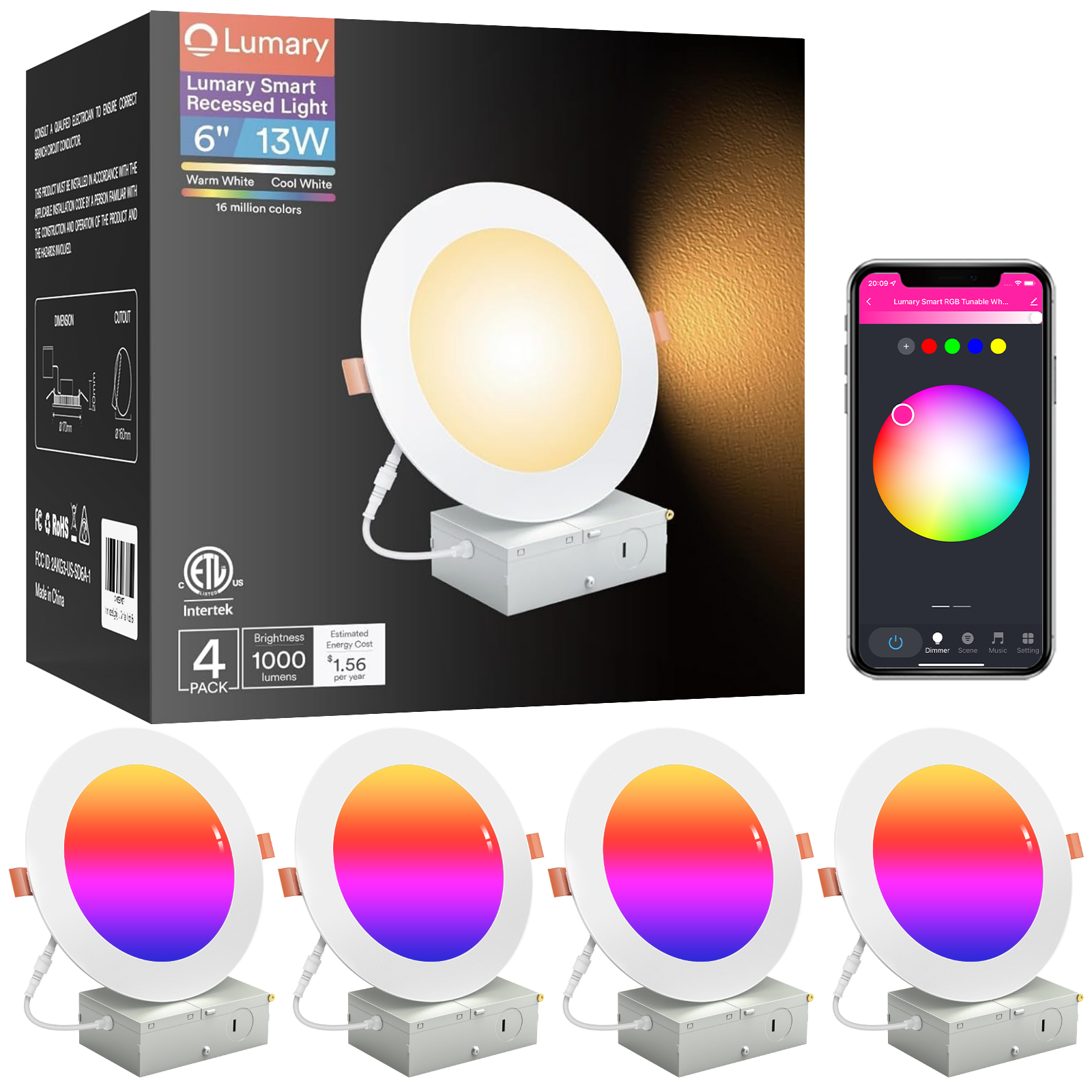
For the Lumary Smart Canless Recessed Lighting 6 inch 4 PCS, there is also a specific specification-reading issue. Its product description states 13 W and 1,100 lm, while the separate Specs block lists 13 W and 1,000 lumens. The article title’s 1,100-lumen question is therefore a useful planning question, but neither published number should be turned into a measured room result or assigned to the white or black variant without confirmation. Treat 1,000–1,100 lumens as the product page’s stated per-light output range and design from the conservative end until Lumary clarifies it. A four-light example would be 4 × 1,000 = 4,000 lumens by the Specs figure, or 4 × 1,100 = 4,400 lm by the description; both are initial source-output totals, not foot-candle readings after ceiling height, surface reflectance, fixture distribution, and furniture are involved.
Downlight geometry explains why the difference matters. ENERGY STAR distinguishes a downlight’s total light output from its distribution, requiring qualified downlights to direct at least 75% of total lumens into the 0–60-degree zone below the fixture. That does not establish Lumary’s distribution or certify the product, but it illustrates the correct buyer question: where will the light land? A downlight has a downward role, whereas a wall sconce, table lamp, or indirect fixture can add light to vertical surfaces or a reading plane. The DOE also defines downlights as small direct-lighting units. As a result, a room can have a substantial ceiling lumen total yet still leave the front of a person at a counter in shadow, or make a television screen uncomfortable because light placement rather than lumen quantity was wrong. ENERGY STAR’s downlight criteria and DOE’s fixture-type definitions support that distinction.
Use a rough calculation only as a first conversation with the room. For example, an illustrative 12-by-12-foot room is 144 square feet. If the design brief calls for a hypothetical 10 foot-candles of general illumination on the floor or task plane, the starting arithmetic is 144 square feet × 10 lumens per square foot = 1,440 lumens reaching that plane. One 1,100-lumen source cannot be assumed to create that level because the fixture’s output is not all delivered uniformly to the plane. Conversely, four 1,000-lumen fixtures should not automatically be called “too bright,” because dimming, placement, room finish, and task layers alter the experience. The calculation identifies what must be verified; it does not replace a layout, a photometric plan, or a light-level measurement.
Placement comes before fixture count. Lowe’s recommends beginning a recessed-light layout with the room’s function, dimensions, and activity zones; its simple starting estimate divides ceiling height by two for fixture spacing, then adjusts for the room and task areas. UC Davis’s residential lighting guide similarly notes that ceiling-product spacing depends on distance to the main task plane and light distribution. Those are planning heuristics, not dimensions for this Lumary model. They matter because a kitchen needs separate attention over preparation surfaces, a living room needs a different balance around screens and seating, and a hallway needs continuity rather than high task brightness. Lowe’s layout guide and the UC Davis residential-lighting guide provide the appropriate framework for adapting a ceiling grid to the room.
Controls make a higher-output plan more adaptable, but they do not erase the need for a plan. Lumary lists 1%–100% brightness adjustment, white light from 2700K to 6500K, RGBWW color, app/remote/voice control, schedules, grouping, shared control, and memory. Brightness adjustment can make an installed set more usable for cleaning and later evening use, while color temperature lets the household select the visual character of its white light. Energy Star’s LED guidance explains that LEDs are directional light sources, so fixture placement and the application remain important even when the source can be dimmed. The product page’s listed CRI 90 also gives a buyer a published color-quality metric to consider for food, clothing, and printed work; it is not a substitute for putting light on the needed surface. ENERGY STAR’s LED overview and DOE’s LED basics explain why direction, color quality, and practical use must be considered together.
Product Recommendation Analysis
The Lumary 6-inch 4-light smart recessed set is a coordinated ceiling-light system rather than one 1,100-lumen lamp placed in isolation. Lumary identifies the white unit as US-SD6A-4 and the black unit as US-SD6B-4. The page lists an ultra-thin canless format, a junction box with spring clips, AC 110 V, 13 W, FCC and ETL compliance, and a four-piece pack. The stated physical arrangement matters to room brightness because four locations can produce a more distributed general-light layer than one centered fixture. It still requires a real ceiling plan: fixture count and placement need to reflect ceiling height, cabinet lines, screens, and seating rather than the fact that the package contains four units.
The smart canless recessed-light package provides 1%–100% brightness adjustment, 2700K–6500K white light, RGBWW color, CRI 90, Bluetooth and Wi-Fi listed connectivity, and app, remote, and voice control. Lumary’s description says the app uses 2.4 GHz Wi-Fi for remote control, grouping, schedules, and remembered settings; Google Assistant, Alexa, and Siri are listed in Specs. These controls are relevant to the “enough” question because a room that feels appropriate for food preparation may need a lower ambient setting for a film or late-night movement. They do not produce additional lumens beyond the stated source output, and they should not be used to mask an unbalanced ceiling layout.
The output discrepancy is the point to resolve before a detailed plan. The description says 1,100 lm, while the Specs block says 1,000 lumens. Use the lower stated 1,000-lumen figure when testing a preliminary fixture count, or ask Lumary to confirm which figure applies to the selected variant. For an illustrative four-light ceiling layout, plan around 4,000 lumens first and regard 4,400 lm as the alternate published description value, not an assured upgrade. The Lumary Wi-Fi downlight system is most useful where a homeowner wants controllable, distributed general lighting and is willing to add task or decorative layers when the room’s use requires them.
Technical Specification Table
| Specification | Lumary Wi-Fi Smart Canless Recessed Lighting 6 inch 4 PCS (US-SD6A-4 / US-SD6B-4) |
|---|---|
| Model designation | Lumary Wi-Fi Smart Canless Recessed Lighting 6 inch 4 PCS: US-SD6A-4 (White) / US-SD6B-4 (Black) |
| Pack format | 6 inch, 4 PCS |
| Physical format | Ultra-thin smart canless recessed lighting |
| Published wattage | 13 W |
| Published light output | 1,100 lm in the description; 1,000 lumens in the Specs block |
| Input voltage | AC 110 V |
| Light color | RGBWW |
| White color-temperature range | 2700K–6500K |
| Brightness adjustment | 1%–100% |
| Color rendering index | CRI 90 |
| Connectivity protocol | Bluetooth, Wi-Fi |
| Control methods | App, remote, voice |
| Voice assistants listed | Google Assistant, Alexa, Siri |
| Scenes and effects | 16 million colors, 8 scene modes, custom scenes, music sync |
| Installation stated | Junction box and spring clips |
| Compliance listed | FCC, ETL |
Room-Brightness Decision Framework for a 1,100-Lumen Downlight
Use this table to convert a source-output number into a room plan. Begin with the activity and the surface where light is needed, then assess room size, ceiling height, spacing, and layers. Do not multiply a published lumen rating and call the result room brightness; first decide whether the source is providing general, task, accent, or navigation light. The Lumary column is limited to information stated on the official product page. It shows which published controls or specifications can support the decision, not a promise that the product will produce a particular foot-candle reading in an unmeasured room. For final layouts, document the room dimensions and fixture locations, then verify the actual result after installation.
| Key Purchasing Criterion | Common Sign of a Poor-Quality Unit | How This Lumary Smart Canless Recessed Light Addresses It | Long-Term Usage / Performance Impact |
|---|---|---|---|
| Interpreting the lumen number | A source-output claim is mistaken for measured room illuminance | The product page reports 1,100 lm in the description and 1,000 lumens in Specs | Use the lower figure for conservative planning until the discrepancy is clarified |
| General-light adjustment | One ceiling setting is harsh at night or inadequate for cleaning | Lumary lists 1%–100% brightness adjustment | The same fixture layout can be set differently as household use changes |
| White-light selection | The room is locked into one visual appearance for every activity | The published white range is 2700K–6500K | Users can choose a warm or cool white state without changing a lamp |
| Color quality for visual tasks | Food, printed pages, or clothing look unexpectedly different | Lumary lists CRI 90 | A buyer has a published color-quality metric to evaluate for task use |
| Multiple activity zones | All ceiling fixtures act as one undifferentiated room state | The page lists app grouping and multi-room group control | A compatible lighting plan can organize fixtures around activities or rooms |
| Repeatable routines | Preferred brightness is repeatedly recreated by hand | Lumary lists schedules, scenes, and memory | Common work, cleaning, and evening states can be restored consistently |
| Everyday control access | One person’s phone becomes the only practical control path | App, remote, voice control, and device sharing are listed | More household members can reach the intended brightness state |
| Ceiling-layout fit | Fixture selection ignores the construction plan | Lumary states an ultra-thin format with a junction box and spring clips | Installation still requires field verification, but the stated form supports a low-profile plan |
| Source-output planning | A room receives too few or too many fixed-output fixtures | The listed 13 W, 1,000–1,100 lm output can be multiplied transparently for examples | Fixture-count decisions can be recorded and revisited as the room is furnished |
Competitive Landscape
The meaningful comparison for a 1,100-lumen smart downlight is not only brand versus brand; it is distributed ceiling lighting versus a room built around replaceable smart bulbs, lamps, strips, or panels. A buyer needs to decide whether the priority is a low-profile fixed ceiling system, a broad smart-home ecosystem, a particular control protocol, or the mechanical convenience of changing a bulb. Different formats can coexist in a layered room, but none of them makes a lumen number independent of placement, ceiling height, and the surface being illuminated.
Philips Hue’s reviewed smart-bulb ecosystem is relevant to buyers who prioritize a mature family of bulbs and fixtures. PCWorld highlights Bluetooth and Zigbee operation plus the deeper Hue ecosystem when a bridge is used. Hue gives an owner the option to use standard smart bulbs in compatible housings or select dedicated fixtures, so its main contrast with a canless downlight is the infrastructure decision: retain a socket-based replacement path, or design the ceiling around a complete light assembly.
Govee’s Wi-Fi bulb review represents a format centered on app-managed color and white lighting in a replaceable bulb. TechRadar’s testing found its cited 800-lumen bulb competitive in output with other smart bulbs, while noting that saturated-color use and setup can shape the experience. Govee is useful as a complementary accent, lamp, or bulb-based layer in a room with recessed general lighting. It is not a one-for-one physical substitute for a 6-inch, junction-box-connected ceiling downlight.
Nanoleaf Matter Essentials suits a buyer who has made multi-platform smart-home compatibility the first filter. Its tested bulb format is designed around a standard light socket, while TechRadar emphasizes Matter as the central ecosystem idea. That can be attractive when existing recessed cans are already in place and future lamp changes are valuable. The tradeoff is that the buyer is still working within the existing housing, trim, and bulb dimensions rather than specifying a new ultra-thin ceiling system.
Kasa’s KL125 smart-bulb review reflects the Wi-Fi-bulb approach: lighting intelligence is added at the lamp, with app settings and scheduling rather than a new recessed assembly. This is a practical architecture for a compatible existing socket, especially where a household expects to exchange lamps as needs change. For a new ceiling layout, though, the brightness calculation still needs to start with the actual bulb output, housing, and intended task plane instead of assuming all smart bulbs distribute light like a downlight.
LIFX in TechRadar’s tested smart-lighting guide highlights an additional practical point: smart bulbs can be physically larger than ordinary lamps, so their fit within a shade or existing fitting needs confirmation. In recessed applications, the parallel check is whether the housing, trim, ceiling opening, and desired distribution fit the plan. LIFX remains a reasonable bulb-based route for users who value replaceable lamps and vivid smart-light effects, but its form factor solves a different problem from adding a four-light canless recessed system.
For this brightness question, the Lumary 6-inch smart downlight 4-pack is most logically evaluated as an adjustable general-light grid. Its verified 13 W per light, reported 1,000–1,100 lm output, ultra-thin canless format, CRI 90, and 2700K–6500K white range establish the starting hardware and light-quality context. Its 1%–100% brightness adjustment and app/remote/voice controls then let the household tune the installed grid for a task, cleaning, movie, or late-evening state. That combination helps when the room needs more than a single central point of light, because the buyer can distribute the fixtures and reduce output later. It does not remove the need to verify the room’s physical layout, decide whether countertop or reading tasks need their own layer, or confirm the published output discrepancy before finalizing a count.
The category-selection rule is straightforward. Choose a socket-based smart-bulb system when existing compatible housings and bulb-level replacement are central to the project. Choose a canless recessed-light layout when low-profile ceiling placement and distributed general illumination are the governing needs. In either case, use lumens to start the conversation, then decide “enough” from the room’s measured dimensions, task plane, distribution, and the layers that will be used alongside the ceiling light.
Application Scenarios
1. Compact Home Office: Desk Brightness Versus Screen Reflections
Consider an illustrative 10-by-12-foot home office with an 8-foot ceiling, a desk under one half of the room, and a monitor facing a wall. The space is 120 square feet. If a homeowner sketches a hypothetical 20-foot-candle target on the desk surface, the first arithmetic is 120 square feet × 20 lumens per square foot = 2,400 lumens arriving at that plane. That calculation does not say that two 1,100-lumen downlights will deliver 2,200 foot-candles or even 20 foot-candles; it identifies the gap between source output and delivered task light. Ceiling height, fixture positions, monitor location, and desk orientation decide the result. DOE’s lighting guidance explains that target illuminance depends on output, spacing, and distribution.
Before installation, use the Lumary recessed lighting 6-inch 4 PCS as part of a task map, not simply as four equal circles. Locate general-light positions so their downward light does not point directly into the display from the user’s sightline. During focused work, choose a white setting within Lumary’s stated 2700K–6500K range and raise brightness as appropriate; the published CRI 90 is relevant when comparing printed proofs, fabrics, or product samples. After work, a saved lower-brightness state or schedule can return the room to a less intense setting. App, remote, and voice controls give multiple documented ways to make that change.
The remaining constraint is shadow and glare. A ceiling grid may light the floor while leaving the keyboard or face unevenly lit, so a desk lamp can still be the correct companion layer. The Forest Service handbook explains why illuminance must be considered at the task plane, and its cited work-space figures should not be treated as a residential-office prescription. The practical outcome is a room where 1,100-lumen sources supply controllable general light, while a dedicated desk light handles close visual work and reduces the temptation to overbuild the ceiling grid.
2. Kitchen Work Triangle: General Ceiling Output Versus Countertop Shadows
In an illustrative 11-by-14-foot kitchen, the cook moves between refrigerator, sink, and range while another person sits at an island. The competing needs are broad room brightness, clear prep visibility, and an evening setting that does not feel like a commercial work area. Four fixtures at the product page’s Specs value would total 4 × 1,000 = 4,000 lumens of stated source output; using the description value would produce 4 × 1,100 = 4,400 lm. Neither total proves countertop illuminance. Cabinets and a person standing at the counter can block ceiling light, so a final layout needs to show the cut lines, counter edges, and the person’s working position before ceiling openings are made.
The 13 W Lumary canless downlight offers useful control once the layout is right. Before cooking, create a grouped kitchen state with a chosen white setting and brightness. During food preparation, use the four-lamp ceiling system as general light and add under-cabinet or other task lighting where hands and cabinets create shadows. The published 1%–100% adjustment can lower the ceiling layer when guests remain at the island after cooking, while schedules and shared control can make the routine repeatable for another household member. RGBWW scenes are additional options, not substitutes for white task light.
Lowe’s recessed-light layout guide notes that kitchen layouts often need extra light over preparation areas and that too much overhead light can create troublesome shadows on an island. The UC Davis residential-lighting guide similarly frames residential lighting around application-appropriate fixture types and task planes. Mark the sink, range, cutting zone, upper cabinets, and island before deciding where the ceiling openings will go. The long-term outcome is not a verdict that 1,100 lumens is “enough for a kitchen”; it is a layered plan where the recessed grid provides ambient coverage and task fixtures solve the specific counter locations that a general downlight cannot guarantee.
3. Living Room Media Night: Cleaning Brightness Versus a Comfortable Screen View
Imagine an illustrative 15-by-18-foot living room with a television on one short wall, a sofa centered opposite it, and a reading chair near the window. The household wants higher brightness for vacuuming and board games but lower output when watching a film. The wrong question is whether one 1,100-lumen fixture is bright; the useful question is how many fixtures will be seen in the screen, where their downward light lands, and how their combined output can be reduced. A four-unit set represents 4,000–4,400 lumens of stated initial source output, depending on which published Lumary value is used, before the room has been measured or furnished.
The Lumary color-tunable ceiling system lets the household set an ordinary white-light scene within its published 2700K–6500K range, then lower brightness through the stated 1%–100% range for viewing. Before guests arrive, group the relevant fixtures in the app. During the film, use the remote or listed voice control for a quick change instead of leaving every ceiling light at the same high output. Afterward, Lumary’s memory function can restore the last chosen setting. Music synchronization and color scenes can be used for a social event, but they should be treated separately from the neutral white state used to judge ambient brightness.
Community reports are not a substitute for a layout calculation, yet they reveal why dimming and layers matter. In a homeowner lighting thread, participants described using multiple recessed lights below maximum output in living spaces and combining kitchens with under-cabinet lighting. That experience should be read as a design prompt, not a Lumary performance claim. A separate lamp also gives someone in the reading chair useful light without raising the light level over the television wall. Put the screen and sightlines on the plan before cutting; then use a floor or table lamp if reading needs more local illumination than a dimmed ceiling layer supplies.
4. Bedroom Morning Routine: Dressing Visibility Versus Low-Light Navigation
For an illustrative 10-by-13-foot bedroom, the lighting problem changes over a day. At 6:30 a.m., one person may need enough white light to select clothing and locate items in drawers; at 11 p.m., another person may only need a quiet path from the door to the bed. Installing a high ceiling-lumen total without a control plan can make the latter use unpleasant, while installing too few fixtures can leave dark corners during cleaning. A downlight’s source lumens do not settle the issue because the room includes wardrobes, bed height, window light, and the direction from which the user looks upward.
Set up the Lumary recessed-light group around normal routines. Before bedtime, select a lower brightness and a preferred warm-white setting from the stated 2700K–6500K range. In the morning, use the app’s listed schedule, remote, or voice option to select a brighter white state; sharing allows more than one household member to operate the fixtures. The lights’ memory function can retain the last setting, which is helpful when a routine should return after a temporary color scene or a cleaning session. These are operation features, not evidence that one brightness level is correct for every bedroom.
The visual check comes after furniture is in place. DOE defines CCT as the color appearance of light and CRI as an indicator of how objects appear under the source; the Lumary page lists CRI 90 and a wide white-temperature range. Evaluate clothes, skin tones, and drawer interiors under the chosen daily white setting rather than under a decorative color scene. If the wardrobe or mirror still lacks usable light, add a targeted layer or adjust the layout. The long-term benefit is a bedroom with several accessible brightness states rather than a ceiling system that must always be operated at full output.
5. Open-Plan Kitchen and Dining Zone: One Fixture Count Versus Two Different Activities
In an illustrative open plan, a 12-by-14-foot kitchen connects directly to an 8-by-10-foot dining zone. The kitchen is used for preparation at 5:30 p.m.; the table becomes a homework or dinner area later. Treating the combined 248 square feet as one flat brightness problem can create a poor result: high ceiling output over the food-prep zone may be welcome, while the same output above a seated diner can feel excessive. A four-light package can be a useful physical starting point, but the decision is where each light supports the activity, whether the wiring plan permits meaningful grouping, and how much daylight reaches the table during the hours it is used.
Before installation, map the work triangle, island, table, and circulation path. A four-pack smart downlight layout can use Lumary’s listed app grouping, schedules, and multi-room group control to organize a kitchen state and a dining state when the installation supports that arrangement. At dinner, lower the dining-side brightness through the stated 1%–100% range and choose a white setting from 2700K–6500K that suits the household. During homework or cleanup, increase the needed zone while keeping the other area at a different routine state. The app’s 2.4 GHz Wi-Fi requirement should be verified in the finished space before schedules become the only way people expect to control the room.
The tradeoff is that grouped control cannot correct a light placed in the wrong location. Lowe’s layout guidance advises sketching room dimensions and marking specific functional areas before locating fixtures; its spacing formula is a starting point to be adjusted for the unique room. The practical outcome is two controllable activity zones rather than one “bright enough” setting. If the dining table needs a more directed or decorative source, add that layer instead of forcing every recessed fixture to solve both kitchen task light and dining ambience.
Editorial Assessment
From a lighting-procurement perspective, 1,100 lumens is a useful source-output figure but an incomplete room specification. It can be a strong contribution to general light in a bedroom, office, hallway, kitchen, or living room, especially when several fixtures are distributed intentionally. It is not a room-size promise because illuminance depends on the plane being evaluated, the fixture’s distribution, ceiling height, spacing, surface finishes, obstruction, daylight, and any task or accent layers. The Lumary page’s two output figures—1,100 lm in the description and 1,000 lumens in Specs—make conservative planning and product confirmation particularly important.
The strongest fit is a homeowner planning a controllable multi-fixture ceiling layer, not someone searching for a single universal room-brightness number. Lumary’s stated ultra-thin 6-inch format, 13 W input, CRI 90, 2700K–6500K white range, 1%–100% brightness adjustment, and app/remote/voice controls support rooms that change between practical work and lower-intensity use. Different categories deserve consideration when an existing bulb-based recessed system must remain easy to service, when a room requires a directed task fixture, or when the ceiling plan calls for a different aperture or optic.
Who Should Buy This Product: buyers who will calculate fixture count from their room and activity needs, verify the product’s published output before finalizing a layout, and use the documented controls to tune a well-positioned four-light general-light grid. Do not treat 1,100 lumens as a standalone answer; treat it as one verified input in a measured lighting plan.
Frequently Asked Questions
Q1. Is 1,100 lumens bright for one ceiling light?
It is a meaningful amount of source output for one ceiling light, but it is not enough information to judge a whole room. Lumens describe light emitted by the source; foot-candles describe light reaching a surface. DOE explains that one foot-candle equals one lumen per square foot and that output, spacing, and distribution together create target illuminance. A 1,100-lumen recessed downlight can contribute useful general light, while a counter, desk, or reading chair may still need a different fixture or placement. For this Lumary product, note that the description lists 1,100 lm while the Specs block lists 1,000 lumens. Use 1,000 lumens for a conservative preliminary count, then obtain clarification before treating 1,100 lm as the selected unit’s planning value.
Q2. How many 1,100-lumen recessed lights do I need?
Start with room function and geometry, not a fixed fixture count. Measure the room, identify the work surfaces, then establish the desired light level for the task. The basic first-pass arithmetic is room area in square feet × chosen target foot-candles = initial planning lumens, but that result still needs adjustment for ceiling height, distribution, furniture, darker finishes, and layers. Lowe’s suggests using ceiling height divided by two as a starting estimate for recessed-light spacing, then adapting the grid for room use. For the Lumary four-pack, compare an illustrative 4,000-lumen conservative total with the room plan, rather than assuming four fixtures always suit a 6-inch layout. Mark counters, desks, screens, and seating before deciding where the four fixtures belong.
Q3. Can I use the Lumary lights for kitchen task lighting?
They can provide a controllable general ceiling layer, but a kitchen task plan should still address shadows at the counter, sink, and range. Lumary lists CRI 90, 1%–100% brightness adjustment, and a 2700K–6500K white range, all relevant to selecting a usable white-light state for food preparation. Lowe’s notes that kitchens may require extra light over preparation areas and that overhead lighting can cast shadows on an island. Use the Lumary group for general coverage, then evaluate actual light on the counter while someone stands there. If cabinets or the cook’s body block the downlights, add under-cabinet or another task layer. The practical check is the work surface, not the sum of ceiling lumens.
Q4. Does dimming mean I can install more lumens than I need?
Dimming gives flexibility, but it is not a license to ignore fixture placement, glare, or the room’s use. Lumary lists 1%–100% brightness adjustment, so a correctly distributed grid can be reduced for a film, conversation, or late-night movement and raised for cleaning. However, a light aimed or placed where it reflects in a screen, creates a hotspot, or leaves a counter in shadow remains poorly positioned at any setting. Community reports often favor a dimmable ceiling layer alongside lamps or under-cabinet lighting, but they are anecdotal rather than a lighting standard. Plan the physical grid first, then use dimming to adapt it across the day. Save one or two normal white-light settings as the baseline for judging whether the room still meets its task needs.
Q5. Why does the product page show both 1,100 lm and 1,000 lumens?
The supplied product page places 1,100 lm in its descriptive copy and 1,000 lumens in its Specs block. The page does not explain the difference or assign the figures to the white and black variants, so it should be treated as an ambiguity rather than converted into a claimed performance distinction. For a conservative room calculation, use 1,000 lumens per fixture: a four-pack is then 4 × 1,000 = 4,000 stated source lumens. Keep 4,400 lm as the alternative product-description total, not as a measured outcome. Before cutting ceiling openings or selecting a fixture count, ask Lumary which published figure applies to the exact selected item. This preserves a usable plan without presenting an uncertain number as fact.

