







For most of lighting history, homeowners bought light bulbs by watts. A 60-watt bulb was a standard bedroom bulb. A 100-watt bulb was for rooms that needed more light. The number was intuitive even if technically incorrect — watts measure electricity consumed, not light produced. With the near-universal adoption of LED technology, that shortcut collapsed. A modern 10-watt LED produces the same light as a 60-watt incandescent, and a 15-watt LED outperforms a 100-watt bulb. Wattage became irrelevant as a brightness indicator the moment LED efficiency made the watts-to-light conversion variable and unpredictable.
Lumens measure the total amount of visible light from a bulb or fixture. More lumens mean a brighter light source, fewer lumens mean a dimmer one. The lumen is the standard unit of luminous flux — the total quantity of visible light energy emitted per second by a source, measured across all directions. A standard LED night light might produce 20 to 50 lumens. A typical LED bulb for lamps might be 600 to 800 lumens. A strong LED for task work might be 1,000 lumens or more. Instead of asking "how many watts do I need?" it is better to ask "how many lumens do I need in this room?" Canyon NewsCanyon News
For recessed lighting specifically, a standard 6-inch LED recessed downlight in 2025 typically produces between 650 and 1,200 lumens, while using only 8 to 15 watts. The practical implication is that a single modern recessed downlight at the high end of this range — 1,000 to 1,200 lumens — produces meaningful room illumination from a fixture drawing no more electricity than a laptop charger. The calculation that determines whether that output is sufficient for a specific room is grounded in a framework established by the Illuminating Engineering Society (IES), which publishes recommended brightness levels for every residential room type. XHLUX
The IES standard approach is to determine the recommended lumens per square foot for your room type, then multiply by the room's square footage to find your total lumen target. For kitchen task areas, the recommended level is 70 to 80 lumens per square foot. Multiply your room's square footage by the recommended lumens per square foot to get your total lumen target. At this total, dividing by the per-fixture lumen output produces the fixture count. A 120-square-foot kitchen at 75 lumens per square foot needs 9,000 total lumens; at 1,000 lumens per 6-inch fixture, that is 9 fixtures for full kitchen task coverage — though as the XHLUX 2025 recessed lighting lumens guide notes, a layered approach combining overhead recessed lights at ambient levels with under-cabinet task lighting reduces the recessed fixture count substantially. XHLUX
The Mike Holt Electrical Forum — the largest professional electricians' community in the United States — captures the practitioner consensus precisely. In a forum thread on recessed lighting for a family room, a licensed lighting professional advises: "Look up the IES recommendations for foot-candles for each room and multiply that by sq/ft to get the necessary lumens. If your family room needs 30 foot-candles, and it's 350 sq/ft, you need 10,500 lumens. Now divide that by the lumens of the lamps you're using to determine how many fixtures." This is the industry-standard approach, and it produces reliable fixture counts when the per-fixture lumen output is known before planning begins.
In a second Mike Holt Forum thread on recessed lighting fixture count for a den, a licensed electrician adds the practitioner refinement that pure formula-based answers miss: "It really depends on how much light the customer is expecting. I suggest brighter lights and dimming if you need more brightness. Any more than six lights will look too 'busy.'" This is the professional's counter-weight to the IES formula: overspecifying on a per-fixture basis and then dimming to the preferred level produces flexibility that under-specified installations permanently lack. The Home Depot recessed lighting buying guide captures the same principle: "Selectable lighting — adjust the lights right from your smartphone or other device" — which is exactly what a smart recessed fixture with built-in app dimming provides, replacing the hardware dimmer complexity with software-controlled brightness at 1% to 100% precision.
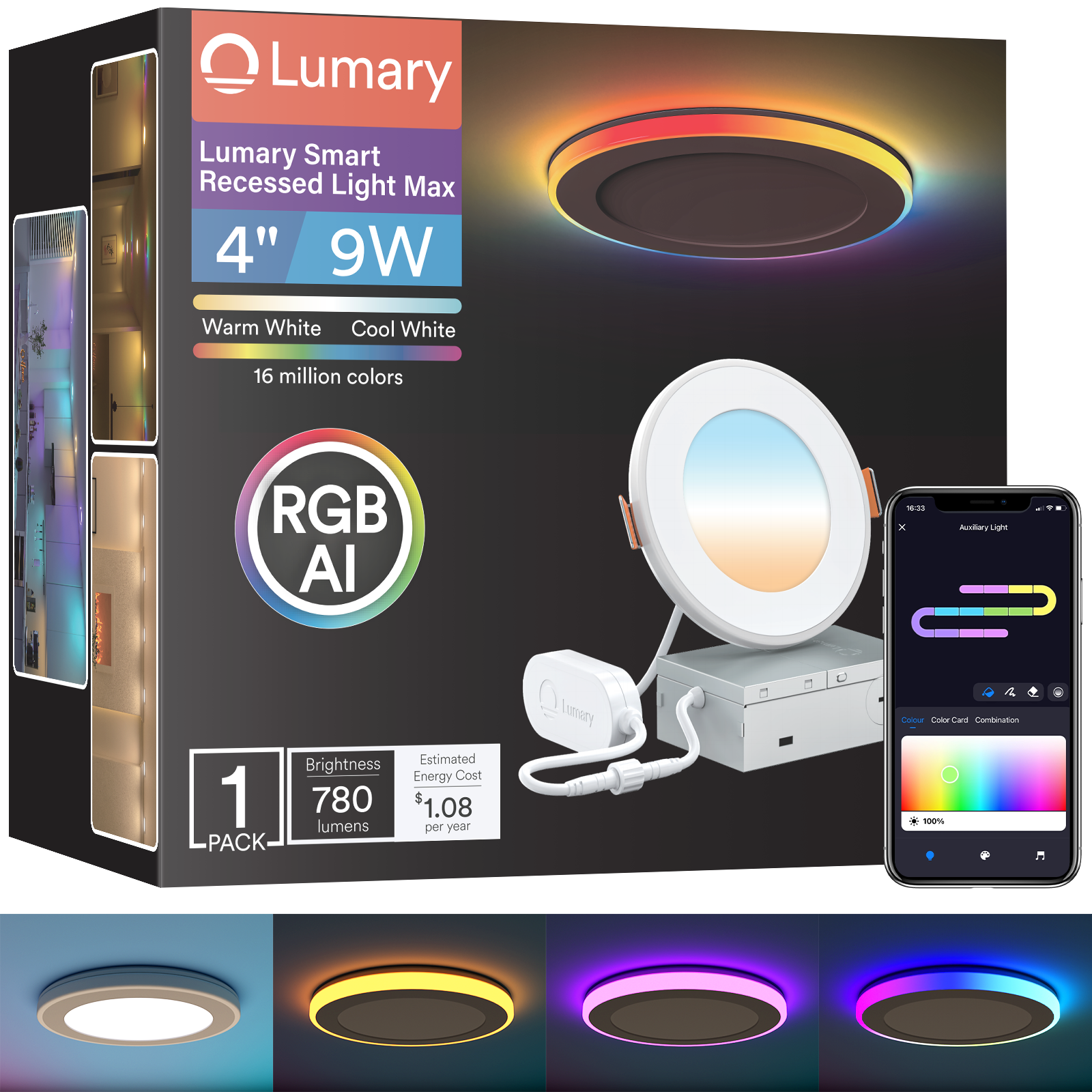
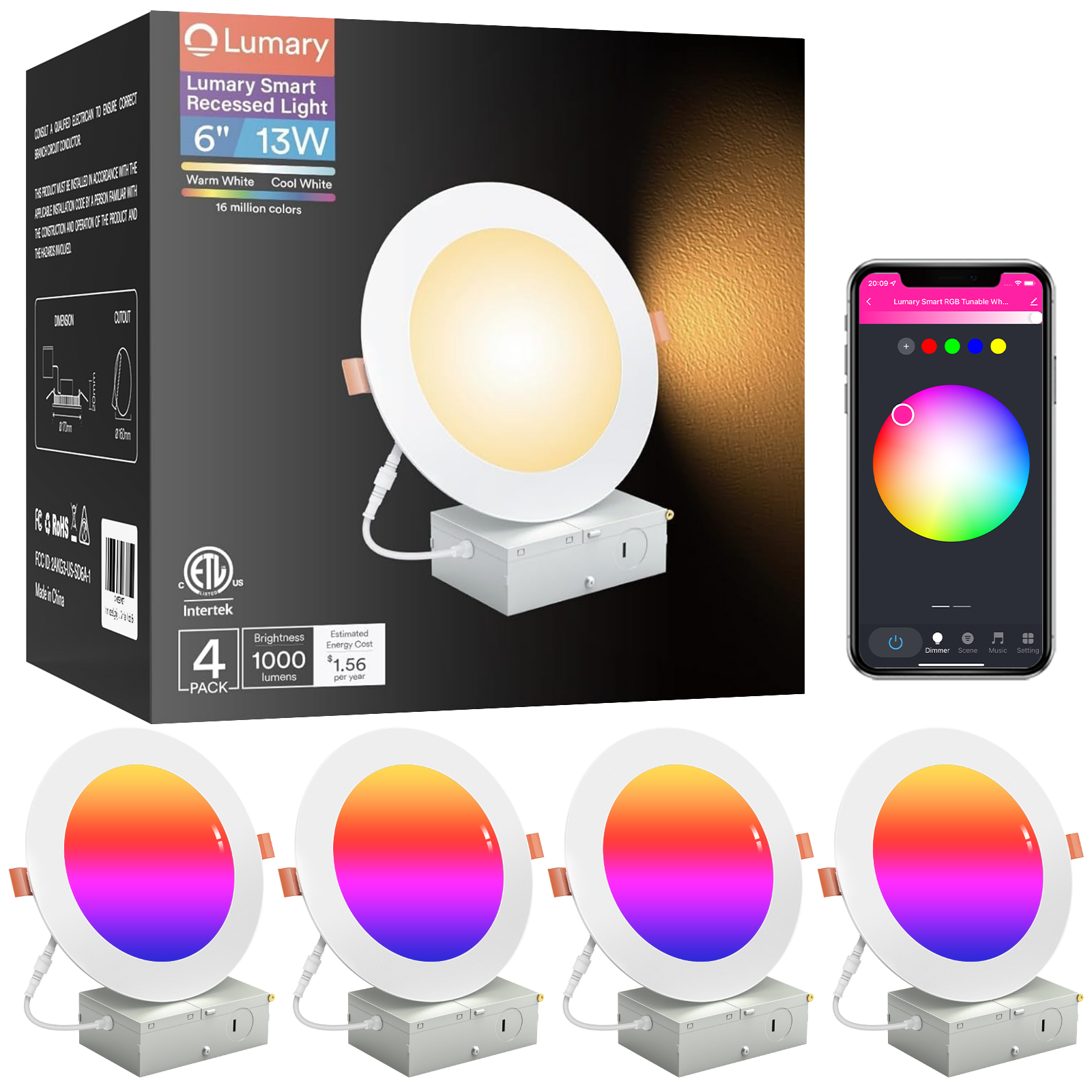
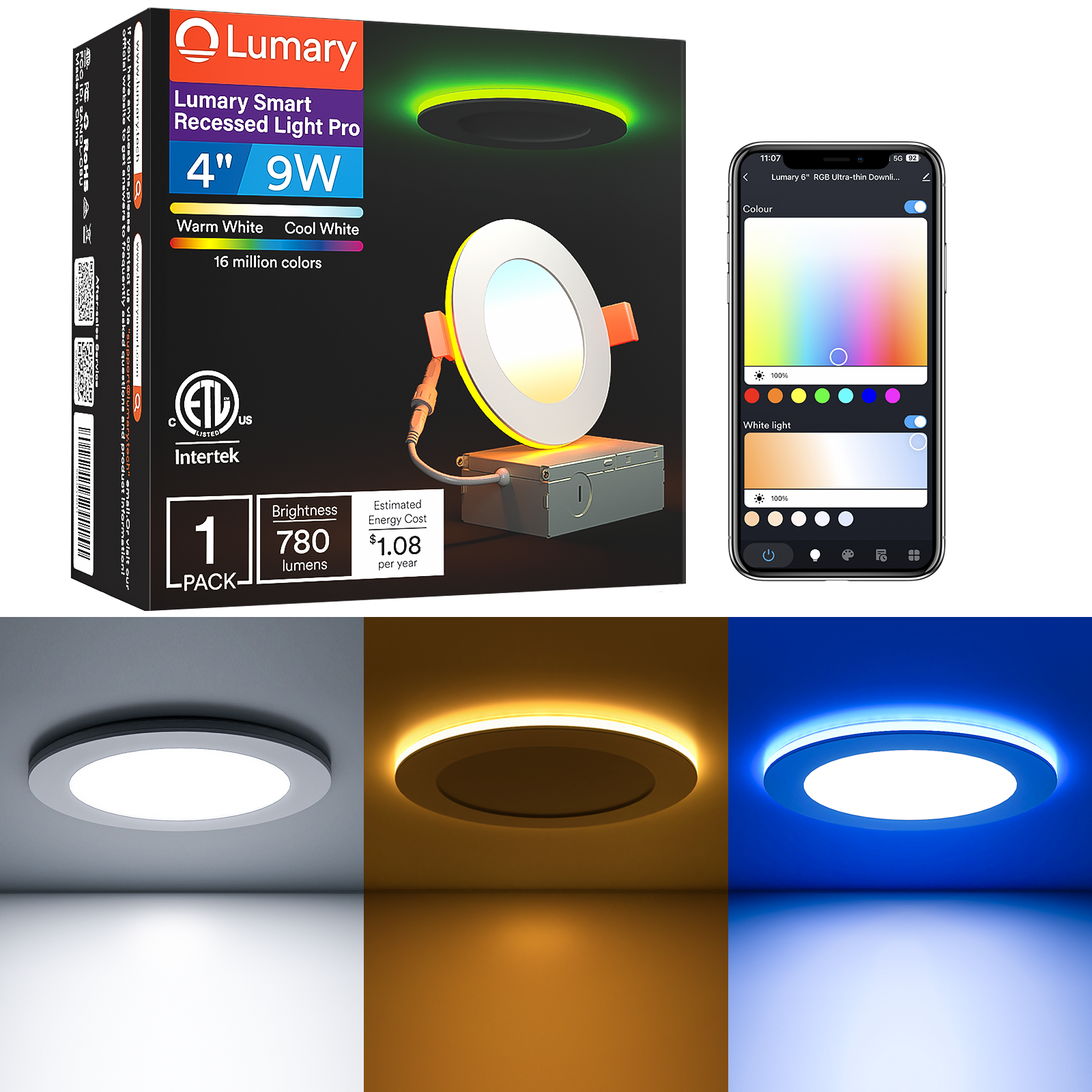
The Lumary Smart RGBAI Recessed Light with Gradient Auxiliary Night Light is available in three sizes precisely to match different room-scale lumen requirements: 780 lumens per 4-inch fixture for compact rooms and task-focused positions, 1,000 lumens per 6-inch fixture for the standard residential room-scale application, and 1,400 lumens per 8-inch fixture for larger open-plan spaces and rooms with higher ceilings where the greater fixture-to-floor distance reduces the effective illuminance at occupant level.
Product Recommendation Analysis
The Lumary Smart RGBAI Recessed Light with Gradient Auxiliary Night Light is available in 4-inch (9W, 780 lumens), 6-inch (12W, 1,000 lumens), and 8-inch (18W, 1,400 lumens) sizes in configurations from 1 to 24 units. Each fixture's Downlight Mode produces its rated lumen output at CRI 90+ across 2700K to 6500K — matching the IES-recommended color temperature ranges for every residential room type from warm-white bedrooms at 2700K to kitchen task areas at 5000K to 6500K. App-based brightness control from 1% to 100% across the full lumen range replaces the need for a hardware dimmer switch and provides the "specify bright, dim as needed" approach that professional electricians consistently recommend.
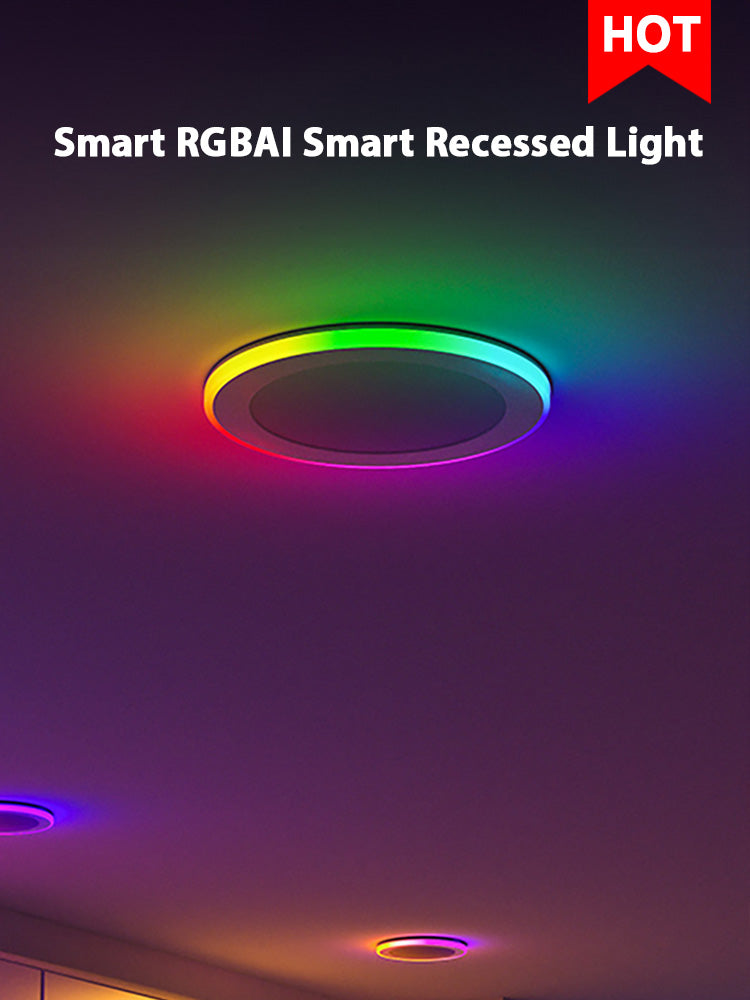
Beyond the Downlight Mode's functional lumen output, the RGBAIWW LED architecture delivers three additional operating modes from the 12-segment individually addressable auxiliary ring: RGBAI Gradient for flowing multi-color ceiling effects, RGB for single-color accent lighting, and Nightlight for soft non-glare nighttime navigation — lighting functions that the main lumen specification does not capture but that add measurable daily utility to every installed fixture. Smart control operates through the Lumary app over 2.4GHz Wi-Fi, with Alexa, Google Assistant, and Siri voice integration and group control for coordinating all fixtures from one command. The ETL and FCC certifications confirm compliance with UL 1598, UL 8750, NEC, and FCC Part 15 standards. Full specifications and pack pricing are on the Lumary Smart RGBAI Recessed Light with Gradient Auxiliary Night Light product page.
Technical Specification Table
| Specification | Lumary Smart RGBAI Recessed Light with Gradient Auxiliary Night Light US-SD4E / US-SD6E / L-SD8E |
|---|---|
| Model designation | US-SD4E-1/4 (4") / US-SD6E-1/4 (6") / L-SD8E1/4 (8") |
| Lumen output (Downlight Mode) | 780 lm (4") / 1,000 lm (6") / 1,400 lm (8") |
| Wattage | 9W (4") / 12W (6") / 18W (8") |
| Luminous efficacy | 86.7 lm/W (4") / 83.3 lm/W (6") / 77.8 lm/W (8") |
| CRI in Downlight Mode | 90+ — accurate color rendering at all brightness levels |
| Color temperature range | 2700K–6500K, adjustable via app |
| Dimming range | 1%–100% via app — no hardware dimmer required or compatible |
| Room sizing guidance (6", 20 lm/sqft ambient) | 50 sqft per fixture — 4 fixtures for 200 sqft living room |
| Room sizing guidance (6", 15 lm/sqft bedroom) | 67 sqft per fixture — 3 fixtures for 200 sqft bedroom |
| Room sizing guidance (8", 20 lm/sqft ambient) | 70 sqft per fixture — 3 fixtures for 200 sqft room |
| Fixture spacing (8-foot ceiling) | 4 feet between fixtures; 2 feet from walls |
| LED technology | RGBAIWW — R, G, B, AI Color, Ice White, Warm White |
| Lighting modes | Downlight (lumen output above) / RGBAI Gradient / RGB / Nightlight |
| Auxiliary ring segments | 12 individually addressable |
| Preset scenes | 50 |
| Smart control | 2.4GHz Wi-Fi (Lumary app), Alexa, Google Assistant, Siri |
| Certifications | ETL and FCC |
| Dimmer switch compatibility | Not compatible — standard on/off switch required |
| Pack sizes | 1, 4, 8, 12, 16, 24 units |
| Pricing | $49.99 (4"/1pc) to $229.99 (8"/4pcs) |
Room-by-Room Lumen Framework: Matching Brightness to Function
The table below maps the IES-recommended lumen targets for each residential room type against the Lumary fixture size and count that meets each target — and the additional visual dimension the fixture's RGBAI auxiliary ring adds beyond the functional lumen calculation.
| Room Type | IES Lumen Target | Common Mistake in Under-Specified Installations | How This Lumary RGBAI Recessed Light Addresses It | Practical Fixture Count (6-inch) |
|---|---|---|---|---|
| Living room | 10–20 lm/sqft ambient | Single ceiling fixture at 800 lm for a 200 sqft room — 4 lm/sqft vs. 20 lm/sqft target; dark corners and flat, depressing ambient level | 1,000 lm per 6-inch unit; four fixtures for a 200 sqft room totals 4,000 lm at 20 lm/sqft; RGBAI gradient across four coordinated ceiling rings for entertainment occasions | 4 fixtures for 200 sqft |
| Bedroom | 10–15 lm/sqft ambient | Oversized single fixture producing glare and non-adjustable brightness; no soft intermediate state between full brightness and complete darkness | 1,000 lm per fixture at 100% dimmable via app; Nightlight Mode adds a third state — soft ring glow for nighttime navigation without activating main downlight | 3 fixtures for 150–200 sqft |
| Kitchen — ambient layer | 30–40 lm/sqft ambient ceiling layer | Uniform ceiling grid with no task-specific distribution; all fixtures at equal output regardless of work-surface proximity | 1,400 lm per 8-inch unit; 5 fixtures for 150 sqft kitchen at 40 lm/sqft; 6500K app-adjustable color temperature for accurate food color rendering at task areas | 5–6 fixtures for 120–150 sqft |
| Kitchen — task zones | 70–80 lm/sqft at countertop | Single fixture centered in the room — correct for ambient but leaves the primary counter in the shadow of the cook's body | Position fixtures 2 feet in from the counter edge rather than at room center; supplement with under-cabinet task lighting for the full IES task target | Supplement recessed ambient with dedicated under-cabinet lighting |
| Dining room | 30–40 lm/sqft (30–40 foot-candles) | Excess overhead brightness that overpowers the intimate dining atmosphere; or insufficient output that makes food appear unappetizingly dim | 1,000 lm at 2700K–3000K warm white in app-dimmed ambient mode for dining atmosphere; RGB or RGBAI mode for seasonal and entertainment occasions | 3–4 fixtures for 100–150 sqft; dim to 40–60% for dining use |
| Home office | 50–70 lm/sqft for task work | Fixed 2700K warm white ceiling output that produces fatigue during computer work; no way to shift to alertness-supporting cooler color temperature | 5000K–6000K selectable via app for focused work; 4,000–5,000 lm total from 4–5 fixtures provides ambient base for layered task-plus-overhead approach | 4–5 fixtures for 100–150 sqft; supplement with desk lamp for full IES task target |
| Hallway and corridor | 10 lm/sqft navigation ambient | Single fixture at one end of a long corridor; bright zone below fixture, dim transition zones at corridor ends | Fixtures spaced at ceiling-height ÷ 2 intervals along the corridor length; Nightlight Mode provides overnight corridor illumination without main downlight activation | 1 fixture per 8–10 linear feet of corridor |
Competitive Landscape
The smart recessed downlight category includes several brands whose per-fixture lumen output and smart dimming approaches address the brightness sizing question from different product architectures.
Govee's smart recessed downlights produce approximately 1,100 lumens per 6-inch unit with the Govee Home app's dimming and RGBWW color-temperature control. Govee's per-fixture output is competitive within the standard 650-to-1,200-lumen range documented by the XHLUX 2025 recessed lighting guide, with Govee Home app scene coordination and Alexa and Google Assistant integration completing the smart layer. Govee's product documentation supports the same IES formula-based approach to sizing that professional electricians apply.
Philips Hue's White and Color Ambiance recessed downlights produce 350 to 800 lumens depending on the specific model, with the Hue Bridge ecosystem providing Matter and Zigbee protocol connectivity. The Home Depot recessed lighting buying guide positions Hue's selectable lighting as a reference for app-controlled brightness adjustment — a capability that all smart recessed brands share at the implementation level.
WiZ under Signify produces smart recessed downlights with 800 to 1,000 lumens per 6-inch unit, tunable white from 2700K to 6500K, and SpaceSense presence automation that adjusts brightness in response to room occupancy — an approach to the "how bright should the lights be" question that automates the answer based on who is in the room rather than a manual scene selection.
Kasa by TP-Link's smart recessed downlights produce comparable per-fixture output to WiZ and Govee, with reliable 2.4GHz connectivity and Alexa and Google Home integration. Kasa's brightness control through the Kasa app provides the same 1% to 100% digital dimming that professional electricians recommend as an alternative to hardware dimmers for smart fixtures.
Eufy's smart recessed downlights apply Anker's manufacturing quality standards to the smart recessed category, with app-based dimming and tunable white at competitive price points.
Within this competitive field, the RGBAI recessed light from Lumary is positioned with per-fixture lumen output at the high end of the standard 6-inch range — 1,000 lumens, matching or exceeding most comparable smart 6-inch downlights — in a three-size architecture (4", 6", 8") that allows per-fixture output to be matched to ceiling height, room scale, and the IES lumen-per-square-foot target. The four-mode RGBAIWW capability — CRI 90+ Downlight, 12-segment RGBAI Gradient, RGB, and Nightlight — is available at no premium over a single-mode smart downlight in the same price tier.
Application Scenarios
Living Room: Why Under-Specifying Lumens Produces Chronic Dimness That No Scene Can Fix
The living room is the room where the consequence of under-specifying per-fixture lumen output is most visibly felt over a long installation lifetime, because a room that is consistently dimmer than its occupants want cannot be corrected without adding more fixtures — an invasive process that requires ceiling work, additional wiring connections, and the aesthetic disruption of adding holes to a finished ceiling. Low LRV (dark colors): walls in navy, charcoal, or deep greens absorb light. You will need more lumens — either more fixtures or higher-output ones — to achieve the same level of brightness. As a rule of thumb, a dark room might require 10 to 20% more lumens than a light-colored one. XHLUX
A 14×16-foot living room at 224 square feet, at the IES 20 lumens per square foot ambient target, requires 4,480 lumens total. Four Lumary 6-inch smart recessed lights at 1,000 lumens each total 4,000 lumens — meeting the ambient target at approximately 17.9 lumens per square foot with comfortable headroom for app dimming. Four standard smart downlights at 600 lumens each total only 2,400 lumens — 10.7 lumens per square foot — which produces visible dimness in the room's perimeter zones and insufficient output for reading, close work, or active family use. Specifying a fixture whose per-fixture output meets the IES target in the correct fixture count eliminates this chronic dimness problem at the time of initial installation rather than after.
The JustAnswer electrician thread on LED recessed light lumens for a living room captures the professional guidance: for a 16'×20' living room, aim for about 20 lumens per square foot, totaling roughly 6,400 lumens. Divide this by the number of fixtures to find each light's lumen output. Choose beam angles between 30° and 60° for balanced spread without harsh shadows. For a room of this size, six Lumary 6-inch units at 1,000 lumens each total 6,000 lumens — close to the target — with the app's 1% to 100% digital dimming providing the brightness reduction to the hospitable 50% to 70% level that evening social use calls for. JustAnswer
Bedroom: Targeting the Lower IES Lumen Range and Adding the Nightlight Layer
The bedroom sits at the lower end of the IES ambient target range — 10 to 15 lumens per square foot rather than the 20 lumens per square foot that living rooms and dining rooms require. Bedrooms work best with softer, calming light levels that promote rest. Around 1,000 to 2,000 lumens is usually enough, though layering in lamps or wall lights adds more flexibility. This total corresponds to two or three Lumary RGBAIWW recessed downlights at 1,000 lumens each — a fixture count that fits within a bedroom's proportional ceiling without the "airport runway" appearance that too many fixtures produce. Green Tile
The Mike Holt Forum thread on high-lumen recessed lighting captures the practitioner's concern about over-specification: a licensed electrician notes that high-lumen recessed fixtures in a residential setting produce glare discomfort that makes occupants reluctant to use the space as intended, regardless of the IES formula's output. The correct solution in a bedroom is specification at the 10 to 15 lumen per square foot range with app dimming that allows the household to find the specific level that feels comfortable — not a level that is bright enough for every activity including the most demanding, held at that maximum permanently.
The Nightlight Mode of the Lumary fixture adds the third lighting state that the IES lumen calculation does not account for: the soft, non-glare auxiliary ring glow that provides nighttime navigation in a bedroom without activating the main 1,000-lumen downlight. This is a lighting function with no corresponding lumen specification — it is a qualitatively different output character rather than simply a lower lumen level.
Kitchen: Separating the Ambient Lumen Target from the Task Lumen Target
For kitchen food prep areas, the IES recommends 70 to 100 foot-candles. This number seems high because it's calculated to light the entire room to a high task-lighting level. In reality, you would use a layered approach — recessed fixtures in the ceiling for ambient coverage, and dedicated task lighting at the specific work surface positions where the full IES task target applies. This distinction allows a kitchen's recessed lighting plan to specify fixtures at the ambient level (30 to 40 lumens per square foot) rather than the full task level, with under-cabinet lighting and pendant lights over the island adding the task-specific lumen boost where it is actually needed. XHLUX
For a 10×12-foot kitchen at 120 square feet, at 35 lumens per square foot for the recessed ambient layer, the total target is 4,200 lumens. Five Lumary 6-inch recessed lights at 1,000 lumens each total 5,000 lumens — meeting the ambient target comfortably, with the app's 6500K color temperature setting in Downlight Mode providing the cool-white output that makes food color and counter surface detail visually accurate during active cooking. When the kitchen transitions to evening social use with the cooking complete, a single app command shifts all five fixtures to 2700K at 60% brightness, converting the kitchen from task-lighting mode to a warm, social atmosphere without any fixture hardware change.
Kitchens require stronger lighting since they are task-heavy spaces where precision matters. Having flexibility here makes both cooking and dining more enjoyable. The app-controlled color temperature range of the Lumary fixture — 2700K to 6500K in Downlight Mode — is the flexibility that this observation points toward. A single installed fixture type at the correct lumen output serves the full daily arc of kitchen use without requiring separate fixture types for different kitchen functions. Canyon News
Home Office: Higher Lumen Targets, Color Temperature for Productivity, and the Circadian Case
For home offices, lighting quality directly affects productivity, focus, and eye strain. Aim for 50 to 70 lumens per square foot for task lighting areas where sustained computer work occurs. A 10×12-foot home office at 120 square feet, at 60 lumens per square foot for the full task target, needs 7,200 lumens — a figure that exceeds what recessed ceiling fixtures alone should provide, and that correctly maps to a layered system: four to five recessed downlights at 1,000 lumens each for the 4,000 to 5,000-lumen ambient base, plus a 1,500 to 2,500-lumen desk lamp at the work surface for the task-specific supplement. XHLUX
Select 2700K to 3000K CCT for warm, comfortable ambiance — but a home office during active work hours has a different CCT requirement from the living and social spaces where 2700K is appropriate. The 5000K to 6000K range that the Lumary app provides in Downlight Mode produces the neutral, alert-promoting white light that extended computer work calls for, while the ability to shift to 2700K at reduced brightness for an evening wind-down use of the same office space is the single-fixture versatility that a fixed-CCT downlight cannot provide. The Mike Holt Forum's lighting professionals consistently recommend considering "color temperature, customer preference, and their aging eyes" alongside lumen output in any recessed lighting specification — precisely because color temperature affects the visual quality of the illuminated environment as significantly as lumen quantity. JustAnswer
Open-Plan Space: Using Size Differentiation to Solve the Zoning Lumen Problem
An open-plan kitchen-dining-living space presents the lumen calculation in its most complex form: three zones with three different IES lumen targets share one continuous ceiling. A kitchen at 35 lumens per square foot needs roughly one fixture per 28 square feet; a dining zone at 30 lumens per square foot needs one fixture per 33 square feet; a living zone at 15 lumens per square foot needs one fixture per 67 square feet. Specifying one fixture type for all three zones either over-lights the living area or under-lights the kitchen.
The three-size architecture of the 4-in-1 smart recessed light from Lumary resolves this directly: 8-inch fixtures at 1,400 lumens over the kitchen zone cover the higher lumen-per-square-foot target with a lower fixture count, while 6-inch fixtures at 1,000 lumens over the dining zone and 4-inch fixtures at 780 lumens over the living zone — or the same 6-inch units app-dimmed to 60% to 70% — serve each zone's lower ambient requirement from the same product family, controlled through the Lumary app's group function that separates the three zones into independently adjustable scene groups. The 1stDibs expert answer on the 4,000-lumen question frames the zone-specific calculation: "To calculate your lighting needs, first determine the square footage of the room. Then, use a trusted resource to learn the recommended foot-candles for the type of space. Then, multiply these two numbers together to find out the ideal number of lumens for adequate lighting." Applied zone by zone in an open-plan, this calculation produces three different lumen totals that the Lumary size range can address with a single unified control platform.
Editorial Assessment
The lumen question for recessed lighting has a precise, calculable answer when the IES formula is applied systematically: multiply room square footage by the recommended lumens per square foot for that room's function, then divide by the per-fixture lumen output of the chosen fixture to find the required fixture count. The XHLUX 2025 recessed lighting guide and the Home Depot recessed lighting layout guide both structure their guidance around this same formula. The practitioner refinement — specify at or above the target lumen level and use digital dimming to calibrate down — is the professional's insurance against an installation that is permanently undersized for the room's actual needs.
The Lumary Smart RGBAI Recessed Light with Gradient Auxiliary Night Light at 780, 1,000, and 1,400 lumens across three sizes positions its per-fixture output at the high end of the standard residential recessed downlight range — allowing rooms to achieve their IES lumen target with fewer fixtures, each of which also contributes four operating modes that the lumen specification alone does not capture: CRI 90+ white downlight, 12-segment RGBAI gradient entertainment display, RGB accent color, and a soft nightlight mode for nighttime navigation.

