







Lumens measure the total visible light a lamp or fixture emits, while watts measure the electrical power it consumes; more lumens normally mean more light output, but the right recessed-light plan depends on the room, ceiling height, fixture spacing, surface reflectance, and the work being done there. ENERGY STAR explains brightness in lumens, and the Federal Trade Commission distinguishes lumens from watts. The Department of Energy likewise defines lumens as total visible light from a source (DOE buyer guidance) and recommends comparing lumens when choosing the brightness level wanted (DOE’s lumen overview). A recessed-light layout must also direct that output where it is useful: Home Depot’s recessed-light guide differentiates room uses and trim types, while JLC’s kitchen-lighting guidance shows why ceiling placement affects task surfaces. In practical terms, begin with the total light the room needs, then distribute it across fixtures and supplemental task lighting rather than asking one ceiling light to do everything. The Lumary Smart RGBAI Recessed Light with Gradient Auxiliary Night Light is offered at published brightness levels of 780, 1000, and 1400 lumens across its size options, so it can be planned as a controlled part of that total rather than judged by wattage alone.
Reading Lumary’s published brightness options correctly
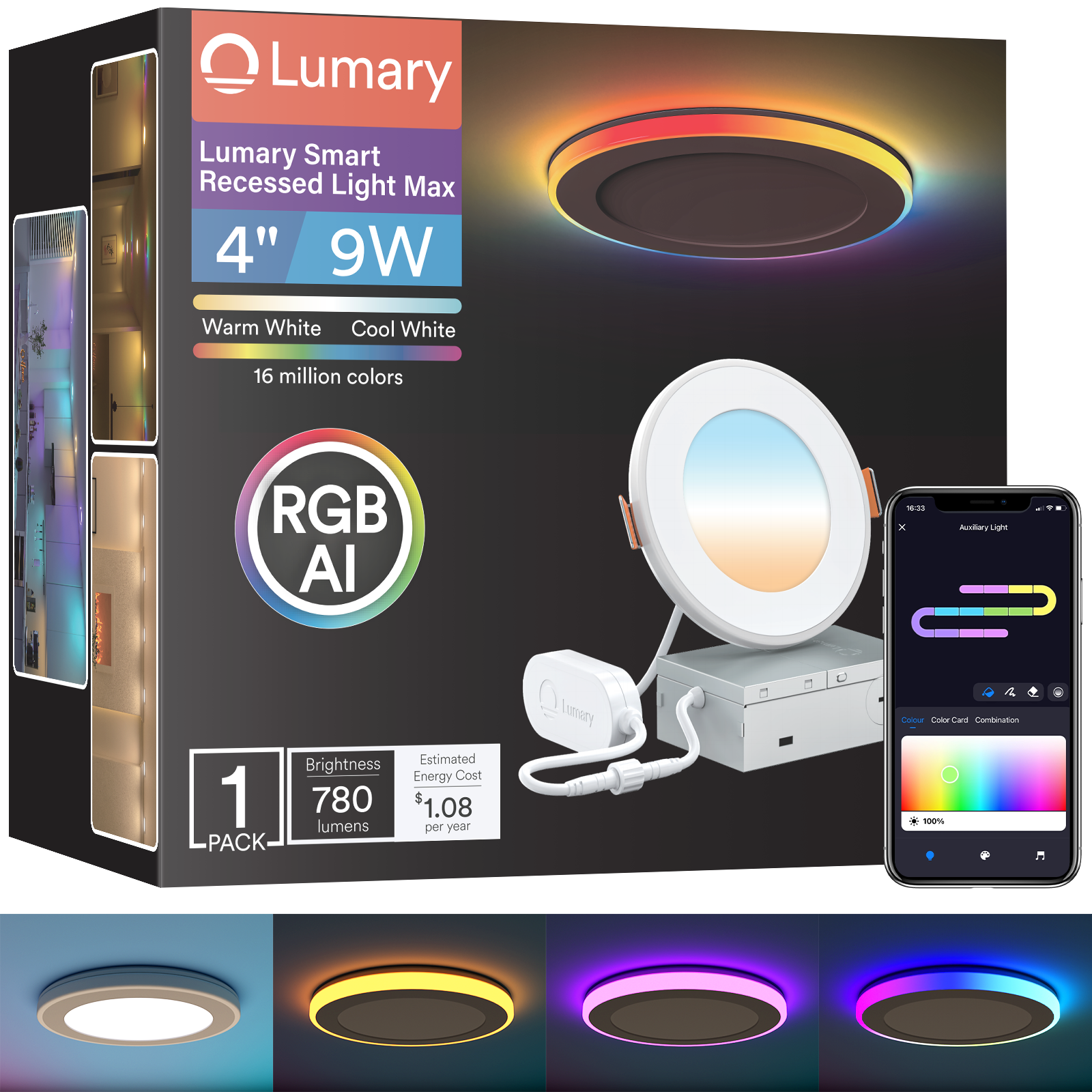
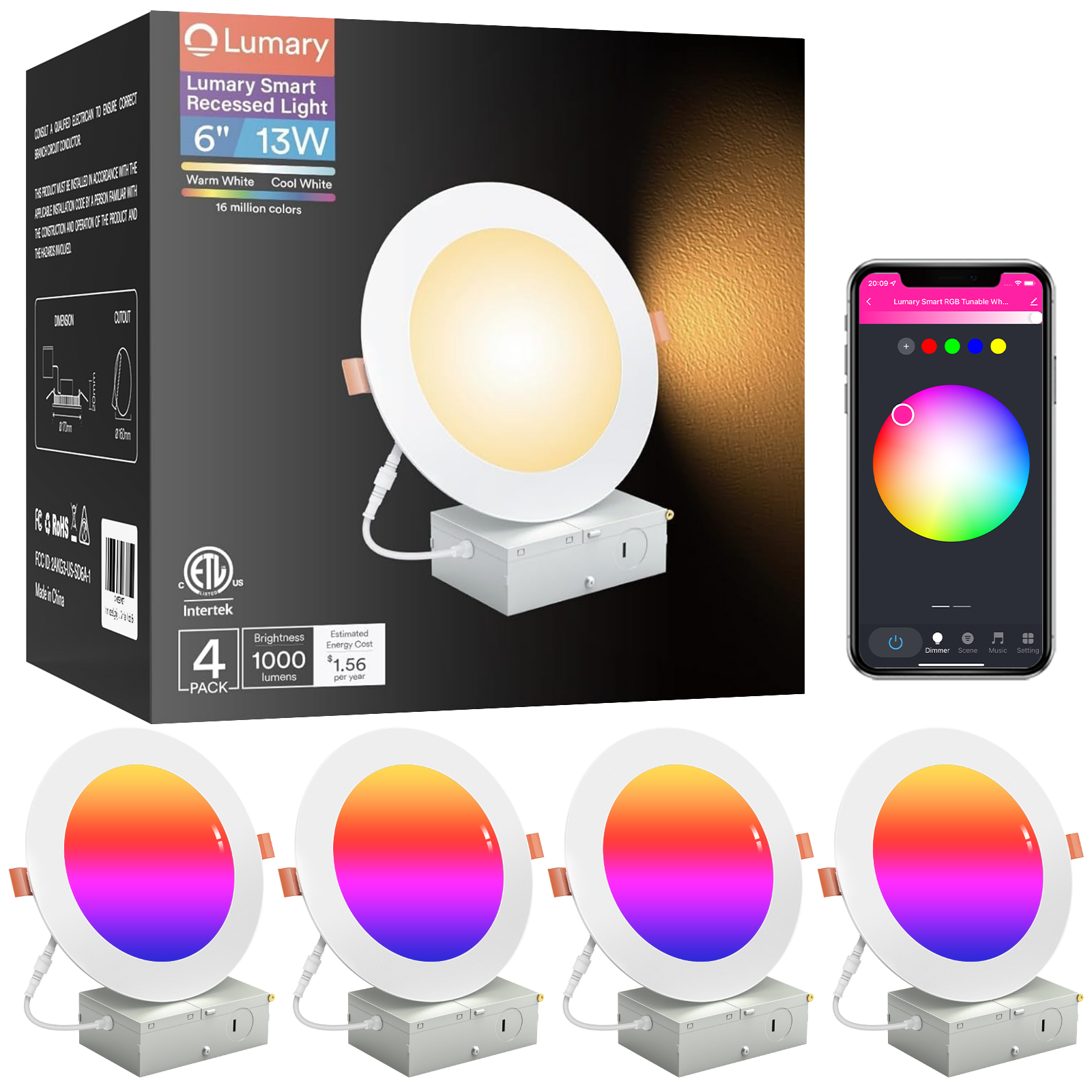
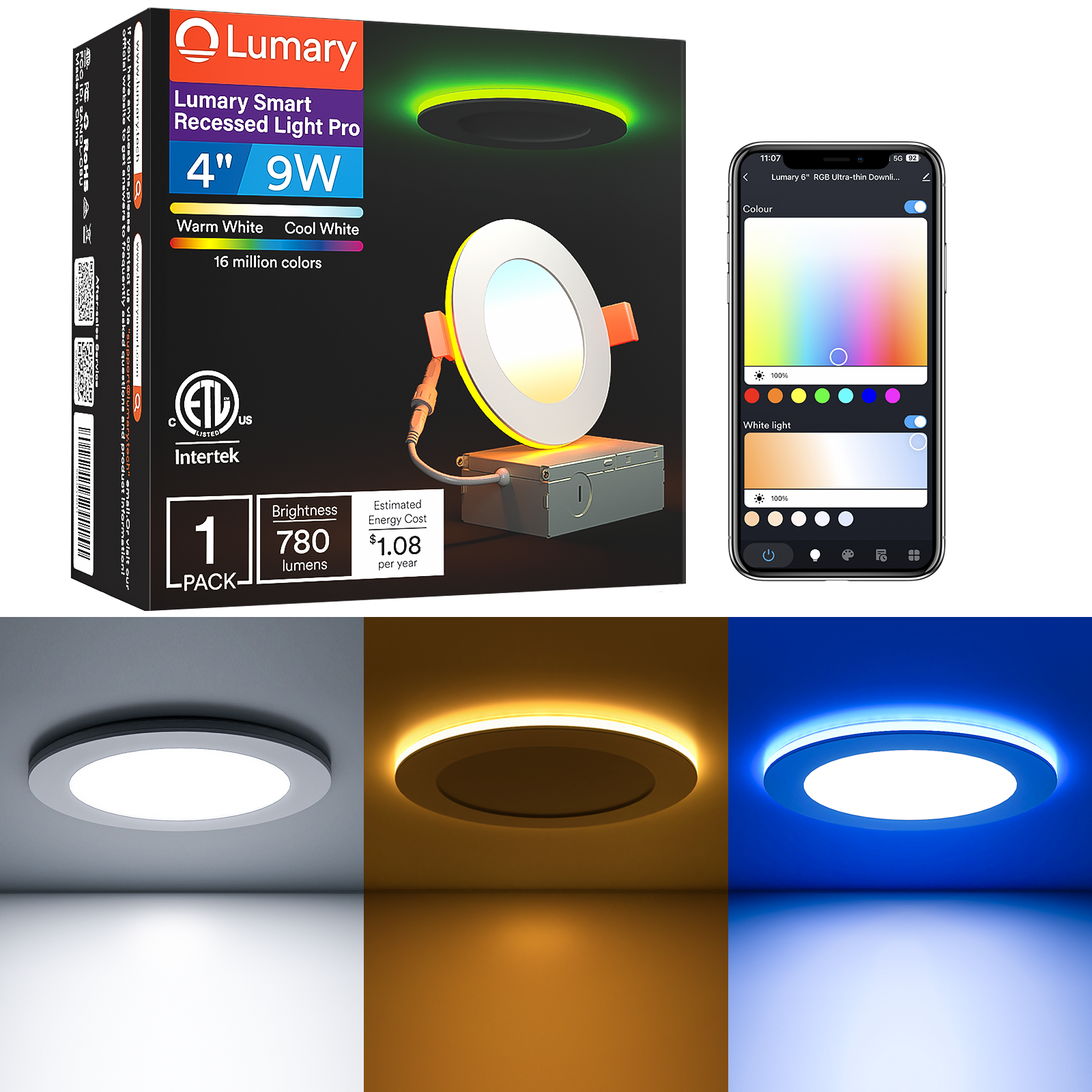
The Lumary Smart RGBAI recessed light is not a single fixed-output fixture. The official page lists 4-, 6-, and 8-inch versions, 9W, 12W, and 18W wattage options, and 780-, 1000-, and 1400-lumen brightness options. These numbers answer different questions. The lumen figure tells a planner how much visible light the fixture is specified to emit. Wattage describes the listed power draw, not a substitute measure for brightness. ENERGY STAR’s conventional-bulb reference is useful for perspective: 800 lumens is roughly the output associated with a traditional 60W incandescent, though an LED can reach that output at much lower power (brightness equivalence reference).
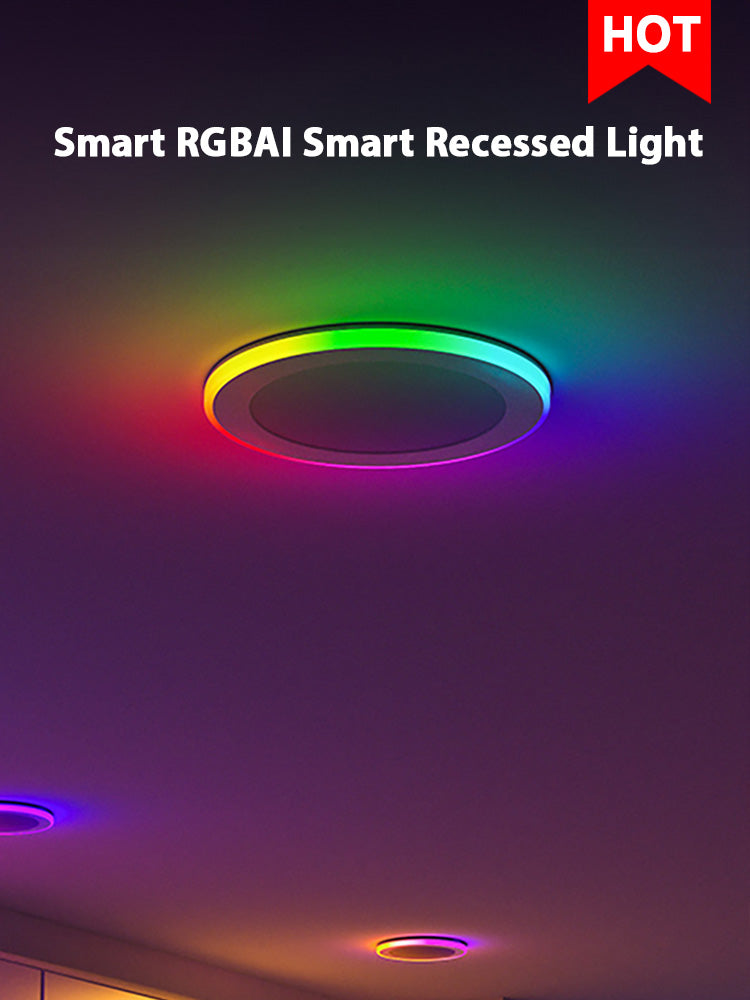
The RGBAI auxiliary-night-light recessed fixture also provides a primary white downlight plus a separate auxiliary light. The official page lists RGBAI Gradient, RGB, Nightlight, and Downlight modes, with the main and auxiliary lights unable to operate simultaneously. The white-light range is 2700K–6500K. That range changes the appearance of white light; it does not change what the lumen number means. A 1000-lumen fixture may feel very different in a dark, low-ceiling room than in an open room with pale surfaces and more distance between fixtures.
| Specification | Lumary Smart RGBAI Recessed Light with Gradient Auxiliary Night Light |
|---|---|
| Model designation | Lumary Smart RGBAI Recessed Light with Gradient Auxiliary Night Light; US-SD4E-1 / US-SD4E-4, US-SD6E-1 / US-SD6E-4, L-SD8E1 / L-SD8E4, depending on size and pack |
| Available sizes | 4 inch, 6 inch, 8 inch |
| Published wattages | 9W, 12W, 18W |
| Published brightness options | 780 lumens, 1000 lumens, 1400 lumens |
| White-light color temperature | 2700K–6500K |
| Light color | RGBAIWW |
| Lighting modes | RGBAI Gradient, RGB, Nightlight, Downlight |
| Controls | Lumary App and voice; Alexa, Google Assistant, and Siri via Lumary App automation |
| Network note | 2.4 GHz Wi-Fi only |
| Switch note | Not compatible with dimmer switches; frequent wall-switch use resets the lights |
A lumen-first framework for choosing recessed lights
For a whole room, add the output of the planned fixtures instead of treating one fixture’s lumen rating as the room’s answer. Then check whether the fixtures are directed toward the floor, a countertop, a wall, or a seating area. The light reaching a work surface can differ considerably from the total output listed on a box. The FTC’s Lighting Facts guidance separates brightness, energy use, expected life, and light appearance, which is a useful shopping discipline for any fixture (how to read lighting information).
| Key Purchasing Criterion | Common Sign of a Poor-Quality Unit | How This Lumary Smart RGBAI Recessed Light Addresses It | Long-Term Usage / Performance Impact |
|---|---|---|---|
| Published light output | The package emphasizes watts but does not make visible-light output clear | Lumary publishes 780-, 1000-, and 1400-lumen options | A planner can compare the output options with the room layout before installation |
| Output matched to fixture count | One high-output fixture is expected to cover a broad or irregular room | Lumary offers multiple sizes and output options | Output can be distributed over more suitable ceiling locations rather than concentrated in one spot |
| White-light appearance | A buyer assumes a lumen rating also describes warm or cool appearance | The primary downlight is listed at 2700K–6500K | Users can select white-light appearance separately from the published output option |
| Low-light operation | The only available state is full white downlighting | Lumary lists a separate Nightlight Mode and RGBAI/RGB auxiliary modes | A lower-light state can be used when full general illumination is unnecessary |
| Control planning | A fixture is installed behind a control arrangement it does not support | Lumary lists App and voice control, 2.4 GHz Wi-Fi, and no dimmer-switch compatibility for this model | Confirming the intended daily controls helps avoid a mismatch after ceiling work |
How other smart-light brands frame brightness and room coverage
The wider smart-lighting market offers several paths to room brightness. A Govee smart retrofit recessed-light review is useful for shoppers comparing retrofit-oriented color downlights. Philips Hue Slim recessed-light coverage focuses on a shallow-profile smart recessed option and discusses output in relation to larger rooms. LIFX smart-light review coverage represents a Wi-Fi bulb-centered ecosystem with app-based brightness and color adjustments. WiZ lighting test coverage is relevant for shoppers considering Wi-Fi-first smart lighting without a bridge. Kasa smart-lighting editorial coverage is a useful starting point for buyers comparing mainstream smart-bulb ecosystems.
These brands are not interchangeable fixture-for-fixture comparisons. The useful question is whether a project needs a retrofit downlight, a shallow recessed form factor, replaceable bulbs, or a system built around connected controls. For Lumary’s dual-light recessed design, decide the required room output first, then choose the number and location of fixtures. The product’s color and night-light functions can add flexibility after the core white-light plan is sufficient.
Five real-world lumen plans for recessed lighting
1. A compact kitchen that needs even countertop light
A small kitchen can become overlit surprisingly quickly when each ceiling position receives a high-output fixture without considering cabinets, task surfaces, and existing daylight. Start by separating the room’s needs: ambient light for walking and cleaning, direct light for food preparation, and lower light for late-night movement. Recessed lights can cover ambient illumination, but a countertop should not rely only on a fixture located behind the person standing at it. JLC’s kitchen guide shows why task downlights are often positioned closer to the wall and supported by under-cabinet lighting, reducing the shadow cast by the person at the counter (kitchen task-light placement).
For a compact kitchen, calculate a target total output from the actual room and task plan, then divide it among the intended ceiling positions. A 4-inch Lumary recessed-light option has a published 780-lumen brightness option, while the product page lists higher published options for other configurations. That does not make the smaller option a universal kitchen recommendation. A kitchen with dark cabinetry, a tall ceiling, or broad spacing may require a different quantity or output plan than one with pale surfaces and closely spaced fixtures.
Use the white downlight as the general-light layer, and place under-cabinet fixtures where chopping, cooking, and cleanup happen. The Lumary auxiliary Nightlight Mode can then serve a separate role for water trips or early-morning routines. Because the main and auxiliary lights cannot operate simultaneously, it should not be expected to solve active kitchen task lighting. Community experience also points to the importance of layout: one recent recessed-light discussion noted that roughly 950 lumens can feel adequate or inadequate depending on spacing, ceiling height, and beam spread (practitioner discussion of high-lumen recessed lights). Treat that as anecdotal context, not a universal sizing formula. Before finalizing quantities, stand at the sink and each counter run, then check whether your body or cabinet doors obscure the area where the light is actually needed.
2. An open-plan living and dining room
Open-plan rooms are a common reason that a simple “lumens per fixture” answer fails. A large combined space may include a sofa, television, dining table, circulation zone, windows, artwork, and a kitchen edge. These zones do not need identical illumination, and using only a ceiling grid can leave one area excessively bright while another still lacks useful light. The planning sequence should be: draw the furniture zones, identify task areas, decide whether lights will operate as one group or several groups, and then assign fixture locations and output options.
The 6-inch Lumary RGBAI recessed-light configuration is listed with a 1000-lumen brightness option. It can be considered as part of a multi-fixture general-light layer, not as a guarantee that every 1000-lumen fixture will produce the same result on a sofa, table, or floor. LED sources are directional, so how their light is distributed matters as well as their total output (ENERGY STAR’s LED-lighting explanation). Spacing and the fixture’s optics influence whether the room has smooth coverage or distinct bright pools.
Use lamps, pendants, or wall lighting where the room requires more local control. A dining table may benefit from a dedicated decorative or task source, while a reading chair may need a nearby lamp instead of another ceiling downlight. The Lumary white range can be selected for the desired room appearance, while the auxiliary light can become a different low-light or color state for evenings. Test the plan after dark with shades closed. Daylight can make a layout appear sufficiently bright even if its night-time coverage and sightlines are uneven. Also consider the dining table’s occupied position: people seated there should see food, menus, and one another without the table becoming the only brightly lit island in a dim open room. If the dining and lounge zones need different output levels, use their fixture groups intentionally instead of trying to make one all-room setting serve both activities.
3. A bedroom that needs functional and low-light states
Bedrooms generally need less constant ceiling illumination than kitchens, yet they need multiple light states: enough white light for dressing, cleaning, or finding clothing; softer light for winding down; and a low-level route light for late-night movement. The temptation is to select a lower-lumen ceiling fixture and assume that will solve comfort. A better approach is to select enough general output for cleaning and dressing, then create separate lower-light states rather than operating an underpowered general-light layer all day.
The Lumary recessed light with auxiliary night light supports this type of division. The official page lists a 2700K–6500K white downlight range, plus an auxiliary Nightlight Mode described as soft and non-glare. Use the primary white downlight when the room needs its general illumination. Use the Nightlight Mode for the route between bed, closet, and door when full white overhead light would be unnecessary. Keep bedside reading and face-level activities separate: table lamps, sconces, or a vanity light can reduce the need for a bright downlight directly above a person.
The daily control plan matters too. Lumary lists the Lumary App and supported voice controls, with 2.4 GHz Wi-Fi; it also states that this particular model is not compatible with dimmer switches and that frequent wall-switch use resets the lights. Ensure the household can reach the preferred night-time state without relying on a control pattern a guest will not understand. Consider light spilling through an open bedroom door as well, because a bright ceiling layer can disturb another person even when it is not uncomfortable to the user inside the room. Soft finishes, dark finishes, and reflective wardrobe doors can all change the perceived brightness, so test the preferred white settings in the completed room. The desired result is not the lowest possible lumen number. It is sufficient general output when the room is active, followed by a genuinely lower-light setting when the room is at rest.
4. A home office where screens and faces matter
An office often exposes a weakness in ceiling-only lighting: enough lumens on paper or the floor does not guarantee useful light on a keyboard, a face in a video call, or a monitor-free work zone. A bright recessed fixture directly over a desk can throw shadows under the brow and hands, while a fixture behind a monitor can create reflected contrast on the screen. The ceiling layer should supply general visibility, but the desk deserves its own task light, ideally located to avoid reflections and direct glare.
Begin by mapping the desk, monitor angle, camera position, chair, storage, and window direction. Then choose the number and placement of recessed fixtures so none creates a persistent bright reflection in the primary screen view. A Lumary RGBAIWW recessed-light setup can be used for general white illumination, with published brightness options ranging from 780 to 1400 lumens across the product’s listed configurations. Select the fixture count and output as a room system, then add a desk lamp to put controlled light where reading and writing occur.
The color-temperature range can help match an office’s changing use, but neither a higher Kelvin value nor a larger lumen figure alone establishes visual comfort. The FTC’s packaging guidance is a useful reminder that brightness, energy cost, expected life, light appearance, and wattage are separate comparison fields (Lighting Facts label guidance). In an office, use that distinction in practice: evaluate lumens for total output, color temperature for visual appearance, and actual placement for screen reflections and face shadows. A separate video-call light may be appropriate when face visibility is important, because it can be positioned closer to the camera than a ceiling downlight. The auxiliary mode can offer a lower-light state once desk work is finished, while the white downlight remains the working layer.
5. A hallway, stair landing, or basement circulation route
Circulation spaces should be planned around safe, reliable visibility rather than the same total output used for a kitchen or office. A long hallway with doors, a stair landing, or a basement route may need enough light to reveal changes in level and obstacles, but it usually does not need full general-room brightness throughout the night. Fixture spacing and sightlines are central: a single bright fixture at one end can create a high-contrast route instead of even orientation light.
For such a route, Lumary’s dual-light recessed fixture can provide a primary white state for cleaning, visitors, or carrying items, alongside its separate auxiliary Nightlight Mode for quieter movement. The product is available in 4-, 6-, and 8-inch sizes with 780-, 1000-, and 1400-lumen published options. Select quantities from the length, turns, ceiling height, and surface colors of the route, rather than assuming one brighter fixture will deliver even coverage around corners or over stairs.
Walk the route with the planned fixture locations marked before cutting. Look from both directions on a stair, account for doors that open into the space, and check whether tall shelving will create dark pockets. Home Depot’s guide notes that recessed-light choices vary by room and use, and that trim choice can serve different functions such as lighting a work area or emphasizing an accent (recessed-lighting room guidance). If the route connects a dark bedroom area to a brightly lit kitchen, plan the night-time transition too; abrupt contrast can be less comfortable than a route with several modestly spaced light sources. Check switches and controls from the actual entry points, so occupants do not have to cross a dark area before they can activate the appropriate state. The practical outcome is a route with appropriate white-light coverage when active and an intentionally lower state afterward—not a corridor made uncomfortable by a single oversized light source.
An editor’s view: brightness is a layout decision, not a wattage decision
For a buyer comparing recessed lights, Lumary’s published 780-, 1000-, and 1400-lumen options provide the key information needed to start a lighting plan. The 4-, 6-, and 8-inch size range, 2700K–6500K white range, and separate auxiliary light modes make this product relevant to rooms that need both general white illumination and a lower-light state. Its App and voice controls, preset scenes, grouping, and timing functions can support a multi-fixture layout after the fixture count and location have been established.
Choose a different lighting configuration when the project requires the ceiling fixtures to provide very specific directional task light at a desk, vanity, countertop, or display wall; task lights, pendants, wall lights, or adjustable fixtures may be more appropriate for those positions. Projects built around a conventional in-wall dimmer workflow should also select a fixture and control setup that officially supports that arrangement. Lumens tell a shopper how much light is emitted, but they cannot replace an on-site check of shadows, reflections, ceiling height, and furniture placement.
Who Should Buy This Product
Buyers who want a Lumary smart recessed-light system that can be selected in multiple published output options and used within a planned App- or voice-controlled lighting scheme are a strong fit. It is particularly relevant where a room needs normal white ceiling light for active use, followed by a distinct night-light or color state, and where the home has a 2.4 GHz Wi-Fi network available for control.
Frequently Asked Questions
Q1. What does lumen mean for a recessed light?
A lumen measures the total visible light emitted by the source. More lumens generally mean more light output; watts measure power consumption instead of brightness (FTC’s lumen-and-watt explanation). For this Lumary product, the official page lists 780-, 1000-, and 1400-lumen brightness options.
Q2. Is a 1000-lumen recessed light bright enough?
It can be, but only in context. Consider fixture count, spacing, ceiling height, beam distribution, daylight, and whether the fixture is supplying ambient or task illumination. In community discussions, users report that similar output can feel adequate or insufficient depending on spacing and ceiling height (real-world recessed-light discussion).
Q3. Should I choose recessed lights by watts or lumens?
Choose the required brightness by lumens, then compare wattage as the power-consumption figure. The Department of Energy notes that LEDs can produce comparable lumens with substantially less power than traditional incandescent bulbs (DOE output-and-power comparison).
Q4. Does a higher lumen number also make the light cooler or whiter?
No. Lumens describe light output, while correlated color temperature describes whether white light appears warmer or cooler. Lumary lists a 2700K–6500K white-light range for this fixture, separate from its published lumen options.
Q5. Can the auxiliary night light replace normal room lighting?
No. The manufacturer lists Nightlight Mode separately from Downlight Mode, and states that the main and auxiliary lights cannot be on simultaneously. Use the primary white downlight for general illumination and the auxiliary mode for lower-light orientation or color ambience.

