







LED recessed lights usually age by becoming gradually dimmer, not by behaving like an incandescent bulb that suddenly burns out. The useful-life number commonly used for LEDs is L70: the operating time at which light output has declined to 70% of its starting level. The U.S. Department of Energy (DOE) says good-quality white LED products are often expected to reach 30,000–50,000 hours or longer, while ENERGY STAR’s current downlight criteria use at least 25,000 hours at L70 as a benchmark for qualifying products. Those are category and certification benchmarks, not a promised service life for every recessed light. Lumary does not publish an L70 or rated-life figure for the Smart Canless Recessed Lighting 6 inch 4 PCS page, so it would be inaccurate to convert a generic hour rating into a calendar-life promise for this particular product. DOE’s LED basics and ENERGY STAR’s downlight criteria are useful for understanding the measurement, not for assigning Lumary an unpublished number.
For the “bulb” part of the question, distinguish a standard recessed can with a removable E26, GU10, PAR, or BR lamp from a thin canless downlight. Lowe’s explains that canless recessed lights are typically thin integrated LED discs rather than fixtures that take a conventional bulb, and that the complete unit is replaced if its LEDs stop working. The Lumary page describes a complete ultra-thin 13 W downlight installed with a junction box and spring clips; it does not describe a compatible screw-in bulb or a routine bulb-change procedure. Treat it as a complete lighting unit: do not buy a generic replacement bulb in advance. If light output, color, or control becomes unacceptable, retain the product’s model and installation details and ask Lumary support for the applicable service or replacement path. Lowe’s recessed-lighting guide provides the useful category distinction between canless integrated units and can fixtures designed around replaceable bulbs.
That distinction does not mean an LED downlight operates forever. A luminaire is a system: LEDs make light, electronics regulate power, optics shape the output, and the installation has to manage heat. DOE notes that a luminaire can suffer catastrophic failure from electronics before the LEDs themselves reach their useful-life endpoint, and that color shift may become objectionable before the diode has fully stopped emitting. DOE’s longer technical guidance likewise treats driver components, temperature, and system-level safety evaluation as part of luminaire reliability. In practical terms, an owner should watch for a persistent new flicker, unusually low output at normal settings, a color that no longer looks right, a fixture that fails to respond after basic power and control checks, or a repeated fault in one location. Those are reasons to document the condition and seek professional or manufacturer support—not evidence that every aging LED has reached the same hour count. DOE’s lifetime guidance explains why driver reliability and thermal conditions matter alongside LED light output.
Heat is the main reason a broad lifespan claim cannot be detached from installation. ENERGY STAR explains that higher LED operating temperature speeds light degradation and shortens useful life; the heat sink’s job is to move heat away. Its downlight criteria also require that the measured driver case temperature remain below the driver maker’s maximum recommended temperature in operation. That is why a credible long-term plan starts with the listed fixture, the intended location, and correct installation rather than a headline number of hours. The ENERGY STAR explanation of LEDs and heat and its thermal-performance criteria for downlights describe the mechanism. They do not certify this Lumary model or substitute for its installation instructions.
Brightness and light quality also change the maintenance decision. A lamp that still turns on may no longer suit food preparation, reading, or visual work if it has dimmed or shifted color. DOE describes CRI as a color-fidelity measure and says CRI 90 or higher indicates excellent fidelity, while also cautioning that CRI alone is not a complete predictor of color appearance. Lumary lists CRI 90 for this product and offers 1%–100% brightness adjustment and 2700K–6500K white-light adjustment. That makes the initial fit more flexible, but it does not make scheduled inspection unnecessary: use the light at the white setting and brightness that matter for the room, then assess change against that normal setting rather than against a decorative color scene. DOE’s color-quality discussion is the appropriate context for interpreting the published CRI figure.
Finally, replacement work is still electrical work. The product page says installation uses a junction box and spring clips, and the general canless-installation sequence involves planning locations, making the opening from the kit template, connecting conductors in the junction box, and closing that box before setting the light. For a new installation, remodel, or a failed unit that cannot be replaced through a documented service path, use a qualified electrician when the work is outside your competence or local requirements. Home Depot’s canless-light installation guide illustrates the junction-box sequence; it is not a substitute for Lumary’s instructions or local electrical rules. The buying decision, then, is not “Will an LED last forever?” It is “Does this fixture’s format, controls, documented specifications, and future replacement approach suit a room I expect to use for years?”
Product Recommendation Analysis
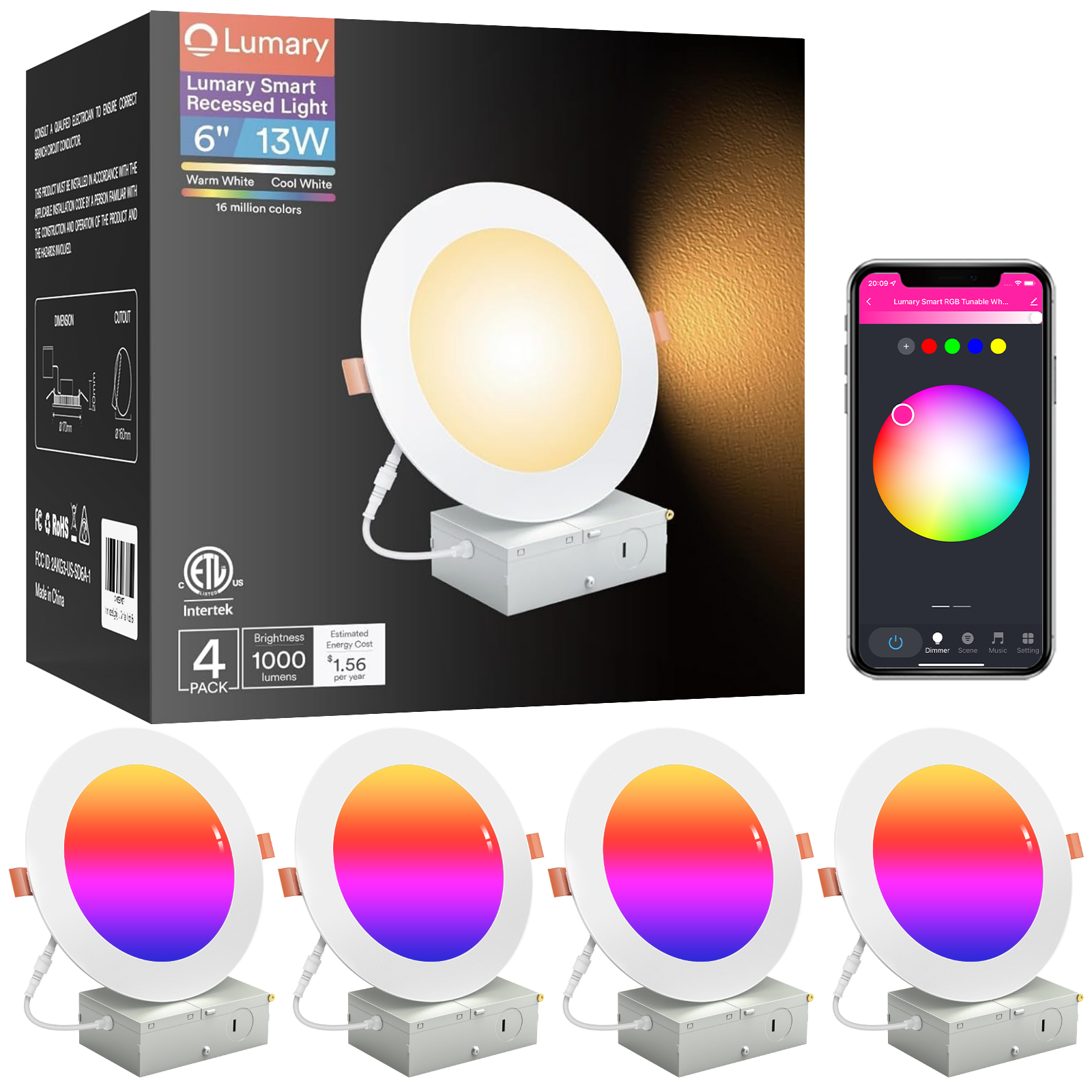
The Lumary Wi-Fi Smart Canless Recessed Lighting 6 inch 4 PCS is a four-light, ultra-thin smart downlight set offered as US-SD6A-4 in white and US-SD6B-4 in black. Lumary specifies 13 W, AC 110 V, FCC and ETL compliance, CRI 90, RGBWW light, Bluetooth and Wi-Fi connectivity, and control by app, remote, or voice. The product description also says the Lumary app uses 2.4 GHz Wi-Fi for scheduling, grouping, remote control, and retained last settings. The physical format matters most to buyers replacing or adding ceiling lighting where a low-profile fixture and junction-box installation fit the construction plan; it is not the same ownership model as keeping a spare screw-in lamp in a drawer.
The performance specification needs one deliberate planning check. The product description states 13 W and 1,100 lm, while the separate Specs block states 13 W and 1,000 lumens. These two published values should not be assigned to the white or black variant without confirmation. For room layouts and fixture counts, use the lower published figure as a conservative starting point or obtain clarification from Lumary; do not represent the 4-pack as delivering a measured room illuminance. The value of the smart 6-inch Lumary downlight set is its range of usable states: brightness can be adjusted from 1% to 100%, white light from 2700K to 6500K, and the product page also lists 16 million colors, eight scene modes, custom scenes, music synchronization, grouping, schedules, and shared control.
For lifespan planning, those controls are useful only if the fixture remains appropriate to the room and serviceable through the product’s supported path. Memory can return a light to its last setting, while shared control gives more than one household member a way to operate the installation. Those features reduce day-to-day friction; they do not establish a lifetime rating. Buyers should save the model designation, purchase record, installation photographs, and the Lumary recessed-light product documentation at installation. That small record is what makes a later support, matching, or electrician conversation faster and more accurate.
Technical Specification Table
| Specification | Lumary Wi-Fi Smart Canless Recessed Lighting 6 inch 4 PCS (US-SD6A-4 / US-SD6B-4) |
|---|---|
| Model designation | Lumary Wi-Fi Smart Canless Recessed Lighting 6 inch 4 PCS: US-SD6A-4 (White) / US-SD6B-4 (Black) |
| Pack format | 6 inch, 4 PCS |
| Physical format | Ultra-thin smart canless recessed lighting |
| Published wattage | 13 W |
| Published light output | 1,100 lm in the description; 1,000 lumens in the Specs block |
| Input voltage | AC 110 V |
| Light color | RGBWW |
| White color-temperature range | 2700K–6500K |
| Brightness adjustment | 1%–100% |
| Color rendering index | CRI 90 |
| Connectivity protocol | Bluetooth, Wi-Fi |
| Control methods | App, remote, voice |
| Voice assistants listed | Google Assistant, Alexa, Siri |
| Scenes and effects | 16 million colors, 8 scene modes, custom scenes, music sync |
| Installation stated | Junction box and spring clips |
| Compliance listed | FCC, ETL |
Long-Term Recessed-Light Ownership and Replacement-Planning Framework
Use this framework before the ceiling is closed and again when a light begins to behave differently. It separates documented configuration from assumptions about decades of use. First read across each row: the middle columns identify the condition that can make an ownership problem costly, while the Lumary column identifies only the published product information that may help a buyer plan. Then keep the evidence that matters—model number, wiring notes, the planned room settings, and a photograph of the pre-close ceiling condition. Each Lumary entry below is limited to the product page: it is a planning response, not an independently measured reliability or longevity claim. A good framework does not predict failure; it makes an eventual support conversation specific.
| Key Purchasing Criterion | Common Sign of a Poor-Quality Unit | How This Lumary Smart Canless Recessed Light Addresses It | Long-Term Usage / Performance Impact |
|---|---|---|---|
| Clear product identification | A future owner cannot match the light after a remodel | The page identifies white US-SD6A-4 and black US-SD6B-4 variants | Recording the model helps support identify the correct product later |
| Documented electrical basics | Voltage and connection approach are unknown during a service call | Lumary lists AC 110 V and a junction-box installation | An electrician can start from stated system details rather than visual guesswork |
| Light-output planning | Fixture counts are selected from an unverified headline | The page displays both 1,100 lm and 1,000 lumens | The discrepancy should be clarified before a layout is finalized |
| Color quality for routine tasks | Food, fabrics, or printed work look unexpectedly different | Lumary lists CRI 90 | A buyer can select around a published color-quality metric rather than assume one |
| Brightness adaptation | One fixed output feels harsh at night or inadequate for a task | The listed dimming range is 1%–100% | The same installed fixtures can be adjusted as room use changes |
| White-light adaptation | A space is locked to one white appearance | The stated white range is 2700K–6500K | Household routines can use a chosen warm or cool setting without changing a lamp |
| Everyday access | One phone or one control method becomes a point of failure for users | Lumary lists app, remote, and voice control plus shared control | More than one normal operating path can be configured for the household |
| Repeatable routines | Manual changes are forgotten when a room changes purpose | The product page lists schedules, group control, scenes, and memory | Recurring room states can be restored without reprogramming every light |
| Ceiling-fit planning | A bulky housing conflicts with a retrofit constraint | Lumary describes an ultra-thin light installed with spring clips | Physical fit still needs field verification before cutting, but the stated form supports a low-profile plan |
| Compliance check | A buyer cannot identify the listed conformity markings | The Specs block lists FCC and ETL | The listing gives a buyer a stated compliance reference to verify against the product documentation |
Competitive Landscape
Smart recessed lighting spans two ownership approaches: a complete low-profile downlight or a conventional housing fitted with a smart replaceable lamp. Neither is automatically longer-lived; electronics, temperature, installation, and support path matter. The useful comparison is whether bulb-swap flexibility matters more than the canless fixture format. Decide that before opening the ceiling.
Philips Hue’s reviewed smart-bulb system is a strong ecosystem-oriented alternative. PCWorld highlights its Bluetooth and Zigbee operation, broad product family, and bridge-based expansion. Hue lets a buyer choose between replaceable bulbs and integrated recessed fixtures, so the future service model is a deliberate format decision rather than a brand-level verdict.
Govee’s Wi-Fi bulb review represents the color-effect and app-scene side of smart lighting. A buyer may use Govee bulbs, strips, or lamps as a replaceable or decorative layer beside recessed task and ambient lighting. Those formats are relevant to a layered room, but they are not a mechanical substitute for a 6-inch ceiling downlight.
Nanoleaf Matter Essentials is especially relevant when mixed-platform interoperability drives the decision. Its bulb-based architecture lets a homeowner keep an existing compatible socket and replace the lamp later. That can suit a sound recessed-can installation, while a junction-box-connected canless light is a different renovation choice.
Kasa smart lighting emphasizes app scenes, schedules, grouping, Wi-Fi operation, and mainstream voice-assistant integrations in an editorial review. Kasa bulbs remain a practical option where an existing socket is the priority. Its light strips occupy a complementary accent-light role, not the downward white-light role of a recessed array.
LIFX in TechRadar’s tested smart-lighting coverage raises a simple physical-fit point: smart bulbs can be larger than standard lamps, so existing shades and housings still need measurement. The same discipline applies to a canless plan, where the opening, junction box, ceiling layout, and intended light distribution need verification before work begins.
Lumary occupies the complete-fixture side of the field with a four-light ultra-thin set, RGBWW light, CRI 90, 1%–100% brightness adjustment, 2700K–6500K white light, and app/remote/voice controls. Choose it for the documented format and controls, then preserve the model and installation record for any future fixture-level service.
Application Scenarios
1. Living Room After Work: Screen Reflections Versus Reading Light
Consider an illustrative 12-by-16-foot living room with a television on one wall, a reading chair near the opposite corner, and four ceiling locations that were planned as a simple grid. The tension is not merely “bright versus dim.” Family members want enough general light to find seats and read, but a high-output cool-white ceiling setting can be distracting during a film and can make a glossy screen more reflective. Fixture count also cannot be justified by adding nameplate lumens alone: the product page displays 1,000 lumens in Specs and 1,100 lm in the description. Four fixtures therefore represent an illustrative 4,000–4,400 lm of listed initial output, not a measurement of the light actually delivered to a sofa, page, or screen.
Here the Lumary 6-inch canless recessed lights can be organized around repeatable states rather than a one-time “bright room” decision. Before the evening, group the four lights in the app and save a reading state with a chosen white temperature and brightness. During television viewing, use the stated 1%–100% adjustment to lower the ambient layer, then use the remote or listed voice control when someone needs a quick change. After the program, memory can return the last setting rather than asking a user to recreate it. The product’s 2700K–6500K range allows a buyer to choose the white appearance for the activity; it does not prove that any one setting prevents glare.
The remaining field check is light placement and visual comfort. ENERGY STAR’s downlight criteria explain that downlights distribute light within a defined zone and that color temperature describes the apparent warmth or coolness of white light; they do not prescribe a living-room grid for every ceiling. Put the screen, chair, ceiling height, and sightlines on the layout before cutting. If four discs visibly reflect in the screen or put a bright source directly over the reading position, change the plan or add a separate task light. The long-term outcome is a room that can change modes over years without constantly changing bulbs, while still recognizing that the whole downlight is the documented system to match if service is needed.
2. Kitchen Prep Zone: Ambient Coverage Versus Countertop Task Light
In an illustrative 10-by-14-foot kitchen, the family may cook at 6 p.m., clean after dinner, and leave a soft pathway light later in the evening. The competing needs are broad ceiling coverage, usable counter visibility, and an atmosphere that does not feel overlit when people remain at the island. Recessed ceiling fixtures do not erase shadows cast by the cook’s body or wall cabinets, so they should be planned with under-cabinet or other task lighting where the counters demand it. DOE describes CRI 90 as indicating excellent color fidelity, which gives the product’s listed CRI 90 practical relevance for a kitchen where food colors and labels are evaluated. It does not convert a CRI number into a guarantee of any food-preparation light level.
Start with the documented Lumary smart recessed-light four-pack, then divide the kitchen conceptually into a work group and a circulation group only if the wiring and room plan support that control topology. Before cooking, a household can select a white setting within the published 2700K–6500K range and an appropriate brightness level. During preparation, the 13 W lights supply the designed ambient layer while a counter-specific layer handles shadows. After cleanup, an app schedule can reduce the need to remember a routine, and shared control lets another family member use the supported system. Color scenes and music sync may be enjoyable during a gathering, but they are not a substitute for white task lighting.
Fixture spacing, cabinet lines, and opening locations remain the decisions that determine whether the installation feels coherent years later. The downlight criteria state that qualified models are evaluated for directional distribution and that light output requirements depend on aperture size, a useful reminder not to treat room area divided by an arbitrary fixture count as a finished lighting design. First mark cabinet fronts, appliance swings, and the island; then verify the product template and clearance conditions before work begins. Long-term success in this kitchen is not “never replace anything.” It is a controlled ambient layer that can be tuned and scheduled, paired with a documented model and installation record for any future fixture-level service.
3. Bedroom Routine: Morning Visibility Versus Low-Disruption Night Navigation
Imagine an illustrative bedroom shared by two adults with different schedules: one leaves at 6:45 a.m.; the other often returns after 10 p.m. A single fixed white ceiling light creates a predictable conflict. The earlier user wants a clear dressing-room-like state, while the later user wants enough light to navigate around furniture without filling the room with a high-brightness cool-white setting. A schedule is a control convenience, not a sleep or health claim. The relevant planning detail is simple: identify the actual activity times, decide which settings are appropriate for those activities, and ensure every intended user has an operating method they understand.
The Lumary canless ceiling-light system provides several documented ways to make that routine less repetitive. Before bed, select a lower brightness and a chosen warmer setting from the stated 2700K–6500K white range, then save it through the app’s listed memory behavior. In the morning, use an app schedule, remote, or listed voice control to change the room to a brighter state; family sharing means one person’s phone does not need to be the household’s only controller. The RGBWW and scene features create additional choices for non-task use, but clear white light should remain the baseline when dressing, locating medication, or checking a label.
The tradeoff is operational discipline. A smart downlight needs a stable plan for how people will use the room’s physical circuit and supported controls; the fixture’s published app connection is 2.4 GHz Wi-Fi, while the Specs block also lists Bluetooth and Wi-Fi. Confirm actual connectivity in the finished room before relying on schedules, and keep a remote where guests or less technical family members can find it. The desired long-term result is not a room full of changing colors; it is a ceiling layer that can be set deliberately for morning and night, with a model record ready if a complete downlight eventually needs attention.
4. Finished-Ceiling Remodel: Low Profile Versus a Future Service Visit
This is the scenario where the word “bulb” can lead to the most expensive misunderstanding. In a finished basement or a living-room remodel, an owner may value a slim ceiling face because joists, ducts, or an existing ceiling finish constrain the work. The Lumary page specifies an ultra-thin 6-inch product installed with a junction box and spring clips, plus AC 110 V and FCC/ETL listings. The appeal is clear: the documented system is a low-profile downlight rather than a conventional can fitted with a later screw-in lamp. The tension is that an easy-looking ceiling face does not make every later electrical change a simple bulb swap.
Before opening the ceiling, use the product’s supplied template and instructions, locate framing and existing wiring, and make the layout agree with furniture and doorway lines. Home Depot’s general canless guide says to plan positions before cutting, then prepare and close the junction box after appropriate conductor connections. It also shows why each location needs enough cable and physical room for the box, not merely a circular ceiling opening. The Lumary ultra-thin 6-inch downlight is best treated as an electrical fixture installation: the stated spring clips finish the ceiling interface, while the junction box remains part of the system above it.
Community experience reinforces the caution without setting a safety rule. In a recent canless-replacement discussion, homeowners described the practical work of matching or enlarging existing openings and reconnecting a new box before pushing a spring-clip light flush. That is anecdotal experience, not a universal method or a recommendation for unqualified DIY work. The long-term outcome is favorable when the future owner can identify the model, access the recorded layout, and call the right professional if service is required. It is unfavorable when a ceiling is closed without records and someone later assumes any standard bulb will fit.
5. Long-Term Ownership: Gradual Dimming Versus a Sudden “Bulb Is Out” Assumption
For a home intended to be occupied for many years, make one small maintenance file at installation. Put the two model designations, purchase date, a photo of each junction-box location before closing the ceiling, the product link, circuit identification, and the white/color configuration into it. This has more value than predicting an exact replacement year. As a transparent category example, a light used three hours per day operates about 1,095 hours per year. A 25,000-hour L70 rating, if a particular qualified downlight actually carries that rating, would correspond to roughly 22.8 years at that use level: 25,000 ÷ 1,095. Lumary does not publish that rating on this page, so that arithmetic must not be read as a Lumary lifespan estimate.
Normal observation should focus on the room’s useful state. Once or twice a year, set all four Lumary smart recessed downlights to the same chosen white setting and brightness, then look for a meaningful difference among units. Check that scheduled, grouped, remote, and voice controls operate in the way the household actually uses them; the page lists all of those pathways, along with memory and family sharing. A color scene is a poor baseline for this check because subjective color effects can mask modest output differences. Compare like with like, and record any persistent change rather than resetting settings until the problem becomes hard to describe.
If a light becomes unacceptably dim, shifts color, flickers, or stops responding, switch off power as appropriate and start with the product information and support path rather than forcing a generic bulb replacement. DOE explains that LEDs can lose useful output gradually while electronics can fail separately, which is why a fixture that suddenly goes dark does not prove the LED emitter alone is the cause. A qualified electrician can assess the fixed wiring and junction-box installation; Lumary can advise on product-specific support. The durable outcome is an informed service decision: replace only what the documented system and diagnosis call for, rather than assuming every recessed ceiling light has a standard bulb behind the trim.
Editorial Assessment
The durable answer is conditional. LED recessed fixtures can provide many years of service, but their useful life is generally defined by maintained light output, and complete luminaires can also reach an electronics or color-quality limit before the LED source itself is exhausted. Lumary’s product page does not publish a rated life or an L70 value, so a careful buyer should not promise a specific year count. It does publish enough to evaluate the planned installation: a four-light ultra-thin canless form, 13 W input, two named variants, AC 110 V, CRI 90, RGBWW light, a 2700K–6500K white range, adjustable brightness, multiple control methods, and junction-box/spring-clip installation.
The strongest fit is a homeowner or remodeler who wants a coordinated smart ceiling-light system and is prepared to treat it as a fixture-level installation. The Lumary 6-inch 4-light package makes particular sense where a slim physical format, grouped control, schedules, shared access, and adjustable white/color light matter more than keeping a standard bulb socket. A different category or configuration deserves attention when existing can housings are sound and effortless bulb-by-bulb replacement is the central long-term requirement, or when a lighting professional recommends a different aperture, optic, trim, or task-light layer for the ceiling and room.
Who Should Buy This Product: buyers who will verify the physical installation first, want app/remote/voice control across a four-light room system, and will keep model and installation records for eventual support. Do not frame the purchase around an unsupported lifetime promise or a presumed bulb type. Frame it around the documented fixture, a suitable electrical plan, and a future service process that begins with the actual model.
Frequently Asked Questions
Q1. How long do LED recessed lights normally last?
They often last far longer than incandescent bulbs, but the meaningful number is usually a lumen-maintenance threshold rather than the moment a light dies. DOE says a good-quality white LED product is often expected to provide 30,000–50,000 hours or more of useful life, and defines common useful-life thinking around reduced light output. ENERGY STAR’s downlight criteria use an in-situ L70 requirement of at least 25,000 hours for qualifying products. Those figures describe tested or qualified category products, not a universal guarantee. DOE’s LED-life explanation and ENERGY STAR’s L70 definition explain the distinction. For the Lumary 6-inch 4-pack, ask Lumary for a written rated-life value if that number is a purchase requirement; the supplied product page does not state one.
Q2. Will I replace a bulb in this Lumary recessed light?
Do not plan on a routine generic bulb swap. Lumary documents this product as an ultra-thin canless 13 W downlight connected through a junction box and retained by spring clips, and does not present a compatible screw-in bulb or a bulb-change process. That aligns with the general canless category described by Lowe’s, where thin integrated LED discs are treated as complete units rather than bulb-and-housing combinations. If output or operation becomes unacceptable, retain the US-SD6A-4 or US-SD6B-4 model record, then seek Lumary’s product-specific support guidance or a qualified electrician’s assessment of the installation. The practical check is to identify whether you have this complete canless unit before buying any replacement part; a standard bulb is not a safe assumption.
Q3. What usually ends the useful life of an LED downlight first?
It can be gradual loss of light, objectionable color shift, or a separate electronics failure; it is not always the LED emitter “burning out.” DOE notes both catastrophic electronics failure and color shift as reliability considerations for LED luminaires. Heat is a major factor because higher operating temperatures accelerate LED degradation, and downlight criteria also treat driver temperature as critical. The Lumary page’s flicker-free statement describes intended operation, but it is not a published lifespan or repair guarantee. If a fixture’s behavior changes persistently at its normal setting, record the model, setting, circuit, and symptoms. Then use the product support path and, when wiring or junction-box work is involved, obtain qualified electrical help rather than diagnosing the ceiling assembly as though it were only a replaceable bulb.
Q4. Does smart control make the recessed lights last longer?
Smart control can make the lighting easier to use and can reduce unnecessary operating time through schedules, but it does not by itself establish a longer rated life. Lumary lists 1%–100% brightness adjustment, schedules, group control, app control on 2.4 GHz Wi-Fi, remote control, voice control, memory, and sharing. These features let a household choose a lower setting for late evening or automate an off routine after a room is empty. The actual long-term outcome still depends on the complete luminaire, operating environment, installation, and the manufacturer’s support terms. Configure schedules around real household use, then keep the white-light setting used for daily tasks consistent enough that a future output change will be easy to notice and describe.
Q5. Can I replace a failed canless recessed light myself?
Sometimes the physical work may appear straightforward, but the right answer depends on the product instructions, existing wiring, junction-box configuration, local requirements, and your competence. Home Depot’s general guide includes planning the opening, making appropriate conductor connections, and closing the junction box; those steps demonstrate why it is more than changing a bulb. A practitioner discussion of recessed-light selection also illustrates why ceiling fit, glare, and future access are recurring real-world concerns, though it is not a safety authority. Start by switching off power as appropriate, identify the exact Lumary model and circuit, and contact Lumary for product-specific service guidance. Use a qualified electrician when the work involves fixed wiring, a damaged enclosure, uncertainty about the existing installation, or any condition you cannot safely verify.

