







The easiest way to tell the difference between a spotlight and a recessed light is to ask two different questions: How is the fixture installed? and how does the light come out of it? “Recessed light” mainly describes the installation method—the fixture sits partly or almost entirely inside the ceiling so that little of the body projects into the room. “Spotlight,” by contrast, mainly describes optical behavior: it produces a relatively concentrated beam intended to direct attention toward a smaller area, object, or surface. The Illuminating Engineering Society (IES) defines beam angle as the angle between the directions where luminous intensity falls to 50% of the maximum intensity, making beam angle one of the most useful specifications for judging whether a light behaves like a concentrated spot. IES also defines a downlight as a small direct-lighting unit that directs light downward and notes that a downlight can be recessed, surface-mounted, or suspended. In other words, “recessed” and “spotlight” are not opposite categories.
That distinction becomes clearer when you think about what the light is supposed to do. IES describes accent lighting as directional lighting used to emphasize a particular object, surface, or portion of the visual field. A spotlight is commonly used for that type of task: highlighting artwork, a fireplace, shelving, a sculpture, merchandise, or a particular architectural detail. A recessed light may instead be designed to provide broad ambient illumination over a room. Home Depot’s recessed-lighting guidance similarly explains that recessed fixtures can be configured either to increase general room illumination or to highlight artwork and décor. Therefore, you cannot reliably identify a spotlight merely by seeing a circular fixture in a ceiling.
The trim and optical system provide additional clues. Lowe’s distinguishes several recessed-light trim designs, including open trims for general lighting, wall-wash trims, pinhole trims that create a tighter beam, and eyeball or gimbal trims that can pivot toward a target. That means a recessed fixture can itself be a spotlight if it combines recessed mounting with narrow or adjustable optics. Cooper Lighting provides an even clearer architectural example: one of its recessed adjustable multi-head luminaires offers optical distributions from approximately 10° to 75° together with substantial tilt and rotation. The product remains recessed because of how it is mounted, while its narrower optical configurations perform a spotlight or accent-lighting role.
Beam width gives you a practical way to visualize the difference. A commonly used lighting relationship estimates beam diameter from beam spread and distance. For example, at an illustrative distance of 8 feet, a 20-degree beam creates a main beam approximately 2.8 feet across, while a 60-degree beam creates a beam approximately 9.2 feet across. The first is much more suitable for deliberately emphasizing a painting or small table; the second covers a much larger area and behaves more like general room lighting. Philips’ lighting-reference material provides the standard beam-spread calculation, while HD Supply’s beam-spread guidance describes spot distributions as relatively narrow and concentrated compared with broader flood distributions. These numbers are examples rather than universal definitions of “spotlight,” but they demonstrate why beam angle matters more than the fixture’s round appearance.
You can also identify the difference by observing what happens on the surfaces below the light. Stand beneath the fixture at night and look at the floor, wall, or object it illuminates. If you see a relatively defined bright zone surrounded by noticeably less light—and especially if the fixture can be aimed—the light is behaving more like a spotlight. If several fixtures create broad overlapping pools intended to illuminate the whole room evenly, they are behaving more like ambient downlights. A discussion in the r/Lighting community about finding a recessed ceiling spotlight for a small podium illustrates how real users make the same distinction: the desired product was described in terms of adjustable accent or gimbal behavior rather than simply being “recessed.” Community discussions are anecdotal rather than technical standards, but they are useful evidence of how the terminology causes confusion in real projects.
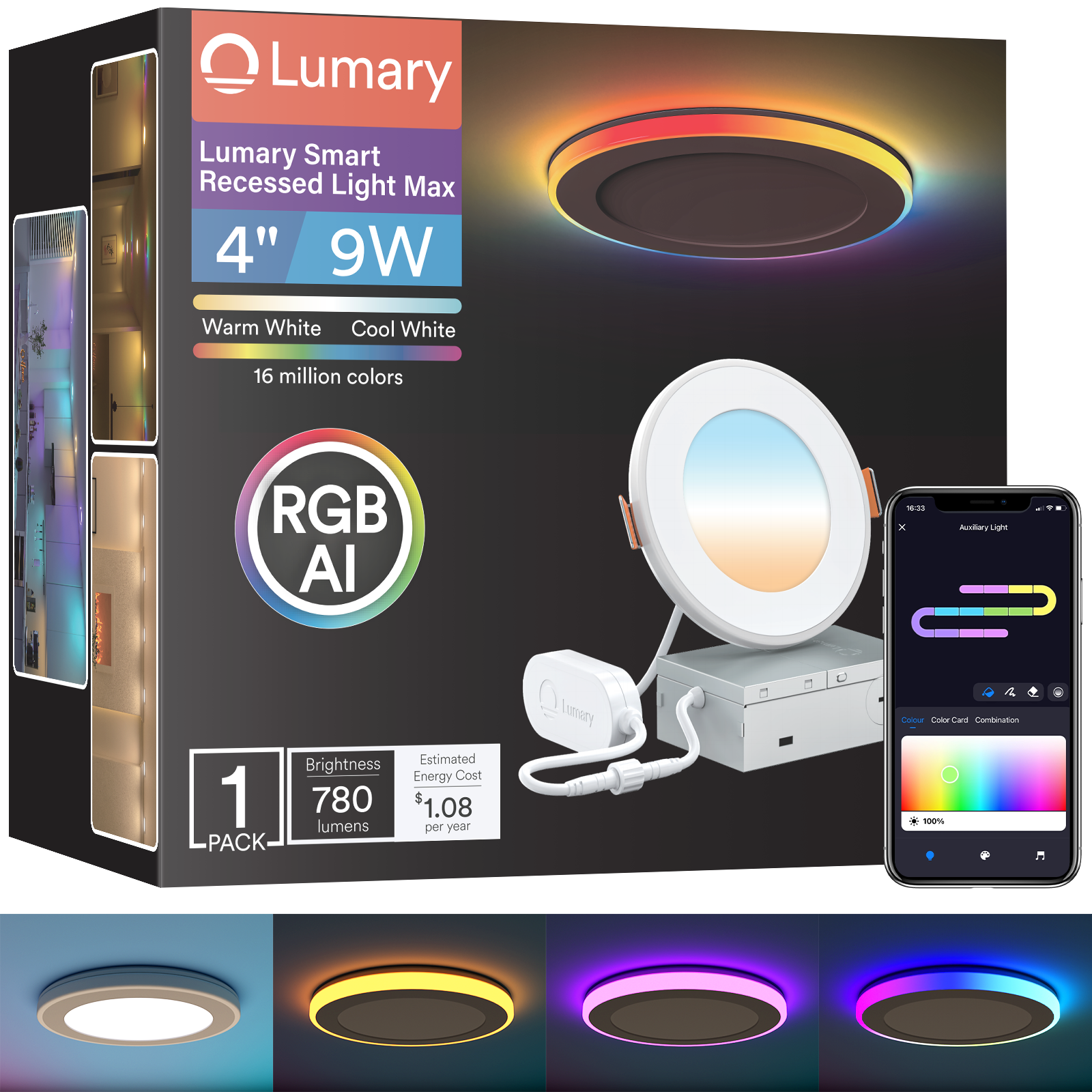
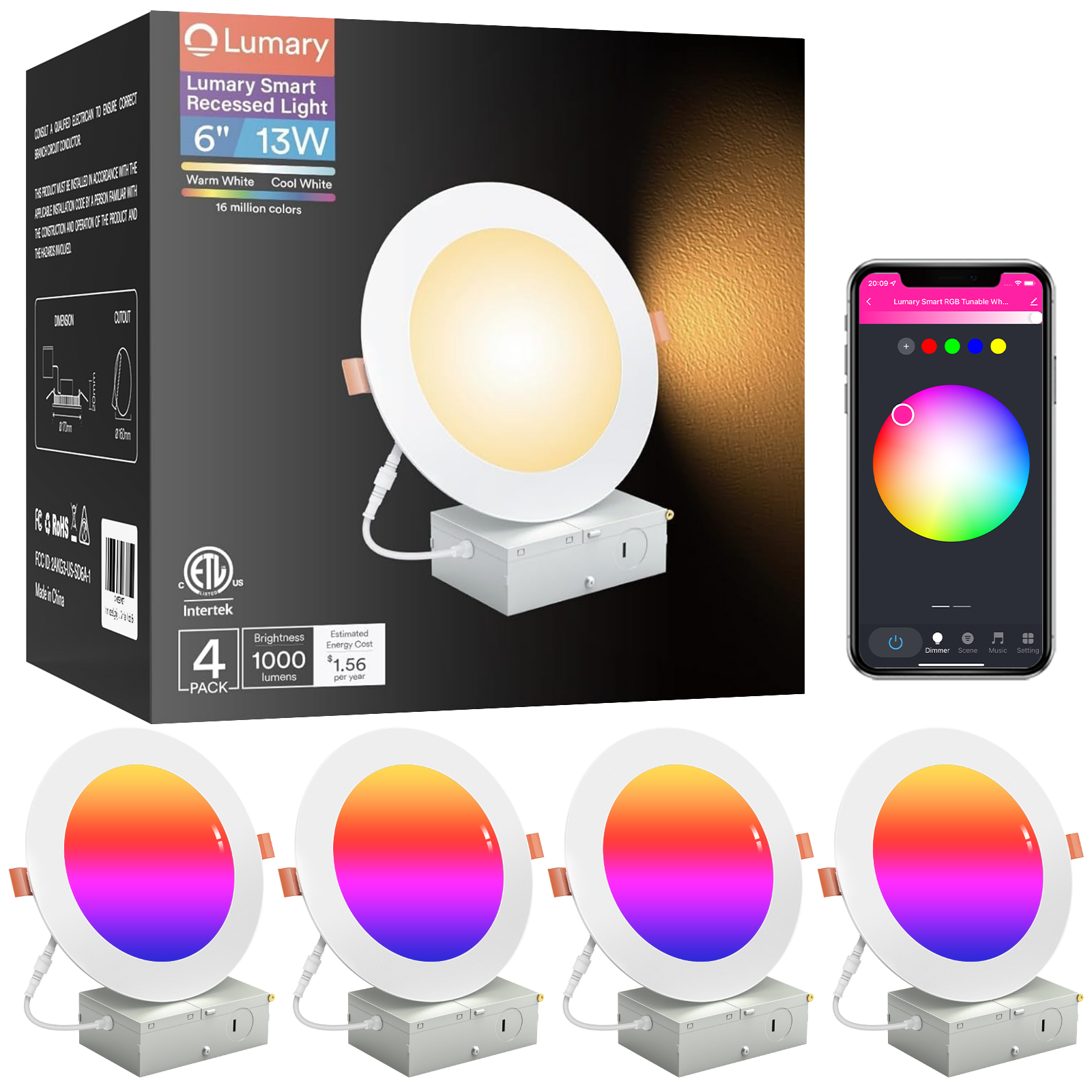
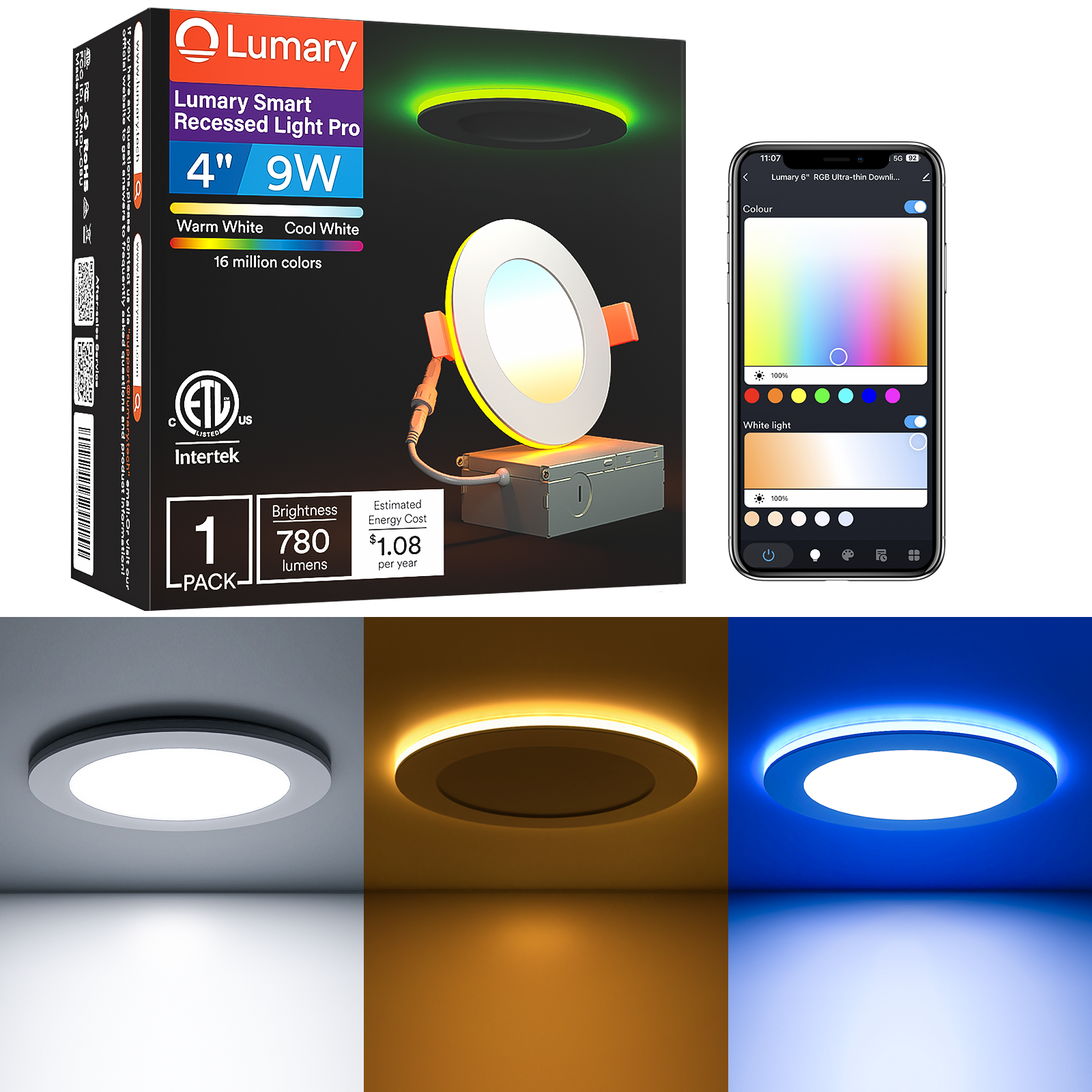
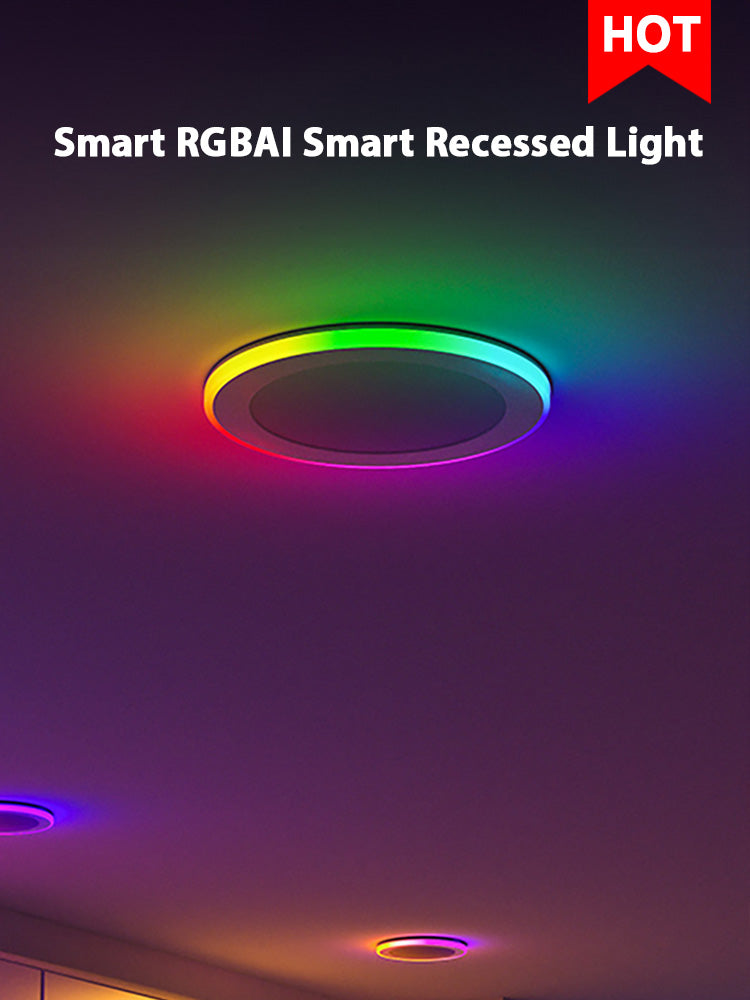
The Lumary Smart RGBAI Recessed Light with Gradient Auxiliary Night Light is a good example of why the distinction matters. Lumary’s official product page identifies it as a recessed lighting system and lists 4-, 6-, and 8-inch sizes, 9W / 12W / 18W power values, 780 / 1000 / 1400-lumen brightness values, and a 2700K–6500K white-light range. It also includes Downlight, Nightlight, RGB, and RGBAI Gradient modes. However, the listed specifications do not provide a beam-angle figure or an aiming range. Therefore, it is accurate to call the product a recessed light and a downlight based on its documented design and operating modes, but it would not be responsible to call it a narrow-beam spotlight without additional model-specific optical data.
Product Recommendation Analysis
The Lumary fixture is most relevant to buyers who are primarily looking for a smart recessed ceiling-lighting system rather than a dedicated precision spotlight. Its official specifications establish the recessed form factor and give three physical sizes—4, 6, and 8 inches—together with three published wattage and lumen values. The product also supports tunable white from 2700K to 6500K, which makes it useful for rooms that need a general white-light layer at different times of day. The key point for this article is that these specifications describe physical format, output, and control capabilities; none of them establish a narrow optical beam.
The Lumary smart recessed downlight also includes a separate auxiliary-light system with 12 individually controlled RGBAI segments and four listed operating modes: RGBAI Gradient, RGB, Nightlight, and Downlight. Lumary states that the main and auxiliary lights cannot operate simultaneously. It also lists 50 preset scenes, group control, a timing function, Lumary App control, Alexa, Google Assistant, Siri through Lumary App automation, and a 2.4 GHz Wi-Fi requirement. Those features make the fixture flexible as a smart ambient and decorative ceiling-lighting system, but decorative color effects should not be confused with spotlight optics.
One installation/control limitation should also be considered before purchase. The official page says the lights are not compatible with dimmer switches and warns that frequent operation of a wall switch can reset the smart lights. Brightness and scenes should therefore be managed through the supported smart-control architecture rather than through a traditional wall dimmer. For buyers whose main objective is to place a tightly controlled beam on an artwork, display shelf, or architectural feature, a published beam angle and aiming range should be treated as separate purchasing requirements.
Technical Specification Table
| Specification | Lumary Smart RGBAI Recessed Light with Gradient Auxiliary Night Light |
|---|---|
| Verified product name | Lumary Smart RGBAI Recessed Light with Gradient Auxiliary Night Light |
| Model numbers listed | US-SD4E-1 / US-SD4E-4 / US-SD6E-1 / US-SD6E-4 / L-SD8E1 / L-SD8E4 |
| Product format | Recessed light |
| Available sizes | 4 inch / 6 inch / 8 inch |
| Published wattage values | 9W / 12W / 18W |
| Published brightness values | 780 lumens / 1000 lumens / 1400 lumens |
| White color-temperature range | 2700K–6500K |
| Light-color system | RGBAIWW |
| Lighting modes | RGBAI Gradient / RGB / Nightlight / Downlight |
| RGBAI segmentation | 12 individually controlled segments |
| Main + auxiliary behavior | Main and auxiliary lights cannot operate simultaneously |
| Control methods | Lumary App / voice |
| Voice platforms listed | Amazon Alexa / Google Assistant / Siri via Lumary App automation |
| Network requirement | 2.4 GHz Wi-Fi |
| Additional functions | 50 preset scenes / Group Control / Timing Function |
| Conventional dimmer compatibility | Not compatible with dimmer switches |
| Published beam angle | Not listed on the official product page |
| Published aiming range | Not listed on the official product page |
How to Identify a Spotlight, Downlight, or Recessed Fixture Before You Buy
Instead of relying on the product name alone, separate the decision into mounting, beam distribution, aiming, and intended use. This works because the same recessed housing can support everything from broad ambient illumination to a narrow directional accent. If a product page gives only diameter, wattage, lumens, and color temperature, you still do not know how concentrated the beam will be. Beam-angle and photometric information become especially important when you are trying to illuminate one specific object rather than the room generally.
| Key Purchasing Criterion | What Usually Indicates a Spotlight | What Usually Indicates a General Recessed Light | How to Apply It to the Lumary Model |
|---|---|---|---|
| Mounting method | Can be recessed, surface-mounted, track-mounted, or otherwise installed | Fixture body is installed into or nearly flush with the ceiling | Officially identified as a recessed light |
| Beam angle | Relatively narrow, concentrated beam | Broader distribution intended to overlap with nearby fixtures | Beam angle is not published; do not infer it |
| Aiming | Often adjustable toward art, shelves, walls, or displays | Frequently fixed downward for general coverage | No aiming specification is published on the page |
| Visual effect | Distinct pool of light with stronger contrast around the target | Broad, overlapping illumination across the room | Product is documented around Downlight and auxiliary ambient/decorative modes |
| Typical purpose | Accent lighting, object emphasis, display lighting, focused task lighting | General ambient illumination and room coverage | Best documented as smart recessed room lighting |
| Lumen rating | Does not determine whether the fixture is a spotlight | Does not determine beam width either | 780 / 1000 / 1400 lumens should not be converted into beam-angle assumptions |
| Trim/optic | Pinhole, gimbal, eyeball, projector-style, or narrow optical lens may indicate focused use | Open/diffuse trim often suggests broad general lighting | Official page does not specify a narrow spotlight trim |
| Product terminology | “Spot,” “accent,” “narrow beam,” or a degree value can provide clues | “Recessed light,” “downlight,” “wafer,” or “general illumination” indicates mounting/use but not necessarily beam width | “Recessed Light” and “Downlight” are verified terms; “spotlight” is not |
Competitive Landscape
Smart recessed lighting spans several designs: shallow integrated panels, retrofit modules for existing cans, compact downlights, and recessed spotlights with narrower or adjustable optics. The brands below are useful comparisons because independent editorial coverage shows how manufacturers prioritize beam distribution, physical depth, control protocol, and retrofit strategy. The useful comparison is therefore not simply which product is called “recessed,” but what kind of light distribution and room function each design supports.
Philips Hue illustrates the difference between a recessed panel-like downlight and older recessed spotlight formats particularly well. Hueblog’s review of the Philips Hue Slim recessed light describes a shallow design in which LEDs are positioned around the perimeter and directed through a diffuser to create relatively broad, even illumination. The review contrasts that format with earlier Hue recessed spot solutions using GU10-style sources. Two fixtures can therefore both disappear into the ceiling while creating very different visual effects.
Nanoleaf approaches the category through Matter-over-Thread and an integrated recessed-downlight form. SmartHomeScene’s review examines the fixture’s physical cutout, integrated electronics, dimming, color behavior, and Thread networking. Nanoleaf is useful for demonstrating that “smart recessed light” involves several decisions at once: ceiling fit, optical behavior, and smart-home architecture. Its network protocol does not by itself tell a shopper whether the beam behaves like a spotlight.
WiZ represents a direct-Wi-Fi ecosystem with an emphasis on relatively simple app setup and room grouping. Tech Advisor’s WiZ smart-lighting review focuses on Wi-Fi connectivity, multi-light control, and the breadth of the ecosystem. For a room with several ceiling fixtures, those controls can matter operationally, but they still do not answer the optical question. Smart color and brightness control can alter output; the physical optic still determines how broadly or narrowly that output is distributed.
Govee provides another useful comparison because its smart recessed products are commonly discussed as integrated RGBIC room-lighting systems rather than as precision art spotlights. An independent 4KGearLab review of Govee smart recessed lighting focuses on its canless ceiling format, multicolor effects, app controls, and grouped room use. That distinction is important: sophisticated RGB effects do not establish a narrow beam. A Govee, Lumary, or other smart recessed light still needs model-specific beam data before it should be assigned a precision spotlight role.
LIFX has long emphasized hub-free Wi-Fi lighting and strong color control, including downlight formats. techAU’s review of LIFX Color downlights discusses GU10-style downlights used in feature-lighting arrangements above spaces such as a kitchen bench. GU10-style light sources are often associated with more directional applications than broad integrated panels, making this a useful reminder that the source and optic inside the ceiling opening can matter as much as the ceiling opening itself.
Lumary sits in the integrated smart recessed-light part of this landscape. Its official page emphasizes a main downlight plus separate RGBAI/night-light behavior, three physical sizes, tunable white, group control, scenes, and app/voice operation. Because the page does not publish a beam-angle specification for this model, its strongest documented positioning is as a flexible smart recessed-lighting system rather than as a verified narrow-beam spotlight. If a project depends on a precise accent cone, beam-angle or photometric data should remain a separate purchasing requirement regardless of brand.
Application Scenarios
1. Living Room With Artwork: Broad Ceiling Light Versus a Deliberate Accent Beam
Consider an illustrative 14-by-18-foot living room with an 8-foot ceiling, a sofa facing a television, and one 36-inch-wide painting on the side wall. The room needs two different types of lighting. First, people need a comfortable ambient layer for conversation, circulation, and cleaning. Second, the painting may benefit from a brighter, more directional emphasis than the surrounding wall. Calling every ceiling fixture a “spotlight” obscures that distinction. IES defines accent lighting as directional lighting used to emphasize a specific object or surface, so the painting light performs an accent job while the rest of the ceiling system primarily performs an ambient job.
Use an illustrative beam calculation to see the difference. If the artwork is approximately 8 feet from the ceiling source and a true spotlight has a 20-degree beam, its main beam diameter is about 2.8 feet. That is close to the width of the painting and could create a deliberate highlight if it is aimed correctly. A 60-degree beam at the same distance is approximately 9.2 feet wide, so it illuminates far more of the wall. Neither distribution is inherently better; they perform different jobs. Lowe’s guide notes that pinhole recessed trims can spotlight specific objects while gimbal and eyeball trims can redirect light, demonstrating how a recessed fixture can perform a spotlight function when the optic and aiming system support it.
For the general ceiling layer, the Lumary smart recessed downlight can be grouped and used in Downlight mode, with the 2700K–6500K white-light range supporting different daytime and evening states. Later, the room can switch to Nightlight or RGBAI Gradient mode for decorative ambience. The official page states that the auxiliary and main downlight cannot operate simultaneously, so these are alternate modes rather than additive layers. Because the page does not publish beam angle or aimability, however, do not assume this model can replace a dedicated 20-degree artwork spotlight. A practical design may use Lumary for the ambient recessed layer and a separately specified accent fixture for the painting.
2. Kitchen Island and Counters: Recessed Does Not Automatically Mean Focused Task Light
Imagine an illustrative 12-by-16-foot kitchen with four recessed fixtures arranged in a ceiling grid and a 7-foot island in the center. The competing needs are relatively even ambient illumination, useful task lighting on work surfaces, and enough visual hierarchy that the island does not disappear into flat overall illumination. A homeowner may call every bright circle on the countertop a spotlight, but the better test is whether each fixture is intentionally concentrating its output or simply creating overlapping downward coverage. Home Depot’s guidance notes that recessed lights can be used both for room illumination and for highlighting specific features.
Suppose, illustratively, the island work surface is approximately 5 feet below the light source. A 30-degree beam would produce a main beam about 2.7 feet across, whereas a 60-degree beam would be about 5.8 feet across. The narrower optic concentrates more light on a smaller part of the island, while the broader one overlaps more readily with neighboring fixtures. Cooper Lighting’s adjustable recessed example offers distributions from narrow to wide together with aiming capability, showing that professional lighting design treats beam distribution as a separate decision from recessed mounting.
A Lumary RGBAI recessed lighting system could provide the kitchen’s general smart ceiling layer through Downlight mode, group control, scheduling, and tunable white. A user might choose a cooler white state while preparing food and a warmer state later in the evening. However, the 780 / 1000 / 1400-lumen values published by Lumary do not tell you whether the light is narrow or broad. Lumens measure total luminous flux, not beam width. If a concentrated task beam over the island is essential, the beam-angle specification should be verified independently instead of assuming that any recessed light performs as a spotlight.
3. Hallway Gallery Wall: When a Recessed Fixture Really Is a Spotlight
Consider an illustrative hallway 4 feet wide and 18 feet long with five framed photographs mounted along one wall. General circulation lighting only needs to make the floor and walls comfortably visible, but the homeowner also wants each photograph to stand out against the wall. This is a classic situation in which a recessed fixture can legitimately also be a spotlight. If the fixture uses a narrow optic and can tilt toward each photograph, recessed mounting describes its physical placement while spotlight describes what the beam is doing.
For example, assume the fixture is approximately 6 feet from the center of a framed photograph along its actual light path. A 20-degree beam produces a main beam around 2.1 feet across. That could suit a relatively compact framed work. A 50-degree beam would be approximately 5.6 feet across, covering much more of the wall and reducing the contrast between the artwork and its surroundings. IES’s definition of accent lighting supports the underlying purpose—directing light toward the object that should receive additional visual emphasis—and Lowe’s pinhole/gimbal examples demonstrate how such behavior can exist within the recessed category.
The Lumary smart recessed light with gradient auxiliary lighting could still be useful as the hallway’s general ceiling-lighting layer and its Nightlight mode could provide lower-level late-night navigation. But the official specifications do not list an aiming mechanism or beam angle for this model. It should therefore not be labeled a gallery spotlight merely because it fits into the ceiling. Where precise placement of light on individual photographs is part of the design, a dedicated adjustable accent fixture with published optical data is the more defensible specification.
4. Low-Ceiling Bedroom: Recessed Lighting Chosen for Form, Not for a Spotlight Effect
Now imagine an illustrative bedroom with a 7-foot-8-inch ceiling where a pendant or low-profile chandelier would still feel visually intrusive above the bed. Here, recessed lighting is selected primarily because of form and mounting. The homeowner wants the light source to stay close to the ceiling plane and preserve a sense of headroom, not to create concentrated pools of light. Lowe’s describes recessed fixtures as sitting flush with or within the ceiling and notes their usefulness where ceiling clearance matters.
If the floor is approximately 7.7 feet below the light, an illustrative 60-degree beam would have a main diameter around 8.9 feet, whereas a 20-degree beam would cover only about 2.7 feet. A grid of narrow beams could create obvious bright islands with darker gaps between them unless the room were deliberately designed around an accent-lighting concept. Broader overlapping distributions are typically easier to use for a general bedroom layer. The exact desirable angle still depends on the selected fixture and layout; the example only demonstrates why the mounting term “recessed” cannot tell you what the light pattern will look like.
The Lumary smart recessed light with night-light mode fits this type of scenario conceptually as a ceiling lighting system with several operating states. During dressing or cleaning, the main Downlight mode can provide tunable white within the documented 2700K–6500K range. Later, the user can switch to Nightlight mode or a decorative scene. Group Control can make several fixtures behave as one bedroom zone, and the Timing Function can automate recurring states.
The remaining constraint is that a clean recessed form factor does not guarantee good beam distribution. The official Lumary page provides dimensions, power, lumens, color range, and controls but no published beam-angle value. Therefore, spacing and optical distribution should still be verified for the final room design. The practical distinction remains simple: in this bedroom, recessed lighting is being chosen because of where the fixture sits, while a spotlight would be added only if the room later needed focused lighting on artwork, a wardrobe, or a reading area.
5. Smart-Home Retrofit: Reading the Product Page Without Being Misled by Category Names
Consider an illustrative retrofit in which a homeowner has eight older ceiling-light locations across an open-plan living and dining area and wants to replace them with smart LEDs. Search results may contain terms such as “smart recessed light,” “downlight,” “recessed spotlight,” “wafer light,” “canless light,” and “retrofit spotlight.” Treating all of these as synonyms creates a significant chance of buying the wrong optical design. A better process is to create three decision columns before purchasing: mounting format, optical distribution, and control architecture. Each answers a different question.
For this Lumary product, the mounting and control columns can be filled from verified information. The Lumary smart recessed lighting model comes in 4-, 6-, and 8-inch versions, while the official page lists 9W / 12W / 18W, 780 / 1000 / 1400 lumens, app and voice control, Alexa, Google Assistant, Siri through Lumary App automation, and 2.4 GHz Wi-Fi. Group control, timing, and 50 preset scenes are also listed. For an eight-light open-plan room, grouped operation is particularly useful because normal use does not require adjusting eight fixtures individually.
The optical-distribution column should remain unfilled until model-specific documentation supplies it. Do not turn “1,000 lumens” into an assumption about beam width because lumens measure total luminous flux. Do not turn the term “Downlight” into “spotlight” because IES defines a downlight by the downward direction of its light and allows downlights to be recessed, surface-mounted, or suspended. And do not assume that an RGB auxiliary ring produces a focused accent beam: Lumary documents its auxiliary system in terms of color segments, scenes, and operating modes rather than beam geometry.
A practical pre-installation sequence is therefore to measure the ceiling openings, confirm which physical fixture size fits the installation, decide which areas need broad ambient light and which need targeted accent light, verify beam data for any fixture assigned to a precision accent role, and then configure groups and schedules after the electrical installation is complete. The Lumary page also states that conventional dimmer switches are not compatible, so the existing control topology needs to be planned accordingly. The result is a much clearer purchase decision: choose a recessed fixture because it fits the ceiling, a spotlight because it fits the optical task, and a smart-light platform because it fits the desired controls. Sometimes one fixture satisfies all three; sometimes a layered system is more appropriate.
Editorial Assessment
The most reliable rule is to stop treating spotlight and recessed light as competing product labels. Recessed describes mounting; spotlight describes concentration and targeting. A recessed luminaire may be a broad ambient downlight, a wall washer, a pinhole accent, or an adjustable gimbal spotlight. IES definitions of beam angle, accent lighting, and downlight support this separation, while Lowe’s trim categories demonstrate that several optical functions can exist inside the recessed-lighting category. When the distinction matters to a buying decision, beam-angle and photometric information deserve more weight than the marketing title.
The Lumary Smart RGBAI Recessed Light with Gradient Auxiliary Night Light is most defensibly positioned for buyers who want a smart recessed ceiling layer with tunable white, separate auxiliary color/night modes, grouping, timing, and app/voice operation. Its official page gives clear size, wattage, brightness, CCT, and control information, but it does not list a beam-angle figure or an aiming range in the specifications reviewed here. It should therefore not be promoted as a narrow spotlight without additional model-specific optical evidence.
Who Should Buy This Product: homeowners planning smart recessed ambient lighting where the available 4-, 6-, or 8-inch formats and Lumary control architecture fit the project. Buyers specifically seeking a precision spotlight for artwork, displays, shelving, or architectural accents should verify beam angle and aiming behavior before choosing the fixture, whether the product is Lumary or another brand.
Frequently Asked Questions
Q1. Can a recessed light also be a spotlight?
Yes. “Recessed” describes how the fixture is installed, while “spotlight” describes how concentrated and targeted its light is. Lowe’s recessed-lighting guide identifies pinhole, eyeball, and gimbal trim types that can focus or redirect light toward a particular object, and IES defines accent lighting as directional light used to emphasize an object or surface. A recessed fixture with a suitably narrow beam and aiming capability can therefore correctly be called a recessed spotlight. When shopping, check beam angle, optical distribution, and adjustment range instead of assuming that every recessed light is broad or that every spotlight must project below the ceiling. For the Lumary model discussed here, recessed mounting is documented, but the official page does not list a beam angle, so a narrow-spotlight classification should remain unverified.
Q2. What beam angle usually makes a light look like a spotlight?
There is no single universal residential cutoff, but a smaller beam angle creates a tighter main beam while a larger angle spreads light across a wider area. IES defines beam angle by the directions where luminous intensity has fallen to 50% of maximum. As an illustrative comparison at an 8-foot target distance, a 20-degree beam is approximately 2.8 feet across, whereas a 60-degree beam is approximately 9.2 feet across. That difference is visually large even if both fixtures produce the same total lumens. The practical approach is to look for a published beam-angle or photometric distribution and compare it with the size and distance of the object you want to illuminate. Do not use lumen output alone to decide whether a fixture is a spotlight.
Q3. Is a downlight the same thing as a recessed light?
Not exactly. IES defines a downlight primarily by the fact that it directs light downward and notes that a downlight can be recessed, surface-mounted, or suspended. “Recessed,” meanwhile, tells you that the fixture is installed partly or substantially within the ceiling or another architectural surface. Many residential recessed fixtures are downlights, so the terms are often used together in stores, but they describe different characteristics. This distinction is useful when comparing products: a surface-mounted cylinder can be a downlight without being recessed, while a recessed adjustable accent fixture can be both a downlight and a spotlight. The Lumary product uses the term Downlight for one of its documented operating modes and is also physically sold as a recessed light.
Q4. Can I tell whether a recessed light is a spotlight by its lumen rating?
No. Lumens measure the total amount of visible light produced by a source; they do not tell you how tightly that light is concentrated. Two fixtures can both produce 1,000 lumens while one distributes those lumens broadly across a room and the other concentrates them into a much smaller area. That is why beam angle, candela distribution, photometric data, lens design, and aiming capability are more relevant when deciding whether a light behaves as a spotlight. The Lumary page lists brightness values of 780, 1000, and 1400 lumens across its variants, but those numbers should not be converted into an assumption about beam width. If narrow accent performance matters, look for model-specific optical information in addition to lumen output.
Q5. Which should I choose for a living room: spotlights or recessed lights?
Most living rooms do not need to choose one or the other because the categories can overlap. A practical design often uses broad recessed downlights for the general ambient layer and narrower spotlights only where specific features—such as artwork, shelving, a fireplace, or architectural texture—need emphasis. IES lighting terminology separates ambient, accent, and task roles, which is more useful than choosing one product label for the entire room. If your goal is clean ceiling integration and flexible general smart lighting, a recessed product such as the Lumary model may fit that role. If you also need a sharply controlled accent beam, verify whether the chosen recessed fixture provides the necessary beam angle and aiming capability; if it does not, add a dedicated spotlight rather than forcing the ambient fixture to perform a job it was not optically specified to do.

