







A recessed LED light should not be expected to remain cold after hours of operation. LEDs are efficient light sources, but they still create heat inside the LED package, driver, circuit board, and surrounding housing. The important question is whether that heat is transferred away from temperature-sensitive components effectively enough that the light can maintain stable output and safe operation over time. ENERGY STAR’s LED guidance calls thermal management one of the most important factors in successful LED performance over its lifetime and notes that higher operating temperature accelerates light degradation and shortens useful life. That means a warm housing is not automatically a defect; repeated thermal shutdowns, burning odors, visible discoloration, unstable light output, or abnormally hot electrical connections are much more meaningful warning signs.
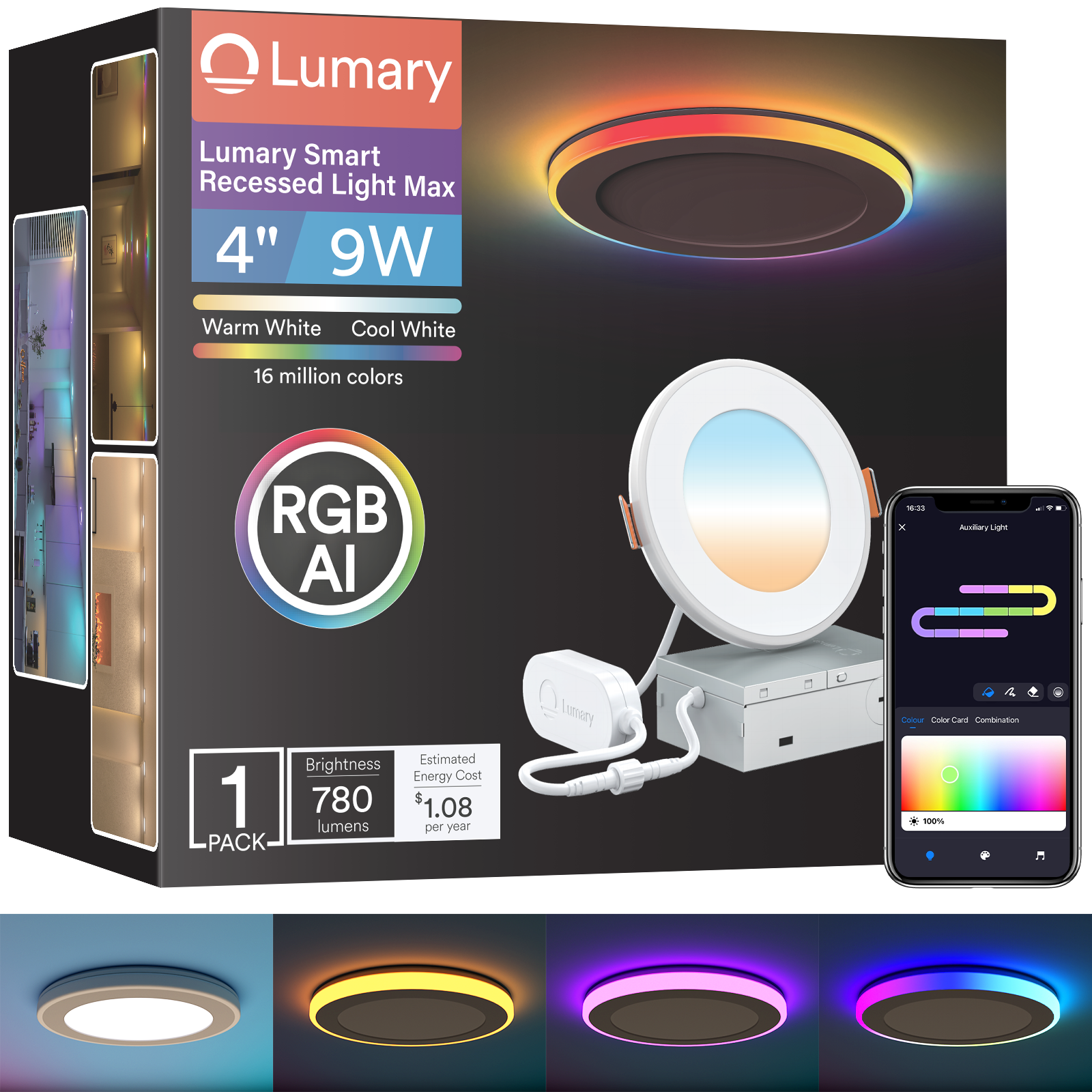
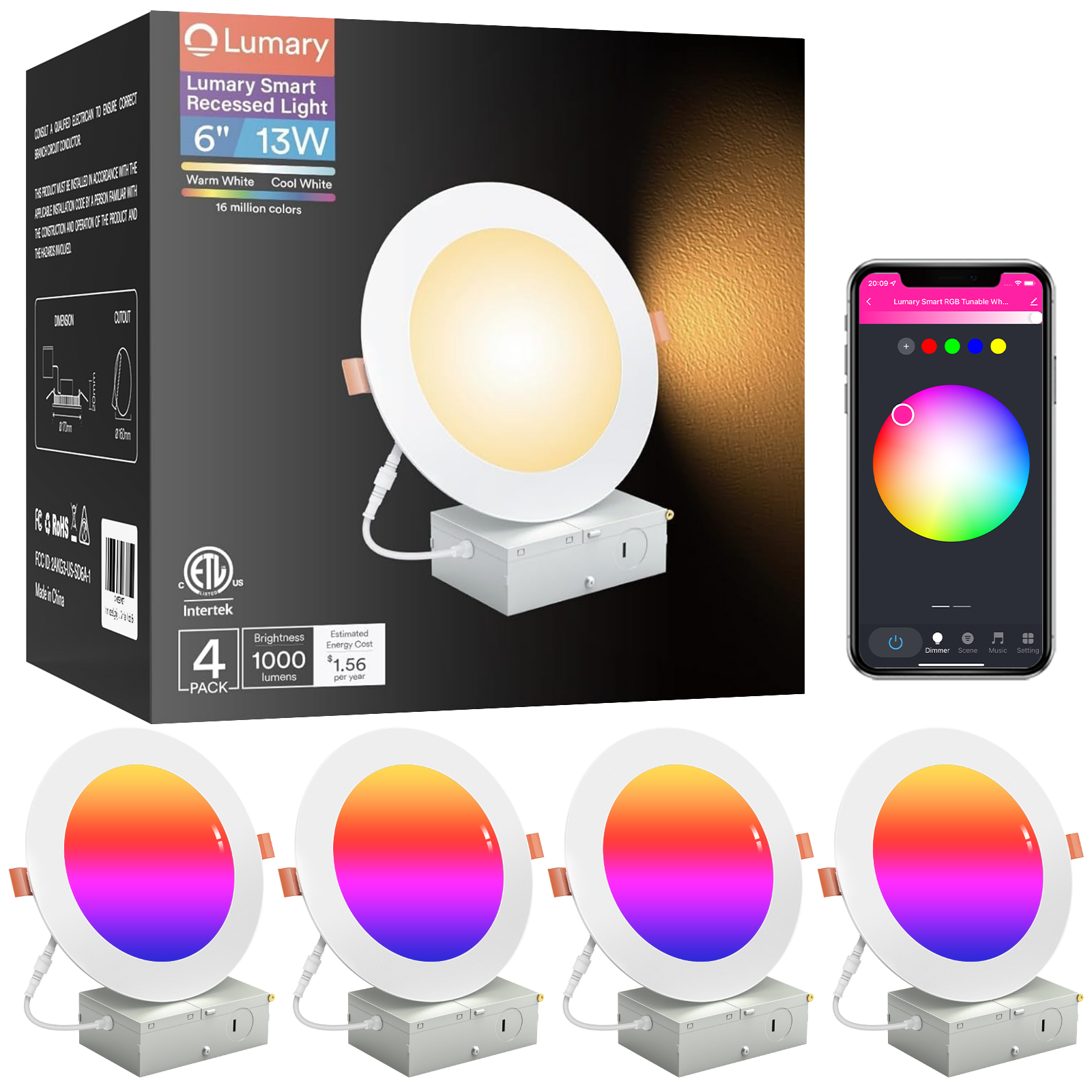
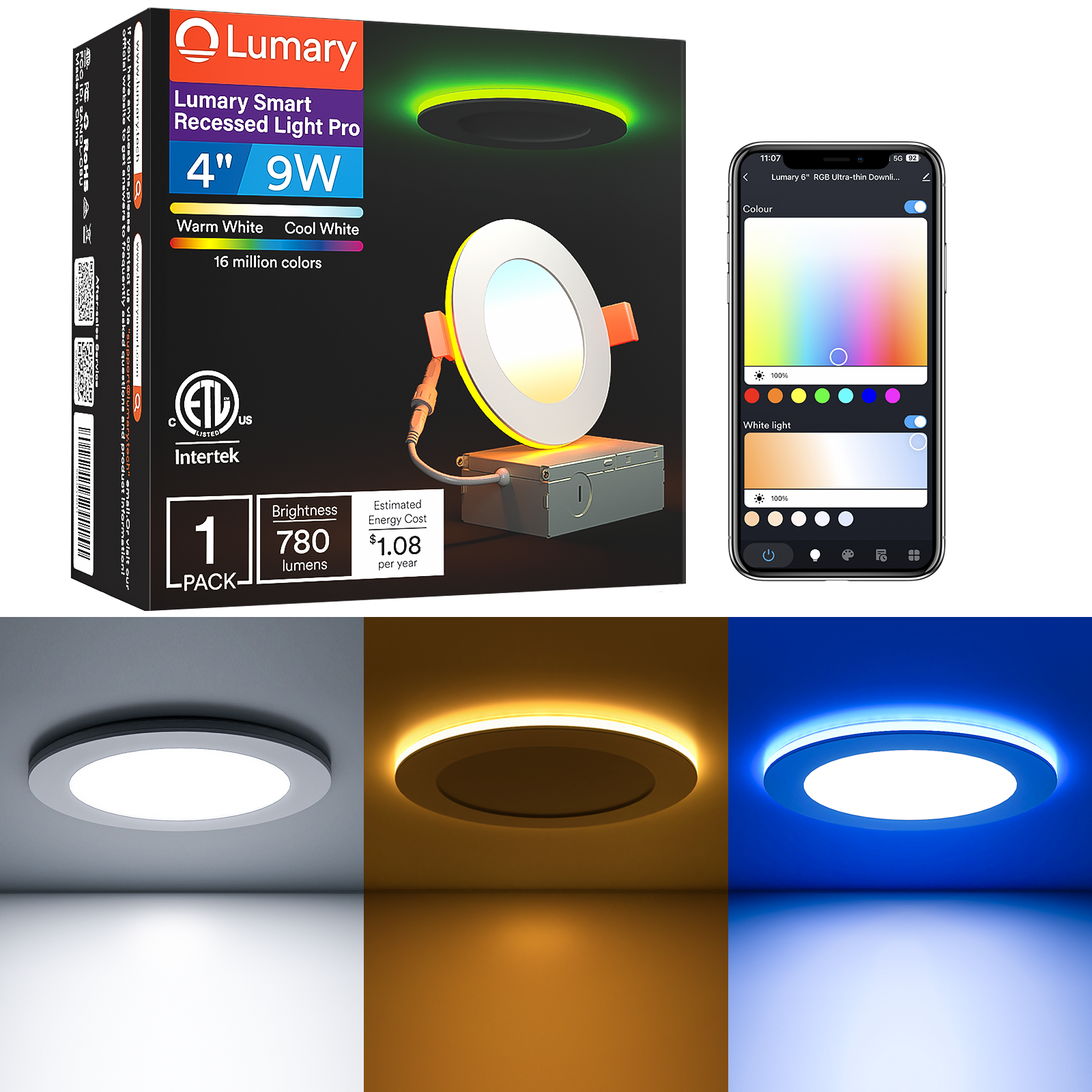
For the Lumary Smart RGBAI Recessed Light with Gradient Auxiliary Night Light, the official product page verifies three published wattage values—9W, 12W, and 18W—across 4-, 6-, and 8-inch size options, together with 780/1000/1400-lumen brightness values and a 2700K–6500K white-light range. It also states that the main downlight and auxiliary light cannot operate simultaneously, that the product is controlled through the Lumary App or voice platforms, and that it is not compatible with conventional dimmer switches. Those are useful operating facts, but they do not by themselves quantify case temperature, LED junction temperature, driver temperature, or long-term thermal margin. A responsible assessment therefore has to separate verified product specifications from general LED thermal principles rather than converting ordinary LED behavior into an unsupported Lumary-specific thermal claim.
Long-term safety also depends heavily on the ceiling environment. Recessed fixtures operate partly above the visible ceiling plane, where insulation, framing, wiring, junction boxes, and restricted airflow can change how heat leaves the system. UL Solutions’ lighting safety resources emphasize that luminaires are evaluated under recognized safety standards, while Intertek’s residential-lighting guidance explains that lighting certification addresses risks such as electrical shock and fire. For recessed installations specifically, insulation-contact suitability and the construction of the ceiling assembly matter. This Old House’s recessed-light insulation guide warns that using lighting not suited to an enclosed or insulated condition can lead to overheating and shortened life. In other words, even a well-designed LED product can be put into an unfavorable thermal environment if the installation does not match the fixture’s approved use conditions.
Electrical workmanship is just as important as the LED itself. The Home Depot’s recessed-light installation guide specifies secure cable clamping, correct conductor matching, approved connectors, and proper placement of wires inside the junction box. The Electrical Safety Foundation International identifies flickering, buzzing, hot or discolored switch plates, the smell of hot insulation, sparks, and repeatedly tripping breakers as warning signs that warrant inspection. These symptoms matter because poor electrical connections can create localized resistance heating independent of the LED’s normal operating temperature. A homeowner who focuses only on whether the visible trim is warm can therefore miss a more important problem in the branch-circuit connection or junction box.
The distinction becomes more important after years of use. The U.S. Department of Energy’s LED Systems Reliability Consortium treats LED lifetime as a system-level issue involving the light source, electronics, optics, materials, and operating conditions rather than a simple “LED chip lasts X hours” statement. DOE research on multi-source LED products also found that different parts of a tunable or multi-source lighting architecture can age differently and affect luminous flux, chromaticity, and tuning range. That is particularly relevant conceptually to color-capable smart fixtures: long-term ownership is not only about whether the light turns on, but whether brightness, color behavior, electronics, and controls remain stable. It would be inappropriate to translate DOE’s category research into a measured lifespan claim for this Lumary model, but the research explains why thermal management and electronics quality matter long after installation day.
Recessed lights also interact with the fire performance of the ceiling itself. UL’s discussion of recessed luminaires in fire-resistive assemblies explains that a ceiling penetration can affect the tested fire resistance of an assembly and that suitable luminaires or supplemental protection must be evaluated as part of that construction. This does not mean every residential ceiling requires a fire-rated recessed fixture; it means the buyer should not treat the lamp as an isolated decorative object. The ceiling type, local code, insulation condition, wiring method, and any required rating all belong in the installation decision.
So, how is the heat dissipation and safety of this Lumary recessed light after long use? The most defensible answer is: its low-power LED architecture is consistent with a category that relies on passive thermal management, but the official page does not publish enough thermal-test data to quantify long-term temperatures or independently prove a specific thermal margin. What the page does give you are operating constraints that should be followed—especially its prohibition on traditional dimmer switches and its specified smart-control method. If the installation matches the fixture instructions and applicable ceiling/electrical requirements, and the light remains stable without thermal cycling, odor, discoloration, or wiring symptoms, that is a much more meaningful long-term safety picture than simply asking whether the fixture feels warm after several hours.
What the Published Specs Tell Us About Long-Term Heat and Safety
The Lumary Smart RGBAI recessed light is a multi-mode smart fixture offered in 4-, 6-, and 8-inch formats. Its official specification block lists 9W / 12W / 18W input values and 780 / 1000 / 1400 lumens, with tunable white from 2700K to 6500K. From a long-use perspective, wattage matters because it establishes the fixture’s electrical input, but wattage alone cannot tell us the operating temperature of the LED board or driver. A lower-watt LED fixture can still run hot at a small internal component if heat is poorly transferred, while a properly engineered fixture can have a warm exterior because that exterior is part of the thermal path. For that reason, the verified power values are useful context rather than proof of thermal performance.
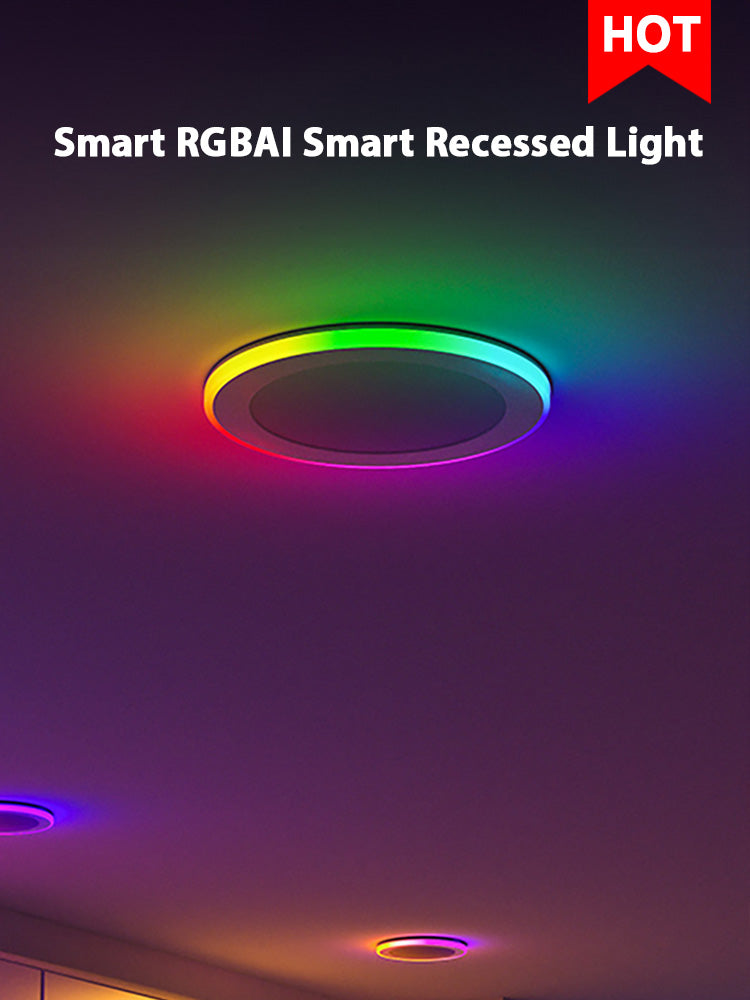
The product’s operating logic is more directly actionable. Lumary states that the main CCT downlight and the auxiliary RGB/night-light system cannot be used simultaneously. The page also identifies four modes—RGBAI Gradient, RGB, Nightlight, and Downlight—and 12 individually controlled RGBAI segments. During long-term ownership, this means the product should be evaluated as a smart electronic luminaire rather than as a simple replaceable bulb: app behavior, power cycling, driver stability, and installation quality all matter alongside the LEDs themselves. The Lumary gradient auxiliary recessed light supports 2.4 GHz Wi-Fi, group control, timing, Alexa, Google Assistant, and Siri through Lumary App automation.
One verified restriction deserves special attention: the official page says these lights are not compatible with dimmer switches and warns that frequent use of the wall switch can reset the lights. For long-term use, the practical implication is simple: do not treat a conventional wall dimmer as a brightness-control device for this model. Use the supported smart controls and a compatible on/off power arrangement instead. This is both a reliability and installation issue because an incompatible control method can produce abnormal behavior that a homeowner might incorrectly interpret as overheating or product failure.
Key Specifications Relevant to Long-Term Use
| Specification | Lumary Smart RGBAI Recessed Light with Gradient Auxiliary Night Light |
|---|---|
| Verified product name | Lumary Smart RGBAI Recessed Light with Gradient Auxiliary Night Light |
| Model designation | Lumary Smart RGBAI Recessed Light with Gradient Auxiliary Night Light — US-SD4E-1 / US-SD4E-4 / US-SD6E-1 / US-SD6E-4 / L-SD8E1 / L-SD8E4 |
| Available sizes | 4 inch / 6 inch / 8 inch |
| Published wattage values | 9W / 12W / 18W |
| Published brightness values | 780 lumens / 1000 lumens / 1400 lumens |
| White color-temperature range | 2700K–6500K |
| Light color system | RGBAIWW |
| Lighting modes | RGBAI Gradient / RGB / Nightlight / Downlight |
| RGBAI segmentation | 12 individually controlled segments |
| Main and auxiliary behavior | Main and auxiliary lights cannot operate simultaneously |
| Primary control methods | Lumary App / voice |
| Voice platforms listed | Amazon Alexa / Google Assistant / Siri via Lumary App automation |
| Network requirement | 2.4 GHz Wi-Fi |
| Additional smart functions | 50 preset scenes / Group Control / Timing Function |
| Conventional dimmer-switch compatibility | Not compatible with dimmer switches |
How to Judge Heat Dissipation and Long-Term Safety
For recessed LED lighting, a useful buying framework separates normal thermal behavior from unsafe or reliability-related symptoms. A warm fixture surface may simply mean heat is moving from internal components into the housing. What matters more is whether the product is installed in the environment for which it is intended, whether connections remain electrically sound, whether operation stays stable after hours of use, and whether the fixture shows progressive signs of thermal stress. The table below focuses only on criteria that can be tied to verified Lumary specifications or to established installation practice; it does not invent a thermal rating that the product page does not publish.
| Key Purchasing Criterion | Common Sign of a Poor-Quality Unit | How This Lumary Smart Recessed Light Addresses It | Long-Term Usage / Performance Impact |
|---|---|---|---|
| Electrical input is clearly specified | Buyer cannot tell how much power the fixture draws | Official page publishes 9W / 12W / 18W values | Gives the installer a defined electrical load to work from instead of guessing |
| Output is stated separately from wattage | Marketing relies only on “watt equivalent” claims | Official page publishes 780 / 1000 / 1400 lumen values | Helps judge whether the selected fixture can meet lighting needs without oversizing solely by wattage |
| Control method is explicit | Fixture behavior changes unpredictably depending on wall control | App and voice control are specified | Reduces misuse when the installed control system follows the documented architecture |
| Dimmer compatibility is explicit | Flicker, reset behavior, or unstable operation appears after installation | Product page explicitly says not compatible with dimmer switches | Avoiding incompatible dimmers removes one preventable source of abnormal operation |
| Power-cycling behavior is documented | Users repeatedly cut power to recover smart functions | Product page warns frequent wall-switch use can reset the lights | Encourages a more consistent long-term control routine |
| Mode interaction is documented | Buyer assumes all LED channels run together | Main and auxiliary lights are stated to be mutually exclusive | Prevents incorrect assumptions about operating modes and light output |
| Network requirement is clear | Repeated setup attempts are mistaken for hardware failure | 2.4 GHz Wi-Fi is specified | Correct network setup helps separate connectivity issues from electrical/thermal issues |
| Multiple sizes are offered | Fixture is forced into an unsuitable cutout or ceiling format | 4-, 6-, and 8-inch versions are listed | Allows the buyer to select a format that matches the intended ceiling layout before installation |
How Other Smart-Lighting Brands Approach Recessed Lighting
Smart recessed lighting is not a single engineering category. Some systems emphasize hub-based reliability, some use direct Wi-Fi, some use Matter over Thread, and others prioritize multizone color effects. When the question is long-term heat and safety, the smart-home protocol is only one layer. Physical housing design, driver placement, installation depth, ceiling compatibility, and safety listing all remain separate considerations. Editorial teardowns and reviews are useful because they sometimes reveal how competitors physically handle drivers and thermal paths, but those observations should not be projected onto Lumary unless Lumary publishes the same construction details.
Philips Hue takes a mature ecosystem approach and, in its newer slim recessed format, also exposes some physical design choices. A Hueblog teardown of the Philips Hue Slim recessed light notes a separate transformer, a minimum installation-depth consideration, and small cooling fins in the housing. Those details illustrate how thermal management and installation geometry can be visibly engineered into a slim downlight. Hue is therefore relevant to buyers who want a well-established smart-lighting platform and who are willing to plan around a dedicated ecosystem and its fixture dimensions.
Nanoleaf approaches recessed lighting through Matter over Thread. SmartHomeScene’s Nanoleaf Downlight review focused on Thread routing, power-loss behavior, dimming consistency, physical cutout size, and real-world smart-home integration. The review is a reminder that long-term ownership of a smart downlight includes firmware, network behavior, power restoration, and ceiling fit in addition to raw light output. For users who already have a Thread border router and Matter controller, Nanoleaf’s architecture targets a different connectivity model from Lumary’s specified 2.4 GHz Wi-Fi approach.
WiZ emphasizes direct, hub-free smart lighting and simple room grouping. In Tech Advisor’s WiZ smart-lighting review, setup is described as using Bluetooth and Wi-Fi, with the app able to detect and organize multiple lights relatively quickly. That ecosystem approach can be attractive when many ceiling lights need to be commissioned at once. From a long-use standpoint, the comparison is less about heat sink shape and more about control architecture: a buyer should decide whether they want direct Wi-Fi simplicity, a mesh protocol, or a bridge-based system before installing a ceiling full of smart fixtures.
LIFX is another useful comparison for hub-free smart lighting. Tom’s Guide describes LIFX smart lights as connecting directly over Wi-Fi without a separate hub and supporting extensive automation. That source is not a thermal teardown of a recessed fixture, so it cannot establish a fixture-temperature advantage. It does show a relevant architecture tradeoff: smart lighting places control electronics alongside the light source, making the exact fixture design, installation conditions, and manufacturer instructions more important than judging long-term safety by ecosystem features alone.
Govee is strongly oriented toward color effects, scene customization, and app-driven automation across a broad smart-lighting portfolio. Tom’s Guide’s current smart-lighting roundup highlights Govee products for vivid effects, scheduling, and extensive customization. Govee also sells recessed lighting, but the editorial source here is most useful for understanding the brand’s ecosystem emphasis rather than making a fixture-level safety comparison. Buyers focused specifically on long-term ceiling installation should still evaluate the exact recessed model’s installation instructions and safety markings rather than assuming that app sophistication answers thermal questions.
The Lumary product sits in a similar direct-smart-lighting space but combines a conventional CCT downlight with a separate RGBAI auxiliary/night-light system. Its official recessed-light page gives enough information to understand power, brightness, modes, and smart-control requirements, but not enough to rank its thermal system against the visible cooling fins, separate drivers, or thermal certifications of any particular competitor. The sensible comparison is therefore architectural: select the smart ecosystem and light behavior you want, then independently verify the installation and safety requirements of the exact fixture you plan to put into the ceiling.
Five Real-World Long-Use Scenarios
1. Eight-Hour Living-Room Use: Warm Housing Versus a Real Overheating Symptom
Imagine an illustrative living room where six recessed lights are switched on from 4:00 p.m. until midnight during winter. After several hours, a homeowner reaches up after turning the power off and notices that the visible trim is warm. That observation alone is not enough to diagnose a problem. ENERGY STAR’s LED heat guidance explains that LEDs use heat sinks or other thermal paths to move internally generated heat into the surrounding environment; if heat is being transferred outward, some accessible parts of a fixture can become warm during operation. The meaningful question is whether the temperature stabilizes as designed and whether the light continues to operate normally rather than becoming progressively unstable.
With the Lumary RGBAI recessed light, the user might run the main Downlight mode for general illumination during dinner and household activity, then switch to Nightlight mode later in the evening. The official page states that the main and auxiliary systems cannot operate at the same time, so the user should think of these as alternate operating states rather than additive light sources. Group Control can make the six fixtures change together, and the 2700K–6500K range allows the white-light mode to move from a more alert daytime setting toward a warmer evening setting without changing the electrical installation.
What should the homeowner actually monitor? A stable warm surface with normal brightness is very different from a fixture that repeatedly turns itself off after an hour, comes back on after cooling, smells like hot plastic or insulation, becomes visibly discolored, causes a switch plate to feel hot, or makes the breaker trip. ESFI lists overheating odors, hot or discolored electrical surfaces, flickering, buzzing, sparking, and repeated breaker activity as warning signs of wiring hazards. Those signs justify shutting the circuit off and having the installation inspected rather than continuing to “test” the light by running it longer.
The long-term outcome is a more useful maintenance habit: do not set an arbitrary rule such as “an LED should always feel cool.” Instead, learn the normal behavior of the room after a few hours and watch for change over time. If the fixtures have operated consistently for months and one suddenly starts cycling, flickering, smelling unusual, or heating adjacent electrical hardware, treat the change as a fault signal. This approach is more technically meaningful than comparing the trim temperature with another lamp by touch.
2. Insulated Attic Above the Ceiling: Installation Conditions Can Matter More Than Wattage
Consider an illustrative second-floor bedroom with blown-in attic insulation directly above the drywall. The homeowner wants to replace older lighting with smart recessed fixtures and assumes that a 9W or 12W LED must automatically be safe because it uses far less power than an old incandescent lamp. That assumption skips the most important installation question: is the exact fixture approved for the ceiling and insulation condition in which it will be installed? Recessed fixtures live in a confined architectural cavity, and surrounding insulation can change the thermal environment dramatically. This Old House specifically warns that unsuitable enclosed/insulated conditions can contribute to overheating and shortened lamp life.
This is also where community experience can be useful as anecdotal context. In a discussion on r/electricians, a homeowner described an LED lamp that worked initially, shut off after heating in a recessed covered fixture, and later worked again after cooling. Commenters focused on fixture suitability and thermal protection rather than assuming that “LED” automatically meant no heat. The thread is not a safety standard and should not be used as one, but it illustrates a recurring field problem: a light source can be efficient and still encounter excessive temperatures when its enclosure or installation condition is wrong.
For the Lumary smart recessed fixture, the official page verifies the 4/6/8-inch sizes and 9/12/18W values, but those numbers should not be substituted for an insulation-contact or ceiling-assembly requirement. Before cutting the ceiling, the installer should use the exact instructions and markings supplied with the selected model and confirm local code requirements. If the ceiling is part of a fire-resistance-rated assembly, UL explains that recessed penetrations can affect the tested assembly and may require an evaluated fixture or supplemental protection.
The practical outcome is that a lower wattage is useful but not a permission slip to bury a fixture in insulation. Long-term thermal safety begins with the right physical installation. If the ceiling condition is uncertain, the better decision is to verify the fixture’s permitted installation environment before purchase or have a qualified electrician evaluate the ceiling cavity rather than relying on power consumption alone.
3. A Smart-Light Retrofit on an Existing Dimmer: When “Flicker” Is a Control Problem, Not a Heat Problem
A common retrofit scenario is an existing living room with a traditional wall dimmer feeding six recessed lights. The homeowner replaces the old fixtures with smart recessed lights but leaves the dimmer in place because “the app can dim them anyway.” After installation, the new lights blink, fail to pair reliably, reset, or behave inconsistently. It is easy to interpret that instability as a defective driver or overheating, especially if the problem gets worse at certain slider positions. In reality, the first diagnostic question should be whether the control arrangement is one the manufacturer supports.
Lumary makes this unusually clear on the product page for this recessed light: it states that the lights are not compatible with dimmer switches, and it also warns that frequent operation of the wall switch can reset them. The intended brightness-control path is the Lumary App or supported voice control, with the lights connected to 2.4 GHz Wi-Fi. For an illustrative six-light room, the correct commissioning sequence is therefore: provide the supported on/off power arrangement, connect each fixture, group the six lights in the app, and control brightness or scenes digitally rather than starving the electronics through an incompatible dimmer.
This matters for long-term safety because diagnostics should start with known incompatibilities before the homeowner opens the ceiling or assumes heat damage. If removing the incompatible dimmer resolves flicker or reset behavior, the fault was in the control topology, not evidence that the LED system was thermally failing. If instability continues even with the documented control method, then wiring, network behavior, or the fixture itself can be investigated in a more orderly way. The Home Depot installation guide’s emphasis on correct conductor connections and secure junction-box wiring remains relevant whenever a retrofit changes existing electrical hardware.
The long-term outcome is a system that behaves predictably and is easier to troubleshoot. Smart lighting works best when wall power and digital control have clearly defined roles. Using an unsupported dimmer introduces an avoidable variable that can mimic the symptoms of a bad driver, loose connection, or failing electronics.
4. Long Daily Operating Hours in a Home Office: Watch for Gradual Change, Not Just Catastrophic Failure
An illustrative home office may use recessed lights much longer than a bedroom—perhaps from 8:00 a.m. to 6:00 p.m. on workdays, or about 50 hours per week. In this kind of schedule, long-term reliability is not simply “did the light burn out?” LED systems can age gradually. The DOE LED Systems Reliability Consortium treats luminaire lifetime as the performance of a complete system, and DOE research on multi-source products notes that LED packages, optics, electronics, and controls can contribute differently to aging. Over time, potential changes can include lower light output, color shift, altered tuning behavior, or electronic instability rather than a single dramatic failure.
The Lumary smart downlight with auxiliary night light is particularly relevant to this kind of room because its official page lists a 2700K–6500K white range, group control, timing, and multiple lighting modes. An illustrative operating routine might use cooler white during concentrated daytime work, warmer white after 5:00 p.m., and a scheduled shutoff at the end of the day. The practical purpose of the schedule is not to claim a specific lifespan extension; it simply makes operating hours more intentional and reduces the chance that a room is left illuminated overnight by habit.
For maintenance, compare the fixtures with each other. If eight identical lights were installed at the same time, a single unit that becomes noticeably dimmer, shifts color relative to the others, starts flickering, disconnects repeatedly, or behaves differently after warming has become a useful diagnostic outlier. That does not prove a thermal failure, but it gives the owner a reason to inspect that fixture and its connection rather than waiting for a complete outage. A smartphone photo taken at the same camera exposure every few months can even provide a rough visual record, although it should not be treated as a calibrated lumen measurement.
The long-term outcome is preventive rather than reactive. In a high-use room, track changes in consistency, not merely whether the LEDs still turn on. This aligns better with how modern LED systems age and gives the homeowner a chance to identify an abnormal fixture before it becomes a larger electrical or maintenance issue.
5. Ten Years Into the Installation: What Should Trigger Replacement or an Electrician Visit?
Consider a mature installation that has been operating for many years. The homeowner no longer remembers exactly how warm the fixtures felt when new, but notices that one light now takes a few seconds to come on, another occasionally flickers, and a third has left a faint brown mark near the ceiling opening. The correct response is not to assume that all aging is normal. Visual discoloration near a fixture, odor, unstable operation, or heat at switches and connection points belongs in a different category from ordinary gradual lumen depreciation.
ESFI’s home wiring safety guidance treats dimming/flickering, sizzling or buzzing, sparks, hot or discolored surfaces, odor from hot insulation, and repeated breaker trips as warning signs that should be inspected by a licensed electrician. Those signs are valuable because they can point to branch-circuit or connection problems, not just an aging LED module. CPSC safety guidance similarly emphasizes inspecting lighting for damaged wiring and loose connections. A long-used recessed light should therefore be evaluated as part of an electrical system rather than simply discarded like a conventional bulb when it misbehaves.
For a room using Lumary RGBAI recessed lighting, start with the documented operating rules: keep the lights on the supported control arrangement, use the Lumary App or listed voice integrations for smart control, and remember that frequent wall-switch power cycling can reset the devices. If only one fixture in a stable group develops abnormal behavior, isolate that unit from routine use until the cause is understood. If several fixtures on the same circuit change behavior together, the circuit, switch, supply connection, or network configuration may deserve attention as well.
The practical outcome is a clear replacement threshold. Gradual reduction in brightness over a very long period can be an ordinary aging mechanism for LEDs; burning smell, visible heat damage, electrical noise, repeated cycling, or hot wiring hardware is not something to normalize. When those warning signs appear, turn the circuit off and have the installation inspected rather than continuing to operate the light to see whether the symptom becomes worse.
Final Safety Assessment
From a hardware-review and procurement perspective, the correct conclusion is more measured than either “LEDs run cool, so there is nothing to worry about” or “a warm recessed light is dangerous.” LED fixtures deliberately move heat away from the semiconductor and driver, so some external warmth can be part of normal operation. The long-term questions are whether the thermal path is adequate for the installed environment, whether the electrical connections remain sound, and whether the fixture maintains stable light and control behavior over repeated use. ENERGY STAR and DOE both make thermal management and system-level aging central to LED reliability.
For the Lumary model specifically, the official page gives a useful operating envelope—4/6/8-inch formats, 9/12/18W published power values, 780/1000/1400-lumen published brightness values, 2700K–6500K tunable white, four light modes, app/voice control, 2.4 GHz Wi-Fi, and an explicit warning against conventional dimmer switches. Those facts are sufficient to plan the electrical load and control strategy, but not to publish a numerical long-term temperature claim. Buyers who require documented IC suitability, a particular safety certification, a specific maximum ambient temperature, or a verified thermal-test result should confirm those exact requirements from the model’s installation documentation or manufacturer support before installation rather than assuming them from the category.
Who Should Buy This Product: buyers who want a smart recessed system with tunable white plus a separate RGBAI/night-light function and who can install it using the documented smart-control arrangement. For long-term safety, treat correct ceiling fit, wiring quality, and symptom monitoring as part of the product decision. If the installation will be surrounded by insulation, penetrate a fire-rated assembly, or operate in an unusual high-temperature cavity, verify the exact installation classification before proceeding.
Frequently Asked Questions
Q1. Is it normal for an LED recessed light to feel hot after several hours?
Yes, some warmth can be normal. LEDs are more efficient than incandescent sources, but they still generate heat in the LED package and electronics. ENERGY STAR explains that LED products use thermal paths such as heat sinks to move heat into the surrounding environment, so an exterior housing that becomes warm does not by itself prove overheating. What matters is whether operation remains stable. If the light begins cycling off and on, flickering, producing an electrical or burning odor, discoloring the ceiling, or heating the switch/junction area unusually, stop treating it as normal warmth and investigate the installation. For this Lumary model, the product page does not publish a specific safe-touch or operating-surface temperature, so a hand-touch comparison should not be used as a precise pass/fail test.
Q2. Does the 9W / 12W / 18W rating mean the Lumary recessed light cannot overheat?
No. Those wattage values tell you the published electrical input for the available variants; they do not directly state LED junction temperature, driver temperature, case temperature, or allowable ceiling-cavity temperature. Thermal performance depends on how internal heat moves through the fixture and into the installation environment. The Lumary recessed-light page lists 9W / 12W / 18W together with 4-, 6-, and 8-inch sizes, but it does not convert those wattages into a temperature claim. The practical action is to install the exact model according to its instructions and ceiling-use conditions, then watch for abnormal behavior rather than assuming low wattage alone guarantees thermal safety.
Q3. What are the warning signs that a recessed light should be turned off and checked?
Treat burning or hot-insulation odor, visible browning or discoloration, sparking, sizzling/buzzing, a hot or discolored switch plate, repeated breaker trips, or new persistent flickering as warning signs. The Electrical Safety Foundation International lists many of these symptoms as indicators of possible home-wiring hazards and recommends professional inspection when they occur. Repeated on/off cycling after the fixture has been operating for some time can also justify investigation because it may indicate thermal protection or an electronic fault, although the exact cause must be diagnosed rather than guessed. Turn the circuit off if there is evidence of overheating or electrical damage and have a qualified electrician inspect the fixture, connection, and surrounding ceiling condition.
Q4. Can I use this Lumary recessed light with my existing wall dimmer to keep it cooler?
No. The official product page explicitly says the Lumary RGBAI recessed light is not compatible with dimmer switches. Brightness should be controlled through the supported Lumary App/voice-control system rather than by reducing line power with a conventional dimmer. The page also warns that frequent use of the wall switch can reset the smart light. If your current recessed-light circuit uses a dimmer, resolve that control compatibility before installing this model instead of assuming that operating at a lower dimmer setting will reduce heat safely. An incompatible dimmer can create flicker, reset behavior, or other instability that makes troubleshooting much harder.
Q5. How can I improve long-term safety after installation?
Start with the ceiling and wiring, not with an app setting. Confirm that the exact fixture is suitable for the ceiling construction, insulation condition, and any applicable fire-resistance requirements; use secure, code-compliant electrical connections; and follow the manufacturer’s control instructions. After installation, observe the lights during a normal multi-hour operating period and establish a baseline for brightness, sound, odor, and temperature behavior. Over the following months, pay attention to changes—especially one fixture behaving differently from the rest. UL’s recessed-luminaire guidance shows why ceiling assembly conditions matter, while ESFI’s wiring guidance identifies the electrical warning signs that should trigger inspection. Long-term safety is therefore a combination of correct installation, correct controls, and noticing abnormal change early.

