







For a typical U.S. home in 2026, a realistic starting budget is about $100-$300 per recessed light in an existing finished ceiling, with many homeowners landing around $180 per fixture before unusual access, repair, or electrical work is added. HomeAdvisor’s 2026 recessed-lighting cost guide gives a $100-$300 normal range and a $180 average, while HomeGuide’s recessed-lighting cost data places existing-ceiling installation at $125-$300 per light and six-light projects at roughly $700-$1,650. Angi’s 2026 cost guide similarly reports $100-$300 per fixture and gives an average project total of about $1,800, with six-to-ten-light projects commonly falling around $1,200-$2,500. The practical decision rule is therefore to budget by fixture count plus wiring/access complexity, not by fixture price alone.
Those averages can move quickly because recessed lighting is partly an electrical project and partly a ceiling-access project. Forbes Home’s recessed-lighting estimate uses a higher average of about $330 per fixture and a broad $100-$500 range, which is a useful reminder that regional labor and job difficulty can outweigh small differences in fixture price. If the electrician can enter an attic, see the joists, and route cable from above, the work is often straightforward. If there is a finished second floor above the room, the installer may need to fish cable through joist bays, drill through framing, or make access holes that later need drywall repair. That is why two six-light quotes can differ by hundreds or even more than a thousand dollars while both are plausible for their specific homes.
The physical installation process explains where that money goes. The Home Depot’s recessed-light installation guide tells installers to check whether there is an attic or another floor above, inspect the existing wiring, locate joists and hidden pipes or ducts, cut each ceiling opening, run cable from the power source to the switch and each light, and make the electrical connections inside the fixture junction boxes. This Old House’s recessed-lighting installation guide similarly rates the project as moderate and notes that swapping fixtures can be simple but adding wiring may require an electrician. In other words, the visible LED disk may take only minutes to clip into the ceiling; creating a compliant wiring path to six or eight new locations can consume most of the labor.
New construction is usually cheaper because the ceiling is open. HomeGuide lists roughly $65-$175 per light in new construction, compared with $125-$300 in an existing ceiling, and says six lights may cost about $390-$1,000 before the ceiling is closed. The same source estimates that difficult routing around joists or ducts can add around $200 per light and that drywall repair can add hundreds of dollars depending on how much opening and patching is required. HomeAdvisor also notes that existing homes generally require more labor than new construction and lists electrical permits around $50-$500, depending on the jurisdiction and project scope. These numbers should be treated as national planning ranges, not as guaranteed local prices, but they explain why installation timing matters: adding recessed lights while a ceiling is already open can be materially cheaper than reopening a finished room later.
Older wiring can change the scope again. The Electrical Safety Foundation International’s home wiring guidance recommends electrical inspection for older homes and identifies warning signs such as frequent breaker trips, flickering, buzzing, overheated or discolored switch plates, and damaged wire insulation. If an electrician discovers an unsafe or unsuitable branch circuit while adding lighting, the quote may expand from “install six lights” to “correct the electrical condition, then install six lights.” That additional work is not a recessed-light premium; it is electrical remediation that happens to be uncovered by the lighting project. Buyers should therefore ask contractors to separate fixture cost, installation labor, wiring upgrades, permits, and wall/ceiling repair in the proposal.
Community experience points to the same access issue. In a HomeImprovement discussion about recessed-light installation cost, commenters repeatedly asked whether attic access was available and noted that no access above the ceiling can increase labor and drywall repair. One homeowner described a $3,600 quote for four lights before obtaining two additional bids closer to $1,000. A community thread cannot establish a national market price, but it is useful evidence for one buying habit: get multiple local quotes that describe the same scope. A $900 quote that excludes patching, switch replacement, and permits is not automatically cheaper than a $1,400 quote that includes them.
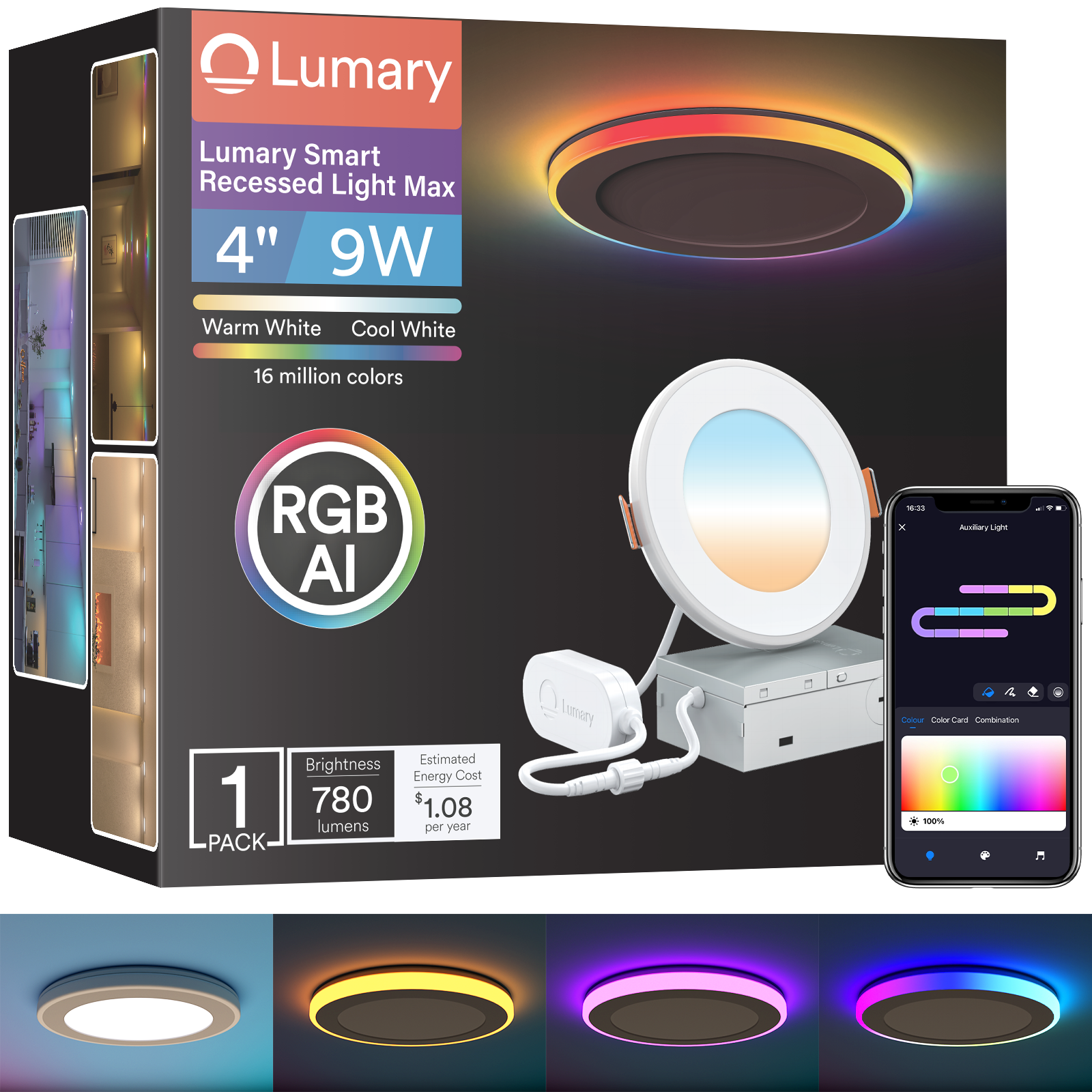
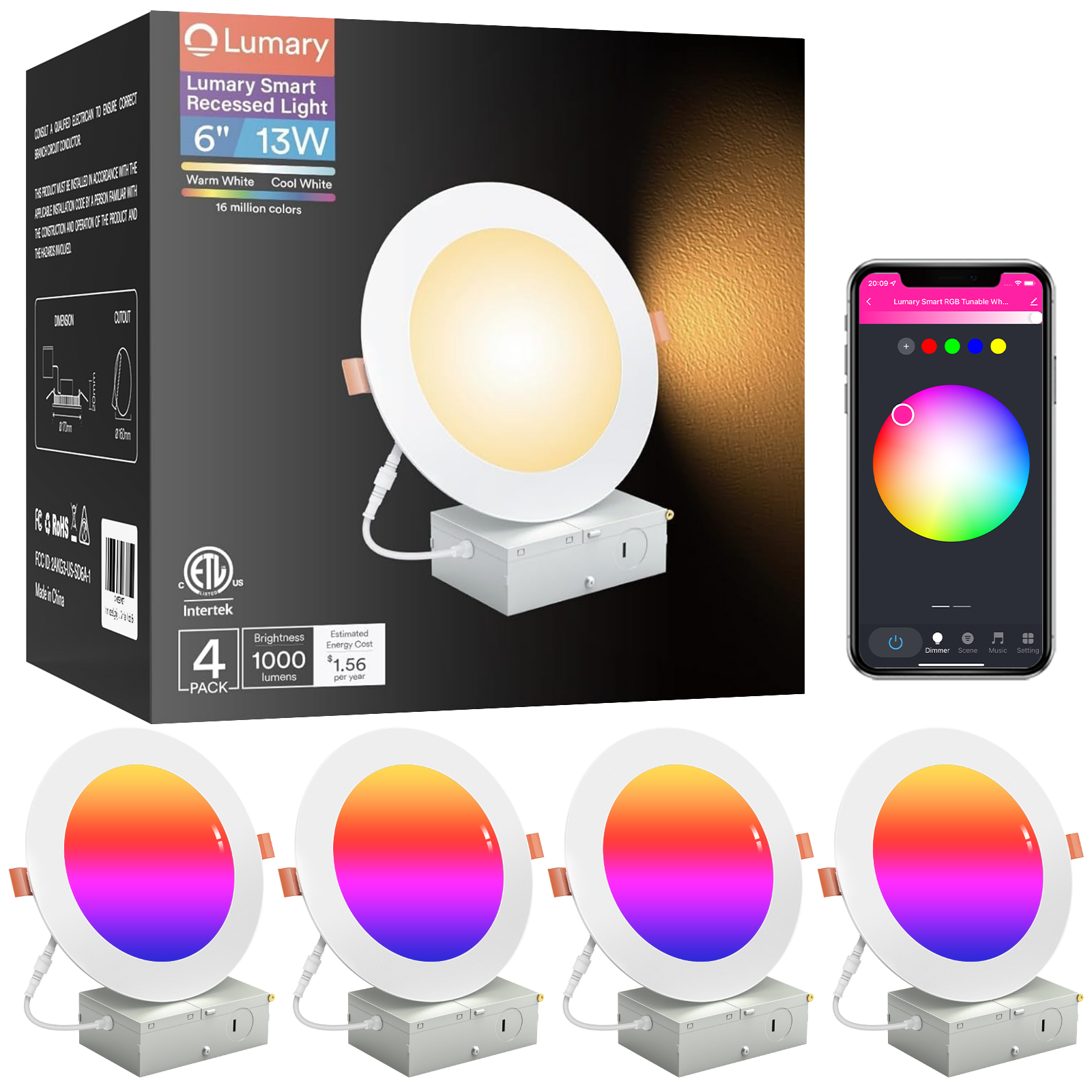
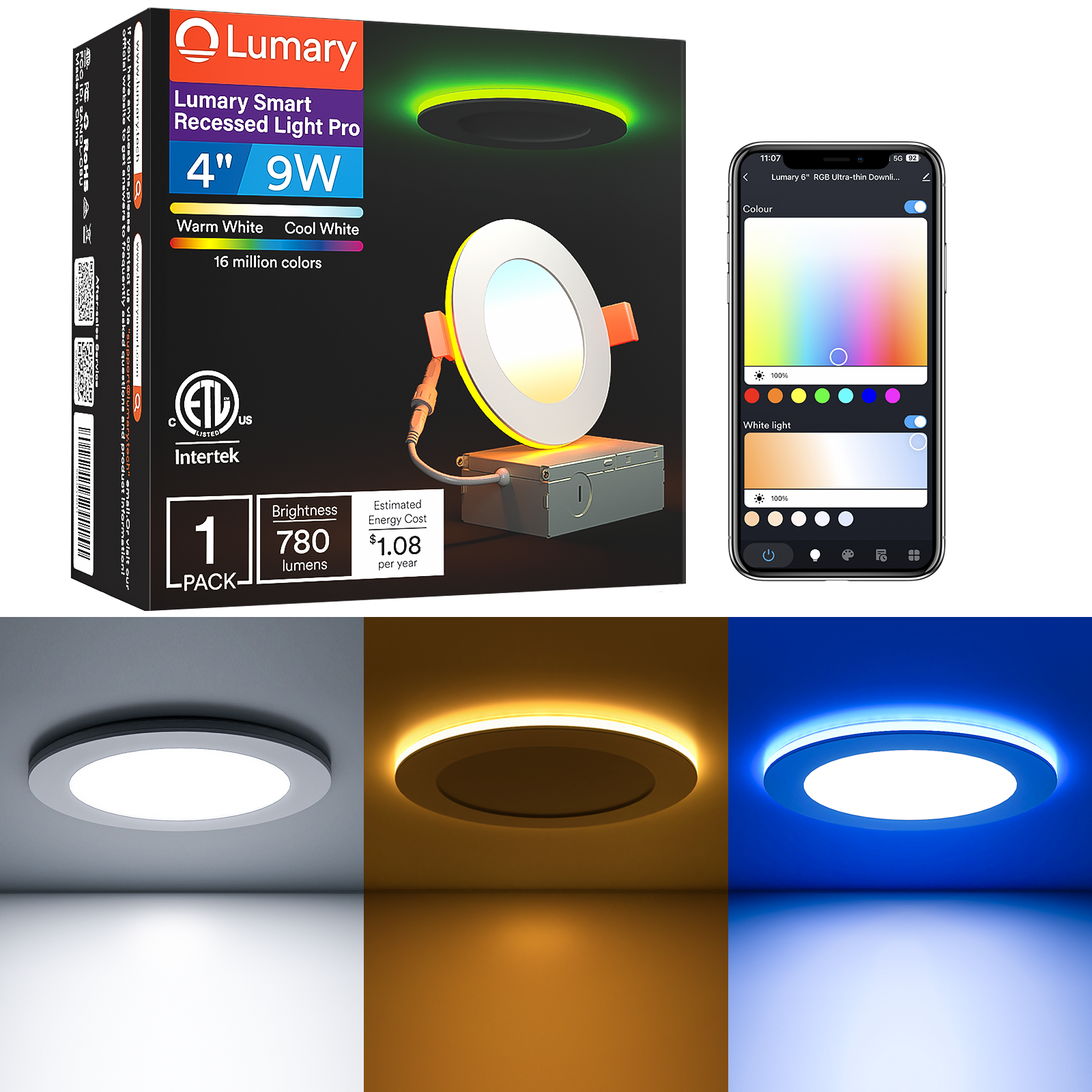
For a smart recessed-light project, the electrical fundamentals are still the same. The Lumary product used in this guide is offered in 4-, 6-, and 8-inch formats with published power values of 9W / 12W / 18W and brightness values of 780 / 1000 / 1400 lumens. It supports app and voice control, 2.4 GHz Wi-Fi, group control, schedules, and several white/color operating modes. Those features can increase the usefulness of each installed ceiling position, but they do not eliminate the cost of cutting openings and routing cable. The most important cost-specific compatibility point is that the official page states these lights are not compatible with traditional dimmer switches, so the existing wall-control arrangement should be discussed with the electrician before the quote is finalized.
Product Recommendation Analysis
The Lumary Smart RGBAI recessed lighting system makes the most sense when a homeowner is already paying for a recessed-light installation and wants those ceiling positions to do more than provide fixed white light. The official product page lists three physical sizes—4, 6, and 8 inches—along with published 9W / 12W / 18W power values, 780 / 1000 / 1400-lumen brightness values, and a 2700K-6500K white-light range. Because those size, wattage, and brightness values are presented as parallel lists rather than explicitly mapped one-by-one in the text, the exact selected variant should be confirmed before fixture count or lighting calculations are finalized.
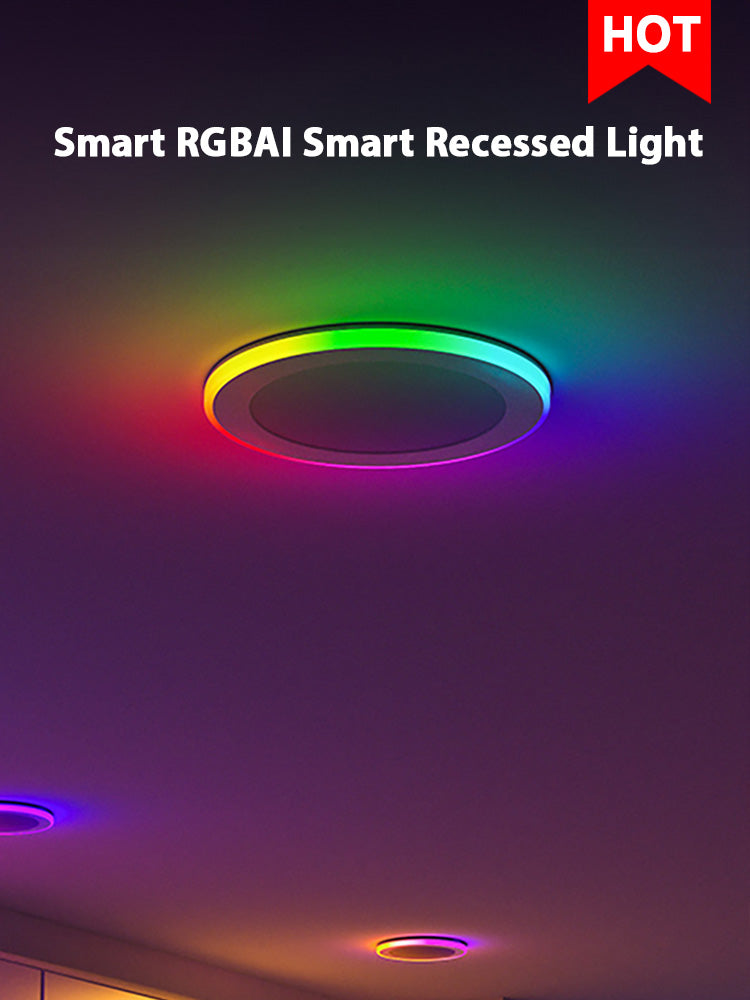
Control is where the product changes the ownership experience after installation. The Lumary gradient auxiliary recessed light supports the Lumary App, Alexa, Google Assistant, and Siri through Lumary App automation, together with 2.4 GHz Wi-Fi, group control, and a timing function. It also lists Downlight, Nightlight, RGB, and RGBAI Gradient modes, with 12 individually controlled RGBAI segments and 50 preset scenes. These capabilities do not reduce electrician labor, but they can reduce the need to install separate decorative lighting for some use cases because one recessed location can switch between functional and decorative states.
The main planning constraint is wall control. The Lumary smart recessed downlight is explicitly listed as not compatible with dimmer switches, and the page warns that frequent use of the wall switch can reset the lights. If an existing room currently has a conventional dimmer, tell the electrician the exact smart-light model before accepting the bid. A standard recessed-light quote that assumes reuse of a dimmer is not the same scope as a quote that correctly accommodates the product’s documented control method.
Technical Specification Table
| Specification | Lumary Smart RGBAI Recessed Light with Gradient Auxiliary Night Light |
|---|---|
| Model designation | Lumary Smart RGBAI Recessed Light with Gradient Auxiliary Night Light — US-SD4E-1 / US-SD4E-4 / US-SD6E-1 / US-SD6E-4 / L-SD8E1 / L-SD8E4 |
| Available sizes | 4 inch / 6 inch / 8 inch |
| Published wattage values | 9W / 12W / 18W |
| Published brightness values | 780 lumens / 1000 lumens / 1400 lumens |
| White color-temperature range | 2700K-6500K |
| Light color system | RGBAIWW |
| Lighting modes | RGBAI Gradient / RGB / Nightlight / Downlight |
| RGBAI segmentation | 12 individually controlled segments |
| Main and auxiliary operation | Main and auxiliary lights cannot operate simultaneously |
| Control methods | App / Voice |
| Voice ecosystems listed | Amazon Alexa / Google Assistant / Siri |
| Network requirement | 2.4 GHz Wi-Fi |
| Preset scenes | 50 |
| Additional functions | Group Control / Timing Function |
| Traditional dimmer compatibility | Not compatible with dimmer switches |
What Drives the Installed Price of Recessed Lighting?
Use the framework below before comparing contractor bids. Start with the number of ceiling positions, then separate fixture cost from electrical access, wiring work, switch/control changes, and surface repair. For a smart product, also verify control compatibility before the electrician prices switches or dimmers. This prevents a common budgeting mistake: comparing two proposals that seem to have the same “price per light” even though one includes new wiring and drywall repair while the other assumes existing wiring and leaves finish work to the homeowner. It also makes contractor quotes much easier to compare line by line.
| Key Purchasing Criterion | Common Sign of a Poor-Quality Unit | How This Lumary Smart Recessed Light Addresses It | Long-Term Usage / Performance Impact |
|---|---|---|---|
| Clear physical size options | Ceiling openings are cut before the final fixture format is selected | Official page lists 4-, 6-, and 8-inch versions | Selecting the format before cutting reduces avoidable ceiling rework |
| Published electrical load | Project is planned from vague “equivalent wattage” claims | Official page lists 9W / 12W / 18W values | Gives the electrician a documented fixture load to incorporate into the circuit plan |
| Published light output | Fixture quantity is chosen only by visual size | Official page lists 780 / 1000 / 1400 lumens | Allows room planning to consider actual light output instead of fixture diameter alone |
| Control compatibility | Contractor assumes any conventional dimmer will work | Product page states that traditional dimmer switches are not compatible | Prevents paying for a control arrangement that must be replaced later |
| Multi-fixture operation | Every smart light must be adjusted individually | Group Control is documented | Makes larger multi-light rooms easier to operate after installation |
| Scheduling | Smart function is limited to manual app control | Timing Function is documented | Allows recurring lighting routines without changing the electrical installation later |
| White-light flexibility | Fixed color temperature forces one visual state all day | 2700K-6500K tunable white is listed | One installed ceiling system can support warmer evening and cooler daytime settings |
| Decorative mode flexibility | Additional accent fixtures are needed for every alternate lighting mood | RGB, RGBAI Gradient, and Nightlight modes are listed | Can expand the usefulness of each paid-for ceiling position, while main and auxiliary modes remain mutually exclusive |
Competitive Landscape
Smart recessed lighting can use very different architectures even when the ceiling work looks similar. Some products retrofit an existing can, some use shallow integrated formats with separate control hardware, some connect directly to Wi-Fi, and others depend on Thread or a dedicated hub. Those differences affect hardware and smart-home setup, while the electrician’s cost still depends primarily on wiring, ceiling access, and the number of new locations.
Govee is positioned strongly around direct smart control, color effects, grouping, and scheduling. In a SeattlePI smart recessed-lighting comparison, Govee’s 6-inch smart recessed lights are highlighted for color customization, white-temperature tuning, grouping, scheduling, and an included junction box. That type of package is relevant when a project is creating new ceiling locations rather than merely changing bulbs. The electrical labor, however, still comes from getting branch-circuit wiring to every position.
Philips Hue takes a more ecosystem-centered approach. A Hueblog review of the Philips Hue Slim recessed light describes a shallow recessed design and a separate transformer, showing how smart-light manufacturers can solve limited installation depth differently. Hue is especially relevant for households already using its bridge, sensors, and switches. The smart-home architecture therefore becomes part of the project decision in addition to fixture format and electrician cost.
Nanoleaf provides a Matter-over-Thread route. SmartHomeScene’s Nanoleaf Matter Downlight review documents a Thread-connected downlight and discusses its physical cutout, integration, and network behavior. That architecture can appeal to households building around Matter and Thread, but it also means a compatible Matter controller and Thread border router become part of the broader ownership setup. None of those network requirements changes the basic need for safe ceiling wiring.
WiZ emphasizes hub-free Wi-Fi lighting and room-based control. Tech Advisor’s WiZ smart-lighting review describes an ecosystem that uses Wi-Fi and Bluetooth for setup, supports rooms, schedules, and multiple fixture styles, and is designed to avoid a separate bridge. For a large recessed-light project, this direct-to-network approach can simplify hardware purchasing, although Wi-Fi coverage and the number of connected devices should still be considered during setup.
LIFX has historically used a direct Wi-Fi approach as well. The techAU review of LIFX Color 650 downlights describes GU10-style downlights with built-in Wi-Fi electronics and app-based color control. The physical format differs from modern integrated recessed fixtures, but it illustrates a useful cost distinction: a smart source that fits an existing compatible opening can be a different installation project from adding brand-new recessed locations throughout a finished ceiling.
Lumary fits into the integrated smart recessed-lighting side of the category, with app/voice control, 2.4 GHz Wi-Fi, grouping, scheduling, tunable white, and a separate RGBAI auxiliary-light system. Its strongest cost-related fit is not that it eliminates installation labor—it does not—but that a homeowner who is already paying to create recessed locations can use each position for several documented lighting states. The electrical quote should still be built around access, wiring, switch compatibility, and finish work rather than the brand name alone.
Application Scenarios
1. Six-Light Living Room With Attic Access: A Straightforward Existing-Ceiling Budget
Consider an illustrative 14-by-18-foot living room with an 8-foot ceiling, an unfinished attic directly above, and one existing switched ceiling circuit nearby. The homeowner wants six recessed lights distributed around the seating area. Because the installer can work from above, inspect joist locations, and route cable without repeatedly opening the finished ceiling, this is close to the kind of project where national averages are useful. HomeGuide’s current cost guide puts six lights in an existing ceiling at approximately $700-$1,650, while HomeAdvisor’s $100-$300-per-fixture range implies roughly 6 × $100 = $600 to 6 × $300 = $1,800 before unusual additions. These overlapping ranges provide a reasonable first budget, not a guaranteed quote.
The mechanism behind the lower complexity is access. The Home Depot installation guide specifically asks whether the space above the ceiling is an attic or another finished floor and instructs installers to check for joists, ductwork, plumbing, and wiring before cutting. In an accessible attic, those obstacles can be inspected directly and cable can often be routed without cutting multiple exploratory openings in the room below. The practical buyer implication is to tell the contractor that attic access exists when requesting a quote; it materially changes how the electrician can perform the job.
If the homeowner selects the Lumary recessed-light system for a six-light living room, the exact 4-, 6-, or 8-inch format should be chosen before the holes are cut. After installation, Group Control allows the six lights to behave as one zone, while the 2700K-6500K white range can support different daytime and evening states. The homeowner can use Downlight mode for normal room illumination and switch to Nightlight or RGBAI modes later, remembering that the official page states the main and auxiliary lights do not operate simultaneously.
The remaining cost check is the wall control. If the current switch is a standard on/off switch, the electrical scope may be relatively simple. If it is a traditional dimmer, the Lumary page states that the product is not compatible with dimmer switches, so the contractor should price the appropriate control change instead of leaving an incompatible device in place. The practical outcome is that this six-light project may stay near the common national range because the ceiling is accessible, but the quote should still list fixture supply, wiring, switch work, permit responsibility, and any final ceiling repair separately.
2. Six Lights Below a Finished Second Floor: Why Wire Fishing Changes the Quote
Now place the same illustrative six-light living room below a finished bedroom. The number of lights has not changed, but the installer no longer has open access above the ceiling. The wiring path may cross several joists, and the electrician has to determine whether cable can be fished through existing openings or whether additional access holes are needed. HomeGuide estimates that difficult routing around joists or ducts can add around $200 per light and that drywall repairs can add hundreds of dollars depending on how much of the ceiling or wall is opened. That is why using only “six lights × average cost” can understate a retrofit.
A HomeImprovement community discussion about recessed-light pricing illustrates the same variable in practice. Commenters repeatedly identified attic access as a major factor and explained that a finished space above the ceiling can create more drilling, wire fishing, and drywall work. One homeowner eventually received bids much lower than the first quote, which reinforces the need for two or three comparable local estimates rather than relying on one national average or one contractor.
For this room, the product choice should be finalized before the electrician decides how to cut. A Lumary smart RGBAI recessed-light installation can still use six grouped fixtures and the documented smart modes, but those features do not reduce the physical need to get electrical cable from the switch/circuit to each ceiling location. The buyer should give the contractor the exact selected size and documented control requirements in advance so the wiring and openings are planned around the product.
The tradeoff is between electrician time and finish repair. A contractor can sometimes spend more time trying to minimize drywall damage, or make a few strategic access openings and let a drywall/painting specialist restore the surface afterward. Ask the estimator which method is included. The practical outcome is that a six-light room with no attic access may cost substantially more than an identical room with attic access, even though the fixture count and smart-light model are exactly the same.
3. Eight Lights During a Remodel: Open Ceilings Can Shift the Budget Downward
Imagine an illustrative kitchen renovation where the ceiling drywall has already been removed and eight recessed-light locations are planned before new drywall is installed. This is a different cost category from cutting eight new locations into a finished ceiling. HomeGuide lists new-construction installation at approximately $65-$175 per light, so a simple eight-light planning range is 8 × $65 = $520 to 8 × $175 = $1,400. The same source lists existing-ceiling installation at $125-$300 per light. The exact local bid can still be higher or lower, but the mechanism is clear: open framing reduces the labor needed to locate obstacles and route cable.
This Old House’s installation guidance shows why. Recessed-light wiring must be run from the switch/power source to the first fixture and then from fixture to fixture. When studs and joists are exposed, the electrician can see the path, drill where necessary, secure cable correctly, and locate boxes before the ceiling is closed. That often saves time and reduces the risk of finish repair. The buyer implication is simple: if recessed lighting is likely to be added eventually, the cheapest time to finalize the layout is often during a remodel when the ceiling is already open.
The Lumary smart recessed lights for a remodel should be selected before rough-in so the electrician knows the intended physical format and control architecture. An illustrative eight-light kitchen could be organized as one group or multiple app groups after installation. The tunable 2700K-6500K white range can support brighter-looking task periods and warmer evening use, while scheduling can establish recurring routines. The product’s multiple operating modes add flexibility without requiring the ceiling to be reopened later.
The main constraint is future-proofing the control plan while access is easy. Because the product is documented as incompatible with traditional dimmer switches, the electrician should not install a standard dimmer by habit and expect it to become the primary brightness control. The practical outcome is that a remodel can lower the installation component of recessed lighting while also giving the homeowner the best opportunity to coordinate fixture size, circuit layout, switching, and Wi-Fi planning before finishes are restored.
4. Four Lights in a 50-Year-Old Home: Electrical Condition Can Matter More Than Fixture Count
Consider an illustrative 1970s home where a homeowner wants only four recessed lights in a bedroom. The room seems small enough that the project should be inexpensive, but the existing electrical system has not been evaluated recently. ESFI’s home wiring guidance recommends inspection for homes 40 years or older and lists frequent breaker trips, flickering, buzzing, hot or discolored electrical surfaces, and damaged insulation as signs that warrant professional attention. If none of those issues exists and the branch circuit is suitable, four lights may remain a straightforward project. If the electrician discovers unsafe or obsolete wiring, the scope changes.
HomeAdvisor’s 2026 guide estimates $50-$500 for permits depending on locality and project scope and notes that existing-home wiring complexity affects cost. For an illustrative four-light project, its normal $100-$300 per-light range suggests $400-$1,200 before any electrical remediation. That arithmetic should not be used to price unknown repair work. A contractor who has to correct wiring, add a suitable circuit, or address other code issues is performing work beyond installing four fixtures, and the proposal should separate those items so the homeowner can see what is driving the total.
Once the electrical condition is resolved, a Lumary recessed-light bedroom setup can use the product’s documented Group Control and Timing Function to make the four lights behave as one zone. The white-light range can support general daytime use, while the Nightlight mode can provide a different late-evening state. Those features are relevant after the electrical foundation is sound; they are not a substitute for an inspection of aging wiring.
The constraint is diagnostic uncertainty. Do not assume that a high quote in an older home means the recessed lights themselves are expensive. Ask the electrician to identify the portion of the price associated with lighting installation, the portion associated with repairing or upgrading the electrical system, and any permit or inspection fees. The practical outcome is a quote that can be compared fairly with another contractor’s proposal instead of reducing a complex older-home job to an artificial “cost per light.”
5. Smart-Light Retrofit With an Existing Dimmer: Price the Control Change Before Installation Day
Imagine an illustrative dining room that already has six conventional recessed fixtures controlled by a wall dimmer. The homeowner wants to replace the ceiling lighting with smart recessed fixtures and expects the work to be mainly a fixture swap. If the existing openings and wiring are compatible with the selected product, this could indeed be simpler than creating six brand-new locations. However, the wall-control arrangement changes the scope because the Lumary product page explicitly says the light is not compatible with dimmer switches.
That detail should be disclosed when bids are requested, not after the electrician arrives. HomeAdvisor’s guide makes the broader point that fixture type and wiring complexity change the installation total, while Home Depot advises homeowners to understand the existing circuit and switching situation before installation. In this scenario, the contractor should evaluate what control arrangement is appropriate for the selected smart lights and include that work in the quote. Otherwise, an apparently cheap “fixture replacement” bid may omit a required control change.
After the electrical work is complete, the Lumary smart recessed-light control system can group the six fixtures, schedule them, and change brightness/color behavior through the supported smart controls instead of the old conventional dimmer. An illustrative routine could use a warmer white state before dinner, a different scene during entertaining, and Nightlight mode later in the evening. The page also warns that frequent wall-switch cycling can reset the lights, so household operating habits should match the documented smart-control approach.
The tradeoff is that smart lighting can shift some control cost from a traditional dimmer toward the fixture/app ecosystem. That does not automatically make the project cheaper or more expensive; it changes what hardware and behavior the homeowner is paying for. The practical outcome is that the correct bid is the one that prices the complete compatible system—fixtures, electrical connections, and wall control—not simply the labor to remove six old trims and insert six new ones.
Editorial Assessment
From a procurement perspective, the most useful national planning figure is roughly $100-$300 per recessed light in an existing U.S. ceiling, with an average around $180 per fixture in HomeAdvisor and HomeGuide data. Six-light projects commonly appear in the high hundreds to mid-$1,000s, while larger six-to-ten-light rooms can move into the $1,200-$2,500 range. New construction can be cheaper because the ceiling is open; limited access, joists/ducts, drywall repair, permits, and electrical corrections can push the total higher. Those are the variables a buyer should use to explain a quote—not just the retail price of the LED.
The Lumary product is a strong fit when the homeowner already wants recessed lighting and values tunable white, app/voice control, group operation, schedules, and separate RGB/RGBAI/night-light states. The Lumary Smart RGBAI recessed light with gradient auxiliary lighting should be specified before the electrician finalizes the switch/control portion because the official page states that traditional dimmer switches are not compatible. In an open-ceiling remodel or an attic-accessible room, the installation economics may be favorable; in a finished two-story home or older electrical system, access and wiring can dominate the price.
Who Should Buy This Product: homeowners who are already budgeting for recessed lighting and want each installed ceiling position to function as part of a coordinated smart-light system. For the best cost control, finalize the fixture size and control method first, then obtain two or three bids that separately identify electrical labor, fixtures, permits, and finish repair.
Frequently Asked Questions
Q1. How much should six recessed lights cost to install?
For an existing finished ceiling, a reasonable national planning range is about $700-$1,650 for six lights, based on HomeGuide’s six-light estimate. HomeAdvisor’s broader $100-$300-per-fixture range implies approximately $600-$1,800 for six. The difference between the low and high end usually comes from wiring access, ceiling material, switch work, local labor rates, and whether repair/paint is included. Ask whether the contractor has attic access and whether the price includes new cable, fixtures, permits, patching, and cleanup. For a smart system, provide the exact fixture model before the estimate so wall-control compatibility is included rather than added later.
Q2. Is it cheaper to install recessed lighting when the ceiling is already open?
Usually, yes. HomeGuide estimates roughly $65-$175 per light for new construction compared with $125-$300 in an existing ceiling. Open framing lets the electrician see joists, plumbing, ducts, and wiring paths directly and run cable before drywall hides those obstacles. That reduces wire-fishing time and the risk of extra patching. If you are already remodeling, finalize the recessed-light locations and control plan before drywall installation. The fixture cost may be the same either way, but the labor required to reach each location can be substantially lower while the ceiling is open.
Q3. Why are recessed-light quotes sometimes so different?
Because two contractors may be pricing different access methods and scopes. A Reddit HomeImprovement cost discussion shows homeowners and tradespeople repeatedly focusing on attic access, joist drilling, and drywall repair rather than just the number of fixtures. One quote may include fixture supply, new wiring, switches, permit work, and patching; another may quote only electrical labor and leave repairs to the homeowner. Ask every bidder to state the same items in writing. Once the scopes match, differences in labor rate, access strategy, and work method become much easier to evaluate fairly.
Q4. Do smart recessed lights cost more to install than ordinary recessed lights?
Not necessarily in basic ceiling labor. Both types still need suitable openings, electrical power, junction connections, and safe wiring. Smart lights can change the control portion of the job, however. This Lumary model uses app/voice control and is documented as not compatible with traditional dimmer switches, so an existing dimmer may need to be addressed as part of the project. Tell the electrician which smart lights you plan to use before the quote is finalized. That avoids buying or installing conventional control hardware that does not match the fixture’s documented operating method.
Q5. What should I ask an electrician before accepting a recessed-lighting quote?
Ask for the number and locations of fixtures, the source of electrical power, whether new cable or a new circuit is required, how the ceiling will be accessed, what switch/control changes are included, who supplies the lights, whether permits are required, and who handles drywall repair and paint. The Home Depot’s installation guide specifically highlights ceiling access, existing wiring, joists, ducts, and permits as planning considerations. For a smart-light project, also give the electrician the exact product page so fixture size and control restrictions are known before any ceiling holes or switch changes are made.

