




There is a persistent misconception that recessed lighting is inherently a "call the electrician first" project. The reality is more nuanced — and for a growing category of fixtures, considerably more accessible to homeowners than the conventional wisdom suggests. Whether you reach for the phone or the drill bit depends almost entirely on what type of fixture you select, the state of your existing wiring, and which specific scenario you are walking into.
The question of professional involvement ultimately hinges on one architectural distinction: are you introducing new wire runs into a ceiling that has never had lighting, or are you connecting to an existing circuit at a point already fed by a switch?
Understanding When Professional Work Is Actually Required
Recessed lighting installation involves more than cutting holes in drywall. Several situations require a licensed electrician: when there is no existing wiring in the ceiling and new circuits must be run; in older homes with outdated electrical panels that cannot handle additional lighting loads; when installing in kitchens, bathrooms, or basements where GFCI protection and moisture-rated fixtures are required; and in ceilings with insulation or limited clearance that require IC-rated fixtures. Myfamilyhvac
The National Electrical Code further imposes load limitations that affect how many fixtures can share a single branch circuit. According to the NEC, branch circuits must not be loaded beyond 80% of their rated capacity for continuous loads, and overloaded circuits are a leading cause of residential electrical fires. This is not a technicality to dismiss — it is the governing calculation that determines whether you are adding recessed lights safely or accumulating a code violation. PDX Electric
Professional electricians understand the NEC requirements for recessed lighting thoroughly, and any unpermitted or non-compliant electrical work will surface during a home inspection when you sell the property, potentially becoming costly to remediate at that stage. Martins-electrical
That said, an entirely different installation paradigm exists for homeowners working with a ceiling that already has a junction box, an accessible switch loop, or an existing can housing that needs to be replaced. The newest technology in recessed lighting comes in the form of canless LED fixtures — slim profile units that mount directly to electrical junction boxes without the traditional housing "can." DIY installation works well with these because they fit into shallow ceiling spaces with only half an inch to two inches of depth needed. Martins-electrical
Canless LED recessed lights consolidate the LED module, driver, and trim into one slim unit, typically just one to two inches thick. You cut a much smaller hole, make electrical connections with accessible junction box pigtails, and secure the fixture with integrated spring clips. What used to take 45 to 60 minutes per fixture now takes 15 to 20 minutes. Amicolight
For multiple lights in a run, you connect the incoming power to the first fixture, then run cable from that junction box to the next fixture, creating a daisy chain — and many canless fixtures include integrated junction boxes that eliminate the need for a separate enclosure. Lehmannelectrical
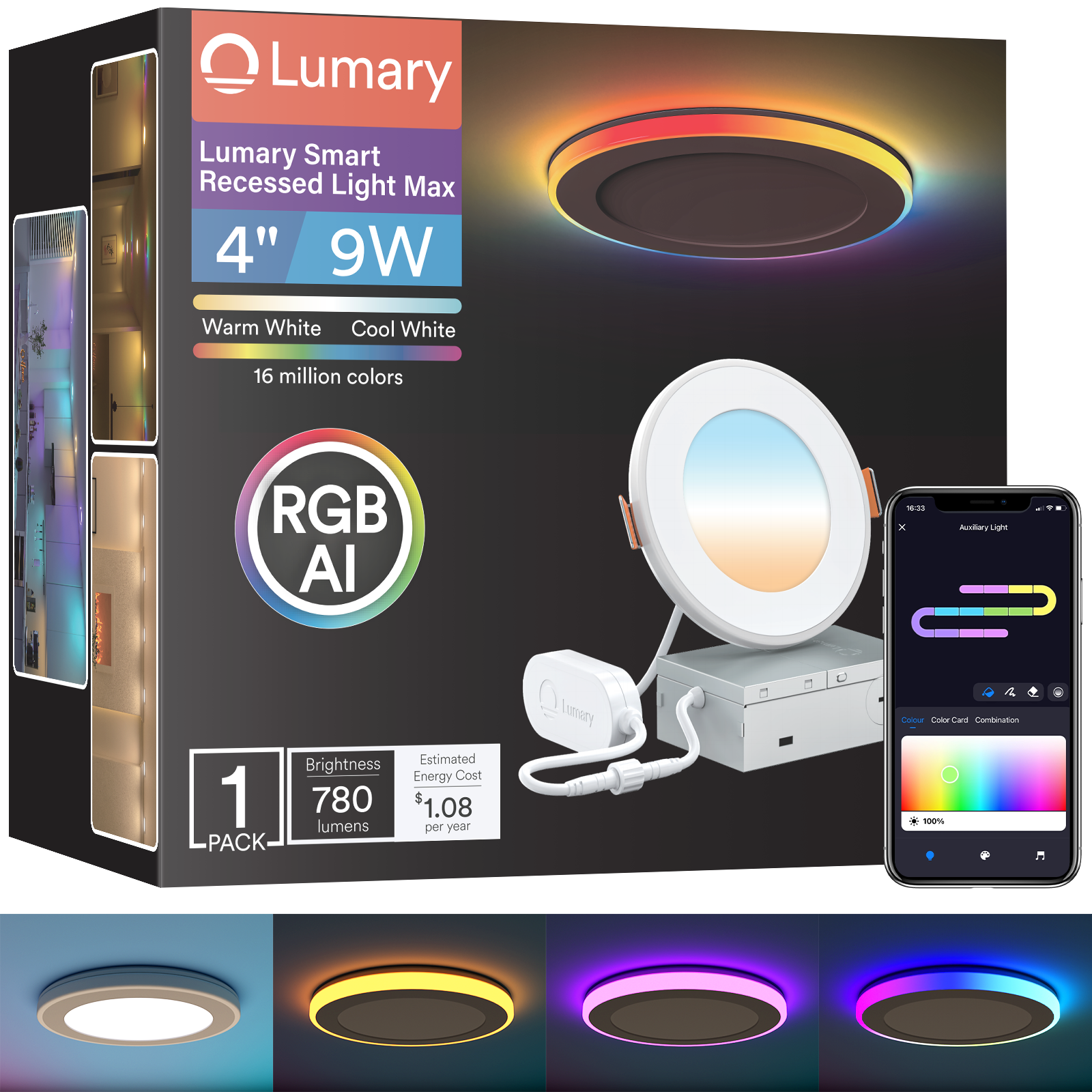
This is the installation context into which a fixture like the Lumary Smart RGBAI Recessed Light with Gradient Auxiliary Night Light fits precisely — an electrically straightforward canless wafer downlight that, once a live circuit is confirmed at the ceiling, can be commissioned and fully configured by a homeowner in an afternoon.
Product Recommendation Analysis
The Lumary Smart RGBAI Recessed Light with Gradient Auxiliary Night Light represents a genuine architectural departure from conventional smart downlights. Where most color-capable recessed fixtures treat the ceiling plane as a single optic — one point of emission, one color at any given moment — this fixture treats the ceiling as a dual-layer canvas.
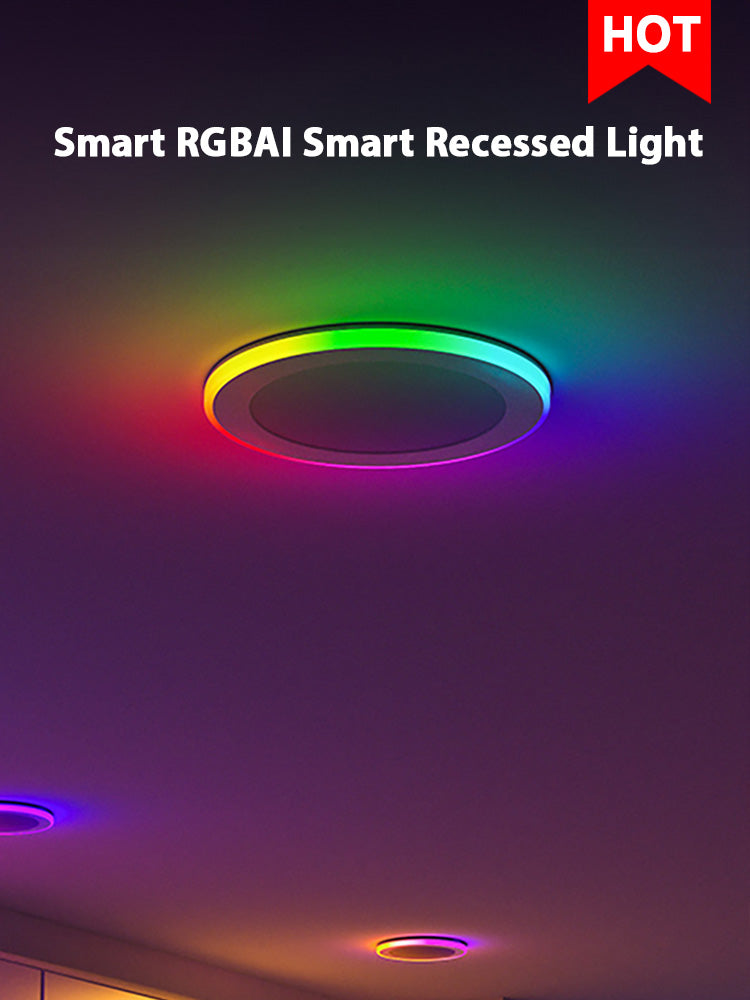
The core architecture pairs a primary downlight with an independently operable gradient auxiliary ring around the fixture perimeter. That auxiliary ring is subdivided into 12 individually addressable LED segments, each capable of rendering a distinct color simultaneously via Lumary's RGBAI addressable-index technology. The result is that the ceiling fixture itself becomes an ambient source, projecting a soft halo of gradient color onto the surrounding ceiling plane while the main emitter handles task or ambient illumination below — or can be switched off entirely when the atmosphere-first mode is active.
Four operating modes define the functional range: a standard downlight mode delivering tunable white output from 2700K to 6500K with 1% to 100% brightness resolution; a nightlight mode using only the auxiliary ring for non-glare, low-intensity orientation lighting; a full RGB atmosphere mode cycling the auxiliary ring through solid-color selections; and the RGBAI gradient mode, which renders multiple simultaneous colors across the 12 segments, producing smooth gradient progressions and dynamic lighting sequences.
Control pathways include the Lumary app over 2.4 GHz Wi-Fi, Amazon Alexa voice integration, Google Assistant, and Siri through Lumary app automation. The app provides access to over 50 preset scene modes, music synchronization, group control across multiple fixtures, scheduling, and remote access from outside the home. The canless form factor with integrated junction box means no housing can is required, and spring-clip mounting secures the fixture to standard drywall thicknesses without attic access.
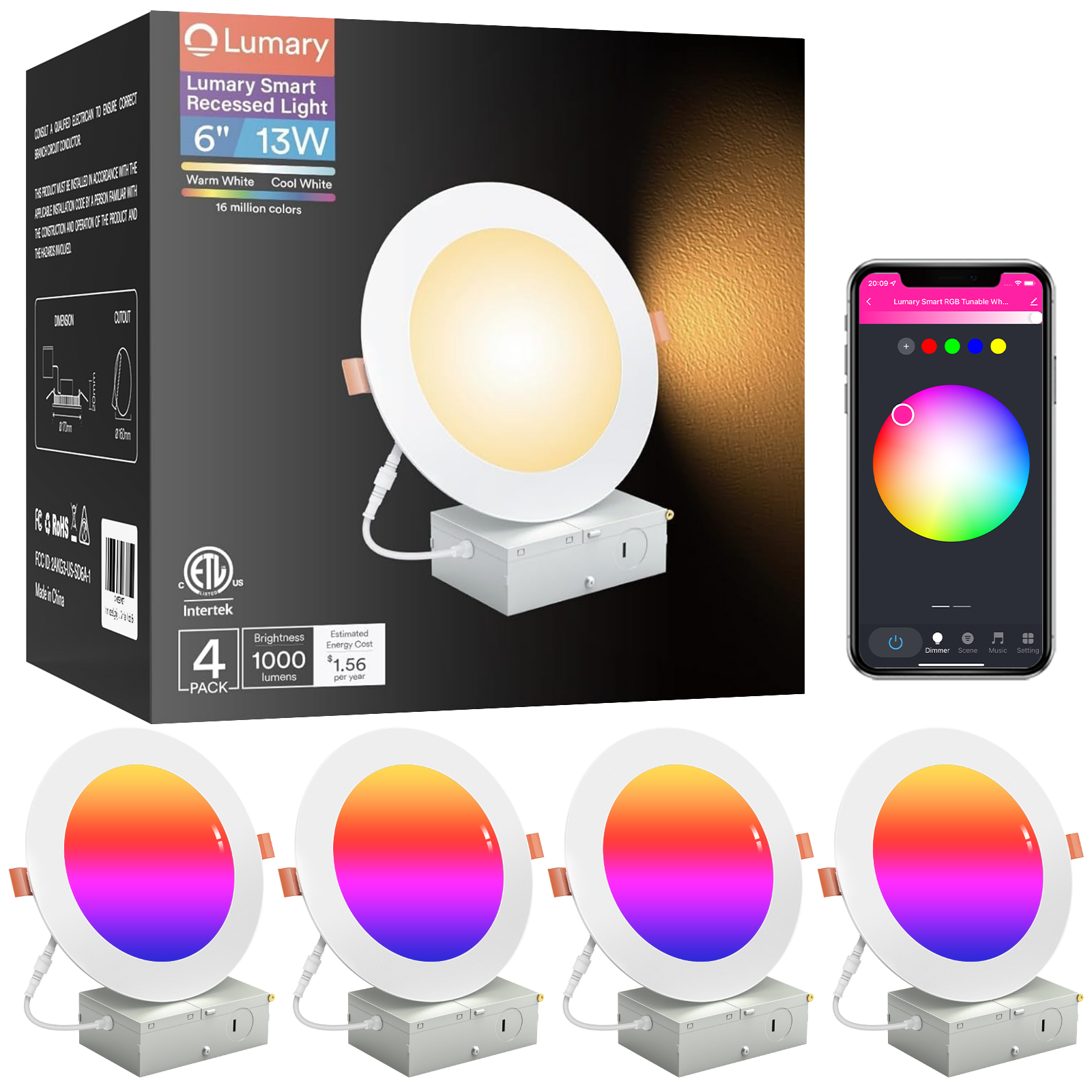
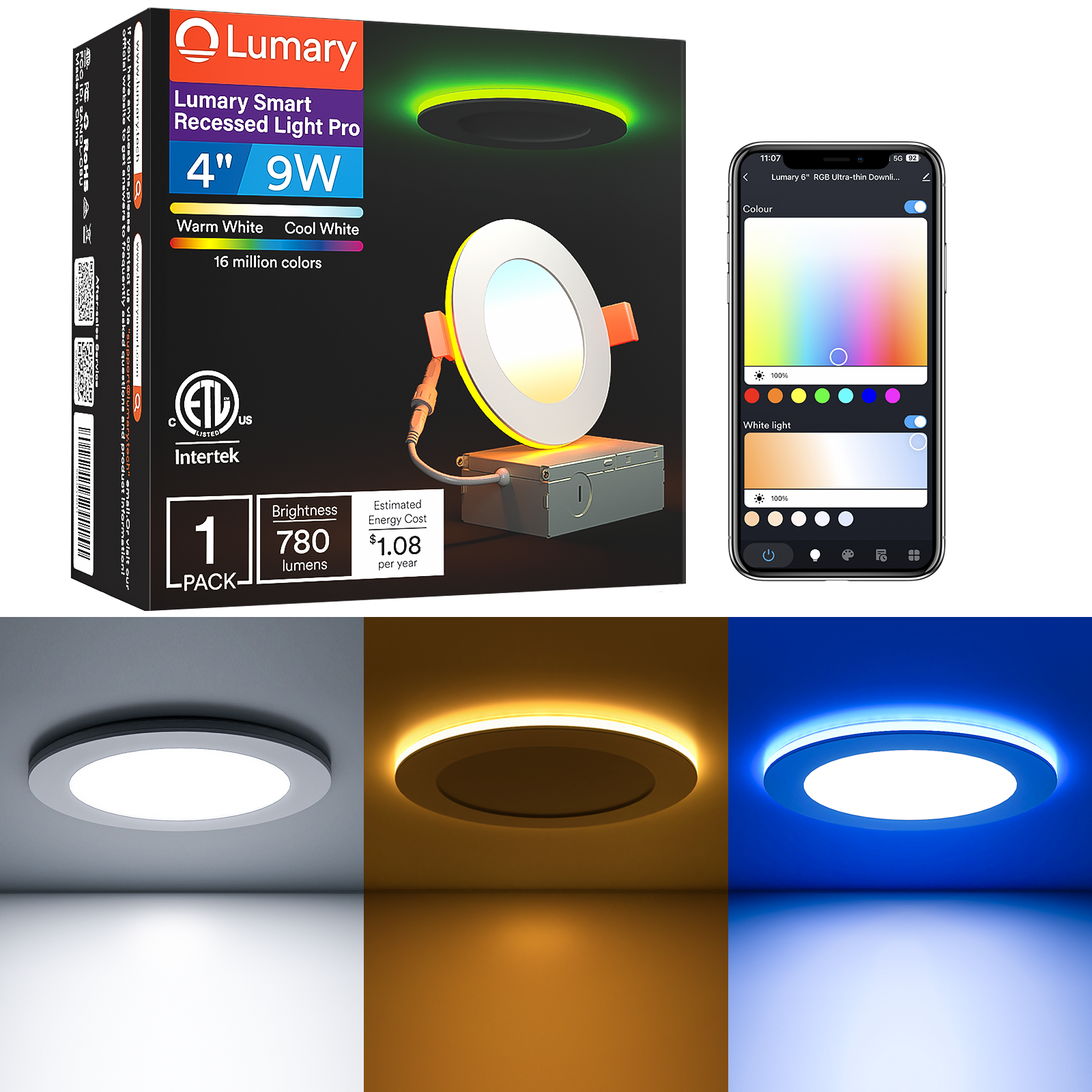
This smart recessed light is available in both 4-inch and 6-inch formats, with the 4-inch variant rated at 9W / 780 lumens and the 6-inch at 12W / 1000 lumens, covering the full range of residential ceiling cutout standards.

Technical Specifications at a Glance
| Parameter | 4-Inch Variant | 6-Inch Variant |
|---|---|---|
| Wattage | 9W | 12W |
| Luminous Output | 780 lm | 1,000 lm |
| Color Temperature Range | 2700K – 6500K | 2700K – 6500K |
| Color Palette | 16 million (RGBWW) | 16 million (RGBWW) |
| Auxiliary Ring Segments | 12 individually addressable | 12 individually addressable |
| Dimming Resolution | 1% – 100% | 1% – 100% |
| Connectivity | 2.4 GHz Wi-Fi + Bluetooth | 2.4 GHz Wi-Fi + Bluetooth |
| Voice Assistant Support | Alexa / Google Assistant / Siri | Alexa / Google Assistant / Siri |
| Scene Modes | 50+ preset scenes | 50+ preset scenes |
| Operating Modes | Downlight / Nightlight / RGB / RGBAI | Downlight / Nightlight / RGB / RGBAI |
| Installation Type | Canless wafer, spring-clip | Canless wafer, spring-clip |
| Junction Box | Integrated | Integrated |
| Attic Access Required | No | No |
| Dimmer Switch Compatibility | Not compatible | Not compatible |
| Group Control | Yes, via Lumary app | Yes, via Lumary app |
| Music Sync | Yes | Yes |
| Scheduling & Automation | Yes | Yes |
| Estimated Lifespan | 25,000+ hours | 25,000+ hours |
Performance Benchmarking: Distinguishing Quality Tiers in Smart Recessed Lighting
| Purchasing Criterion | Signs of a Substandard Implementation | Technical Execution in This Product | Impact on Long-Term Use |
|---|---|---|---|
| Flicker behavior | PWM dimming at frequencies below 1,000 Hz causes perceptible flicker and accelerates visual fatigue during extended exposure | Flicker-free driver topology designed for continuous residential occupancy | Reduced eye strain; safe for children's rooms and workspaces |
| Addressable segment count | Fixed RGB ring with no per-segment control; single color across the entire perimeter at any time | 12 independently addressable RGBAI segments allow gradient and multi-color simultaneous output | Substantially greater scene variety; genuine ambient differentiation impossible to replicate with single-zone rings |
| Color temperature range | Narrow CCT window (e.g., 3000K–5000K only) limits utility across different room functions | Full 2700K–6500K tunable white; covers warm residential ambiance through task-accurate daylight | Single fixture can serve multiple functional roles without replacement |
| Dimming resolution | Coarse dimming steps produce visible "staircase" banding, particularly at the low end of the brightness range | 1%–100% continuous dimming; low-end resolution preserves ambient gradations for nightlight and scene applications | Smooth transitions; nightlight mode remains genuinely functional rather than still-bright |
| Installation depth requirements | Traditional can housings require 5–7 inches of ceiling cavity clearance, precluding installation in shallow coffers or concrete-deck scenarios | Canless ultra-thin wafer profile with integrated junction box; as little as 1–2 inches of cavity clearance required | Compatible with the widest range of ceiling constructions, including finished ceilings with no attic access |
| Multi-device synchronization stability | Firmware implementations without local processing redundancy lose synchronization when Wi-Fi experiences momentary packet loss | Dual-mode Wi-Fi + Bluetooth connectivity provides fallback control path; Lumary app supports group-level command broadcasting | Consistent scene coherence across large installations; individual fixture drop-out does not collapse the group |
| Thermal management | Drivers without adequate copper substrate heat dissipation experience thermal throttling at sustained high output, shortening LED lifespan | Ultra-thin form factor with thermally optimized driver positioning and rated lifespan of 25,000+ hours | Predictable long-term lumen maintenance; color point stability throughout operational life |
Competitive Landscape: Smart Recessed Lighting in 2025
The smart recessed downlight category has matured considerably, with several brands offering color-capable canless fixtures at comparable price points. Each approaches the ambient lighting problem from a slightly different architectural angle.
Govee has built significant market presence with its Wi-Fi and Bluetooth direct-connect RGBWW recessed downlights, offering 65 scene modes and pairing with the established Govee Home ecosystem. Govee's strength lies in its broad smart home device catalog and its cross-platform scene synchronization with other Govee ambient products, making it a coherent choice for homes already invested in the Govee ecosystem.
Philips — through both its standard and Hue lines — brings decades of LED optical engineering to recessed applications. The Hue White and Color Ambiance downlight family offers deep Zigbee-based protocol support with Matter bridge compatibility, prioritizing local network operation and integration with professional-grade home automation controllers. Philips Hue occupies the premium tier with a corresponding price premium.
LIFX recessed offerings are cloud-native Wi-Fi fixtures with a strong reputation for color accuracy and a wide color saturation envelope. LIFX does not require a hub, operates at high color depth, and integrates with a broad range of third-party platforms.
WiZ (a Signify brand) focuses on accessible smart lighting with SpaceSense presence detection in select fixtures and a straightforward onboarding experience. WiZ recessed lights deliver warm-to-cool white tuning with RGB capability at an approachable price point, targeting first-time smart lighting adopters.
Kasa (by TP-Link) builds its recessed line around proven Wi-Fi reliability, leveraging TP-Link's networking infrastructure expertise. Kasa fixtures are consistently praised for stable connectivity and are particularly popular in homes that already use TP-Link network equipment.
What differentiates the Lumary RGBAI recessed light within this competitive field is the structural decision to add a physically separate gradient auxiliary ring as an independently operable component. No other fixture in this price category delivers 12-segment addressable ambient output from a recessed ceiling position — the ambient light projection is generated at the fixture level without any supplemental strip or halo hardware. This is a functionally distinct capability, not merely a specification increment.

Application Scenarios
Scenario 1: Living Room Layered Lighting Without Supplemental Hardware
Contemporary interior lighting design separates illumination into functional layers: ambient (general fill), task (focused work or reading), and accent (atmospheric differentiation). In practice, achieving all three layers in a living room traditionally requires three separate fixture categories: downlights for ambient fill, pendant or track fixtures for task, and strip lighting or sconces for accent. The installation cost, wiring complexity, and visual ceiling clutter multiply accordingly.
The Lumary RGBAI recessed light collapses the ambient and accent layers into a single ceiling cutout. When the main downlight is operating in tunable white mode at its full 2700K warmth, the room reads as conventionally and comfortably lit for evening socializing — a neutral, flattering spectrum that does not color-shift skin tones or fabrics. At that point, the auxiliary ring can be activated independently, projecting a soft halo of warm amber or deep amber-rose onto the surrounding ceiling plaster. The ceiling plane itself becomes a reflective surface that adds perceived room height and warmth without any fixture being visible.
Shift to the RGBAI gradient mode, and the 12-segment ring begins cycling through a programmed color sequence — perhaps a slow gradient from indigo through cobalt to cyan for a film-screening atmosphere, or a static tricolor progression for a family game night. The main light remains off during these atmosphere-forward scenes, allowing the color ring's reflection to act as the room's only source and defining the mood entirely.
For homeowners who have resisted accent lighting on grounds of installation complexity or ceiling aesthetics, the architectural implication here is meaningful: a single 4-inch or 6-inch cutout — the same hole that would have housed a plain white downlight — now delivers the full tonal range from clinical task illumination to cinematic ambient color. The wiring load is identical to a conventional downlight. The ceiling penetration is identical. The visual payoff is structurally different.
The Lumary app's group control function ensures that when four, six, or eight of these fixtures are installed across a ceiling plane, they can be addressed as a single unit for consistent scene deployment, or subdivided into zones — perimeter fixtures in gradient mode, central fixtures in downlight mode — delivering spatial lighting differentiation that would otherwise require a dedicated lighting controller and a separate fixture type for each zone.

Scenario 2: Home Theater and Dedicated Media Room Configuration
Home theater lighting design operates under a specific constraint that general-purpose smart lighting often handles poorly: the transition between full-room illumination for seating arrangement and activity before a film, and the very-low-output ambient state required once the content begins. Standard smart downlights handle this transition through dimming, but dimming a white downlight to 5% or 10% still produces a directional downward pool that competes visually with the screen — the eye is drawn to the brightest point in the field of view, and a dimmed downlight remains a local brightness peak even at low output levels.
The nightlight mode on the Lumary auxiliary ring addresses this differently. The main downlight is deactivated entirely, and the perimeter ring operates at its minimum output — a narrow band of warm, diffused color around the ceiling fixture's rim, projecting softly upward onto the ceiling rather than downward into the viewing field. The illumination level is sufficient for safe navigation (standing up during a film, moving to the kitchen) without introducing any downward-directed light source that would reflect off the screen surface or compress the perceived contrast ratio of the display.
The RGBAI mode adds a further dimension for home theater applications: synchronized scene lighting. During action sequences, the 12 individually addressable segments can be programmed via the Lumary app to mirror content-driven color progressions, creating an ambient light field around the ceiling that extends the on-screen palette into the room periphery. This effect — well-documented in the bias lighting and ambient extension category — reduces the perceived contrast between the bright screen and the dark surround, which measurably reduces eye strain during extended viewing sessions.
The music synchronization function opens an additional operating mode for combined music and film applications, allowing the auxiliary ring to respond dynamically to audio output levels and frequency bands. Installation of multiple units across the ceiling creates a fully enveloping ambient field without a single strip of LED tape, no structural channels, and no power injection points to manage.
Scenario 3: Home Office and Productivity Workspace
The intersection of occupational health research and lighting engineering has produced a well-supported consensus over the past decade: the spectral composition and flicker characteristics of ambient lighting in work environments have measurable effects on alertness, sustained attention, and end-of-day cognitive fatigue. This is not a marginal or disputed finding — it is the basis for jurisdictional requirements in commercial office construction codes in several European markets and is increasingly referenced in home workspace design literature.
The two specific concerns for productivity spaces are color rendering accuracy — whether the light source reproduces the full visible spectrum faithfully, so that document colors, screen calibration, and fine visual work are not distorted — and flicker behavior at the PWM frequency used by the fixture's dimming circuit.
High-frequency flicker in LED fixtures operating below 1,000 Hz PWM is not reliably perceptible as visible flicker but is detectable at the neural level, contributing to headache incidence and visual fatigue in sensitive individuals during multi-hour exposure. The flicker-free driver design in the Lumary smart recessed light eliminates this mechanism at the source rather than managing it through spectral or optical means.
Color temperature control across the full 2700K–6500K range allows the home office lighting to be tuned to the task at hand and the time of day. Morning deep work at 5000K–6000K — a daylight-correlated spectrum that supports alertness and visual acuity for reading or screen-intensive tasks — transitions to 3000K–3500K during late-afternoon video calls, where warm tones render skin more naturally on camera and reduce the physiological alertness signal that extended cool-white exposure suppresses melatonin production and disrupts sleep onset timing.
The 1%-to-100% dimming resolution ensures that early morning or late evening sessions at low brightness do not produce the stepped brightness artifacts that characterize coarser dimming implementations. For users who work across multiple time zones or keep irregular schedules, the scheduling and automation functions allow pre-programmed CCT and brightness progressions tied to calendar time rather than requiring manual adjustment throughout the day.
Scenario 4: Kitchen Renovation and Remodel Installation
The kitchen represents the most demanding intersection of functional lighting requirements in the residential built environment. It requires high-output, high-accuracy illumination for food preparation surfaces; lower, warmer ambient output for dining and social use; and sufficient flexibility to transition between these modes without fixture changes or zone-by-zone manual switching.
The canless installation format is particularly well-matched to kitchen remodel scenarios, which characteristically involve finished ceilings with no attic access above. Canless LED recessed lighting mounts directly to your ceiling from below through a simple cutout, with the built-in junction box accepting your electrical connections right at the fixture, making it ideal for remodel situations where attic or above-ceiling access is limited or impossible. Amicolight
For a kitchen renovation, six Lumary RGBAI 6-inch recessed lights at 12W / 1,000 lm each deliver 6,000 aggregate lumens across the ceiling plane — a quantity sufficient for most residential kitchen footprints at standard 8-foot ceiling heights without exceeding typical 15- or 20-amp circuit capacity, given the 12W-per-fixture draw. A licensed electrician confirming circuit capacity and completing the wire runs from the switch location to each fixture position is the professional work required here; the fixture installation itself, including junction box connections and spring-clip mounting, follows the standard canless process.
The tunable white range, shifting from 2700K for evening dining ambiance to 6000K for morning food preparation, covers the full functional envelope. The auxiliary ring in nightlight mode provides the low-level orientation lighting needed when entering the kitchen at night without activating the full array — a feature that addresses a common behavioral pattern with smart lighting, where users default to wall-switch operation rather than voice or app control because the latter requires conscious engagement at a moment of low cognitive demand.
Scenario 5: Bedroom and Sleep Environment Optimization
The bedroom occupies a unique position in residential lighting design because its primary occupancy period — the two to three hours before sleep — is also the interval most sensitive to the alerting effects of short-wavelength light. Fixtures that cannot reduce color temperature below 3000K or that exhibit high-frequency flicker artifacts during low-output operation are physiologically mismatched with the environment's primary function.
The Lumary smart recessed downlight addresses the bedroom scenario from multiple angles. The downlight mode's full 2700K output at its warmest setting produces a spectrum with substantially reduced blue-channel content relative to a standard cool-white fixture — appropriate for evening winding-down periods. At 1% dimming, the main light delivers a level suitable for light reading without producing the ceiling-directed brightness that conventional downlights generate even at low output.
The nightlight mode — using only the auxiliary ring at its minimum output — provides the lowest-intensity operating state the fixture offers. A single fixture in nightlight mode on one side of a bedroom ceiling delivers enough light for safe navigation without disturbing a sleeping partner, and without the disruptive directional spill of a conventional dimmed downlight or a table lamp pointed at the ceiling.
For households with young children, the RGBAI gradient mode provides a functional nightlight experience at the ceiling level rather than at the baseboard — a positioning that distributes soft color more evenly across the room volume and eliminates the sharp shadow edges that low-position nightlights create. The Lumary app's scheduling function can automate the nightlight activation at a set time and the full-off command at a later scheduled hour, removing the operational friction of remembering to switch states manually.
Professional Assessment and Purchasing Guidance
From an engineering evaluation standpoint, the Lumary Smart RGBAI Recessed Light with Gradient Auxiliary Night Light occupies a technically coherent position in the smart downlight market. The RGBAI addressable-ring architecture is a genuine structural innovation — not a marketing specification increment — because it enables simultaneous dual-zone operation from a single ceiling cutout without requiring supplemental hardware, secondary wiring, or a separate controller channel.
The decision logic for prospective purchasers resolves along a few clear axes:
If your primary requirement is task and ambient illumination with a single fixture type, and you want the ability to shift that fixture from functional daylight-output downlighting to atmospheric accent lighting without installing separate hardware, the RGBAI recessed format addresses that requirement directly.
If you are building out a ceiling with multiple fixtures and want scene-level coherence — all fixtures cycling through a synchronized gradient sequence during entertaining, or all shifting to warm nightlight mode at a scheduled hour — the Lumary group control implementation via the app handles this without a bridge device or additional controller hardware.
If your installation is a remodel scenario with a finished ceiling and no attic access, the integrated junction box and canless wafer profile are operationally compatible with that constraint in a way that traditional can-and-housing recessed systems are not.
Lighting design professionals and hardware reviewers evaluating smart recessed fixtures in this category consistently note that the meaningful differentiation between products lies not in raw lumen output or color count — these are now commodity specifications — but in the addressability architecture and the quality of the control implementation. A fixture that delivers genuine per-segment addressability, a well-maintained app platform, and reliable group synchronization across large installations is substantively different from one that offers a fixed-color ring and a simpler control stack. The Lumary RGBAI fixture's 12-segment independent addressing is the specific technical implementation that places it in the former category.
Who Should Buy This Product
This fixture is well-suited for homeowners undertaking kitchen, living room, or bedroom lighting renovations where a single ceiling cutout needs to serve multiple functional roles across the day. It is particularly appropriate for anyone who has wanted ceiling-level ambient color without the installation complexity of concealed strip lighting, and for users already operating within the Alexa or Google Assistant ecosystem who want lighting that responds to voice commands without a separate hub or protocol bridge. Renters or homeowners with finished ceilings and no attic access will find the canless format architecturally compatible with their installation constraints in a way that conventional recessed systems are not.
Frequently Asked Questions
1. Why do the auxiliary ring and the main downlight need to be operated separately — can they run simultaneously?
The two light engines in this fixture share a single driver architecture optimized for each operating mode. Operating the main downlight and the auxiliary ring simultaneously would require both emitter systems to draw from the driver concurrently, which affects color rendering accuracy and long-term driver thermal performance. The four-mode architecture — downlight, nightlight, RGB, and RGBAI — is designed so each mode deploys one emitter system at its optimal operating parameters. In practical use, the transition between modes takes less than a second via the app or voice command, so the operational separation does not create meaningful friction.
2. How many of these fixtures can run on a single 15-amp circuit without violating the NEC's 80% continuous load rule?
The 4-inch variant draws 9W and the 6-inch draws 12W. At 120V, a 15-amp circuit has a rated capacity of 1,800W, with the NEC's 80% continuous-load limit placing the practical ceiling at 1,440W. The 4-inch units at 9W each allow up to 16 fixtures per circuit within that limit; the 6-inch units at 12W allow up to 12. These are theoretical ceilings — a licensed electrician confirming actual circuit loading, including all other devices sharing the circuit, should be consulted before installation.
3. The fixture specifies 2.4 GHz Wi-Fi only. Does this create connection problems in homes with dual-band or Wi-Fi 6 routers?
Modern dual-band routers broadcast 2.4 GHz and 5 GHz on separate SSIDs or as a unified band-steering network. For the Lumary app onboarding process, your phone should be connected to the 2.4 GHz band (or a 2.4 GHz-only SSID) at the time of pairing. Once paired, the fixture retains its 2.4 GHz association regardless of where your phone connects afterward. Homes with band-steering unified SSIDs may need to temporarily connect to the 2.4 GHz band on a secondary SSID during initial setup. The Bluetooth fallback control path functions entirely independently of Wi-Fi band assignment.
4. The fixture is described as not compatible with dimmer switches. Why, and how does brightness control work instead?
Conventional phase-cut dimmer switches modulate the AC waveform to reduce power delivery, which conflicts with the internal PWM dimming controller in smart LED fixtures. Combining a phase-cut dimmer with an LED smart fixture can produce audible buzzing, erratic behavior, accelerated driver degradation, and loss of the granular software dimming that makes smart fixtures useful. Brightness control for the Lumary RGBAI recessed light is handled entirely within the fixture's driver, commanded via the app (1%–100% resolution), voice, or the optional Lumary smart switch, which communicates with the fixture through the Lumary protocol rather than by modulating the AC supply. This preserves full dimming resolution and driver integrity.
5. How does the color gradient effect actually work across 12 individually addressable segments, and does the effect look continuous or segmented?
Each of the 12 auxiliary ring segments contains an independent RGBAI LED node addressable by the Lumary app firmware. When the RGBAI gradient mode is active, the firmware assigns each segment a distinct point along a defined color progression, producing a visible gradient arc across the ring. The optical diffusion layer of the auxiliary ring's lens system blends the transitions between adjacent segments, so the gradient reads as a smooth color sweep rather than 12 discrete patches. The number of simultaneous colors, the speed of progression, and the specific palette are adjustable through the app's scene editor or from the 50+ preset scene library.

