




For a standard room with an 8–10 ft ceiling, 6-inch recessed lights are usually the safest default. They provide enough visual presence and light spread for bedrooms, living rooms, kitchens, and hallways without making the ceiling feel crowded. A simple planning rule is to space recessed lights at roughly half the ceiling height—for example, about 4 ft apart on an 8 ft ceiling—then adjust for furniture, task zones, and room shape. (The Home Depot)
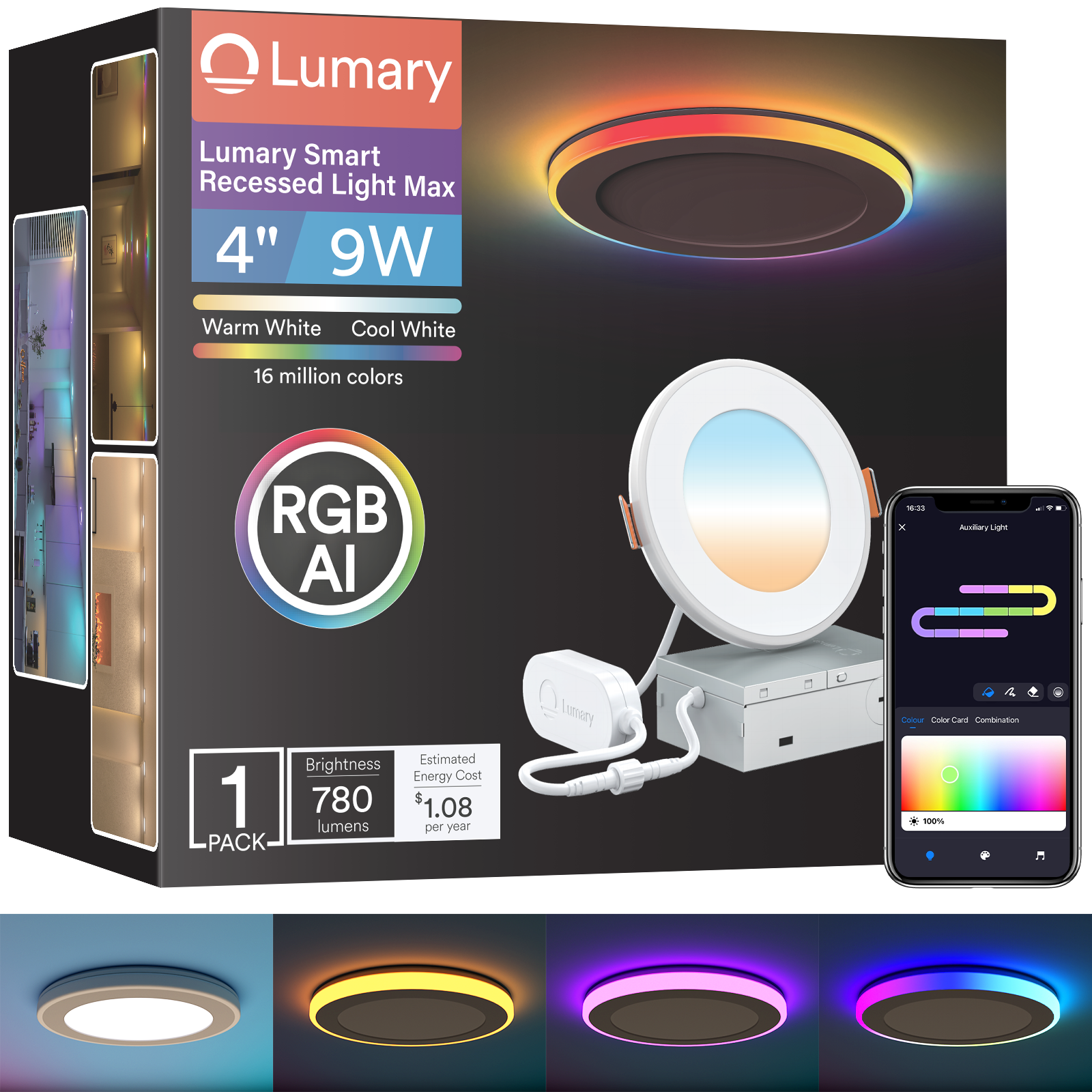
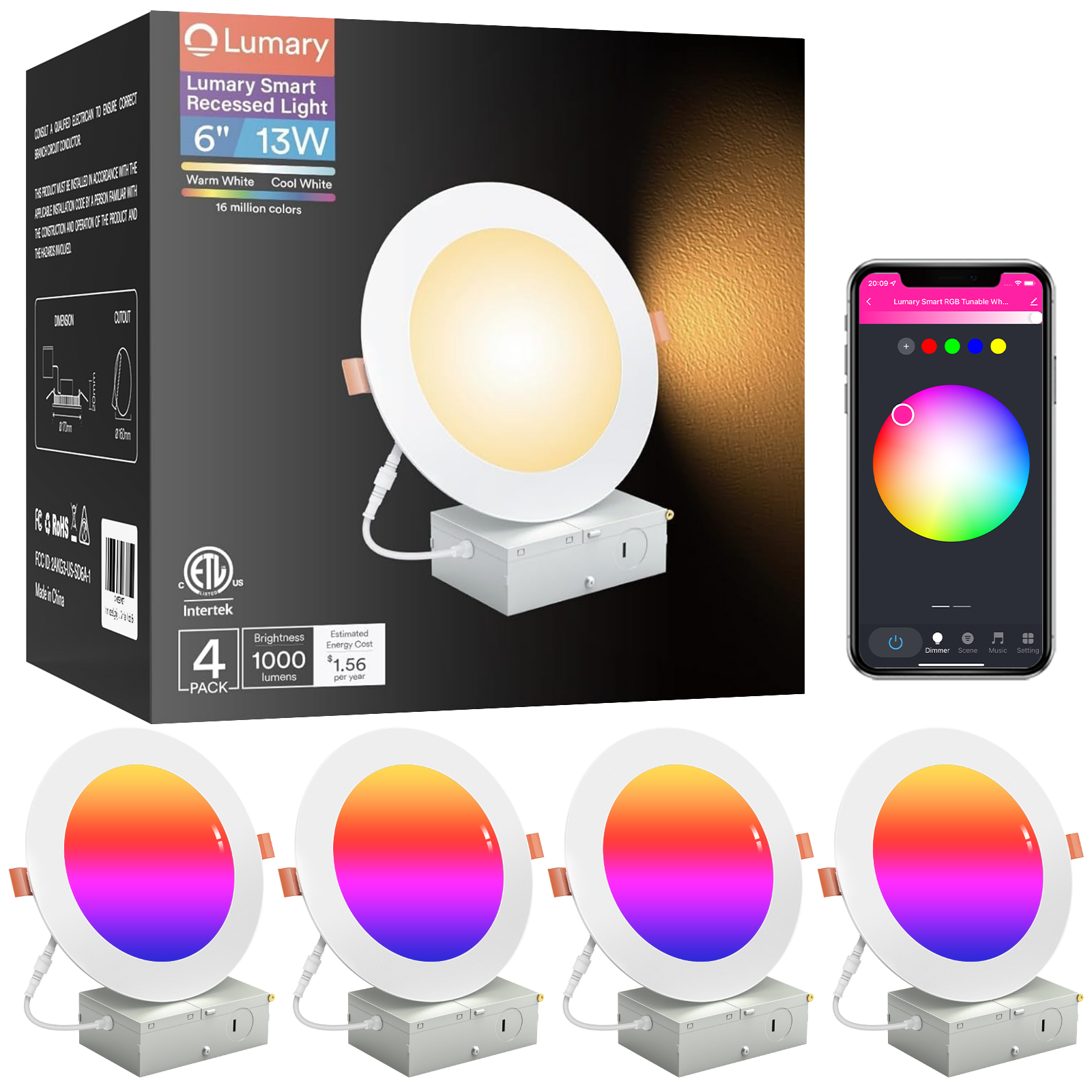
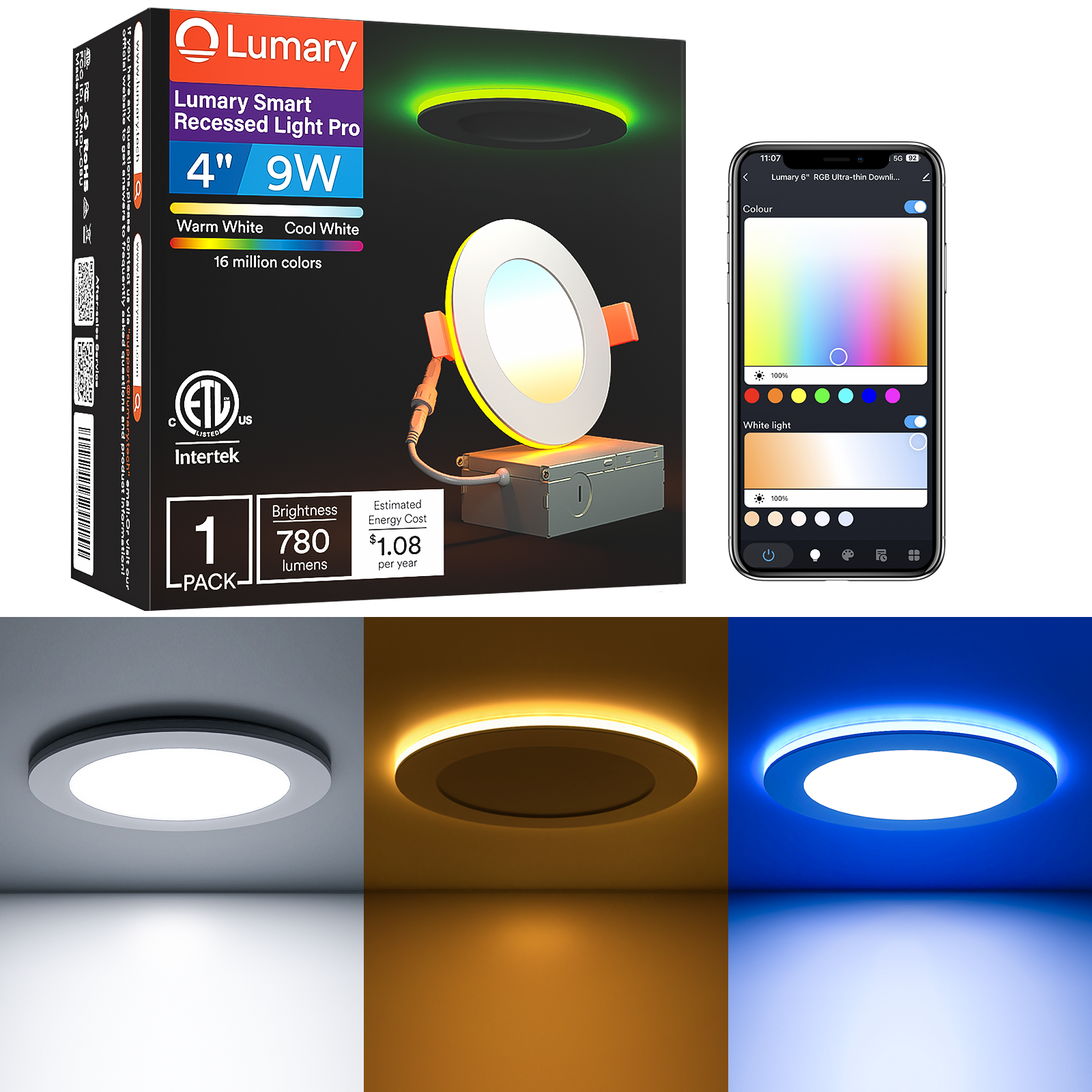
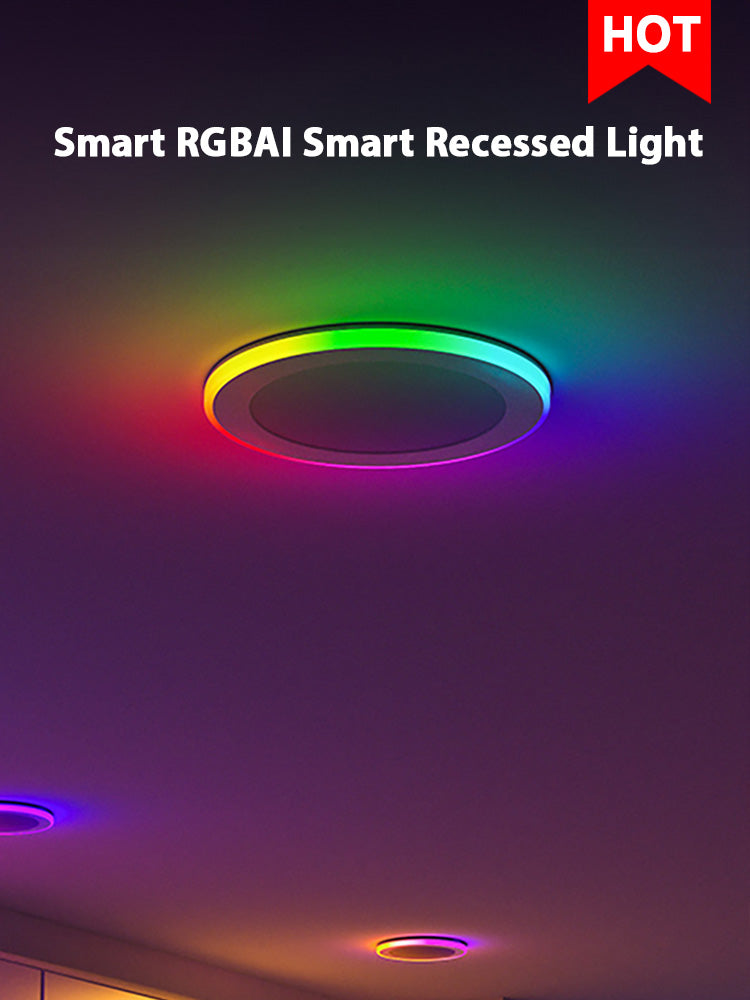
The more precise answer is this: 4-inch lights are best for compact, modern, or accent layouts; 6-inch lights are best for most standard rooms; 8-inch lights are best for larger rooms, higher ceilings, or spaces where stronger general illumination is needed. The Lumary Smart RGBAI Recessed Light supports all three sizes—4 inch, 6 inch, and 8 inch—so the same lighting system can scale across bedrooms, kitchens, living rooms, and open-plan areas. (Lumary)
The practical size rule
| Room condition | Best recessed light size | Why it works |
|---|---|---|
| Small bedroom, hallway, closet, accent zone | 4 inch | Cleaner ceiling look, better for tighter layouts |
| Standard bedroom, living room, kitchen, dining room | 6 inch | Balanced output, coverage, and ceiling proportion |
| Large living room, open-plan area, high ceiling | 8 inch | More output and stronger visual coverage |
| Media room or gaming room | 4 or 6 inch | 4 inch for dense atmospheric layouts; 6 inch for balanced daily use |
| Renovation with mixed room sizes | 4/6/8 inch family | Keeps design consistent while matching room scale |
For most homeowners, the 6-inch Lumary model is the most universal choice. It sits between the 4-inch unit’s compact look and the 8-inch unit’s stronger output, making it the best fit for a “standard room” where the light must handle daily brightness, ambience, and smart scenes.

Lumary’s size range in one view
The Lumary Smart RGBAI Recessed Light is built around a scalable 4/6/8-inch lineup. The 4-inch version is rated at 9W, the 6-inch at 13W, and the 8-inch at 18W. Brightness options are listed as 780 lumens, 1100 lumens, and 1400 lumens, with 2700K–6500K tunable white, CRI 90, RGBAI color, 16 million colors, Bluetooth/Wi-Fi connectivity, ETL listing, and a 25,000-hour average life. (Lumary)
| Specification | Lumary Smart RGBAI Recessed Light |
|---|---|
| Available sizes | 4 inch, 6 inch, 8 inch |
| Wattage | 4-inch/9W, 6-inch/13W, 8-inch/18W |
| Brightness classes | 780 lm, 1100 lm, 1400 lm |
| White temperature | 2700K–6500K |
| Color rendering | CRI 90 |
| Color system | RGBAI, RGB, 16 million colors |
| Segment control | 12 individually controlled segments |
| Lighting modes | RGBAI Gradient, RGB Mode, Nightlight Mode, Downlight Mode |
| Control | Lumary App, Alexa, Google Assistant, Siri via Lumary App automation |
| Connectivity | 2.4 GHz Wi-Fi, Bluetooth |
| Installation style | Canless recessed light |
| Voltage | AC 120V |
| Average life | 25,000 hours |
| Listed starting price | $49.99 for 4-inch single unit at the time checked |
Why size alone is not enough
A recessed light that is too small may require too many ceiling cuts. A light that is too large can make a standard room feel visually heavy. But the hidden issue is usually not diameter—it is output, spacing, heat behavior, color quality, and control logic.
| Selection factor | Weak specification pattern to avoid | Lumary’s relevant implementation | Long-term effect |
|---|---|---|---|
| Diameter | Choosing one size for every room | 4/6/8-inch options | Better match between ceiling scale and room function |
| Brightness | Too few lumens for the ceiling height | 780/1100/1400 lumen classes | More accurate room planning |
| Color quality | White light that makes finishes look dull | CRI 90 | Better rendering of wood, paint, food, fabrics, and skin tones |
| Use cases | Downlight-only fixture | Downlight, nightlight, RGB, RGBAI gradient modes | One ceiling fixture supports task, ambient, and decorative lighting |
| Atmosphere | Single-color RGB effect | 12 individually controlled RGBAI segments | More dimensional ceiling ambience |
| Smart control | Isolated manual-only lighting | App and voice assistant control | Easier room grouping and scene recall |
ENERGY STAR’s downlight criteria emphasize that downlights are expected to distribute light in the correct downward zone, which is why size, lumen output, beam behavior, and spacing should be considered together rather than judged by diameter alone. (ENERGY STAR)
How Lumary compares with other smart recessed lighting options
Govee’s 6-inch Smart Retrofit Recessed Can Lights focus on existing can-light upgrades, offering 16 million colors, 0–100% dimming, Wi-Fi/Bluetooth control, group control, and preset scenes. (Govee) Philips Hue’s Slim Downlight 6 inch is built for the Hue ecosystem and is positioned as a canless, thin-profile color-capable recessed option for rooms where traditional cans may not fit. (Philips Hue) WiZ’s 6-inch Slim Recessed Downlight offers full color, tunable white from 2200K–6500K, CRI ≥90, 110° beam angle, 120V operation, and a 50,000-hour nominal lifetime. (WiZ) LIFX’s SuperColor 6-inch Canless Downlight provides 1200 lumens, 1500K–9000K CCT, CRI 90, 2.4 GHz Wi-Fi, 120V AC, and Matter-enabled smart control. (LIFX - Smart Lighting)
| Brand / product family | Best-fit use | Size-related strength |
|---|---|---|
| Lumary Smart RGBAI Recessed Light | Whole-room smart lighting with gradient ambience | 4/6/8-inch range lets one product family scale across room types |
| Govee Smart Retrofit Recessed Can Lights | Existing 6-inch can upgrades | Strong retrofit path with color scenes and group control |
| Philips Hue Slim Downlight | Hue-based smart homes | Thin-profile 6-inch smart downlight for color ambience |
| WiZ 6-inch Slim Recessed Downlight | Wi-Fi smart lighting with practical white-light specs | 6-inch slim form with CRI ≥90 and broad tunable-white range |
| LIFX SuperColor 6-inch Canless Downlight | High-output color and smart-home integration | 6-inch canless design with 1200-lumen output |
Lumary’s advantage is size flexibility. Many smart downlight families concentrate on one dominant size, usually 4 inch or 6 inch. Lumary’s 4/6/8-inch structure makes it easier to keep the same visual language across a home while changing output and aperture by room.
Real-world sizing scenarios
Standard bedroom: choose 6 inch.
A standard bedroom usually needs comfortable general lighting, soft evening scenes, and enough brightness for cleaning or organizing. The 6-inch Lumary model is the balanced option because it gives stronger room coverage than a compact 4-inch layout while avoiding the heavier ceiling presence of an 8-inch fixture.
Small hallway or reading corner: choose 4 inch.
A hallway does not need the same ceiling aperture as a kitchen or family room. The 4-inch Lumary version keeps the ceiling visually quiet while still supporting tunable white, RGB color, RGBAI gradient effects, and soft night-light behavior.
Kitchen or dining area: choose 6 inch, sometimes 8 inch.
A standard kitchen benefits from the 6-inch size because it balances brightness and spacing. In a larger kitchen, open dining area, or room with higher ceilings, the 8-inch version can be used where stronger output is more useful.
Open-plan living room: mix 6 inch and 8 inch carefully.
A large living area may need stronger downlighting in circulation zones and softer ambience near seating. Lumary’s 6-inch fixtures can handle the main grid, while 8-inch units can be reserved for broader coverage zones.
Gaming or media room: choose by mood density.
For a clean entertainment ceiling, 4-inch fixtures can create a tighter, more architectural layout. For a room that must also function as a daily living space, 6-inch fixtures are usually the more practical base. Lumary’s RGBAI 12-segment design gives the recessed layer more atmosphere than a simple white-only downlight.

Professional buying judgment
For a standard room, choose 6-inch recessed lights unless the room is unusually small, unusually large, or designed around a very minimal ceiling aesthetic. Choose 4 inch when the ceiling should look more refined and less fixture-heavy. Choose 8 inch when the room needs stronger visual output, broader coverage, or a more substantial architectural presence.
The Lumary Smart RGBAI Recessed Light is a strong fit because it does not force a single-size decision across the whole home. A buyer can use 4-inch lights in compact areas, 6-inch lights in standard rooms, and 8-inch lights in larger zones while keeping the same app control, color behavior, CRI 90 white-light quality, and RGBAI gradient experience. (Lumary)
FAQ
What size recessed light is best for a normal bedroom?
A 6-inch recessed light is usually the safest choice for a standard bedroom. Use 4-inch lights if the room is small or the design goal is a cleaner ceiling.
Are 4-inch recessed lights bright enough for a standard room?
They can be, but they usually need tighter spacing or more fixtures. For general lighting in a standard room, 6-inch fixtures are easier to plan.
Are 8-inch recessed lights too large for a bedroom?
They can feel visually heavy in smaller bedrooms. They make more sense in larger rooms, high ceilings, open-plan spaces, or areas that need stronger general illumination.
How far apart should recessed lights be?
A common rule is to divide ceiling height by two. With an 8 ft ceiling, recessed lights are often spaced about 4 ft apart, then adjusted based on room layout and task areas. (The Home Depot)
Which Lumary size should I buy first?
For a standard room, start with the 6-inch Lumary Smart RGBAI Recessed Light. Use 4 inch for compact or accent zones and 8 inch for larger rooms that need more output.

