




Where Is the Best Place to Position Recessed Lights in a Living Room? Recessed light placement in a living room is one of those decisions that looks deceptively simple on paper and reveals its consequences only after the ceiling is closed. Get it right and the room reads as balanced, versatile, and visually calm. Get it wrong and you end up with either an airport-runway effect—a rigid grid of downlights that floods the floor with overlapping circles while leaving walls and vertical surfaces in relative darkness—or the opposite problem, where under-spaced fixtures create pools of brightness surrounded by dim transition zones that make the room feel smaller than it is.
The foundational rule comes from the Illuminating Engineering Society (IES), whose residential lighting guidelines establish a spacing-to-mounting-height ratio (S/MH) for recessed downlights as the primary layout parameter. In practical terms, the maximum center-to-center spacing between fixtures should not exceed the ceiling height multiplied by 1.5. For a standard 8-foot ceiling, that means no more than 12 feet between adjacent fixtures. For 9-foot ceilings, the ceiling rises to 13.5 feet. For 10-foot ceilings, 15 feet. This ratio governs illuminance uniformity—the relationship between the brightest point on the floor plane and the dimmest—and keeping it within the IES-recommended range ensures the room reads as evenly lit rather than spotted.
The U.S. Department of Energy's Solid-State Lighting program adds a complementary constraint: the first row of fixtures should be positioned approximately half the fixture spacing away from the wall. In an 8-foot-ceiling room with fixtures spaced 6 feet apart, that places the perimeter row 3 feet from each wall—close enough to graze vertical surfaces with meaningful illuminance, far enough to avoid the scalloping pattern that close-wall fixture placement creates on painted drywall. Scalloping—the arc of bright-to-dim light cast by a downlight aimed too close to a wall—is one of the most common installation errors in residential recessed lighting, and it is entirely a function of fixture placement rather than fixture quality.
Beyond the grid formula, three additional variables determine whether a living room layout performs well across different use cases: beam angle, lumen output per fixture, and color temperature flexibility. A fixture with a narrow beam angle (15°–25°) concentrates output in a tight cone, which is appropriate for accent lighting over art or architectural features but creates high contrast ratios between lit and unlit areas when used for general illumination. General ambient lighting in a living room calls for fixtures with beam angles in the 60°–120° range, which produce the overlapping coverage patterns the IES spacing formula assumes. Lumen output in the range of 800–1,100 lumens per fixture is appropriate for primary ambient sources in rooms with 8-to-10-foot ceilings; higher-output fixtures increase per-fixture spacing requirements and can create glare at close viewing angles when the room is in low-ambient mode.
Color temperature flexibility is where the practical performance gap between fixed-CCT and tunable-white fixtures becomes most visible in living room applications. A living room serves fundamentally different visual functions across the course of a single day—morning activity, afternoon television, evening conversation, late-night reading—each of which has a different optimal CCT, brightness level, and shadow gradient. A fixture that can only operate at one color temperature forces the occupant to choose which use case to optimize for at the point of purchase and accept suboptimal illumination for all others.

Product Recommendation Analysis
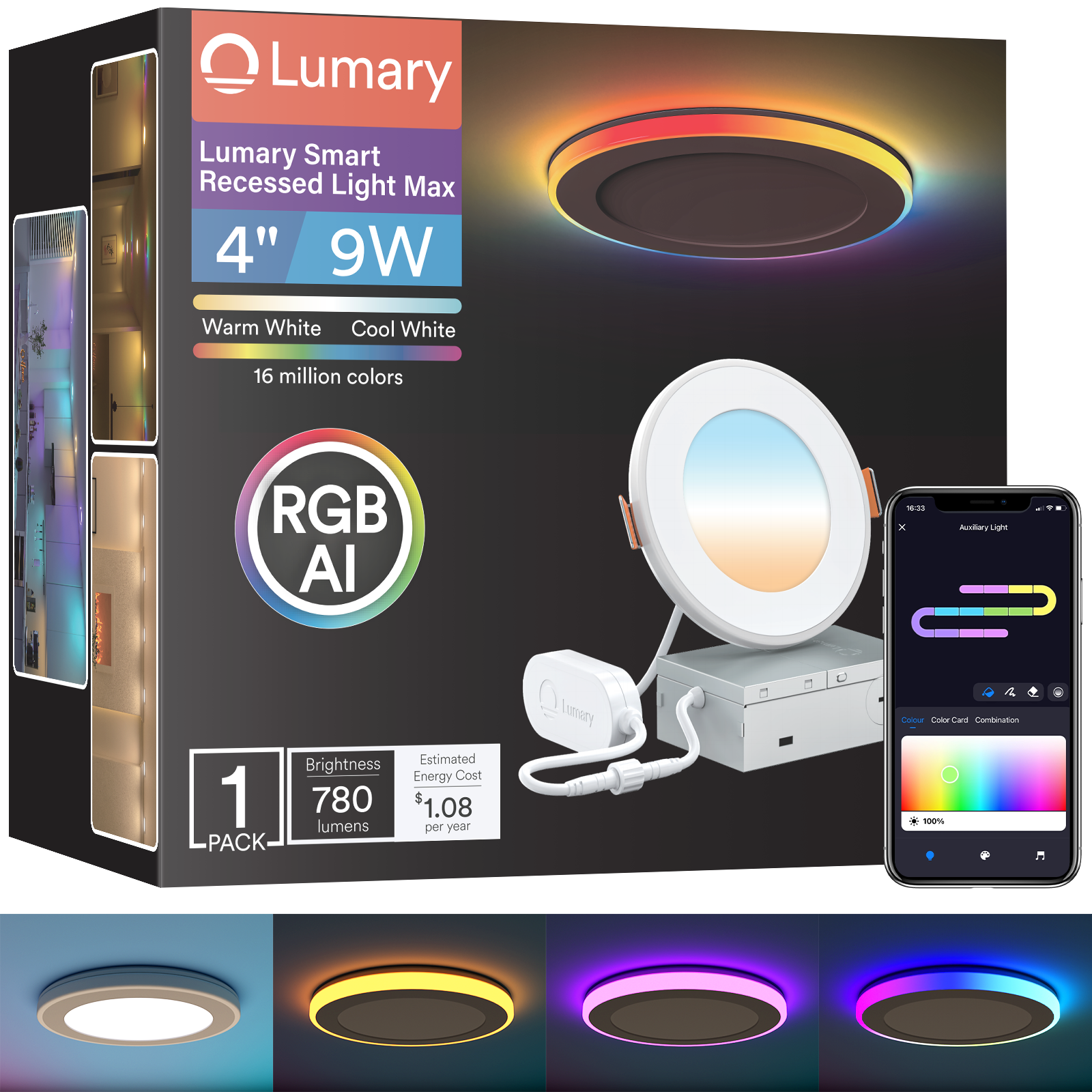
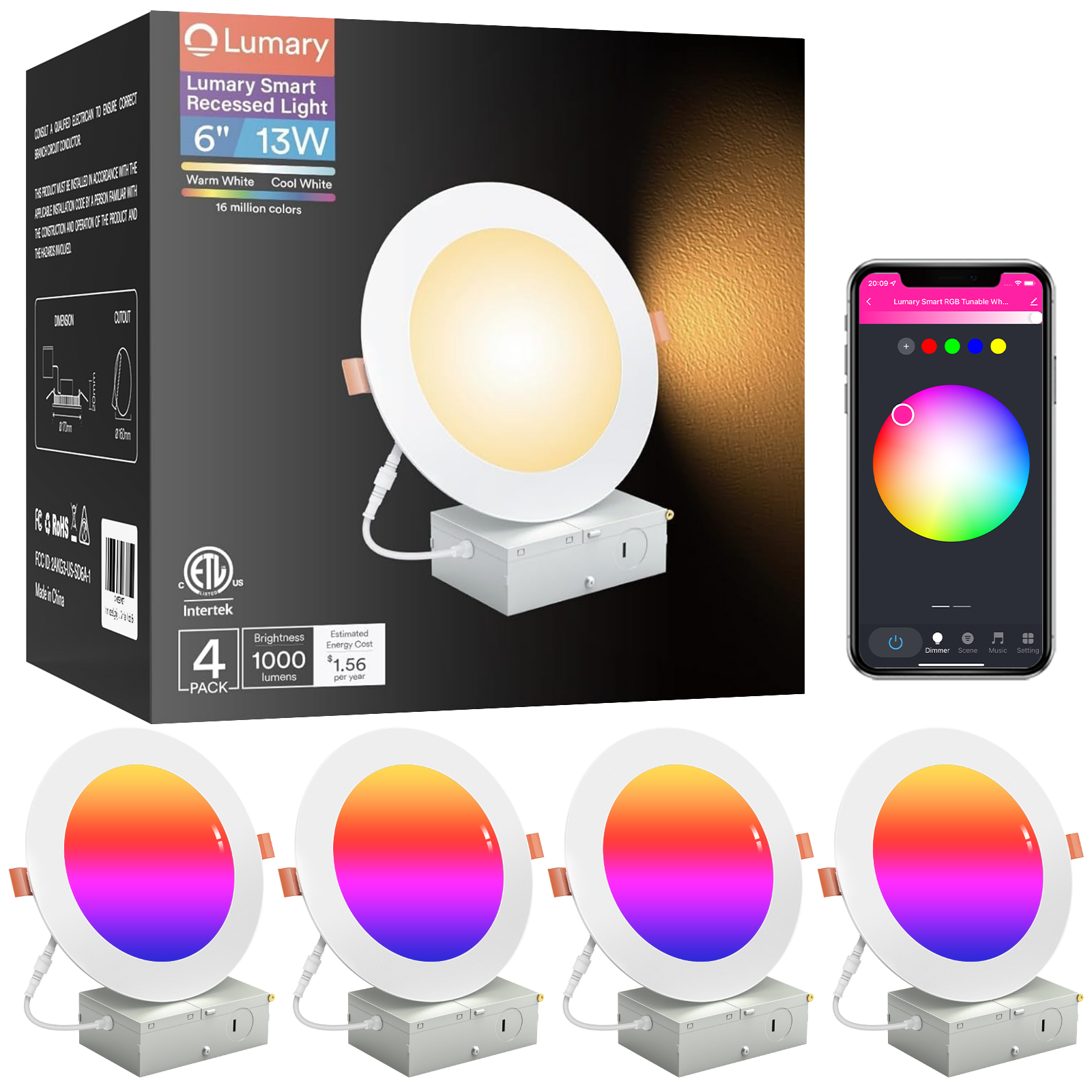
The Lumary Wi-Fi Smart Canless Recessed Lighting 6 Inch (4-Pack) is an IC-rated, junction-box-mount downlight engineered specifically for the retrofit and new-construction residential market. At 13W and 1,100 lumens, it delivers approximately 85 lm/W—a luminous efficacy figure consistent with commercial-specification LED luminaires and well above the ENERGY STAR minimum threshold of 75 lm/W for qualified residential recessed downlights. The fixture body measures 6.69 inches in diameter and protrudes just 0.55 inches below the ceiling plane, making it one of the lowest-profile 6-inch downlights in the consumer market.
The RGBCW architecture—five independent LED channels covering red, green, blue, cool white, and warm white—is the specification that distinguishes this fixture from standard tunable-white products. Dedicated phosphor-converted white channels handle all white-light output independently of the RGB primaries, which means white light across the full 2700K-to-6500K range is generated from a broadband spectral source rather than from additive primary mixing. The practical consequence is spectrally consistent white light without the blue-cast artifact that RGB-only fixtures exhibit at high-brightness white settings. Dimming runs from 1% to 100% through a flicker-free, silent driver—no audible buzz, no visible PWM modulation at mid-range levels, no minimum-threshold cutoff.
Control is hub-free via 2.4 GHz Wi-Fi through the Lumary app, with simultaneous voice control through Amazon Alexa, Google Assistant, and Apple Siri. Eight built-in scene modes, a music synchronization function via microphone-based audio analysis, DIY scene creation, group control across rooms, scheduling, and family sharing are all managed within the app. The memory function retains the last active state through power interruptions. The 4-pack at $139.99 in white trim or $136.99 in black covers a standard living room footprint, with the full Lumary canless collection scaling to 8, 12, and 24-unit packs for larger deployments.
Performance Benchmarking Grid
| Key Purchasing Criterion | Common Signs of Poor Quality (Pitfalls to Avoid) | Technical Implementation in This Product | Impact on Long-Term Usage |
|---|---|---|---|
| Lumen Output & Spacing Compatibility | Under-specified lumen output forces overly dense fixture grids; thermal throttling reduces actual output after first 500 hours | 1,100LM / 13W; ~85 lm/W stable efficacy; IC-rated housing prevents thermal accumulation that causes throttling | Correct IES S/MH spacing achievable with four fixtures in a standard living room; consistent brightness over fixture lifespan |
| Beam Angle for Ambient Use | Narrow-beam fixtures (15°–25°) marketed as general lighting produce high contrast ratios and dark transition zones between cones | Wide-beam downlight output suitable for general ambient illumination; overlapping coverage at IES-recommended spacing | Even illuminance distribution across floor plane; no spotted or runway-pattern appearance |
| Color Temperature Range | Fixed 4000K or 5000K CCT optimized for one use case; warm evening ambiance and bright task modes require separate fixture types | Continuous 2700K–6500K adjustment via app; biorhythm scheduling automates CCT transitions across the day | Single fixture type serves all living room functions across the full daily arc without lamp changes |
| White Light Spectral Quality | RGB-only white mixing produces spectral gaps and visible blue cast; CRI performance degrades with LED batch variation | Dedicated RGBCW warm and cool white channels; phosphor-converted broadband spectral output independent of RGB mixing | Accurate color rendering for furnishings, artwork, and skin tones; no blue tint at any CCT setting |
| Dimming Behavior | Phase-cut PWM dimming produces visible flicker at mid-range; audible buzz from driver; hard cutoff above 10% minimum | Flicker-free driver; 1%–100% smooth silent dimming; no minimum threshold cutoff | Comfortable low-level evening ambiance; no flicker artifacts in video or photography in the room |
| IC Rating & Ceiling Safety | Non-IC fixtures require 3-inch insulation clearance; impossible to maintain in blown-in attic insulation; code violation risk | IC-rated canless housing tested for direct insulation contact; junction-box mount eliminates enclosed plenum heat trap | Code-compliant installation in insulated ceilings; no attic dam construction required around each fixture |
| Installation Profile | Can-based systems require pre-installed housing in ceiling cavity; 3–5 inch depth requirement incompatible with shallow framing | 0.55-inch ceiling-plane depth; spring-clip junction-box mount; no housing can required | Compatible with new-work and remodel boxes; flush ceiling profile with no visible protrusion |
| Smart Ecosystem Compatibility | Single-ecosystem lock-in; hub required; 5 GHz incompatibility causes connection drops in dual-band networks | 2.4 GHz Wi-Fi direct; simultaneous Alexa, Google Assistant, and Siri support; no hub required | Works with any existing voice assistant setup from day one; no additional hardware cost |
| Group & Scene Control | Per-fixture individual control only; no scheduling; no music sync; family members cannot share access | Group control across rooms; 8 scene modes; music sync; DIY scenes; scheduling; family sharing | Whole-room scene changes from a single voice command or tap; automated lighting transitions without manual intervention |
| Power Interruption Recovery | Defaults to full-brightness white after circuit trip; jarring recovery from breaker events or power outages | Memory function retains last active state through power interruptions | Predictable post-outage behavior; no manual re-configuration after electrical events |
Market Context: Where This Fixture Sits Within the Competitive Landscape
The smart recessed downlight segment now spans several brands with meaningfully different ecosystem architectures, each suited to different buyer priorities.
Philips Hue occupies the premium tier in smart recessed lighting, with its White and Color Ambiance recessed lineup operating on Zigbee via the Hue Bridge. The Hue ecosystem's depth of third-party integration—HomeKit, Alexa, Google Home, and an extensive developer API—makes it the preferred platform for buyers building complex multi-room automations. The Hue Bridge requirement adds hardware cost and a single point of failure, but it also enables the local-control reliability that Zigbee mesh networking provides independent of internet connectivity.
Govee has built a strong consumer following through its RGBIC addressable lighting products and Wi-Fi/Bluetooth hybrid connectivity. Govee's color fidelity and app feature depth—particularly in dynamic scene creation and music synchronization—are consistently well-reviewed. Buyers already in the Govee ecosystem will find familiar app architecture and scene management tools.
LIFX shares the hub-free Wi-Fi direct architecture that the Lumary canless fixture uses, and the LIFX app is noted for polished design and broad platform integration. LIFX products in the downlight segment tend to operate at higher wattage tiers, which can be an advantage in larger rooms requiring higher lumen output per fixture.
Kasa (TP-Link) is a reliable choice in the tunable-white segment, with well-regarded 2.4 GHz Wi-Fi implementation and competitive pricing. Kasa's value proposition is strong for buyers whose living room lighting requirement is CCT adjustment without full RGB color, and the brand's setup process is consistently rated as one of the more straightforward in the category.
WiZ, under the Signify (Philips) umbrella, delivers hub-free Wi-Fi smart lighting with tunable white and full-color options at an accessible price point. WiZ has expanded its recessed downlight formats meaningfully, and its integration with the broader Philips smart home portfolio is a consideration for buyers who own other Signify products.
Eufy has entered the smart lighting space with HomeKit-native products that appeal specifically to Apple ecosystem households, where the native Home app and Siri integration are priorities.
The Lumary 6-inch canless occupies a well-defined position within this field: IC-rated canless form factor, full RGBCW color architecture with dedicated white channels, hub-free operation across all three major voice ecosystems simultaneously, and multi-pack pricing that makes four-to-eight-fixture living room deployments economically practical. For buyers who need IC-rated ceiling compatibility, want RGBCW color flexibility, and prefer to avoid hub hardware, the directly comparable product set in the category is narrower than the broader smart downlight market might initially suggest.

Application Scenarios
General Ambient Lighting for a Standard Living Room Layout
The most common living room configuration in North American residential construction is a rectangular room between 200 and 350 square feet with an 8-to-9-foot ceiling, a primary seating area oriented toward a television wall, and one or two furniture groupings that serve secondary functions—reading, conversation, or game play. Lighting this space effectively requires resolving a genuine conflict: the illuminance level appropriate for active daytime use (television watching with ambient light, children's activities, reading) is substantially higher than what works for evening relaxation or film viewing, and no single static fixture setting satisfies both ends of that range.
The IES spacing formula for this room type with 8-foot ceilings places four 6-inch fixtures in a 2×2 grid with approximately 5-to-6-foot center-to-center spacing and perimeter rows set back 2.5 to 3 feet from the walls. At 1,100 lumens per fixture, that grid delivers a combined output of 4,400 lumens into the room—sufficient for an average maintained illuminance of approximately 30–40 foot-candles at the floor plane, which aligns with IES RP-11 recommended illuminance values for residential living spaces under active use conditions.
The Lumary 6-inch canless 4-pack is dimensioned precisely for this use case. Once grouped in the Lumary app, all four fixtures respond to a single scene command. A "daytime active" scene at 100% brightness and 4500K provides the alert-spectrum illumination appropriate for activity and task work. An "evening relax" scene at 35% brightness and 2700K shifts the room toward warm incandescent-equivalent ambiance appropriate for conversation or passive television viewing. A "film mode" scene at 8%–12% brightness and 3000K provides enough ambient fill to prevent the high-contrast eye adaptation fatigue that pure darkness behind a screen creates, without producing screen glare. All three scenes are accessible through voice command, app tap, or schedule—with no physical dimmer switch or manual lamp change required.
Accent Lighting Integration for Art and Architectural Features
Living rooms with artwork, built-in shelving, fireplaces, or architectural niches require a layered lighting approach that general ambient fixtures alone cannot achieve. The standard technique—documented in IES lighting design practice guidelines—is to supplement the ambient grid with accent sources aimed at specific vertical surfaces, achieving a luminance ratio of approximately 5:1 between the accented feature and its immediate surround. This ratio draws the eye toward the intended focal point without creating the harsh contrast that higher ratios produce.
In a living room where the ambient grid is handled by the Lumary 6-inch canless fixtures, accent functions can be addressed through the same fixture type by positioning one or two units closer to the feature wall—approximately 18 to 24 inches from the wall surface—and directing output at the target. At 2700K and 60%–70% brightness, this configuration produces warm grazing light across artwork textures and creates the shadow modeling that makes three-dimensional objects read with visual depth. The RGBCW architecture allows the accent fixtures to be held at a warmer CCT than the ambient group simultaneously, creating a layered CCT gradient in the room that directs visual attention toward the feature zone without requiring separate fixture types or circuits.
The group control function in the Lumary app supports this layered approach by allowing the ambient fixtures and the accent-position fixtures to be assigned to separate sub-groups within the same room, each with independent CCT and brightness settings while remaining coordinated under a single room-level scene command. This is a control architecture that hub-dependent systems typically achieve only through additional programming; the Lumary hub-free implementation handles it natively within the app.
Evening Circadian Transition Lighting
The living room is the primary space where household members spend the two-to-three hours between dinner and sleep—precisely the window during which light exposure has the most significant impact on melatonin production and sleep onset timing. Research from the Harvard Medical School Division of Sleep Medicine and the Lighting Research Center at Rensselaer Polytechnic Institute has established that sustained exposure to luminaires with correlated color temperatures above 4000K during this window suppresses melatonin secretion through blue-wavelength activation of the ipRGC photoreceptor pathway, delaying sleep onset by measurable intervals. The photopic stimulus that matters is not just brightness—it is the spectral composition of the light, specifically the proportion of energy in the 450–490nm short-wavelength band.
A living room lit at 5000K–6500K through the evening—common in installations where the homeowner selected a "bright white" LED downlight for general use—delivers precisely the wavelength profile that circadian research identifies as most disruptive to pre-sleep physiology. The Lumary 6-inch canless addresses this through its biorhythm scene mode, which automates a gradual CCT reduction from neutral-white afternoon illumination toward 2700K warm-white as the evening progresses. This scheduled transition can be configured to the household's specific routine—beginning at 7 PM, completing the shift to warm by 9 PM, and dimming further toward 15%–20% by 10 PM—without any manual intervention after initial setup. The entire transition is invisible in the sense that it happens gradually enough to avoid being noticeable, but its cumulative effect on pre-sleep light exposure is physiologically significant.
Multi-Function Entertainment and Social Space
The living room in contemporary residential use is frequently a multi-function space that transitions between television viewing, social gatherings, background music listening, and children's play within the same day. Each of these activities has a distinct optimal lighting configuration, and a static fixture setting can only optimize for one. The music synchronization feature in the Lumary 6-inch canless addresses the entertainment function specifically: the Lumary app's microphone-based audio analysis maps amplitude and frequency content in real time to color and brightness changes across all grouped fixtures, producing a dynamic chromatic response to music playback that single-channel white fixtures cannot replicate through brightness modulation alone.
For social gatherings, the eight built-in scene modes and the DIY scene builder allow the room to be configured for a specific aesthetic within seconds—warm amber for dinner parties, cool neutral for afternoon gatherings, full-color dynamic for celebratory occasions. The family sharing function allows any household member to trigger scenes from their own device without requiring credential access to the primary account, which removes the friction of a single point of control for shared spaces. The scheduling function can be configured to set the room to a designated "social" scene at a regular time on weekend evenings without requiring anyone to interact with the app at all.
The transition between these configurations—from film mode at 10% brightness and 3000K to full social scene at 80% brightness and 4000K—takes effect simultaneously across all four grouped fixtures within the Lumary app's command response window, which on a properly performing 2.4 GHz network is imperceptible as a delay. This simultaneity is what distinguishes group-controlled smart downlights from per-fixture smart bulbs, where sequential individual response creates a visible wave effect across the room during scene transitions.
Whole-Home Ecosystem Integration and Cross-Room Coordination
For homeowners deploying smart lighting across multiple rooms, the living room fixtures are typically the highest-visibility installation in the home and the one most likely to anchor the broader smart lighting architecture. The hub-free 2.4 GHz Wi-Fi connectivity of the Lumary 6-inch canless integrates directly into the home network without requiring a dedicated bridge or gateway, which means the same fixtures can participate in whole-home automation routines alongside other smart devices—thermostats, locks, speakers, and security systems—through Alexa routines, Google Home automations, or Apple HomeKit scenes.
A practical whole-home routine might trigger the living room fixtures to shift to 4000K at 70% brightness when the front door lock disengages at a typical arrival time, transition to 2700K at 40% after a defined interval, and coordinate with the bedroom fixtures—if those are also Lumary canless units—to begin their own evening transition sequence simultaneously. The Lumary app's group control architecture allows fixtures in different rooms to be assigned to different groups for independent control while remaining addressable through a unified home-level command from the voice assistant. This is the control hierarchy that smart lighting platforms describe as "zones within rooms within home"—and it is achievable within the Lumary ecosystem without hub hardware, external bridge devices, or third-party automation software beyond the native Alexa, Google, or HomeKit apps the homeowner already uses.

Professional Assessment and Buyer Guidance
From a hardware evaluation standpoint, the Lumary 6-inch canless 4-pack satisfies the technical requirements for a primary ambient lighting installation in a standard residential living room across the parameters that determine long-term performance: lumen output appropriate for IES spacing compliance at 8-to-9-foot ceiling heights, IC-rated housing for insulated ceiling installation without code-compliance workarounds, a flicker-free driver with a full 1%–100% dimming range, and a RGBCW color architecture that produces spectrally accurate white light from dedicated channels rather than from RGB mixing.
The hub-free connectivity model is a meaningful resilience advantage over bridge-dependent systems in the living room context specifically, because the living room is the household space where lighting control failures are most immediately noticed. A Hue Bridge that goes offline during a firmware update takes every Hue fixture in the home with it; a Wi-Fi direct fixture that loses connectivity affects only that fixture, and recovery is automatic when network availability is restored.
Decision logic for different buyer profiles:
If the priority is full-color RGBCW capability, IC-rated insulated ceiling compatibility, hub-free tri-ecosystem voice control, and four-fixture living room coverage at a single purchase, this product satisfies all four criteria simultaneously. If the priority is the deepest possible third-party automation platform integration with a mature developer ecosystem, Philips Hue's bridge-based system offers capabilities that Wi-Fi direct products do not currently match. If the requirement is tunable white only without full RGB color and cost-per-fixture is the primary variable, Kasa or WiZ CCT-tunable products serve that use case at a lower price point.
Who should buy this product: Homeowners and renovation contractors furnishing living rooms in insulated residential ceilings who want a single fixture type capable of serving the full range of living room lighting functions—ambient, accent, circadian, entertainment, and social—through a hub-free smart control system compatible with all three major voice assistants. The 4-pack configuration at $139.99 covers a standard 200-to-300-square-foot living room at IES-compliant spacing with room to spare, and the fixture's consistent form factor allows seamless expansion into adjacent rooms from the same product line.
Technical FAQ
Q: How do I calculate the correct number of recessed lights for my living room ceiling height and dimensions?
The IES S/MH ratio provides the starting point: multiply your ceiling height in feet by 1.5 to get the maximum center-to-center spacing between fixtures. For an 8-foot ceiling, that is 12 feet maximum spacing; for a 9-foot ceiling, 13.5 feet. Set the perimeter row of fixtures back from the wall by half the fixture-to-fixture spacing—typically 2.5 to 3 feet. Then calculate how many fixture positions fit within those constraints given your room dimensions. For a 15-by-18-foot living room with 8-foot ceilings, a 2×2 or 2×3 grid of six-inch downlights at 5-to-6-foot spacing covers the space within IES uniformity guidelines. The Lumary 6-inch canless 4-pack at 1,100 lumens per fixture is dimensioned to serve as the primary ambient source in this fixture-count range.
Q: Why do my existing recessed lights create bright spots on the floor rather than even illumination across the room?
This is typically the result of one of two placement errors: fixtures spaced too far apart, leaving dark transition zones between cones, or fixtures with beam angles that are too narrow for the mounting height. The IES S/MH ratio addresses the spacing problem, and selecting a wide-beam fixture—one with a 60°–120° beam angle rather than 15°–25°—addresses the beam angle problem. Both errors produce the spotted, uneven appearance that makes a room feel smaller and more cave-like than it is. The Lumary 6-inch canless, positioned at IES-compliant spacing, produces the overlapping coverage pattern that eliminates these dark transition zones.
Q: Can I use the same recessed light fixtures for both ambient lighting and accent lighting in a living room, or do I need separate fixture types?
For most residential living room applications, a single 6-inch downlight type can handle both functions if the fixtures are positioned thoughtfully. Fixtures placed 18–24 inches from a feature wall—closer than the standard ambient spacing—graze the vertical surface with enough directional light to create accent effects on artwork or architectural features. The Lumary 6-inch canless supports this dual-function approach through its group control feature, which allows accent-positioned fixtures to be placed in a separate sub-group from the ambient fixtures and controlled at a different CCT and brightness level simultaneously—achieving a layered lighting effect without separate fixture types or additional circuits.
Q: Does the Lumary app support automated lighting schedules, or does everything need to be controlled manually?
The Lumary app includes a full scheduling function that allows scene activation, CCT transitions, brightness changes, and on/off events to be programmed on daily or weekly schedules independent of any manual input. The biorhythm scene mode automates a gradual CCT progression across the day aligned with the natural solar arc—shifting from cooler alert-spectrum illumination in the morning through neutral midday lighting to warm evening ambiance—without requiring manual adjustments. Once configured, the schedule runs autonomously through the fixture's Wi-Fi connection to the app backend, with the memory function ensuring that the last scheduled state persists through any power interruptions.
Q: What is the difference between RGBCW and standard RGB or tunable-white fixtures, and why does it matter for living room lighting?
A standard RGB fixture has three LED channels—red, green, blue—and produces white light by mixing those primaries. The result is spectrally thin white light with gaps in the visible spectrum that reduce color rendering accuracy and often produce a visible blue or green cast at certain white settings. A tunable-white fixture has two channels—warm white and cool white—and can adjust CCT but cannot produce saturated colors. An RGBCW fixture, such as the Lumary 6-inch canless, has five independent channels: red, green, blue, cool white, and warm white. White light is generated by the dedicated white channels, not by RGB mixing, producing spectrally accurate broadband white output at any CCT setting. The RGB channels add full-color capability independently without compromising white light quality. For a living room, this architecture means accurate color rendering for furnishings, artwork, and skin tones in white mode, and full dynamic color capability for entertainment and scene modes—from a single fixture type.

